1. National Mission for Clean Ganga (NMCG)
National Mission for Clean Ganga, in the year 2025, completed 39 projects, which resulted in the completion of a cumulative total of 344 projects, so far, and also sanctioned 34 new proj3ects amounting to ₹2,368 Crore, bringing the cumulative total to 513 projects sanctioned worth ₹42,019 Crore.
- Nirmal Ganga:
- Sewage Treatment Infrastructure projects
In sewerage infrastructure, 15 projects for the creation/ rehabilitation of 329 MLD sewage treatment capacity have been sanctioned between January and December 2025. In the same period, 11 projects for the creation/ rehabilitation of 359 MLD sewage treatment capacity have been completed. Till date, a total of 216 sewerage infrastructure projects have been sanctioned in the Ganga Basin for the creation of 6,560 MLD sewage treatment capacity and the laying of a 5,220 km sewer network.
-
- Inauguration and Laying of Foundation Stones Sewerage infrastructure projects by Hon’ble Prime Minister
A total of 8 sewerage infrastructure projects were inaugurated worth ₹2763 crores by the Hon'ble Prime Minister in the year 2025. i. ii. iii. iv. v. vi. vii. viii. Interception, Diversion & Sewage Treatment Plant works at Mokama, Patna (8 MLD) Interception, Diversion & Sewage Treatment Plant works at Fatuha, Patna (7 MLD) Begusarai STP and Sewerage Project (17 MLD) I&D works and STP at Bakhtiyarpur (10 MLD) Bhagalpur I&D and STP Project (45 MLD) Digha STP Facilities (100 MLD) Kankarbagh STP Facilities (56 MLD) Sewer network SPS and STP at Munger town (30 MLD).
A total of 8 sewerage infrastructure projects were foundation stone worth ₹1347 crore by the Hon'ble Prime Minister in the year 2025.
- Interception & Diversion (I&D) and STP scheme at Motihari town (23 MLD)
- I&D and STP scheme at Raxaul town (12 MLD)
- I&D and STP scheme at Buxar town (51 MNLD)
- I&D and STP scheme at Arrah town (47 MLD)
- I&D and STP works at Supaul (12.1 MLD)
- I&D and STP scheme for Jamui town (13 MLD)
- I&D of drains and STP works at Daudnagar (10.5 MLD)
- I&D and STP scheme at Katihar town (55.5 MLD)
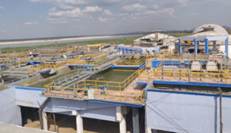
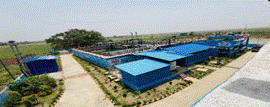
- MLD Digha STP
- Inauguration and Laying of Foundation Stones Sewerage infrastructure projects by Hon’ble Prime Minister
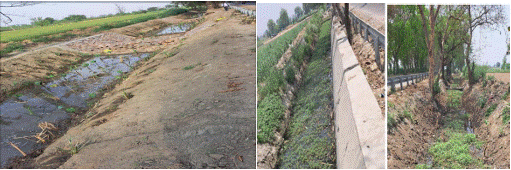
NMCG has expanded its mandate to rejuvenate small rivers and tributaries through ecological flow restoration, water quality improvement, wetland conservation, and community-led interventions. Key actions include drain treatment, solid waste management, and catchment restoration. Approved projects include:
- Established in collaboration with DDA and CEMDE as a Knowledge cum-Skill Development Centre.
- A 5 MLD CAMUS–SBT pilot project for drain treatment (₹27.12 crore), now proposed at RD 180, Madanpur Khadar Village, with NOC from Uttar Pradesh agreed in principle.
- Treatment of Shastri Park and Kailash Nagar Drains in Delhi through Nature-based Solutions (NbS).
- Monitoring of STPs and Drains of river Yamuna
NMCG in May 2025 has sanctioned a project of “Strengthening of Environmental Regulators” to CPCB for the monitoring of STPs and drains of river Yamuna.
-
- Completion of 20 MLD CETP at Jajmau
Construction of 20 MLD CETP project for Jajmau Tannery Cluster, Kanpur, UP worth Rs. 741.36 Crore has been completed and the plant is currently in the testing, commissioning and Performance Guarantee Test Run (PGTR) phase. First time Odour Control & management measures has been adopted.
- Aviral Ganga
2.1 Maintaining minimum E-flow
NMCG has sanctioned three major E-flow Assessment Projects:
-
- NIH Roorkee for the Son, Damodar, Chambal and Tons basins
- IIT Roorkee for Ghaghra and Gomti, and IIT Kanpur for Kosi, Gandak and Mahananda.
- Additionally, two new discharge monitoring sites are being made operational downstream of the Hathnikund and Okhla barrages on the Yamuna.
- 2.2 Aquatic Biodiversity, Wetlands and Afforestation Initiatives of NMCG
- More than 50 Lakhs native fish (Rohu, Katla, Mrigal, Kalbasu, Mahseer, Hilsa) were released to revive riverine fisheries and strengthen ecological food chains.
- Floodplain wetlands across UP, Bihar, and Jharkhand were mapped, leading to prioritised lists (UP: 282; Bihar: 124).
- Conservation projects have begun at Kalewala Jheel, Kheduva Taal, Dahtal Reoti, and Nathmalpur Bhagad, along with restoration of the Asan Ramsar Site.
- Wetland extent maps of Floodplain Wetlands of the River Yamuna in Delhi have been prepared.
- Survey for condition assessment of 217 wetlands done.
- The floral diversity initiative documented 1,117 plant species across 26 sites, including 935 medicinal plants of traditional and pharmaceutical relevance.
- Seven Biodiversity Parks (466.3 ha) were established in degraded forest areas of Uttar Pradesh.
- Gangetic Dolphin Conservation: Gangetic dolphin surveys covered 7,680 km across 22 rivers, documenting 2,510 sightings and identifying high-, moderate-, and low-priority conservation stretches, along with 95 mortality/rescue cases.
- India’s first Dolphin Rescue Ambulance was developed and tested, enabling safe rescue and translocation; 8 Gangetic dolphins were rescued and released.
- A citizen-led Soons-Saathi network (100 volunteers across 250 km), 160 trained personnel, 2,000 sensitised community members, and 15 Dolphin Clubs strengthened early reporting and conservation outreach.
- Gharial Conservation: Gharial assessments across 22 rivers recorded 3,037 individuals, with habitat models indicating only 5.6% highly suitable habitat, underscoring the need for flow regulation and habitat protection.
- Comprehensive studies across the Ganga basin generated critical biodiversity data: Basin-wide biodiversity studies recorded island nesting birds (11–12 species, 1,832 nests), water birds (41,506 individuals of 90 species), and rich fish diversity (39–83 species), including a new species record; Maha-Kumbh 2025 monitoring documented 157 bird species along the Ganga and 79 along the Yamuna.
- Gyan Ganga
- Digital portals and tools
NMCG has developed an integrated suite of digital portals and tools that greatly enhance the planning, implementation, monitoring, and knowledge management processes for river rejuvenation and water conservation efforts.
- Drain Dashboard & LiDAR Mapping: Comprehensive high-resolution LiDAR mapping (1:3,000 scale) over 44,000 sq. km—supported by helicopter (2,200 sq. km) and UAV surveys (80 sq. km)—has enabled precise assessment of drainage networks and river morphology. This forms part of NMCG’s innovative IT-enabled river rejuvenation framework, which integrates 13 digital systems to manage the entire lifecycle of river system management.
- NMCG has built a strong digital ecosystem anchored by key dashboards that enhance decision-making, execution, and monitoring. The Drain Dashboard, Geo-PRAYAG, Waterbody Diagnostics, and the Corona Imagery Dashboard strengthen scientific planning. For monitoring, platforms such as Ganga Tarang, the Ganga District Performance Portal, the Real-Time Water Quality Monitoring Network, the Satellite-Based Water Quality Network, and the E-Flow Dashboard provide transparent, real-time insights into river health. Supporting these systems, the AI-enabled Ganga Knowledge Portal, Bioclimatic Atlas of India, and River Atlas serve as key knowledge repositories.
- Research Initiatives (2025): In 2025, NMCG sanctioned several high impact research projects to deepen scientific understanding of river systems. These include ecological and floodplain impact studies (IISER Bhopal), historic river mapping using Corona imagery and digitized archives (IIT Kanpur and SAIARD Kolkata), capacity building for river conservation (INTACH), glacier–hydroclimate assessments (NIH Roorkee), SONAR-based riverbed mapping in Uttar Pradesh (UP Remote Sensing Centre), and managed aquifer recharge studies along paleo-channels in the Ganga–Yamuna Doab (UPGWB & NGRI).
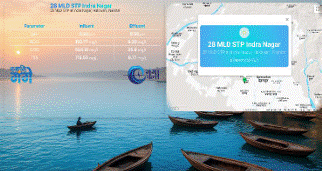
- Ganga Pulse Public Portal: The Ganga Pulse Public Portal offers real-time, accessible monitoring of STPs across the five Ganga basin states— Uttarakhand, Uttar Pradesh, Bihar, Jharkhand, and West Bengal. Displaying key parameters such as pH, BOD, COD, and TSS at both inlet and outlet points, the portal provides a clear picture of wastewater quality improvements after treatment. By placing this data in the public domain, NMCG has significantly enhanced transparency, accountability, and oversight of wastewater treatment infrastructure under the Namami Gange programme. (www.gangapulse.in)
- Urban River Management Plans (URMPs)
- Riversensitive governance was strengthened in Ganga Basin States through the initiation of Urban River Management Plans (URMPs) as below:
- Uttarakhand - Gangotri-Yamunotri, Haridwar, Rishikesh, Haldwani Kathgodam, and Ramnagar
- Uttar Pradesh - Bijnor, Gorakhpur, Mirzapur, MathuraVrindavan, and Shahjahanpur
- Bihar - Bhagalpur, Buxar, Chapra, Munger, and Gaya
- Jharkhand - Ranchi, Dhanbad, Sahibganj-Rajmahal, Adityapur, and Chas
- West Bengal - Siliguri, Durgapur, Asansol, Howrah, and Nabadwip
- Capacity Building & Planning: In 2025, a robust foundation was established for mainstreaming river-sensitive planning into urban governance through training, frameworks, and national-level policy guidance. Key workshops and seminars in Ahmedabad (Feb), Patna & Delhi (May), Delhi (June), and Chennai (Sept) advanced eco-friendly waterfront design and nature-based solutions, enabled integration of river considerations into master plans, and promoted multi-dimensional approaches for urban water management — collectively strengthening institutional capacity and embedding ecological integrity into river city governance nationwide.
- Arth Ganga:
Arth Ganga emphasizes ecologically conscious development, livelihood generation, and community participation while ensuring the health and vitality of the Ganga river.
-
- Zero budget Natural Farming
NMCG conducts natural farming trainings through state agencies, DGCs, SPMGs, and NCONF. Two model farms have been established (Haridwar & Sambhal) to demonstrate practices. A WALAMTARI research project assesses impacts on water, energy, soil, and productivity.
- 4.2 Cultural and Heritage Tourism
Dolphin safaris, eco-tourism sites, and homestays promoted under WII and HESCO projects.
- INTACH carried out heritage mapping across 51 districts, producing Samagrata and Samakshata.
- Pilot Arth Ganga Trails in Kannauj and Bhagalpur to showcase cultural, ecological, and tourism assets.
-
- Safe Reuse of Treated Water (SRTW)
NMCG issued the National Framework for reuse of treated wastewater. Uttarakhand & Uttar Pradesh are in the final stages of development of state policies on SRTW aligned to National Framework. This exercise has been initiated in other Ganga main stem states.
City level reuse plans are being developed for Prayagraj, Varanasi, Agra & Kanpur.
-
- Livelihood Linkages
- Jalaj Project (WII): Dolphin safaris, homestays, livelihood centers; training in local product development (Prasad, incense, jute bags, millet foods, stitching, beautician skills).
- HESCO Initiatives: One Arth Ganga Centre and three Ganga Resource Centre’s delivering ~300 trainings benefiting ~30,000 people.
- Awareness and marketing centres set up at Chheoki Railway Station (Prayagraj) and Dilli Haat, New Delhi.
- Parmarth Niketan conducts Aarti training and awareness programs. IIPA (Phase-II) organized ~150 programs with schools, DGCs, and stakeholders, including e-learning modules and certificate courses on river management.
- Jan Ganga:
- Maha-Kumbh
- NMCG’s interventions at Maha Kumbh 2025 included riverfront development, real-time water quality monitoring, strengthened waste management, and large-scale awareness campaigns. A network of 1,500 Ganga Sewa Doots promoted proper waste disposal, sanitation, plastic-free practices, and community participation, while the Paint-My-City Campaign converted city walls into impactful artworks on cleanliness, sustainability, and the cultural significance of the Ganga.
- Public engagement was further elevated through the Namami Gange Pavilion, featuring live data, demonstrations, and educational exhibits. A wide range of IEC activities—exhibitions, street plays, awareness sessions, and cleanliness drives—reinforced sustained behavioral change among pilgrims.
- Global Outreach
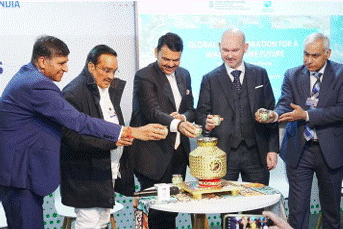
India’s global leadership in river-sensitive urban development was prominently highlighted in 2025. At the World Economic Forum (WEF) in Davos (January 2025), flagship initiatives such as River Cities Alliance (RCA) were positioned international as benchmarks, reinforcing India’s role in advancing water security. Later, at the World Water Week in Stockholm (August 2025), the RCA’s cohosted session “River Cities Reimagined” catalyzed dialogue on basinsensitive urban planning, resulting in deeper engagement with global experts and institutions and strengthening India’s influence in shaping international urban water agendas.
-
- School Outreach Programs
- A large-scale cleanliness drive, ‘Ek Din, Ek Ghanta, Ek Saath’, was conducted on 25 September 2025 at Kalindi Kunj, Delhi, led by Hon’ble Union Minister of Jal Shakti, with wide participation from officials, students, NGOs, and local communities.
- The Swachhta Hi Sewa fortnight (17 Sept–2 Oct 2025) spanned 5 Ganga basin states, covering 139 districts and engaging around 10 lakh students along with local communities.
- Special Campaign
- Namami Gange conducted a month-long cleanliness and awareness campaign (2–31 October 2025) across Ganga Basin States, engaging students, youth groups, spiritual leaders, environmentalists, and local communities to promote environmental and river-cleaning initiatives.
- The campaign successfully strengthened youth involvement, reaching about 7 lakh students across 5 Ganga Basin States.
- Community Outreach Programs
- International Day of Yoga 2025: ‘Ghat Par Yoga’ was organized by DGCs across Ganga Basin States, and with over 1000 participants in Delhi alone, achieving strong public and youth engagement.
- Ganga Utsav 2025: The 9th edition was celebrated with the main event in Ayodhya, alongside multiple partner-led activities such as an international conference at IIT-BHU and a riverathon, engaging communities across all 5 Ganga Basin States.
- Yamuna Awareness & Cleanliness Campaign: Namami Gange, in partnership with NGOs, has launched a year-long public awareness and cleanliness campaign along the Yamuna in Delhi to deepen people–river connect and build a sense of responsibility and ownership. This major initiative supports the Hon’ble Minister of Jal Shakti Shri C.R. Paatil’s call of “Ek Din, Ek Ghanta, Ek Saath.” To further boost public participation, a dedicated portal has been developed, enabling citizens to easily register and join these campaigns.
- Finance:
The Finance Wing achieved significant progress across multiple areas, including the successful adoption of the Hybrid Treasury Single Account (TSA) system, ensuring just-in-time fund releases across all programme levels. It also facilitated the refund of unutilized grants and accrued interest, strengthened financial governance through a major reduction in pending Utilization Certificates and improved reporting, and ensured the timely laying of audited annual accounts in Parliament. Key income tax-related issues were fully resolved, granting unconditional income-tax exemption to NMCG. To reinforce financial discipline, the Finance Wing implemented strong internal controls, including periodic internal audits, quarterly CA audits, Audit/Budget Review Committee meetings, and 12 dedicated reviews with State Finance Teams in FY 2024–25.
2. National Water Mission (NWM)
To address the adverse impacts of climate change on water resources, NWM was set up under the National Action Plan on Climate Change (NAPCC) by the Government of India on 30th June 2008. One of the main objectives of the mission is to ensure integrated water resource management, which would help conserve water, minimise wastage and ensure more equitable distribution both across and within States. The five goals of the mission are as follows:
- Comprehensive water database in the public domain
- Assessment of the impact of climate change on water resources
- Promotion of citizen and state actions for water conservation, augmentation and preservation and focused attention to vulnerable areas, including overexploited areas
- Increasing water use efficiency by 20%
- Promotion of basin-level integrated water resources management.
NWM has been making progress toward achieving the above five goals through the implementation of various strategies and action points prescribed in the Mission Document. The mission, through its goals, adopts an integrated, holistic approach to water.
Activities and new initiatives taken during the year
- “Jal Shakti Abhiyan- Catch the Rain (JSA: CTR)” 2025 campaign: Jal Shakti Abhiyan-I (JSA-I) was conducted in 2019 in 1,592 blocks out of 2,836 blocks in 256 water stressed districts of the country and was expanded as “Jal Shakti Abhiyan: Catch the Rain” (JSA: CTR) with the tagline “Catch the Rain, Where It Falls, When It Falls”. in 2021, 2022, 2023 and 2024 to cover all the blocks of all districts (rural as well as urban areas) across the country. “Jal Shakti Abhiyan: Catch the Rain” (JSA: CTR) 2025 campaign, the Sixth in the series of JSAs, was launched on World Water Day in Panchkula, Haryana with special theme of “Jal Sanchay Jal Bhagidar-Jan Jagrukta Ki Or”, by Hon'ble Chief Minister of Haryana on 22.03.2025 in all districts (rural as well as urban areas) of the country for implementation from 22th March, 2025 to 30th November, 2025 - the pre-monsoon and monsoon period. The event was attended by esteemed dignitaries, including Shri C. R. Patil, Hon’ble Minister of Jal Shakti; Smt. Shruti Choudhary, Hon’ble Minister for Irrigation & Water Resources, Haryana.
Jal Shakti Abhiyan, a flagship campaign of the National Water Mission, involves inter-sectoral convergence of all development programmes like MGNREGS, AMRUT, Repair, Renovation and Restoration Scheme, Water Shed Development Scheme, Per Drop More Crop, etc.
-
- Focused interventions of the campaign: The focused interventions of the campaign include (1) water conservation and rainwater harvesting; (2) enumerating, geo-tagging & making inventory of all water bodies; preparation of scientific plans for water conservation based on it; setting up of Jal Shakti Kendras in all districts; (4) intensive afforestation; and (5) awareness generation. Apart from the above five focused intervention, JSA-CTR 2025 has a distinctive emphasis on following key aspects this year (i) Continuation of JSJB activities (ii) Jal-Jangal-Jan: Ek Prakritik Bandhan: Abhiyan, activities like mapping of forest springs, catchment area protection in forest land, forest community engagement by MoEFCC and States in 13 major river basins of the country (Jhelum, Chenab, Ravi, Beas, Sutlej, Yamuna, Brahmaputra, Luni, Narmada, Mahanadi, Godavari, Krishna and Cauvery) in partnership with Ministry of Environment, Forest and Climate Change.
-
- This year, the campaign also focuses on 148 groundwater-stressed districts identified by the Central Ground Water Board (CGWB), including 102 over-exploited, 22 critical, and several high-extraction districts. These areas demand urgent, targeted, and sustained interventions
-
- Appointment of Central Ministries/ Departments Nodal Officers and State Nodal Officers: For seamless coordination and better implementation of the campaign, Nodal Officers from the Central Ministries/ Departments concerned and State Nodal Officers from each State/ UT have been appointed.
-
- Orientation of CNOs and TOs: To discuss the modalities related to the field visits of CNOs and TOs, a workshop-cum-orientation programme was organised on 8 th May, 2025, at Dr Ambedkar International Centre (DAIC), New Delhi, for the Central Nodal Officers and Technical Officers appointed for JSA: CTR-2025. The workshop was chaired by the Hon'ble Minister for Jal Shakti. Among other officials, the meeting was also attended by the Secretary, DoWR, RD & GR, Secretary, Additional Secretary and Mission Director, National Water Mission, Ministry of Jal Shakti. During the workshop, presentations were made on 'Introduction of JSA: CTR – 2025 and Role of CNOs and TOs'. The workshop highlighted the roles of CNOs and SNOs during their visit to the allotted districts.
- Meetings with DM/DCs/Municipal Administrators:
The National Water Mission webinar session on “Best Practices of Water management: Dialogues with DMs” began on 7th August 2020. NWM has so far organised 62 Sessions, “Dialogues with District & Municipal Administrators‘' on Best Practices of Water management.
A monthly 'Water Talk' lecture series is an important activity undertaken by the NWM to stimulate awareness, build capacities of stakeholders and encourage people to become active participants to sustain life by saving water on earth. Leading water experts are invited to present inspiring and broadening perspectives on current water issues in the country. 'Water Talk' series was launched on 22nd March 2019 on the occasion of World Water Day. NWM has so far organised 63 'Water-Talks' on a wide range of topics related to the water sector, featuring speakers from NGOs to grassroots workers.
- Progress under Jal Shakti Abhiyan: Catch the Rain-2025:
As per the information uploaded by various stakeholders on the JSA: CTR portal (jsactr.mowr.nic.in) the JSA: CTR initiative has facilitated the creation of more than 1.94 crore water conservation structures since its inception.During the period 22 March 2025 to 30 November 2025, the campaign added25-lakh water conservation works across the country and these efforts are part of an intensified drive to strengthen local water security and promote sustainable resource management. So far, 640 districts have prepared detailed water conservation plans, marking a significant step toward coordinated and longterm water resource development.
- Launch of “Jal Sanchay Jan Bhagidari” Initiative:
Jal Sanchay Jan Bhagidari” initiative under the Jal Shakti Abhiyan: Catch the Rain (JSA: CTR) campaign has been launched in Surat on 6th September, 2024, with a virtual address by the Hon’ble Prime Minister, emphasising the importance of jan bhagidari in water conservation. This initiative embodies a pledge for united action from all stakeholders, including government bodies, industries, local authorities, philanthropists, resident welfare associations (RWAs) and individuals to have a special focus on constructing artificial recharge structures/borewell recharge/recharge shafts among other activities, which will increase storage capacity and help to augment groundwater recharge.
The key objective of the Jal Sanchay Jan Bhagidari initiative is to ensure that every drop of water is conserved through collective efforts, following a wholeof-society and whole-of-government approach. By promoting community ownership, the initiative seeks to develop cost-effective, local solutions tailored to specific water challenges across different regions. To further strengthen the JSA:CTR, the Jal Sanchay Jan Bhagidari (JSJB) campaign was launched in September 2024, with a goal to build 1 million groundwater recharge structures by 31st May 2025 was not only met but significantly surpassed with 2.7 million structures uploaded in the year 2024. For the year 2025, the target has been revised to 10 million. JSJB’s success is built on a convergent funding model combining MGNREGA, AMRUT, PMKSY , and private sector participation including CSR, philanthropy, and crowdfunding.
Furthermore, the amendment to Schedule-I of MGNREGA dated 23 September 2025 designates water-stressed regions as priority areas, enabling enhanced allocations, with approximately ₹32,000 crore expected to be invested in water conservation works during 2025–26. The Dynamic Ground Water Resources Assessment Report of the Central Ground Water Board (CGWB) designates assessment units (Blocks) as Over-exploited, Critical, Semi-critical, or Safe, and these classifications must guide priority interventions. Accordingly, the District Programme Coordinator or Programme Officer must ensure that a minimum share of project costs in each category is devoted specifically to water conservation, water harvesting, and other waterrelated works with at least 65% in Over-exploited and Critical rural blocks, 40% in Semi-critical blocks, and 30% in Safe blocks.
- Financial assistance to districts for GIS Mapping of Water Bodies and for preparation of Scientific Plans:
A financial grant of up to Rs 2.00 lakh to each district is provided in two instalments of Rs 1.00 lakh each to meet part of the expenditure in undertaking GIS mapping of water bodies and preparation of scientific action plan under JSA: CTR campaign. GIS Mapping of water bodies of a district depends on many factors such as area, geographic characteristics, etc. Further, the task requires hiring technical man-power for its completion. The financial grant of Rs 2.00 lakh was to encourage the district authorities to undertake the activity and was meant to cover only a part of the cost. The first instalment of Rs. 1.00 lakh each has been released to 623 districts to date. The second instalment of Rs 1.00 lakh has been released to 235 districts.
Jal Shakti Kendra is one of the most focused interventions of the “Jal Shakti Abhiyan: Catch the Rain” campaign. The rationale for forming a JSK in each district of the country is to establish a localised centre that can help the local population with solutions to all water-related activities. As water issues are impacted by the work of various Departments in the State Governments (e.g., Agriculture, Irrigation, Water Resources, Public Health Engineering, Land Resources, Soil & Water Conservation, Environment, Forest & Climate Change, Rural Development), the Jal Shakti Kendras are expected to provide a single platform to synergize data flows with different organizations and make the information available to the local population. JSK will help people gather and disseminate information related to any water-related issue.
Accordingly, it has been proposed to the States to set up Jal Shakti Kendras in every district of the country. All State Governments have been requested to set up 'Jal Shakti Kendras' in every district headquarters as a part of the campaign. As per the information available on the 'Jal Shakti Abhiyan: Catch the Rain' portal (jsactr.mowr.gov.in), 712 Jal Shakti Kendras (JSKs) have been set up in various States/UTs.
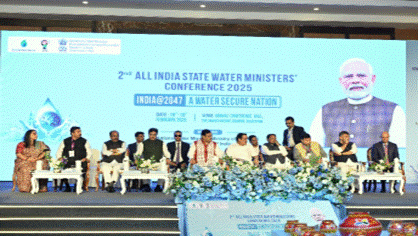
- 2nd All India State Water Ministers’ Conference from 18th – 19th February 2025 at Udaipur, Rajasthan:
National Water Mission, Ministry of Jal Shakti organised the 2nd All India State Water Ministers’ Conference with theme “India@2047 – A Water Secure Nation” The 2 nd All India State Water Ministers’ Conference 2025 was a landmark event, bringing together top policymakers and experts to shape India’s water security vision. With strategic discussions, technology-driven solutions, and collaborative decision making, the conference aims to ensure sustainable water resource management for future generations.
- Departmental Summit on “Vision for Sujalam Bharat”
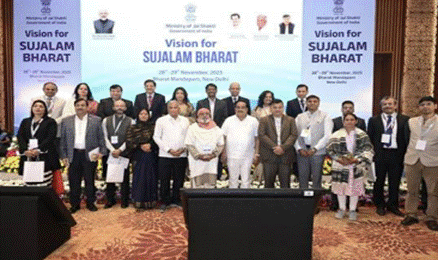
In line with the Hon. Prime Minister’s address during the Fourth National Conference of Chief Secretaries, the Government of India has adopted a transformative approach to governance, one that emphasizes coherence, collaboration, capacity building, evidence-based decision-making, and systemic reforms. As part of this initiative, Six Departmental Summits are planned for 2025–26. Each summit will be led by a designated Nodal Ministry and will convene officials from both Central and State Governments. In this context, the Ministry of Jal Shakti (Department of Water Resources, River Development & Ganga Rejuvenation) planned to organise the Departmental Summit on “Vision for Sujalam Bharat” with DDWS, MoRD and MoHUA under the guidance of NITI Aayog. The Summit serves as a national platform for deliberations on sustainable water management, resilience, and governance toward Viksit Bharat @2047.
To address key challenges in water management and possible solutions, six interlinked thematic areas were identified for focused deliberation. Each theme was guided by a designated Thematic Lead, supported by State Nodal Officers and subject experts. During September–October 2025, the Thematic Leads conducted six workshops—five virtual and one physical—which collectively engaged more than 2,800 participants.
The two-day departmental summit organized from 28 th to 29 th November, 2025 at Bharat Mandapam, New Delhi, chaired by Hon’ble MoJS, on "Vision for Sujalam Bharat" deliberated on six key themes: Rejuvenation of Rivers and Springs; Sustainability of Drinking Water Sources; Technology for Efficient Water Management; Water Conservation and Groundwater Recharge; Greywater Management and Reuse; and Community and Institutional Engagement for Behavioural Change. The event brought together approximately 300 participants from various States and Union Territories, including senior officials from partner ministries, the Ministry of Housing and Urban Affairs (MoHUA), the Ministry of Rural Development (MoRD), as well as middle-level and grassroots implementers from the Water Resources, Public Health Engineering (PHED), Rural Development, and Irrigation departments and representatives from Civil Society Organizations, nongovernmental organisations (NGOs), and Panchayati Raj Institutions.
- Invitation to Sarpanches to participate in Flag Hosting Ceremony at Red Fort on 15 th August 2025
On the occasion of79 th Independence Day celebration 2025, 100 Sarpanches along with their spouses were invited to participate in Flag Hosting Ceremony at Red Fort on 15 th August 2025. These Sarpanches have been selected for their exceptional contribution to building the nation and securing India’s future by conserving water and making Swachh Sujal Gaon a reality led from the grassroots. On the eve of Independence Day 2025, Booklet (Voices from Field) “Jal Shakti Abhiyan: Catch the Rain, 2025” was also released. This booklet profiles Sarpanches from across States and Union Territories who have set inspiring examples through community participation, innovation and tireless commitment.
Through their leadership, these Sarpanches are reviving rivers and ponds, conserving every drop of rain, improving rural health and hygiene, and inspiring communities to take ownership of their resources. They are not only conserving water, but they are also safeguarding India’s ecological heritage and securing a prosperous, resilient, and self-reliant future for generations to come. The event was a salute to India’s new-age Nation Builders.
- Invitation to Water Warriors to participate as Special Guests to join Republic Day Celebrations, 2025.
For the first time, best performing water warriors who have taken exemplary initiatives to save water were invited to special guests to witness the Republic Day Parade 2025 at Kartavya Path in the national capital. A total of 100 water warriors from Department of Water Resources (35 from NWM) along with their spouses, who have demonstrated transformative actions on the ground in water conservation with the active involvement of local communities, from various States and Union Territories were invited to attend the Republic Day Parade. Hon’ble Minister Shri Patil congratulated and motivated the water warriors to continue adopting innovative practices towards water conservation & management. He urged them to continue to serve both the nation and their communities, creating a lasting impact. Hon’ble Minister of Jal Shakti Shri C.R. Paatil also hosted a lunch for the water warriors at PSOI, New Delhi.
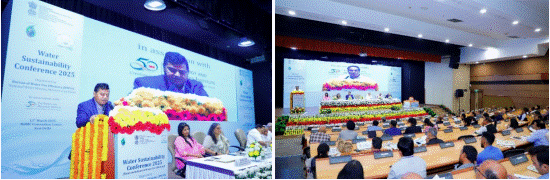
- National Level Workshop / Conference: BWUE has conducted a national workshop on 27.01.2025 titled "Water Use Efficiency: Strategies for a Sustainable Future" with focus on the domestic water sector in collaboration with the Indian Plumbing Association (IPA). Also, organised a national conference on 12.03.2025 titled “Water Sustainability Conference 2025” with a focus on industrial water use efficiency in collaboration with The Energy and Resources Institute (TERI), and recommendations of the workshop/conference have been forwarded to concerned Ministries / industries for taking further necessary action.
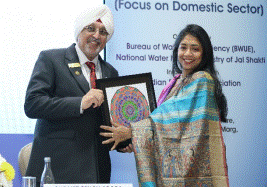
- Other Workshop / Conference: A Stakeholder Consultation Workshop on “Enhancing Water Use Efficiency: RO-based Water Purification Systems with Focus on Domestic, Industrial, and Commercial Sectors” with RO manufacturers and suppliers was organized by the Bureau of Water Use Efficiency, held on 05.06.2025, and records of the meeting have been forwarded to concerned Ministries / RO industries for taking further necessary.
A meeting with various Ministries to discuss sustainable groundwater management under the various schemes/programmes in the Central Ministries on groundwater extraction and recharge was organized by the Bureau of Water Use Efficiency, held on 04.07.2025, and records of the meeting have been forwarded to concerned Ministries / Departments for taking further necessary action.
A Stakeholder Conference on "Enhancing Water Use Efficiency in Air Conditioners” (focus on domestic, commercial and industrial use) with AC manufacturers was organized by the Bureau of Water Use Efficiency, held on 05.08.2025.
- First Regional Conference on “Enhancing Water Use Efficiency in Irrigation Sector” was organized on 22nd November, 2025 at NIAM Campus, Jaipur, Rajasthan to promote water use efficiency in irrigation through technological innovations, effective implementation of existing policy provisions, and adoption of best practices in agriculture and irrigation by States. A total of about 150 participants attended, including representatives from line Ministries and the States of Rajasthan, Himachal Pradesh, Uttarakhand, Punjab, Haryana, Karnataka, Jammu & Kashmir and Leh (100), agricultural scientists (30), and NGOs and progressive farmers (20). Farmers and NGOs also participated actively in the deliberations.
NWM successfully implemented impactful IEC initiatives across digital and mass communication platforms. A key highlight was the digital campaign on IRCTC, where a 300x250 mm banner ran continuously for six months and received over 21.86 crore views, spreading awareness on rainwater harvesting.
Further, audio announcements on Rainwater Harvesting and Jal Shakti Abhiyan were broadcasted 233 times across 189 railway stations, reaching more than 50 crore people, as reported by NFDC.
Innovative ongoing activities include interactive water conservation games to promote behavioural change and community engagement. Additionally, the Radio Talk Show series features local Water Warriors, with amplification support from popular RJs helping extend campaign reach through both radio and social media platforms.
- Preparation of State Specific Action Plans for water Sector:
NWM envisaged developing a State Specific Action Plan (SSAP) for the water sector covering irrigation, industry, domestic and waste water of a State/UT. NWM is providing financial assistance of Rs. 50 Lakh to major States and Rs. 30 Lakh to minor States/UTs as a grant for formulation of SSAPs for the water sector. NWM engaged two nodal agencies to coordinate and monitor SSAP formulation. North Eastern Regional Institute of Water and Land Management (NERIWALM), Tezpur, Assam, is coordinating & monitoring SSAP formulation for 19 States and National Institute of Hydrology (NIH), Roorkee, Uttarakhand, is doing so for the remaining 16 States/UTs. So far, 35 States/ UTs have signed MoUs with the Nodal Agencies. 32 States/UTs have submitted the first draft status report. 16 States/UTs have submitted the second phase of the Interim Report. 03 States, namely Uttar Pradesh, Maharashtra & Gujarat, have submitted the Final SSAP Report and have been approved by the Competent Authority.
- HRD & Capacity Building and Mass Awareness Programmes:
Goal - III of NWM envisages ‘Promotion of citizen and state actions for water conservation, augmentation and preservation, and focused attention to vulnerable areas including over-exploited areas.’ Capacity building of organisations associated with water resources development and management is one of the action points under strategy 3.1 (b) of this Goal. In this direction, the National Water Mission provides grants to various Central/State Government Organisations and academic institutions of national repute across the nation for conducting training & capacity building programs. This year, training proposals submitted by WALMI Dharwad, NERIWALM Tezpur, WALAMTARI Hyderabad, CWRDM Kerala, NIH Roorkee, and ICAR-IISWC Bhubaneswar have been approved (Nov 2025) for this purpose.
- Setting up of Bureau of Water Use Efficiency (BWUE):
Fulfilling the requirement of one of the goals of NWM, a Bureau has been set up under the scheme “National Water Mission” in October 2022, for Promotion, Regulation, and Control of efficient use of water in Irrigation, Industrial and Domestic sectors in India to increase water use efficiency. The proposed Bureau will serve as a facilitator in promoting the improvements in water use efficiency across various sectors, namely irrigation, drinking water supply, power generation, industries, etc. The Bureau may engage with multiple stakeholders in developing standards, implementing them, preparing case studies, making necessary regulatory directions to promote water-use efficiency, assessing water footprint and water auditing, showcasing national/ international best practices and evolving innovative mechanisms to secure community participation.
- Water Heritage Structures:
As part of Azadi Ka Amrit Mahotsav, the National Water Mission identified 75 ancient water conservation structures across the Country and declared them as "Water Heritage Structures." Details of these Water Heritage Structures can be seen on the Jal-Itihas subportal under the India-WRIS portal.
To evaluate water use efficiency of the major/medium irrigation projects, National Water Mission (NWM) has completed 17 baseline studies through 3 premier institutes namely Water and Land Management Training and Research Institute (WALAMTARI), Hyderabad, Water and Land Management Institute (WALMI), Aurangabad, Centre for Water Resources Development and Management (CWRDM), Kozhikode. The overall project efficiency of the studied projects comes out at 38% (the group weighted average on culturable command area basis).
To enhance water use efficiency in some of the water intensive industries viz. Thermal Power plants, Textile, Pulp & Paper and Steel Industry, NWM had awarded a benchmarking study to The Energy and Resources Institute (TERI) regarding “Benchmarking Industrial Water Use to Assist Policy for Enhancing Industrial Water Use Efficiency in India”. The study focuses on two industrial sectors viz. Thermal Power Plants & Textile Industries in Phase-I and Pulp & Paper and Steel Industries in Phase-II. TERI has submitted its final report on both Phase I (Thermal Power Plants, Textile Industries) and Phase II (Pulp & Paper and Steel Industries).
- Mandating Low Flow Fixtures:
Water scarcity and insecurity has become a crucial issue worldwide with consistent increase in global water withdrawals in the last century and it is predicted that more than half of the global population will be living in water-stressed areas by 2050. The standards, IS 17650 (Part 1) and IS 17650 (Part 2) cover additional requirements for assessment and water efficiency rating of the sanitary wares (such as water closets, squatting pans, flush valves, flushing cisterns and urinals) and sanitary fittings [such as faucets (taps) and showerheads] for their performance based on water efficiency. Department for Promotion of Industry and Internal Trade (DPIIT) has been requested to consider Water Use Efficiency as additional criteria in the scope of Quality Control Orders issued by them after due stakeholders' consultation process. Also, a research study has been proposed to be conducted in residential, commercial and institutional establishments to assess the quantum of water savings by deploying low flow fixtures (conforming to BIS code IS-17650 Part1 & Part-2).
- Mission Lifestyle for Environment (LiFE):
The National Water Mission organised field visits and social media campaigns as part of Mission LiFE (Lifestyle for Environment) outreach activities for mass mobilisation ahead of World Environment Day 2024. These efforts aimed to raise awareness about sustainable lifestyles and promote public engagement in environmental conservation.The NWM also organised a plantation drive under the "Ek Ped Maa Ke Naam 2.0" Campaign launched by the Hon’ble Prime Minister on 29th November, 2024, at the National Zoological Park in Delhi. Around 2000 trees were planted across the country in collaboration with various NGOs and partner organisations, with active support from the National Water Mission.
3. National Water Development Agency (NWDA)
Inter-Linking of Rivers Project:
National Water Development Agency (NWDA) has been entrusted with the work of Interlinking of Rivers (ILR) under National Perspective Plan (NPP) formulated by Government of India. NWDA has identified 30 inter-basin water transfer links (16 under Peninsular and 14 under Himalayan component) under NPP. NWDA has completed Detailed Project Reports (DPRs) of 14 link projects under NPP including one Intra-State link project, Feasibility Reports (FRs) of 26 link projects and Pre-Feasibility Reports of all the 30 link projects.
Five link projects have been identified as Priority links viz.; Ken-Betwa Link Project, Modified Parbati-Kalisindh-Chambal (MPKC) Link Project and Godavari-Cauvery Link Project {comprised of three projects: Godavari (Inchampalli)-Krishna (Nagarjunasagar) link, Krishna (Nagarjunasagar)-Pennar (Somasila) link and Pennar (Somasila)-Cauvery (Grand Anicut) link}.
System studies of four link projects viz. Manas-Sanksoh-Teesta-Ganga (MSTG) link, Ganga-Damodar-Subernarekha (GDS) link, Subernarekha-Mahanadi (SM) link and Farakka-Sunderbans (FS) link have been initiated and the work of these four links has been awarded to IIT, Guwahati, NIT, Patna, NIT, Warangal and NIH, Roorkee respectively. The draft final reports of all four link projects have been submitted by the respective Institutes. Awarding of work for system studies of southern linkage may be taken up after finalization of quantity of water that can be transferred from MSTG, GDS, FS and SM link projects to Mahanadi river, as per system studies.
- Ken-Betwa Link Project (KBLP) is the first Interlinking of Rivers (ILR) Project of NPP that is under implementation.
- Project is planned to provide annual irrigation of 10.62 lakh ha, out of which 8.11 lakh ha in Madhya Pradesh and 2.51 lakh ha in Uttar Pradesh (mostly in Bundelkhand region) and provide drinking water supply to a population of about 62 lakh people in both the States (MP- 41 lakh & UP-21 lakh). Project will generate 103 MW of Hydro and 27 MW of Solar power.
- Govt. of India has approved the implementation of KBLP with an estimated cost of Rs. 44605 crore (year 2020-21 price level) with central support of Rs. 36290 crore through a Special Purpose Vehicle viz.; Ken Betwa Link Project Authority (KBLPA).
- Initial focus is on land acquisition, R&R and EMP of the project.
- Work of main component viz.; Daudhan dam has been awarded to M/s NCC Ltd. on 28.11.2024 and preliminary work is under progress.
- A Project Management Consultant has been hired for implementation of project. The work has been awarded to JV of M/s Tractebel Engineering Pvt. Ltd. & M/s LEA Associates South Asia Pvt. Ltd. on 30.05.2025. Contract Agreement was signed on 24.06.2025.
- Land Acquisition work is under progress.
- 100% land under submergence has been transferred to WRD, MP.
- State specific projects are also under progress.
- Project is planned to be completed in period of 8 years i.e. upto March, 2030.
2. Modified Parbati-Kalisindh-Chambal (PKC) Link Project (Integration of PKC & ERCP)
- With a view to optimize the utilization of water of the Chambal River System and based on deliberations with Rajasthan and Madhya Pradesh, at various platforms, a proposal of Modified Parbati-Kalisindh-Chambal (Modified PKC) link, incorporating the components as proposed by Govt. of MP in Kuno, Parbati and Kalisindh sub-basins along with components of ERCP has been framed. Modified PKC link has been made a part of NPP of ILR and has been declared as a priority interlinking project by Special Committee for Interlinking of Rivers (SCILR) in its 20th meeting held in December, 2022.
- Draft PFR of Modified PKC link and a draft MoU for preparing the DPR of the Modified PKC link was circulated to both the States in January, 2023.
- The persistent efforts of Govt. of India has led to signing of MoU by both these States with Ministry of Jal Shakti (MoJS), Govt. of India (GoI) on 28.01.2024 in New Delhi in the presence of Hon’ble Chief Ministers of both the States, for preparation of its DPR followed by signing of MoA on 05.12.2024 for implementation of link project.
- Preparation of DPRs of its components by both the States have been completed by both the States and have been uploaded on e-PAMS Portal of CWC for appraisal.
- After technical and cost appraisal of the project by CWC, proposal would be put up for PIB and Cabinet approval.
- The project will provide benefits to MP extending annual irrigation to command area of about 6 lakh ha by about 1815 MCM water and drinking water supply of about 71 MCM to the districts of Shivpuri, Gwalior, Bhind, Morena, Sheopur, Shajapur, Rajgarh, Guna, Ratlam, Ujjain, Dhar, Sehore, Mandsaur, Dewas and Agar Malwa.
- The Project is planned to provide drinking water of about 1744 MCM to targeted population of 21 districts of Eastern Rajasthan (Jhalawar, Baran, Kota, Bundi, Tonk, Sawai Madhopur, Gangapur city, Dausa, Karauli, Dholpur, Bharatpur, Deeg, Alwar, Khairthal-Tijara, Kotputali - Behror, Jaipur urban, Jaipur rural, Dudu, Ajmer, Beawar, Kekri) and en-route towns, tanks and villages as well as to meet industrial water demand of about 205 MCM for Delhi Mumbai Industrial Corridor (DMIC) and other industries. There is also provision of about 1360 MCM water irrigating more than 2.5 lakh ha of new command area as well as stabilizing the existing command area of about 1.5 lakh ha in Rajasthan.
3. Godavari-Cauvery (G-C) Link Project (comprising of 3 link systems)
- Modified proposal for transfer of 4189 MCM of water from Godavari along with supplementation in Krishna basin through Bedti Varda link (524 MCM) has been studied by NWDA.
- Draft DPR of the modified revised proposal has circulated to the concerned State/UT during Jan., 2024.
- Draft MoA has been prepared for implementation of the project and circulated to concerned State/UT for perusal and observation during April, 2024.
- Concerted efforts are being made for building up consensus amongst the States/UT for signing of MoA for the early implementation of this link project.
- Six Consultation meetings for arriving at a consensus among party States have been held so far and the last meeting was held on 22.08.2025.
4. Kosi-Mechi Intra-State Link Project of Govt. of Bihar
- Kosi-Mechi Interlinking River Project under Himalayan Component of NPP was taken up for studies by NWDA and its Pre-Feasibility Report (PFR) was completed in year 1997 but as the link project entirely lies in Nepal so due to international issues, preparation of its Feasibility Report was dropped. As requested by State of Bihar, the study of Kosi-Mechi Intra-State link which starts from existing Hanuman Nagar Barrage and benefits Bihar was undertaken by NWDA, as for this, an agreement with Nepal was not needed.
- Present proposal is an extension of EKMC upto river Mechi, a tributary of river Mahananda. The aim of extension of 76.20 km of EKMC upto Mechi river and remodelling of existing EKMC 41.30 km is mainly to provide irrigation benefits to the water scarce Mahananda basin command in the districts of Araria, Kishanganj, Purnea and Katihar during Kharif season depending upon the pondage available in Hanuman Nagar barrage. The total length of the link canal including the length of existing EKMC is 117.50 km.
- PFR of Kosi-Mechi Intra-State Link Project was prepared by NWDA in June, 2009. subsequently, on request of Govt. of Bihar, its DPR was prepared and sent to State Govt. in March, 2014 and further revised in year, 2017.
- All statutory clearances have been obtained from various Ministries/Departments.
- Govt. of Bihar during March, 2022 has requested NWDA to prepare the Working DPR of the link project. MoU has been signed on 24.12.2022 between NWDA & WRD, Govt. of Bihar for preparation of Working DPR of link project in two Phases (Phase-I & II).
- Remodeling of Existing Eastern Kosi Main Canal (EKMC): 41.30 Km
- Construction of new link canal system: 76.20 Km (RD 41.30 km to 117.50 Km)
- NWDA has updated the revised cost of this Link Project at 2022-23 PL in December, 2022. The cost of the link project as Rs. 6282.32 crore has been approved by the Technical Advisory Committee of DoWR,RD&GR in its 155th meeting held on 08.03.2024.
- Investment Clearance has been accorded by DoWR,RD&GR, MoJS on 22.05.2024.
- PIB Note of Kosi-Mechi Intra-State Link Project has been submitted and as per minutes of PIB meeting held on 21.11.2024, the proposal has been recommended for inclusion under PMKSY-AIBP.
- In accordance with the decisions taken in the meeting of the Cabinet Committee on Economic Affairs held on 28.03.2025 for inclusion of projects under PMKSY-AIBP, approval for inclusion of Kosi-Mechi Intra-State Link Project of Bihar under the PMKSY-AIBP Programme of DoWR,RD&GR has been accorded.
- The report on remodeling works (Phase-I) was completed by NWDA and submitted to State Govt. on 30.06.2025.
- DPR of Phase-II is likely to be completed by September, 2026.
- Project is scheduled to be completed by March, 2029.
5. 9th India International Water Week (IIWW) – 2026
- IWW was conceptualized and organized for the first time in 2012, the Ministry of Jal Shakti, Government of India is organizing Water Week biannually. It comprises Conference, Exhibition and a Study Tour.
- Eight editions of event have been organized in 2012, 2013, 2015, 2016, 2017, 2019, 2022 and 2024. The 8th India Water Week-2024 was successfully organized at Bharat Mandapam, New Delhi during September 17-21, 2024 and the event was inaugurated by Hon’ble President of India.
- With the approval of Hon'ble Minister of Jal Shakti, it has been now decided to organize “India Water Week” as “India International Water Week”.
- 9th India International Water Week – 2026 with theme "Climate Resilient Water Management" from September 22-26, 2026 at Bharat Mandapam, New Delhi and focus on theme and International issues in field of water.
- Central Water Commission (CWC)
1. Evaporation-transpiration (ET) Based Irrigation Performance Assessment Tools
Globally, irrigation accounts for nearly 70% of freshwater withdrawals, and in India, the share is about 80% and employs nearly half of the workforce, making a significant contribution to GDP. Over the last few decades, rapid population growth, urbanization, and climate variability have exerted tremendous pressure on available water resources, necessitating a shift toward scientific water management and data-driven irrigation performance assessment (IPA). Irrigation Performance Assessment (IPA) is a systematic process used to evaluate how effectively, efficiently, and equitably an irrigation system delivers water to agricultural fields to meet crop water requirements. It provides essential feedback for improving management practices, optimizing water allocation, and ensuring sustainability of irrigation infrastructure.
Traditionally, irrigation performance was evaluated using various indicators viz. the system performance, agro-economic impacts, socio-economic impact, environmental impacts & economic evaluations. These assessments were based on field surveys, manual discharge measurements, and crop-cutting experiments—methods that were often time-consuming, subjective, and spatially limited. With growing complexity in water management and the expansion of major and medium irrigation projects, such conventional techniques have become insufficient to represent the true picture of system performance across vast commands. Having an extensive network, assessing releases and usage data for irrigation infrastructure and water use efficiency remains a significant challenge in this sector. Therefore, there was a need to develop a tool using available ready to use remote sensing (RS) products for assessing the performance of these irrigation schemes, benchmarking the schemes and further to plan the corrective measures for projects with low performance/WUE.
Thus, on the initiative of DoWR, RD and GR, MoJS, two ET based tools for performance assessment of Irrigation projects with Remote sensing and Satellite input have been developed by CWC, NWIC& World Bank Team. This endeavor encompasses two primary objectives: first, to develop a generic performance assessment system for benchmarking irrigation systems at the national level; second, to conduct a scheme-level performance assessment for selected irrigation systems, offering a higher resolution analysis.
Two tools have been developed by CWC in collaboration with the World Bank and National Institute of Hydrology (NIH) namely EQIPA (Evapotranspiration based Quick Irrigation Performance Assessment) & EDIPA (Evapotranspiration based Detailed Irrigation Performance Assessment. The E-DIPA tool provides in-depth assessments of irrigation systems by analyzing spatial and temporal variations in evapotranspiration across irrigated areas within command regions. Both tools address key performance aspects, including equitable water distribution, reliability of service (related to irrigation scheduling), and adequacy (Quantum of water supplied with respect to potential). By leveraging these insights, water managers can make data-driven decisions to optimize resource utilization and improve irrigation system efficiency. Satellite products like WaPOR by FAO, Sentinel-1 and Sentinel-2by ESA, Landsat 30m etc. were used in developing the ET based tools.
During 2nd State Water Ministers’ conference held at Udaipur in Feb, 2025 theversion-1 of the EQIPA tool was launched and state wise results generated from EQIPA tool were shared with the states for their inputs and further improvement in tools. Virtual meetings were held with 15 states in Jan-Feb 2025 in which the tool was demonstrated to the states. For capacity building of the different stakeholders, different training programs have been organized regularly in which
245 officers have been trained for ET based Irrigation Performance Assessment Tools till November-2025. These officers are not only from CWC but state govt. engineers, PhD scholars from states like Odisha, Maharashtra, Gujarat, Assam, Andhra Pradesh, Karnataka, Punjab, Telangana have also been trained.
CWC with the help of World Bank and NIH has developed a CWC Geo Crop Application to create a crop library for whole country as supervised classification will give better understanding of the results and will help make the tool more competent and robust.
2. Support for Irrigation Modernization Program (SIMP):
Central Water Commission (CWC), DoWR, RD & GR has taken up an initiative Support for Irrigation Modernization Program (SIMP) with technical assistance from the Asian Development Bank (ADB) to modernize Major/Medium Irrigation (MMI) projects in the country.
SIMP is proposed to be taken up in 4 phases. SIMP Phase-1 concluded on 31.12.2021 under which 4 MMI projects have been identified for inclusion under 1st batch of projects for preparation of Irrigation Modernization Plans (IMPs) out of the 57 proposals received from 14 States and 2 UTs. The entire process including the preparation of IMPs, Detailed Project Report (DPRs), detailed designs and final implementation/ project execution is expected to be completed by Phase-4. Implementation of the project would lie with the concerned States who would have an option to either fund it from their own resources or they can avail loan facility from ADB or any other financial institutions.
SIMP Phase-2 was initiated from November 2022. Irrigation Modernization Plan (IMP) of four projects namely Vani vilasa Sagara Project, Karnataka, Palkhed Project Maharashtra, Purna Project, Maharashtra and Loharu Lift Irrigation Project, Haryana have been prepared. As a 1st step for preparation of IMPs, FAO developed RAP-MASSCOTE (Rapid Appraisal Procedure- Mapping System and Services for Canal Operation Techniques) workshops were organized to assess the present status of the identified four projects. The findings of RAP MASSCOTE workshops and issues related to Batch 1 SIMP projects were discussed in a mid-term workshop organized by ADB and CWC on 09.06.2023 at New Delhi.
For capacity building under SIMP phase-II, the following activities were organized:
-
- From 6th to 10th November 2023, a five days training on modernization and design of Pipe Distribution Networks (PDN) was organized at Panchkula/ Chandigarh. 22 Engineers from Karnataka, Maharashtra, Haryana, Punjab and CWC participated in the training.
- On 15th and 20th December 2023, a Webinar on Irrigation Modernization and Design of PDN Systems was organized.
- A Training on Asset Management Planning for Irrigation Schemes was held from 8 to 12 January 2024 at WALMI, Aurangabad.
- A training on new technologies in Agriculture and Water Practices was held from 22 to 25 January 2024 at HIRMI, Kurukshetra, Haryana.
The Preliminary Project Reports (PPR) of all the four projects has been submitted by ADB consultants to the concerned project authorities for approval of state Govt. PPRs are yet to be approved by Planning/WRD of the states for further submission to DEA. After necessary approval from DEA, action for phase-3 will be taken up for preparation of DPRs.
3. National Task Force for Integrated Water Resources Development and Management
The Department of Water Resources, RD & GR, Ministry of Jal Shakti, Government of India has constituted a National Task Force for Integrated Water Resources Development and Management (NTFIWRDM), 2024 vide O.M. dated 25.11.2024 under the chairmanship of Shri Ramesh Chand, Hon’ble Member, Niti Aayog; comprising of distinguished Members viz. Secretary/Additional Secretary of various Ministries, Heads of various Govt. Departments and Senior officials from various organizations. Chief Engineer (BPMO), Central Water Commission is the Member-Secretary of the NTFIWRDM.
The first meeting of the NTFIWRDM was held on 21st January 2025 under the chairmanship of Prof. Ramesh Chand, Member, NITI Aayog to deliberate on the terms of reference, organizational setup and various proposed activities of the national task force. Based on the recommendation of NTFIWRDM, a core group was constituted under the chairmanship of Prof. Ramesh Chand, Member, NITI Aayog to
- Formulate proposals for various thematic Working Groups
- Prepare and finalize a detailed work plan in line with the terms of reference of the NTFIWRDM and
- Review and recommend proposals and matters of NTFIWRDM.
The first meeting of the core group was held on 31/01/2025, during which the following eight (08) working groups, comprising of eminent experts to address specific aspects of water sector were finalized, and their objectives/key activities were also identified:
-
- Water Resources Supply and Demand Scenario Group
- Integrated Water Resources Management Group
- Water Governance Group
- Water Infrastructure Assessment Group
- Water Services Delivery Group
- Water Use Efficiency Group
- Environmental and Ecological Group
- Data, Technology and Innovation Group
The second meeting of the core group was held on 18/07/2025 to review the progress of all the working groups.
The respective working groups are conducting meetings and undertaking activities aligned with their thematic areas. The status of the meetings of the working groups is as under:
|
S.
No.
|
Name of Working
Group
|
Status of Working Group as on 27.11.2025
|
|
1.
|
Water Resources Supply and Demand Scenario
|
Four(04) meetings were held under the working group on 03.04.2025,09.06.2025,01.09.2025 and 21.11.2025,
respectively
|
|
2.
|
Integrated Water Resources Management
|
Three (03) meetings were held under the working group on 02.04.2025,10.06.2025 and 18.08.2025, respectively.
|
|
3.
|
Water Governance
|
Four (04) meetings were held under the working group on 26.05.2025,17.07.2025, 03.09.2025 and 24/10/2025,
respectively.
|
|
4.
|
Water Infrastructure Assessment
|
Three (03) meetings were held under the working group on 05.05.2025,16.05.2025 and 29.08.2025, respectively.
|
|
5.
|
Water Services Delivery
|
Two (02) meetings were held under the working group on 24.04.2025 and 09.07.2025, respectively.
|
|
6.
|
Water Use
Efficiency
|
Two (02) meetings were held under the working group on 04.04.2025 and 29.07.2025, respectively.
|
|
7.
|
Environmental and
Ecological
|
Five (05) meetings were held under the working group on
03.06.2025, 02.08.2025, 23/09/2025, 01/10/2025 and10.10.2025, respectively.
|
|
8.
|
Data, Technology and Innovation
|
Three (03) meetings were held under the working group on 30.04.2025,08.08.2025 and 09.10.2025, respectively.
|
Further, various working groups are in the process of framing their draft interim reports.
4. CWC Activities under National Hydrology Project (NHP) (w.r.t. EMO)
Central Water Commission has taken up sedimentation assessment studies of selected reservoirs located all over the country using Hydrographic Survey. During the Year 2021- 24, under National Hydrology Project (NHP) Phase-I, sedimentation assessment study for 32 reservoirs have been completed in all respect. During the Year 2023-25 under phase –II, sedimentation studies in respect of 87 reservoirs located in 10 States (Rajasthan, Gujarat, Uttar Pradesh, Uttarakhand, Madhya Pradesh, Maharashtra, Andhra Pradesh, Kerala, Telangana, and Odisha) had been taken up through outsourcing. Studies in respect of 84 out of 87 reservoirs have been completed in all respect and the works of the remaining 03 reservoirs was withdrawn due to various reasons.
Reservoir Sedimentation Studies using Hydrographic survey for 32 & 84 reservoirs under National Hydrology Project under Phase I & II respectively, have been completed across the country and their reports published.
5. The important publication released during October 2025:- "Water Sector at a Glance 2024"
M&CC Dte
CWC was monitoring 902 Glacial Lakes & Water Bodies having size greater than 10 ha on monthly basis during monsoon season (June to October) every year through remote sensing as per NRSC inventory 2011 till 2024. From 2025, CWC has increased monitoring to 2843 Glacial Lakes and Water Bodies as per NRSC published Glacial Lake Atlas (GLA) of Indian Himalayan River Basins in the year 2023 under National Hydrology Project (NHP). Of these, 2485 are Glacial Lakes and 358 are Water Bodies. Total 681 Glacial lakes located in India, out of which, Ladakh hosts 179 lakes, J&K 76, Himachal Pradesh 17, Uttarakhand 13, Sikkim 72 and Arunachal Pradesh 324.
RC Dte
The Technical Guidelines on Flood Plain Zoning 2025, issued by Central Water Commission under Ministry of Jal Shakti during August 2025. (copy attached)
CM Dte
This Directorate published the Guidelines for Preparation of DPR for Salinity Ingress Management Projects in Coastal Areas in May 2025.
The guidelines provide a structured approach for developing technically sound and climate- resilient interventions to address salinity intrusion in coastal regions. They emphasize the use of salinity control structures, groundwater recharge measures, and nature-based solutions such as mangrove restoration. This initiative will support states and UTs in preparing effective DPRs and strengthen institutional capacity for safeguarding coastal communities and ecosystems.
6. CWC Activities under National Hydrology Project (NHP):
-
- Study on “Physical based Mathematical Modelling for estimation of Sediment Rate and Sediment Transport in Seven River Basin” has been completed.
- Consultancy services for Development of Decision Support System near to real time for Integrated Reservoir Operation System of Ganga Basin” has been completed.
- Study of the issue of floods and siltation in river Ganga due to Farakka Barrage in the State of Bihar has been completed.
- Early Flood Warning System Including Inundation Forecast in Ganga Basin is in progress.
- Reservoir Sedimentation Studies using Hydrographic survey for 32 reservoirs in Phase-I and 84 reservoirs in Phase-II has been completed under NHP
- Extended Hydrological Prediction (multi week forecast) for Yamuna, Narmada and Cauvery basins is in progress.
- Supply, Installation, Testing & Commissioning (SITC) of 103 Nos. ADCP for the measurement of discharge at the HO sites of CWC has been completed
- Supply, Installation, Testing & Commissioning (SITC) of 32 velocity radar sensors for modernization of discharge observations has been completed.
- Real Time Data Acquisition System (RTDAS) for Narmada Control Authority (NCA) and Arunachal Pradesh comprising of network of 48 & 50 nos hydro meteorological Stations respectively has been commissioned.
- Flood forecasting activities:
In the year 2025, 10 new stations (Inflow) have started functioning. Currently CWC is providing flood forecast at 350 stations (200-level forecasting stations & 150-inflow forecasting stations). During the period from 1st April to 30.10.2025, 11581 (i.e. 6538 Level and 5043 Inflow) forecasts were issued, out of which 11096 (95.81%) forecasts were found within the accuracy limit (±0.15m for level forecast and ±20% for inflow forecast).During flood season, CWC operates the Central Flood Control Room on 24x7 basis at its headquarter in New Delhi and 36 Divisional Flood Control Rooms spread throughout the country for monitoring flood situation. On an average, about 10,000 forecasts are issued during flood season every year by the CWC. Normally, these forecasts are issued 6 to 30 hours in advance, depending upon the river terrain and location of the flood forecasting sites and their base stations. In addition to conventional flood forecasting techniques, mathematical model forecasting based on rainfall-run off methodology is being used for some areas. This has enabled CWC to issue 7-day advance flood advisory.
Automated online 7-day flood advisory for all the level and inflow forecasting stations is maintained. “Flood Situation for next seven days” in respect of stations likely to be above warning level has been added in the “Daily Flood Situation Report cum Advisory” based on the 7-day advisory.
In 2025, CWC began issuing flood advisories and warnings through its YouTube channel, “CWC Flood Updates.” By using YouTube, CWC aims to reach the public faster, more widely, and in a more user-friendly format.
NRSC has developed Spatial Flood Early Warning Systems for the Godavari and Tapi Rivers under NHP. Further, C-DAC, with the support of CWC, has developed an Inundation Forecast Model for the Mahanadi Basin The solution for mentioned basins was also rolled out during the 2025 monsoon season. The inundation forecast outputs of the above Mahanadi, Godavari and Tapi River Basin models are available on newly developed Unified Dissemination Portal C-Flood (https://inf.cwc.gov.in/) inaugurated by Hon'ble Minister of Jal Shakti.
CWC has also initiated the in-house development of Inundation Forecast Models for the all the regions where high-resolution Digital Elevation Model (DEM) are available. Till now, inundation forecast model for 26 Flood Forecasting stations have been developed and their outputs have been made live on https://aff.india-water.gov.in/inundation.php portal. CWC further plans to cover all the existing 200 Level Forecasting stations for inundation forecasting in future subjected to availability of High-Resolution DEM.
- Flood Management Wing (FM):
The “Flood Management Programme (FMP)” and “River Management Activities and Works related to Border Areas" (RMBA) under operation during XII Five Year Plan were merged as "Flood Management and Border Areas Programme" (FMBAP) for the period 2017-18 to 2019-20 and further extended up-to March, 2021. Cabinet further approved the continuation of FMBAP scheme during 2021-22 to 2025-26 with an outlay of Rs. 4100 Crore (FMP-Rs. 2940 Crore and RMBA – Rs. 1160 Crore). Since the inception of FMBAP (till March 2025), Central Assistance of Rs. 7228 crores have been released to States/UTs under FMP component of Flood Management & Border Area Programme (FMBAP) scheme and Central Assistance of Rs. 1477 crores have been released to UTs/States under RMBA component of FMBAP scheme.
A. Expert Level Mechanism (ELM)
During the visit of the Hon’ble President of the People’s Republic of China to India on November 20-23, 2006, it was agreed to set up an Expert-Level Mechanism to discuss interaction and cooperation on provision of flood season hydrological data, emergency management and other issues regarding trans- border Rivers as agreed between them. Accordingly, the two sides have set up the Joint Expert Level Mechanism through a Joint Declaration by both the countries. The ELM meetings are held alternately in India and China every year. Sixteen meetings of ELM have been held so far. The 16 meeting of ELM was held in New Delhi during 22nd and 23rd April 2025. The
GoI delegation was led by Shri S.K. Sinha, Commissioner (B&B), DoWR, RD & GR, Ministry of Jal Shakti and the Chinese delegation was led by Mr. Hao Zhao, Director General of the International Economic & Technical Cooperation and Exchange Centre, Ministry of Water Resources, People’s Republic of China. Representatives of Ministry of External Affairs (MEA), Central Electricity Authority (CEA) and Central Water Commission (CWC) had also participated in the meeting.
B. Joint Experts Team (JET) on Flood Forecasting:
A Joint Experts Team (JET) consisting of senior officials from the Government of India and Royal Government of Bhutan(RGoB) continuously reviews the progress and other requirements of a network of 36 hydro-meteorological sites located in the catchments of trans-border rivers Puthimari, Pagladiya, Sankosh, Manas, Raidak, Torsa, Aie and Jaldhaka. So far, JET has met 39 times alternately in India and Bhutan since its reconstitution in 1992 and the last JET meeting i.e. The 39th meeting of Joint Expert Team (JET) was held during 8th - 9th October 2025 at Paro, Bhutan. The Indian delegation was led by Shri Subhrangshu Biswas, Chief Engineer, Teesta&Bagarathi-Damodar Basin Organisation (T&BDBO), Central Water Commission, GoI and the Bhutanese delegation was led by Mr. Karma Dupchu, Director, National Centre for Hydrology and Meteorology (NCHM), RGoB.
C. National Committee on Seismic Design Parameters:
The National Committee on Seismic Design Parameters (NCSDP) was constituted by erstwhile MoWR order dated 21st October,1991. Member (DCR), CWC is the chairman of the committee with other experts from various engineering disciplines from different technical institutions and Government organizations as its members. Director (FECSA), CWC is the Member Secretary of NCSDP.
The main objective of NCSDP is to recommend the site-specific seismic design parameters for water resource projects received from the dam owners. Further, it recommends attenuation relationships, derive Maximum Credible Earthquake (MCE), finalize recommendation on Controlling Maximum Credible Earthquake (CMCE) as well as Design Basis Earthquakes (DBE).
The 39th meeting of NCSDP was held on 24.04.2025 at CWC, New Delhi under the Chairmanship of Member (DCR) wherein twelve projects were cleared. The 40th meeting of NCSDP was held on 24.07.2025 at CWC, New Delhi under the Chairmanship of Member (DCR) wherein one project was cleared. Further, the Guideline for Preparation and Submission of Site-Specific Seismic Study Report of River Valley Project to National Committee on Seismic Design Parameters was revised in the 40th NCSDP meeting and third revision of guidelines was published in August 2025.
- Technical examination of instrumentation aspects of the projects
Detailed Project Report (DPR/Pre-DPR) of 5 projects and construction stage drawings of 2 projects (Lakhwar and Polavaram) in various States/countries namely Andhra Pradesh, Arunachal Pradesh, Gujarat, Sikkim Uttarakhand and Nepal were cleared with respect to instrumentation aspects.
|
SN
|
Name of the Project state wise
|
State
|
|
1.
|
Polavaram Irrigation Project
|
Andhra Pradesh
|
|
2.
|
Subansiri Upper Hydroelectric Project (1605
MW)
|
Arunachal Pradesh
|
|
3.
|
Oju Hydroelectric project (2220 MW)
|
Arunachal Pradesh
|
|
4.
|
Flood Mitigation works for Dholera Special
Investment Region (DSIR) at Ahmedabad (Gujarat).
|
Gujarat
|
|
5.
|
Teesta-III HE Project (1200MW)
|
Sikkim
|
|
6.
|
Lakhwar MPP
|
Uttarakhand
|
|
7.
|
Upper Karnali HEP (900 MW)
|
Nepal
|
10. Other Seismic works:
The ongoing work on the technical evaluation and critical examination of the web-based tools, Seismic Hazard Assessment Information System (SHAISYS) and Seismic Hazard Assessment of North and North East India (SHANNEI), being developed by IIT Roorkee and CWPRS Pune, respectively, under DRIP is of significant importance and is being diligently carried out.
Additional Inputs:
Guidelines for Assessment of GLOF specific to river valley Projects in Indian Himalayan region
CWC has released “Guidelines for Assessment of GLOF specific to river valley Projects in Indian Himalayan region” in July 2025. The guidelines provide a comprehensive framework for identifying vulnerable glacial lakes, estimating breach parameters and volumes, and simulating GLOF scenarios using appropriate hydraulic models. This document outlines a comprehensive methodology—starting from glacial lake inventory and criticality analysis to simulation of GLOF scenarios and sensitivity analyses. They aim to ensure uniformity and scientific rigor in GLOF assessment practices across the country.
11. DAM REHABILITATION AND IMPROVEMENT PROJECT (DRIP) Phase-II and III.
Dam Rehabilitation and Improvement Project (DRIP) is an externally aided project with financial assistance from the World Bank, targeting rehabilitation of some of the selected dams of the Country along with accompanying institutional strengthening component.
Based on the success of DRIP Phase- I, Ministry of Jal Shakti initiated another externally funded scheme, DRIP Phase-II and Phase-III. The Union Cabinet has approved the Scheme on October 29, 2020.
The scheme has provision for rehabilitation of 736 dams located in 19 States (Andhra Pradesh, Chhattisgarh, Goa, Gujarat, Jharkhand, Karnataka, Kerala, Madhya Pradesh,Maharashtra, Manipur, Meghalaya, Odisha, Punjab, Rajasthan, Tamil Nadu, Telangana, Uttar Pradesh, Uttarakhand, West Bengal, and three Central Agencies (Central Water Commission, Bhakra Beas Management Board, and Damodar Valley Corporation). It is a State Sector Scheme with Central component, with duration of 10 years, to be implemented in two Phases i.e. Phase- II and Phase-III, each of six years duration with an overlap of two years. The budget outlay is Rs 10,211 Cr (Phase II: Rs 5107 Cr; Phase III: Rs 5104 Cr) with rehabilitation provision of 736 dams. Out of this cost, Rs. 7,000 crore is an external loan and Rs. 3,211 crores would be borne by the respective participating States and the three Central agencies. The funding pattern of scheme is 80:20 (Special Category States), 70:30 (General Category States) and 50:50 (Central Agencies). The scheme also has provision of Central Grant of 90% of loan amount for special category States (Manipur, Meghalaya and Uttarakhand). The DRIP Phase-II and III Scheme is 10 years duration, proposed to be implemented in two Phases, each of six-year duration with two years overlapping. Each Phase has external assistance of US$ 500 M. The Phase-II of the scheme is being co-financed by World Bank and Asian Infrastructure Investment Bank (AIIB), with funding of US$ 250 million each. The loan agreement by World Bank was signed on August 04, 2021 with 10 States (Gujarat, Kerala, MP, Maharashtra, Manipur, Meghalaya, Rajasthan, Odisha, Tamil Nadu, and Chhattisgarh) and became effective from 12th October, 2021. In addition to 10 States, four States (Uttarakhand, Uttar Pradesh, West Bengal and Karnataka) have been notified by World Bank for inclusion under this scheme in June 2022 and their loan declared effective in January 2023. Another 4 agencies (DVC, BBMB, Punjab and Telangana) have been onboarded and their loan has been made effective on October, 2025.
The loan agreement by AIIB was signed on 19th May, 2022 with 10 States (Gujarat, Kerala, MP, Maharashtra, Manipur, Meghalaya, Rajasthan, Odisha, Tamil Nadu, and Chhattisgarh) and declared effective on 29th December, 2022 by AIIB.
Important project achievements include approval of PSTs of 162 dams costing Rs 4548.73 Cr by the World Bank. The contract(s) amounting approximately Rs 2776 Cr have been awarded by various Implementing Agencies and an amount of Rs 1931 Cr spent as on 15.11.2025 on various project activities including dam rehabilitation, institutional strengthening and project management activities
4th meeting of Technical Committee of DRIP Phase II and III and World Bank Implementation and Support Mission was held during 03rd to 04th March 2025 under the chairmanship of Member (DCR), CWC at Shillong, Meghalaya in which Nodal officer and Project Director of DRIP IAs participated. Deliberations in respect of technical matters pertaining to implementation of the scheme were held during the meeting.
The 2nd Meeting of Executive Committee of ICED, IIT Roorkee was held on 10th March 2025.
A National Level Training Program on “Dam Safety Act-2021 Overview: Public Safety Around Dams” was organized by CPMU in collaboration with Uttarakhand (UJVNL) during 07-08 May, 2025 at Dehradun, Uttarakhand.
2nd Meeting of Executive Committee of ICED, IISc, Bengaluru was held at ICED, IISc, Bengaluru on 25th June 2025.
World Bank Implementation Support Mission of DRIP Phase II were held during 13th to 15th October, 2025 at Indore, Madhya Pradesh.
3rd meeting of National Level Steering Committee (NLSC) on DRIP Phase-II and III chaired by Secretary, DoWR, RD and GR were held on 30.10.2025 at New Delhi to discuss the progress and issues of DRIP Scheme.
3rd Meeting of the Advisory Board of the Institutions for Centre of Excellence in Dam Safety (ICED) were held on 31.10.2025 at New Delhi.
5th meeting of Technical Committee of DRIP Phase II and III was held on 25.11.2025 under the chairmanship of Member (DCR), CWC at New Delhi in hybrid mode in which Nodal officer and Project Director of DRIP IAs participated. Deliberations in respect of technical matters pertaining to implementation of the scheme were held during the meeting.
One of the significant activities under DRIP is Institutional Capacity building. Based upon the need assessment, tailor made training programmes are being conducted with participation of not only DRIP Implementing agencies but also other stakeholders associated with Dam Safety. During 2025, 13 nos. of training programmes were organised under DRIP apart from ongoing M Tech Programme on Dam Safety by IIT Roorkee and IISc Bangalore.
Ø Hydrological Studies: The success of a project is largely governed by the hydrological inputs. The success of a project is largely governed by the hydrological inputs. The Hydrological Studies Organization (HSO), a specialized unit under Design and Research (D&R) Wing of CWC, carries out hydrological studies in respect of the water resources projects in the country. The inputs in Detailed Project Report (DPR) or Pre- Feasibility (PFR) stage are made available in the form of:
-
- Water availability/yield studies.
- Design flood estimation.
- Sedimentation studies.
- Diversion flood studies.
The country has been divided into 7 zones and further into 26 hydro- meteorologically homogeneous sub-zones and flood estimation models are developed for each subzone to compute the design flood in ungauged catchments. So far, flood estimation reports covering 24 sub-zones have been published. During the year 2025- 26, technical examinations of hydrological aspects of DPRs in respect of 138 projects have been carried out in CWC. Out of this, 55 projects have been cleared, and comments were issued for 59 projects. Rest of the projects are under examination:
Some of the major works carried out during this period are:
-
-
- Damring Irrigation Project, North Garo Hills, Meghalaya.
- Madhura Irrigation Project, Cacher, Assam.
- Design Flood Studies for various structures under the MSTG Link (NWDA Project).
- Shyampur Barrage Major Micro Irrigation Project.
- Nainagarh Barrage Major Micro Irrigation Project.
- Dhanwadi Major Irrigation Project.
- Kateela-Pawa Major Micro Irrigation Project.
- Sonpura Major Micro Irrigation Project.
- Lakhundar Complex Major Micro Irrigation Project.
- Kalisindh Complex irrigation project.
- Ranjit Sagar complex major micro irrigation project.
- Hydrological studies of Khudirampur Dam, Andaman & Nicobar.
- Hydrological studies of SMC Barrage project, Gujarat.
- Design flood of Proposed Barmul dam, Odisha.
Ø Technical Assistance / Advice tendered:
-
- HSO has provided secretariat assistance to various technical/ expert committees for undertaking special studies on various aspects related to water resources development and management. Some of the important contributions during the year 2025- 26 are as under:
- Climate adaptation in Vennar Sub-basin in Cauvery Delta project-2.
- Hydrological aspects of the proposed Korang Nallah Dam, Andaman & Nicobar.
- Sectional Committee WRD-31 on Urban Flooding constituted by of Bureau of Indian Standards for the “Standardization related to assessment, planning and design for urban flooding and recommendations for mitigation and management of urban floods” under the chairmanship of Chief Engineer, Hydrological Studies Organization.Central Water Commission and Indian Institute of Technology Roorkee signed a Memorandum of Understanding (MoU) on Urban Flooding.
- The urban Hydrology Assessment study of pilot city has been considered under the collaborative initiative of phase-III of „India-EU Water Partnership between European Union and the Ministry of Jal Shakti, Government of India.
- Planning and Design of Water Resources Projects
CWC is actively associated with design of majority of the mega water resources projects in India and neighboring countries, viz., Nepal and Bhutan by way of design consultancy or in the technical appraisal of the projects. At present CWC is provided design consultancy to
83 projects. Out of this, 27 projects (including 3 from neighboring countries) are at construction stage, 39 projects (including 2 from neighboring countries) are at DPR stage and 17 projects involve special problems.
- Technical Examination of Instrumentation aspects of the projects: Hydroelectric project:-
Detailed Project Report (DPR)/ construction drawings of 29 river valley projects in various States/ countries namely Andhra Pradesh, Arunachal Pradesh, Gujarat, Himachal Pradesh, Madhya Pradesh, Meghalaya, Odisha, Sikkim Uttarakhand, West Bengal, Jammu & Kashmir, Bhutan and Nepal were examined, out of which 4 projects have been cleared with respect to instrumentation aspects and remaining 25 projects are at various stages of examination.
Detailed Project Report (DPR)/ construction drawings of 46 river valley projects in various States/ countries namely Andhra Pradesh, Chhattisgarh, Gujarat, Jharkhand, Karnataka, Madhya Pradesh, Maharashtra, Odisha, Rajasthan, Tamil Nadu and Uttar Pradesh were examined, out of which 8 projects have been cleared.
5. Central Ground Water Board (CGWB)
National Aquifer Mapping and Management Programme(NAQUIM)
Central Ground Water Board (CGWB) is implementing National Aquifer Mapping and Management program (NAQUIM), which envisages mapping of aquifers (water bearing formations), their characterization and development of Aquifer Management Plans to facilitate sustainable management of ground water resources. Out of 32 lakh sq km of the entire country, entire mappable area of 25 sq lakh km has been covered under this programme. NAQUIM outputs are shared with various stakeholders including the District Authorities. Building on the experiences of the NAQUIM, the NAQUIM 2.0 has been initiated from the year 2023-24 which emphasizes on detailed mapping and implementable management plans for identified priority areas. CGWB has completed 68 such studies (covering nearly 40,000 sq km) in year 2024 and 35 studies (covering nearly 21,524 sq km) in 2025.
In order to create infrastructure for data generation under NAQUIM, a Project has been approved by the Public Investment Board (PIB) with an outlay of Rs. 805 Cr for implementation by CGWB during the period 2022-2026. As of now, tenders amounting approximately Rs. 602 Cr have been awarded.
One of the component of the project involves the construction of 7000 piezometers and the installation of Digital Water Level Recorders with telemetry devices for strengthening and automation of groundwater monitoring networks in the country. Construction of piezometers for strengthening groundwater monitoring has been initiated in 23 states (Andhra Pradesh, Telangana, Tamil Nadu, Kerala, Gujarat, Maharashtra, Rajasthan, Madhya Pradesh, Chhattisgarh, Uttar Pradesh, Bihar, Jharkhand, West Bengal, Odisha, Delhi, Haryana, Punjab, Himachal Pradesh, Uttarakhand, Assam, Meghalaya, Arunachal Pradesh and Jammu & Kashmir). A total of 4853 piezometers have been constructed till date.
Another component of the project involves construction of 1135 wells {Exploratory Wells (EW) and Observation Wells (OW)} for completing the data gap in the NAQUIM project area for which work has been initiated under all awarded packages in 11 states (Andhra Pradesh, Karnataka, Gujarat, Rajasthan, Madhya Pradesh, Chhattisgarh, Uttar Pradesh, Bihar, West Bengal, Odisha, Assam). A total of 908 wells (EW/OWs) have been constructed till date.
Ground Water Resources
The Ground Water Resource Assessment for the water year 2025 was carried out jointly by Central Ground Water Board (CGWB) and States/UTs, through the web-based automated application “INDIA-GROUNDWATER RESOURCE ESTIMATION SYSTEM (IN-GRES) for the entire country. The assessment provides the state wise ground water resource scenario and insights required to adopt an integrated and sustainable ground water management in the Country.
As per GWRA-2025, the total annual groundwater recharge in the country has been assessed as 448.52 bcm. Keeping an allocation for natural discharge, the annual extractable ground water resource has been assessed as 407.75 bcm which is 1.56 bcm increase as compared to the 2024 assessment. The annual groundwater extraction is 247.22 bcm which indicates an increase of 1.58 bcm as compared to the 2024 assessment. The average stage of groundwater extraction for the country as a whole works out to be about 60.63 % showing a marginal increase by 0.16 % as compared to 2024 (60.47%).
Out of the total 6762 assessment units (Blocks/ Mandals/ Talukas) in the country, 730 units in various States/ UTs (10.80%) have been categorized as ‘Over-exploited’ indicating ground water extraction exceeding the annual replenished ground water recharge. In, 201 (2.97 %) assessment units, the stage of groundwater extraction is between 90-100% and have been categorized as ‘Critical’. There are 758 (11.21 %) “Semi-critical’’ units, where the stage of ground water extraction is between 70 % and 90 % and 4946 (73.14 %) ‘Safe’ units, where the stage of Ground water extraction is less than 70 %. Apart from these, there are 127(1.88%) assessment units, which have been categorized as ‘Saline’ as major part of the ground water in phreatic aquifers in these units is brackish or saline. The percentage of Over-exploited and Critical administrative units are more than 25% of the total units in the State/UT of Punjab, Rajasthan, Haryana, Delhi and Tamil Nadu.
Key Highlights:
- Total GW Recharge has increased by 1.62 bcm in comparison to the year 2024 and 16.52 bcm in comparison to the year 2017.
- Recharge from Tanks, Ponds and Water Conservation Structures (WCS) has shown a consistent increase in the last six assessments (2017 to 2025). In the year 2025, it has increased by 1.59 bcm w.r.t. 2024.
- With respect to the year 2017, there is an increase of 12.93 bcm in recharge from Tanks, Ponds & WCS (from 13.98 bcm in 2017 to 26.91 bcm in 2025).
- Total Annual Extraction has increased by around 1.57 bcm wrt 2024. The increase is mainly due to increase in ground water extraction particularly in Telangana, Tamil Nadu, Madhya Pradesh, Gujarat, Bihar & Assam States.
- There is increase in % of Assessment Units under Safe Category (from 62.64% in 2017 to 73.14 % in 2025).
- There is consistent decrease in % of Assessment Units under Over-Exploited Category (from 17.24 % in 2017 to 10.80 % in 2025).
The Union Minister for Jal Shakti released “National Compilation of Dynamic Ground Water Resources of India 2025” on 18th November, 2025.
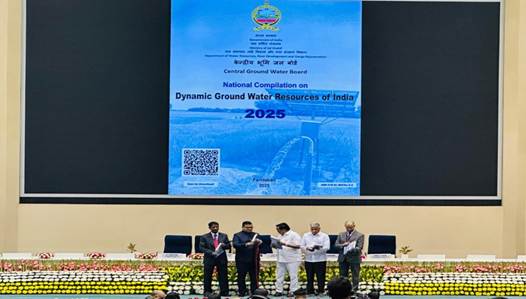
Artificial Recharge Activities
Groundwater augmentation through artificial recharge in identified water stressed areas of Rajasthan,comprising Jodhpur, Jaisalmer, Alwar, Jhunjhunu & Sikar districts of Rajasthan has been taken up in three phases under the GWMR Scheme
- Phase-1: Two large dams have been constructed :
- Zoned Earth Fill Dam with Clay Core, Indroka, Mandore, Jodhpur
- Concrete Gravity Dam, Bastawa Mata, Balesar, Jodhpur.
- Phase 2: 83 WHS (Stone Masonary Check Dams (MCD), Anicuts, Concrete Check Dams (CCD & Recharge shafts) have been constructed in certain water stressed blocks of Jodhpur, Jaisalmer and Sikar district.
- Phase 3: 49 WHS (Check Dam, Anicut, Model Talab) have been constructed in certain water stressed blocks in Jodhpur, Jaisalmer, Sikar, Jhunjhunu and Alwar districts of Rajasthan for augmenting groundwater resources.
AR project in Kala Amb Valley, Sirmaur District, HP:
- 07 Check Dams and 12 Recharge well in Kala Amb Valley, Sirmaur district, H.P proposed and tendering process in progress.
Aquifer Management for Augmentation and Sustainability of Urban Water Supply- Faridabad
CGWB had undertaken a study on augmentation of water supply to Faridabad city through sustainable groundwater development in the active Yamuna floodplain, as per the Memorandum of Understanding (MoU) signed between CGWB and the Faridabad Metropolitan Development Authority (FMDA).
After detailed field investigations, data analysis, and interpretation, a comprehensive report in line with the objectives of the MoA was prepared by CGWB during AAP 2024-25. The report, including detailed management strategies, was shared with the Chief Executive Officer (CEO), Shri Shyamal Mishra, on 27.05.2025 for implementation. Considering the concerns related to groundwater in the study area, the MoA has been extended for a further period of two years for detailed investigation and refinement of the proposed management strategies
Leveraging advanced technologies for improving NAQUIM studies
Central Ground Water Board has signed a MoU with Space Application Centre (SAC), Ahmedabad to promote application of remote sensing in NAQUIM studies on 10th July 2025.
Ground Water Quality Analysis
The comprehensive assessment of Ground Water Quality conducted by the Central Ground Water Board (CGWB) provides valuable insights that can guide remedial actions and inform future planning by various stakeholders. The Union Minister of Jal Shakti, Shri C.R. Patil, released the Annual Ground Water Quality Report–2025 on 18 November 2025 during the 6th National Water Awards held at Vigyan Bhawan, New Delhi. The report presents a comprehensive nationwide assessment of groundwater quality based on the Standard Operating Procedure (SOP) adopted by CGWB in 2023. The report evaluates a broad spectrum of inorganic water quality parameters relevant to drinking and agricultural use. These include major physico-chemical parameters—Ca²⁺, Mg²⁺, Na⁺, K⁺, Total Hardness, CO₃²⁻, HCO₃⁻, Cl⁻, SO₄²⁻, F⁻, PO₄³⁻, and NO₃⁻—as well as key trace elements such as Arsenic (As), Iron (Fe), Manganese (Mn), Zinc (Zn), Copper (Cu), Uranium (U) and Lead (Pb).
Key Highlights:
- Some regions face sporadic contamination of nitrates, fluoride, and arsenic.
- 94.3% of groundwater samples are classified as excellent for irrigation based on Sodium Adsorption Ratio indices.
- Monsoon recharge showed mixed effects—improving water quality in some areas while increasing concentrations in others, depending on local aquifer conditions and contamination levels.
- CGWB conducted detailed hotspot studies at 340 locations for Arsenic, Uranium, Nitrate, Electrical Conductivity and Fluoride, assessing contaminant spread through 2 km × 2 km grid sampling.
- CGWB issues fortnightly Groundwater Quality Alerts to States and concerned agencies to facilitate early action, public health protection, and rapid response to contamination events.
- The report also discusses mitigation measures for arsenic, fluoride, nitrate and other key contaminants.
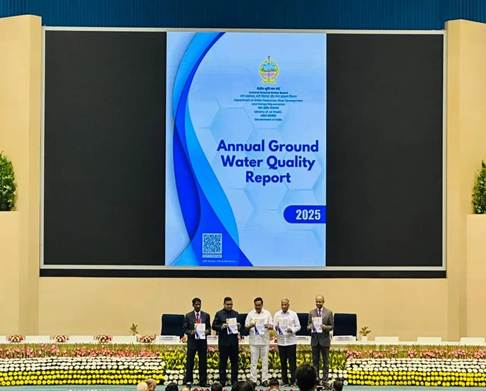
Regulation of Ground Water extraction
- The primary role of Central Ground Water Authority (CGWA) is to regulate groundwater resource exploitation in the country. The Authority has been regulating groundwater development and management by way of issuing ‘No Objection Certificates’ for groundwater extraction to industries, infrastructure projects, Mining Projects, registration of drilling rigs etc., as per the notified guidelines in this connection.
- Development of a new portal for NoC issuance to ground water users i.e. BhuNeer APP, which is an advanced version of the application processing software of CGWA for issuing NOC to ground water users of Industries, Infrastructure & Mining projects and Bulk Water Supply. The motto of developing this portal is to provide users a smooth experience with new features and functionalities.
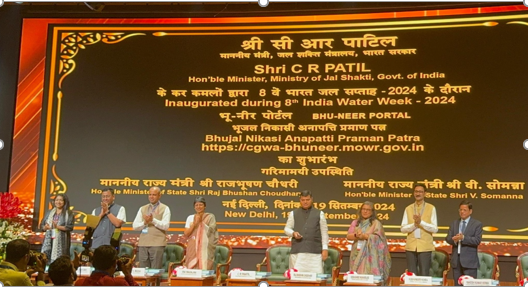

- CGWA continued to evaluate applications received from Industries/ Infrastructure Units / Mining Projects for grant of NOC for groundwater withdrawal as per provisions of the notified guidelines. During the year 2025, total 4294 applications were received for Fresh NOC/ Renewal of NOC. Out of which 3616 NOCs/ Renewal of NOCs were issued. In addition, a total of 8221 NOCs are issued in exempted category. A total of 994 applications were rejected. As per requirement for processing of NOCs, total 65 Meetings of Expert Appraisal Committees (Internal/ External) were held during this period.
Rajiv Gandhi National Ground Water Training & Research Institute (RGNGWTRI)
Rajiv Gandhi National Ground Water Training & Research Institute (RGNGWTRI) is the training wing of Central Ground Water Board, Department of Water Resources, River Development and Ganga Rejuvenation, Ministry of Jal Shakti, Govt. of India. The institute implements a three-tier training programme [Tier I(National & International level), II(State & District Level), III(Block & Village Level)].
Tier-I training programs are carried out at National Level and International Level from RGNGWTRI itself.
RGNGWTRI started conducting One Year Duration Induction Level Training Courses for the newly recruited Scientific Officers (Group A& B) of CGWB from 2023-24. All the newly recruited officers are joining RGNGWTRI for undergoing the induction training and are then posted to different field formations after successful completion of the training.
The Tier II trainings are conducted in different states through the region offices of CGWB. Objective of such trainings is to enhance the knowledge and technical skills of groundwater professionals and to disseminate the outputs of scientific studies carried out by CGWB. Target group includes professionals from State Government Departments, NGOs, PRIs, Industries and other stakeholders.
The Tier III trainings are conducted at block/village level through the region offices of CGWB. Objective of such trainings is to make the participants aware about Local groundwater issues, basic skills like water level measurement and to disseminate outputs of scientific studies carried out by CGWB. Target group includes farmers, persons from PRIs, RWAs, NGOs, students, and other direct stakeholders.
Major achievements of RGNGWTRI during the period Jan 2025 to Nov 2025
- Trainings and Webinars:
- Tier 1 Training Programs : During the period of January 2025 – November 2025, a total of 63 Tier-I trainings were organized, which were attended by 2165 Participants.
- Tier II Trainings: A total of 10 Tier-II training programs were conducted which were attended by 383 Participants including 152 female participants.
- Tier III Trainings: A total of 32 Tier-III training programs were conducted which were attended by 4103 Participants including 1500 Female participants.
- Collaborative Studies : Under collaborative studies a study on “Developing an Earthquake Early warning system from aquifer responses from Easter Himalayan Regions” was undertaken in collaboration with CGWB-NER, Geological Survey of India and National Centre of Seismology. A Multilateral MoU on this was signed on 10th November 2025.
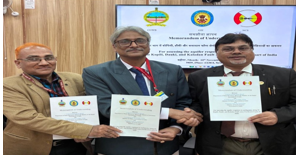
- Publication : As a part of our publication initiatives, the 34th Volume of the Internal Research Journal of Bhujal News was published in November 2025. The 2nd Volume of the Rajbhasa Magazine - Prasikshan Bharti too was published in September 2025.
6. Pradhan Mantri Krishi Sinchayee Yojana (PMKSY)
The Government of India on 27.07.2016 approved funding of the 99 prioritized irrigation projects (and 7 phases) with an estimated balance cost of Rs. 77,595 Crore (Central share- Rs. 31,342 crores; State share- Rs. 46,253 crores) for completion in phases. The works include both the AIBP and CAD works. Funding arrangement for both Central Assistance (CA) and State Share made through NABARD under Long Term Irrigation Fund (LTIF). Targeted Irrigation Potential to be created under the scheme is 34.63 Lakh ha. An expenditure of Rs. 71,724.35 crore (up to March 2025) has been reported to be incurred by the concerned State Governments on these projects since 2016-17. In January 2020, Ministry of Finance conveyed the continuation of ongoing centrally sponsored scheme up-to 31.03.2021.
Physical Progress: Against the target of 34.63 Lakh Ha, Irrigation Potential of about 26.71 Lakh ha. Has been created through AIBP works of the prioritized projects during 2016-17 to 2024-25. The potential created during 2025-26 shall be available only after the end of cropping season.
Project Completed under PMKSY-AIBP: AIBP works of 66 prioritized projects out of identified 99 projects (and 7 phases) were reported to be completed till date.
Implementation of PMKSYAIBP (including CADWM) during 2021-26:
The Government of India has approved implementation of Pradhan Mantri Krishi Sinchayee Yojana (PMKSY) for 2021-26 with an outlay of Rs. 93,068 Crore on date 15-Dec-2021 to benefit about 22 Lakh farmers. The Union Cabinet has approved central support of Rs. 37,454 Crore to States and Rs. 20434.56 Crore of debt servicing for loan availed by Government of India for irrigation development during PMKSY 2016-21. Accelerated Irrigation Benefit Programme, ‘Har Khet Ko Paani’ and watershed irrigation potential creation targeted during 2021-26 under AIBP is 13.88 Lakh hectare along with focused completion of 60 ongoing projects including their 30.23 lakh hectare command area development. 10 additional projects have also been taken up till date. Additionally, two national projects, namely Renukaji Dam Project (Himachal Pradesh) and Lakhwar Multipurpose Project (Uttarakhand) have also been included for central funding of 90% of works of water component under the scheme.
A slew of innovative measures and modification have been made to improve implementation and maximize benefits, such as:
- Inclusion of new major/medium (MMI) projects as well as funding of National Projects under AIBP.
- Financial progress requirement is dropped for inclusion of a project under AIBP, and only physical progress of 50% to be considered.
- Advanced stage (50% physical progress) criteria are relaxed for projects having command area and 50% or more in drought Prone Area Programme (DPAP), tribal, Desert Development Programme (DDP), Flood prone, Tribal area, left wing extremism affected area, Koraput, Balangir and Kalahandi region of Madhya Pradesh and Uttar Pradesh, as also for Extension Renovation Modernization (ERM) projects and also for States with net irrigation below national average.
- Reimbursement is allowed for due central assistance in subsequent year also.
- Project completion permitted with physical progress of 90% or more.
- Online Management Information System (MIS) has been developed for monitoring of the projects. A nodal officer for each of the 99 priority projects has been identified who updates the physical and financial progress of the project regularly in the MIS.
- GIS based Application has been developed for geo-tagging of project components. Remote Sensing Techniques have been used for digitization of the canal network of the projects. Further, the Cropped Area Estimation in the command of 99 priority projects is being carried out annually through remote sensing.
- To resolve the issue of Land Acquisition (LA) and increase water conveyance efficiency, use of Underground Pipeline (UGPL) has been actively promoted. Guidelines for Planning and Design of Piped Irrigation Network were released by this Ministry in July, 2017.
- Pari-passu implementation of Command area development works in the commands of these projects is envisaged to ensure that the irrigation Potential Created could be utilized by the farmers.
- New Guidelines bringing focus on Participatory Irrigation Management (PIM) have been brought out.
- Further, transfer of control and management of irrigation system to the Water users’ Association (WUA) has been made necessary condition for the acceptance of CADWM completion.
The Financial Progress under PMKSY-AIBP is as follows:
|
Funds Released
|
2016-17 to 2024-25
|
2025-26 (so far)
|
Total
|
|
Central Assistance for AIBP projects
including special & National Projects
|
20,009.44
|
997
|
21,006.44
|
|
State Share
|
35,106.29
|
0
|
35,106.29
|
|
Total
|
55,115.73
|
997
|
56,112.73
|
Special Package for Maharashtra: A Special Package approved on 18.07.2018 which provides Central Assistance (CA) to complete 83 Surface Minor Irrigation (SMI) projects and 8 Major / Medium Irrigation Projects in drought prone districts in Vidarbha and Marathwada and rest of Maharashtra in phases up to 2023-24 (extended till March-25). The overall balance cost of the said projects as on 1.4.2018 is estimated to be Rs. 13651.61 crore. Total CA is estimated to be Rs. 3831.41 Crore including reimbursement for expenditure during 2017-18. Balance potential of 3.77 Lakh Ha would be created on completion of these schemes. CA of Rs. 3023.95 crores have been released under the scheme so far.
Under the scheme, 67 SMI and 3 MMI projects have been reported to be completed by the State Government of Maharashtra. Overall irrigation potential or 2.16 Lakh ha. has been reported to be created through all these projects during 2019-19 to 2024-25. Further potential created during 2025-26 shall be available only after the end of cropping season.
7. Atal Bhujal Yojana (Atal Jal)
The Atal Bhujal Yojana (Atal Jal) was conceived as a pilot scheme for participatory groundwater management, implemented in seven States viz. Gujarat, Haryana, Karnataka, Madhya Pradesh, Maharashtra, Rajasthan, and Uttar Pradesh for a period of five years from 1st April 2020. After slight extension, the Scheme’s tenure has now ended.
The Scheme marked a paradigm shift from groundwater development to groundwater management, emphasizing a community-based approach. Its salient features included participatory groundwater monitoring, public disclosure of groundwater data, preparation and implementation of Gram Panchayat (GP)-level Water Security Plans (WSPs), capacity building, and targeted Information, Education and Communication (IEC) activities.
Atal Jal was the first Central Sector Scheme to focus primarily on demand-side interventions for groundwater conservation. The GP-level WSPs, containing detailed water budgets and proposals for both demand- and supply-side interventions, were implemented through convergence with ongoing schemes.
Demand-side measures included micro-irrigation, crop diversification, and piped water conveyance.
Supply-side measures included construction of check dams, farm ponds, recharge shafts, and other artificial recharge and water conservation structures.
Atal Bhujal Yojana substantially improved the capacity of States for ground water governance through strengthening of institutions dealing with ground water management, improving ground water monitoring networks, creation of awareness among the public on the importance and criticality of ground water resources and building the capacity of the grass root level stakeholders to plan and utilize the available resources in a judicious manner. It also successfully addressed the gender perspective by including large number of women in all activities of the scheme.
Key Achievements
Public disclosure of groundwater data in all Atal Jal GPs through various mode viz. central and state web portals, display board at each GP, social media, wall paintings, brochures, public meetings, and the Atal Jal mobile application.
Innovative information dissemination mechanisms adopted by States, including Groundwater Data Information Dissemination Centers, QR codes, and social media platforms.
Community-led Water Budgets and WSPs prepared for all 8,203 GPs and updated annually.
Strengthened groundwater monitoring systems at the GP level with installation of Digital Water Level Recorders, water level indicators, rain gauges, water quality testing kits, and flow meters. Piezometers were also constructed for regular water level monitoring.
Extensive capacity-building efforts: More than 1.27 lakh GP-level trainings, along with 95 state-level, 576 district-level, and 1,307 block-level training sessions conducted.
Interactive learning sessions through ‘Water Games’, training through Satellite Communication (SATCOM) covering a vast geographic area in Karnataka, mass awareness on Water Security Planning (WSP) through live broadcasts ‘Vande Gujarat’ making groundwater knowledge accessible, relatable, and scalable even in remote rural areas
Innovative IEC campaigns carried out across States, including narrowcasting in Haryana, delivering educational content through folk performances in Karnataka, Jal Dindis in Maharashtra, and Ratri Choupals in Rajasthan to promote sustainable groundwater management.
Convergence expenditure of over Rs. 4,730 crore achieved towards implementation of WSP interventions.
About 9 lakh hectares brought under efficient water-use practices such as drip, sprinkler, underground pipeline irrigation, mulching, crop diversification, direct seeded rice, zero tillage practice etc., directly benefitting more than 10 lakh farmers
Monitoring of around 70,000 wells at GP level, with data shared publicly.
Mapping of over 90,000 existing water conservation and artificial recharge structures.
Improvement in groundwater levels observed in 4665 GPs across 180 blocks.
Financial progress: Since inception, a total of Rs. 3,524.34 Crore has been released to the States, of which Rs. 3,505.57 (99.5%) Crore has been utilized.
8. Minor Irrigation Statistics: Progress under the scheme “Irrigation Census”
1. Background
"Irrigation Census" is a centrally sponsored scheme with 100% Central funding through which State Statistical Cells constituted under different States/UTs are also supported. Under this scheme, Minor Irrigation (MI) Census, Census of Water Bodies, Census of Springs and Census of Major & Medium Irrigation (MMI) projects are conducted. The broad objectives of scheme are as follows:
- To build up a comprehensive and reliable database in the irrigation and water sector for effective planning and policymaking including water use efficiency, water budgeting etc.
- To provide statistical frame of irrigation schemes/ waterbodies/ spring for carrying out future surveys.
- To build a national level database of Major and Medium Irrigation Projects since water resources projects are planned, formulated, implemented and maintained by the State Governments.
2. Chronology
- So far, six censuses have been conducted with reference years 1986-87, 1993-94, 2000-01, 2006-07, 2013-14 and 2017-18 respectively.
- The First Census of Water Bodies was conducted in the States/UTs along with Sixth Minor Irrigation Census with reference year 2017-18.
- The scope of Irrigation census scheme has been enlarged by including st Census of Springs and 1st Census of Major & Medium Irrigation (MMI) projects along with 7th Minor Irrigation (MI) Census and 2nd Census of Water Bodies with Reference year 2023-24. The field work of these censuses is progressing in States/UTs.
3. Brief on census
- Minor Irrigation (MI) Census: The MI census is covering all ground water and surface water schemes which are mostly under private ownership with Culturable Command Area up to 2000 ha. In this census, detailed information on various parameters like irrigation sources (dug well, shallow tube well, medium tube well, deep tube well, surface flow and surface lift schemes), irrigation potential created (IPC), potential utilized (IPU), ownership, holding size of land by owner, devices used for lifting water, sources of energy, energy conserving devices such as sprinkler and drip irrigation, use of non-conventional energy sources such as solar pumps, wind mills etc is collected.
- Census of Water Bodies: The census inter-alia collects information on all important aspects like type of water body, ownership, condition, cost of construction, status of encroachments, use, storage capacity, status of filling up of storage etc. The census covers rural as well as urban areas and also takes into account all types of uses of Water Bodies like Irrigation, Industry, Pisciculture, Domestic/ Drinking, Recreation, Religious purpose, Ground Water Recharge and other uses. In this census, all natural or man-made units bounded on all sides with some or no masonry work used for storing water for irrigation or other purposes (e.g. industrial, pisciculture, domestic/drinking, recreation, religious, ground water recharge etc.) will be treated as water bodies.
- Census of Springs: A spring is a focused discharge of naturally occurring groundwater on the Earth's surface. In general springs can be seen either as a free flow or seep spring. The spring census inter-alia collects information on type and nature of Spring, discharge of water, colour/smell/ taste/temperature/usage of spring water etc
- Census of Major & Medium Irrigation (MMI) projects: This Census is the complete enumeration of all completed as well as ongoing Major & Medium irrigation projects of India. A scheme having Culturable Command Area more than 10000 hectares (CCA>10,000 ha) are classified as Major Irrigation Project and those schemes having CCA more than 2,000 ha and up to 10,000 Ha are classified as Medium Irrigation Projects. In MMI census, information like nature of project, gross command area, culturable command area, irrigation potential created, irrigation potential utilized, location, design features of project, status of Water User Associations etc is collected.
4. Key features of 7th Minor Irrigation (MI) Census, 2nd Census of Water Bodies, 1st Census of Springs and 1st Census of Major & Medium Irrigation (MMI) projects
- Paperless and end to end digital solution:
- Mobile application for data collection and
- Web application for management and validation processes
- Ground truthing of data on 3.58 million wetlands/water bodies generated by Space Application Centre (SAC) using multi-date and multi-seasonal Resourcesat-2/2A LISS-IV datasets of 2018-19 timeframe.
- Recording Latitude, Longitude and images of all schemes
- Pre-population of previous census data (th MI and 1st Water body Census) using LGD codes in the mobile application during data collection
- Use of reverse GIS technology for ensuring accurate recording of Latitude/Longitude of all scheme wherever village boundaries are available
5. Progress under "Irrigation Census" during 2025
Launch of four censuses namely, 7th Minor Irrigation (MI) census, 2nd census of water bodies, 1st census of Major & Medium Irrigation (MMI) projects and 1st census of Springs by Hon'ble Minister of Jal Shakti on 03.04.2025. The filed work of the censuses is underway in States/UTs.
9. Flood Management Wing (FM)
Flood Management and Border Areas Programme (FMBAP):
The “Flood Management Programme"(FMP) and “River Management Activities and Works related to Border Areas" (RMBA) under operation during XII Five Year Plan were merged as "Flood Management and Border Areas Programme" (FMBAP) for the period 2017-18 to 2019-20 and further extended up-to March, 2021. Cabinet further approved the continuation of FMBAP scheme during 2021-22 to 2025-26 with an outlay of Rs. 4100 Crore (FMP-Rs. 2940 Crore and RMBA – Rs. 1160 Crore).
Since the inception of FMBAP (till March 2025), Central Assistance of Rs. 7260.50 crores have been released to States/UTs under FMP component of Flood Management & Border Area Programme (FMBAP) scheme and Central Assistance of Rs. 1477.15 crores have been released to UTs/States under RMBA component of FMBAP scheme.
Completion of balance works of North Koel Reservoir Project:
DoWR, RD & GR has taken up the long pending project for completion of balance works of North Koel Reservoir Project, Bihar and Jharkhand. In August, 2017 the Union Cabinet has approved the proposal for balance works of North Koel Reservoir Project at an estimated cost of Rs. 1622.27 crore during three financial years from the start of the project. Subsequently, at the request of both State Governments, certain other components were found necessary to be included in the project. Complete lining of Right Main Canal (RMC) and Left Main Canal (LMC) was also regarded essential from technical considerations to derive envisaged irrigation potential. Thus, the works of Gaya distribution system, lining of RMC and LMC, remodeling of enroute structures, construction of a few new structures and one-time Special Package for R&R of Project Affected Families (PAFs) were to be provided in the updated cost estimate.
Accordingly, Revised Cost Estimate of the project was prepared. Out of the cost of balance works of Rs. 2430.76 crore, the Central would provide Rs.1836.41 crore. The Cabinet Committee on Economic Affairs (CCEA) has given its approval to the proposal to complete the balance works of North Koel Reservoir Project at a revised Cost of Rs. 2,430.76 crore on 04.10.2023. Project will provide irrigation benefit to 114,021 hectares of land annually in drought prone areas of Aurangabad and Gaya districts of Bihar and Palamau and Garwa districts of Jharkhand. CCEA also approved the execution of balance works of the project on turnkey basis by M/s WAPCOS Ltd., a CPSU under DoWR, RD & GR as Project Management Consultant (PMC). 10% works on dam & appurtenant, 100% works of Mohammad Ganj barrage, 86% works on Left Main Canal, 67% work on LMC distribution (Kandi distributary) and 38% works on Right Main Canal (Jharkhand Portion from Ch. 0.00 to 31.40 Km), 45% works on Right Main Canal (Bihar Portion from Ch. 31.40 to 68.37 Km) and 15% works on Right Main Canal (Bihar Portion from 75.39 Km to 109.09 Km) have been completed.
10. National River Conservation Directorate (NRCD)
Cleaning of river is a continuous process and Government of India is supplementing the efforts of the State Governments in addressing the challenges of pollution of river by providing financial and technical assistance. Assistance is provided to State Government for abatement of pollution in identified stretches of various rivers (excluding river Ganga and its tributaries) under the Centrally Sponsored Scheme of National River Conservation Plan (NRCP) on cost sharing basis between the Central & State Government for taking up various pollution abatement works relating to interception & Diversion of raw sewage, constructions of sewerage system, setting up of sewage treatment plants, low cost sanitation, river front/bathing ghat development, etc.
Schemes taken-up under NRCP programme are aimed primarily at reduction in pollution load in rivers. Apart from improvement in water quality of rivers leading to better public health and ecology of the river systems, the pollution abatement works taken up under NRCP help to improve the aesthetics & sanitation in the towns and in maintaining a cleaner environment.
The objective of National River Conservation Plan (NRCP) is to improve water quality of rivers except Ganga and its tributaries, to the prescribed standards by reducing pollution load entering the rivers through implementation of pollution abatement works in various towns mainly along identified polluted stretches of rivers in the country along with controlling of their sources of pollution such as Industrial through Central Pollution Control Board/ State Pollution Control Board/Pollution Control Committee.
Achievements and initiatives under NRCD (01.01.2025 – 31.10.2025)
- The project ‘Rehabilitation of the Sewerage System of Singtam Town for Pollution Abatement of River Tista in Sikkim’ has been sanctioned at an estimated cost of Rs. 39.03 crore. which includes creation of sewage treatment capacity of 3 mld along with allied sewerage works.
- Central Assistance amounting to Rs.595 crore released to various State Governments/Agencies for implementation of projects under NRCP.
- Subsequent to the introduction of NRCP SNA SPARSH, all the SLS have been mapped and 14 Mother Sanctions have been issued, releasing an amount of Rs. 80 crore to the State/UTs Government for the implementation of pollution abatement schemes under NRCP.
- Second Meeting of the Stakeholder Advisory Committee (SAC) was held on 26.09.2025 under the Chairmanship of Secretary, DoWR, RD&GR at Indian Institute of Science (IISc), Bengaluru, Karnataka under the project Condition Assessment and Management Plan (CAMP) of Six Rivers Basin (Cauvery, Periyar, Narmada, Mahanadi, Godavari and Krishna).
- Under the Condition Assessment and Management Plan (CAMP) project Consortium Institutes have submitted the target deliverables during the period.
- Two Central Monitoring Committee meetings for review of action plans implementation for restoration of identified polluted river stretches across all States/UT in the country have been held under the Chairmanship of Secretary, DoWR, RD & GR.
- One review meeting for the project of ‘Pollution abatement and conservation of River Nag at Nagpur, Maharashtra’ sanctioned at a cost of Rs.1,926.99 crore with Japan International Cooperation Agency has been held under the chairmanship of Hon'ble Minister of Jal Shakti on 10.09.2025. In addition, review meetings of the ongoing projects are held from time to time, at the level of Secretary, DoWR, RD & GR / Project Director, NRCD/Joint Secretary, NRCD. Besides, Two Project Steering Committee meetings have been held at the level of Project Director, NRCD for the JICA (Japan International Cooperation Agency) assisted project for pollution abatement of Mula-Mutha river at Pune sanctioned for Rs. 990.26 crore, which includes creation of sewage treatment capacity of 396 mld along with allied sewerage works.
- The project “Assessment of ecological status of 7 rivers viz. Narmada, Mahanadi, Godavari, Cauvery, Periyar, Pamba and Barak for conservation planning” has been entrusted to Wild Life Institute of India (WII) at a sanctioned cost of Rs. 24.56 crore in September, 2020. The project broadly aims to spearhead river conservation in above seven Indian rivers for biodiversity conservation and maintenance of ecosystem services. WII has completed the ecological assessment of River Narmada and Mahanadi. Draft assessment report has also been prepared for river Cauvery and Pamba.
- Following stakeholder Consultation Workshop on Guidelines for National River Conservation Plan and DPR Preparation held on 06th May, 2024 in the presence of Secretary, DoWR, RD & GR, the existing guidelines for the NRCP have been comprehensively revised to reflect current requirements and improvements, and the updated version is presently in the approval stage.
- Under the ongoing technical cooperation project ‘Capacity Enhancement for Management of Sewage Sludge (Bio-Solids) in India’ supported by the Government of Japan, the JICA expert team has completed and finalized the draft guidelines for the effective disposal and management of sewage sludge. To ensure wider awareness and stakeholder engagement, the finalized guidelines were disseminated through four zonal workshops organized across the country in April and May 2025.
- Pollution Abatement of River Mula–Mutha, Pune, Maharashtra, and the project “Pollution Abatement and Conservation of River Zuari, Goa”: Construction of sewage treatment infrastructure has achieved 85% completion against the annual target.
11. External Affairs and International Cooperation (EA & IC)
DoWR, RD & GR has signed Memorandum of Understandings (MoUs) with different countries on cooperation in the field of water resources management and development. For effective implementation of activities under the various signed MoUs, to enhance the collaboration under the MoU, certain activities were undertaken, the details of which is as following: -
- MoC with Nepal: A Memorandum of Understanding (MoU) between India and Nepal was signed on 03.03.2025 for a period of five years by Hon'ble Ministers of both sides. The MoU covers cooperation in groundwater monitoring and management, artificial recharge, rainwater harvesting, aquifer mapping, sharing of best practices from India’s Clean India Mission, technical support and training for Nepali personnel, and assistance for developmental projects in Nepal’s Water, Sanitation and Hygiene (WASH) sector.
The first Joint Working Group meeting under the MoU was held on 20.06.2025. Both sides reaffirmed their commitment to strengthening bilateral cooperation in the WASH sector under the framework of the MoU between India and Nepal. Nepal acknowledged the relevance of India’s initiatives and models and sought technical and institutional support in priority areas such as arsenic mitigation, aquifer mapping, groundwater recharge, check dam design, faecal sludge management, adopting ODF+ sustainability models, and capacity building using the Training of Trainers (ToT) approach. India agreed in principle to support these areas and emphasized the importance of identifying priority actions to move the collaboration forward.
It was agreed that Nepal would share detailed proposals outlining its requirements for further deliberation. The Indian side supported the proposal for expert visits to Nepal for on-ground assessment and also encouraged continued engagements through virtual discussions. Opportunities to frame small grant- based projects under High Impact Community Development Projects (HICDPs) were highlighted, alongside collaboration in capacity building through Indian institutions such as NIH, NWDA and CGWB. The meeting concluded with mutual appreciation and a shared commitment to continued partnership for sustainable WASH development.
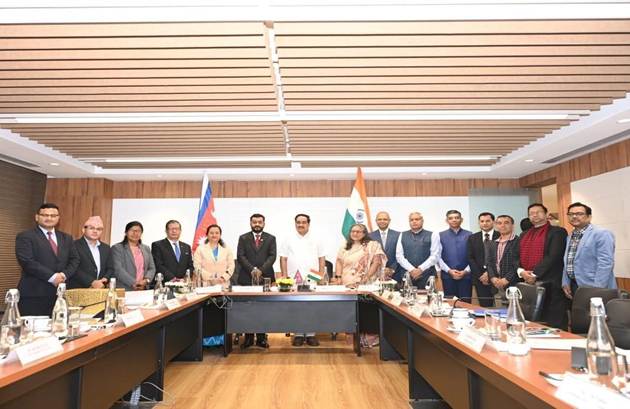
- MoC with Japan (DDWM): The Memorandum of Cooperation (MoC) between India and Japan was signed on 19.03.2022 in the area of Water Resources for two years and had expired on 19.03.2024. The MoU has been renewed and signed on 20.08.2025 for a further period of 2 years.
- MoU with Morocco: The MoU between India and Morocco on cooperation in the field of water resources was signed on 14.12.2017, and four JWG meetings were subsequently held on 03.07.2018, 18.06.2019, 13.07.2021, and 20.09.2024. The 5th JWG meeting was held in Morocco on 05.06.2025, during which both sides identified priority areas for collaboration such as dam management, extreme events, irrigation governance, and capacity building. They also agreed to enhance exchange of expertise, explore training opportunities for water professionals, and further strengthen cooperation under the MoU. It was mutually agreed that the 6th JWG meeting will be held in India in February–March 2026, with dates to be finalized through diplomatic channels.
- MoU with the Netherlands: The MoU between India and the Netherlands was signed on 27.06.2017 for cooperation in the field of Water Management. This existing MoU was replaced with "STRATEGIC PARTNERSHIP ON WATER (SPW) document signed between India - Netherlands on 29.03.2022". A Centre of Excellence (CoE) has been established at IIT Delhi by NMCG in collaboration with the Netherlands, based on a jointly developed concept note modeled on the Smart Lab on Clean Rivers at IIT-BHU, Varanasi. The concept note was approved by the Secretary, DoWR, RD & GR in the presence of the Ambassador of the Netherlands on 21 March 2025, and the proposal received approval in the 61st Executive Committee meeting of NMCG.
The first meeting of the Project Review Committee (PRC) for the CoE was held at NMCG on 09 September 2025. The PRC gave in-principle approval to the Digital Twin proposal and recommended expanding its scope to address broader Namami Gange themes such as flood prediction, river flow assessment, and river morphology. It advised involving relevant end-users early, incorporating climate change projections, and reviewing past studies by institutions like CWC and CGWB.
12. Brahmaputra & Barak (B&B) Wing
Achievements of the Brahmaputra Board
1. Preparation and Updation of Master Plans
The Brahmaputra Board continued its mandate of preparing comprehensive master plans for flood control, erosion mitigation, and integrated basin management in the North-Eastern Region.
1.1 Master Plans Undertaken (New/Continuing)
Preparation of following master plans continued during 2025:
1.2 Updation of approved Master Plans continued during 2025:
The Board continued updating master plans for:
- Tripura: Haora, Muhuri, Gumti
1.3 The European Union has initiated preparation of a comprehensive master plan for the entire Barak Basin, including tributaries from Meghalaya.
1.4 Following special studies continued during 2025:
- Study on soil erosion & flood problem in Barak Basin by NIT Silchar- Completed
- Sedimentation study on Siang & Dibang Basin by IIT Guwahati
- Comprehensive assessment of riverbank erosion and prioritization of mitigation strategies for the Brahmaputra River Basin by IIT Guwahati
- Formulation of policy for riverine islands by INTAC
2. Scientific Dissemination and Water Management Practices
2.1 Indigenous Water Management Systems
- Improvement of “Dong” water management system of the Bodo tribes in Baksa district, Assam, is underway.
- Development of three-tier farming system for augmentation of water resources in Choumoukedima & Peren Districts of Nagaland
3. Springshed Management Initiatives are taken up for a sustainable and climate resilient source of water in lean season for the springs under stress.
Execution continued during 2025:
- Mizoram: Dakla and Dialdawk
4. Bio-Engineering Measures for Flood and Erosion Control
- A major pilot project for riverbank erosion protection at Kordoiguri, Majuli Island, initiated in 2022–23, was completed in 2024–25. Performance evaluation was carried out by Guwahati University.
5. Anti-Erosion and Flood Management Schemes
5.1 Arunachal Pradesh Schemes
- Mirem, Miglung & Remi Villages (East Siang): Completed in March 2025 with expenditure of Rs. 18.90 crore ; protects 260 ha and 2,705 people.
- Oyan & Sile Villages (East Siang): completed in 2025–26 at a cost of ₹16.67 crore; protects 315 ha and 2,534 people.
5.2 Assam Schemes
- Neamatighat (Jorhat): Scheme of ₹22.93 crore; work foreclosed after 70.23% progress with expenditure of ₹13.11 crore (2025–26). Will protect 293.8 ha and 10,000 people.
6. Rejuvenation of NEHARI (North Eastern Hydraulic and Allied Research Institute)
Capacity Building Programmes during 2025:
As per expanded mandate to NEHARI by Ministry for capacity building of Engineers and officers of North eastern Region, NEHARI organized training programmes in following subjects in collaboration with NIH, CGWB, IIT Guwahati, NWA Pune, NESAC, CWPRS Pune, and CSMRS New Delhi.
|
Soil investigation for river engineering
|
Flood Management
|
Source Sustainability (JJM)
|
|
Project management & quality control
|
Model Study
|
Springshed Management
|
|
BRAHMA Model by IIT Guwahati
|
DPR Prep (Theory)
|
Project Management (Theory)
|
|
GIS & Remote Sensing
|
E-Procurement / GeM
|
Flood Plain Zoning & EAMS
|
North – East Division
- INDIA-CHINA COOPERATION
Expert Level Mechanism (ELM)
During the visit of the Hon’ble President of the People’s Republic of China to India on November 20-23, 2006, it was agreed to set up an Expert-Level Mechanism to discuss interaction and cooperation on provision of flood season hydrological data, emergency management and other issues regarding trans- border Rivers as agreed between them. Accordingly, the two sides have set up the Joint Expert Level Mechanism through a Joint Declaration by both the countries.
The ELM meetings are held alternately in India and China every year. Sixteen meetings of ELM have been held so far. The 16th meeting of ELM was held at New Delhi, India during 22nd – 23rd April, 2025. The GoI delegation was led by Shri S.K. Sinha, Commissioner (B&B), DoWR, RD & GR, Ministry of Jal Shakti and the Chinese delegation was led by Mr. Hao Zhao, Director General of the International Economic & Technical Cooperation and Exchange Centre, Ministry of Water Resources, People’s Republic of China. Representatives of Ministry of External Affairs (MEA), Central Electricity Authority (CEA) and Central Water Commission (CWC) had also participated in the meeting.
- INDIA-BHUTAN COOPERATION
- Joint Group of Expert (JGE) on Flood Management:
A Joint Group of Expert (JGE) on Flood Management has been constituted between India and Bhutan to discuss and assess the probable causes and effects of the recurring floods and erosion in the southern foothills of Bhutan and adjoining plains in India and recommend to both Governments appropriate and mutually acceptable remedial measures. Eleven meetings of JGE have been held so far. The 11th meeting was held at Paro, Bhutan during 14-15 May 2025. The GoI delegation was led by Shri S. K. Sinha, Commissioner (B&B), Department of Water Resources, River Development & Ganga Rejuvenation (DoWR, RD& GR), Ministry of Jal Shakti, GoI and the RGoB delegation was led by Mr. Karma Dupchu, Director, National Centre for Hydrology and Meteorology (NCHM), RGoB.
-
- Joint Technical Team (JTT) on Flood Management:
In accordance with the decision taken during the first meeting of JGE, a Joint Technical Team (JTT) on Flood Management between the two countries was constituted. The purpose of JTT is to assess the field situation and provide technical support to JGE on flood management. Eight meetings of JTT have been held so far. The 8th meeting of JTT was held during 18th–20th November, 2024 at Chalsa, Jalpaigudi, West Bengal. The Indian delegation was led by Shri G.L. Bansal, Chief Engineer, Brahmaputra Basin Organisation (BBO), Central Water Commission, GoI and the Bhutanese delegation was led by Dr. Singay Dorji, Chief of Meteorological Services Division (MSD), National Centre for Hydrology and Meteorology, RGoB.
- Joint Experts Team (JET) on Flood Forecasting:
A Joint Experts (JET) consisting of senior officials from the Government of India and Royal Government of Bhutan (RGoB) continuously reviews the progress and other requirements of a network of 36 hydro-meteorological sites located in the catchments of trans-border rivers Puthimari, Pagladiya, Sankosh, Manas, Raidak, Torsa, Aie and Jaldhaka. So far, JET has met 39 times alternately in India and Bhutan since its reconstitution in 1992 and the last JET meeting i.e. 39th meeting was held at Paro, Bhutan during 8th - 9th October, 2025. The Indian delegation was led by Shri Subhrangshu Biswas, Chief Engineer, Teesta & Bagarathi-Damodar Basin Organisation (T&BDBO), Central Water Commission, GoI and the Bhutanese delegation was led by Mr. Karma Dupchu, Director, National Centre for Hydrology and Meteorology (NCHM), RGoB.
13. NERIWALM
North Eastern Regional Institute of Water and Land Management (NERIWALM) under the Ministry of Jal Shakti continued to serve eight states of the North East India through its mandate of capacity building and skill enhancement in water and land management. During the year 2025 (January to November), the institute organized 60 training programmes benefitting 2259 trainees. 10 Nos. of trainings are planned to organize in the month of December, 2025 which will thus achieve the target of 70 Nos. These training were organized based on the training needs assessment done jointly by NERIWALM & NIH for the 8 states of NE region. Among these are induction training for newly recruited CGWB officials, DPR preparation for Multipurpose projects, RS& GIS application for irrigation command area, advanced techniques in irrigation management, irrigation management in PPP mode, micro irrigation, water quality and multiple cropping and water management which were organized across the NE states.
In research and development, the institute has currently undergoing 14 projects, out which 08 Nos. funded by state and central government department and 06 Nos. by NERIWALM. Key initiatives included the preparation of State-Specific Action Plans for 19 states, comprehensive, study on sustainable development of irrigation sector in Assam, concurrent evaluations of irrigation projects in Assam, LiDAR and bathymetric survey of Tuirial dam, Mizoram , assessment of real economic impact on Indian side during lean season of diversion of Brahmaputra water by China, provision of rainwater harvesting/ water conservation infrastructure at RIPANS, Mizoram, traditional water management practices in Northeast states, livelihood problems and probable lasting solutions for displaced people due to bank erosion in Brahmaputra valley and hydrogeomorphic & social aspects of dam in lower reaches of Ranganadi HPP, Arunachal Pradesh.
NERIWALM’s academic program also attracted overwhelming response and successfully enrolled of 18 students in the M.Tech course on Water Resource Management for 2025-26 session. The entrance examination of 05 seats of Ph.D. scholars is due soon.
The institute further strengthened its credentials by developing 02 (two) e-learning modules viz. Warabandi System and Watershed Management for i-GOT platform.
14. National Hydrology Project (NHP)
National Hydrology Project (NHP), with support from the World Bank, envisages establishing a system for timely and reliable water resources data acquisition, storage, collation and management. It has pan-India coverage with 48 Implementing Agencies (IAs) {12 from Central Government (including 3 fromRiver Basin Organisations) and 36 from States/ UTs}. It will also provide tools and systems for informed decision making for water resources assessment, planning and management. The National Hydrology Project has been approved with an outlay of Rs. 3,679.77 Crore as a Central Sector Scheme with 100% grant to State Governments and Central Implementing Agencies. The project originally had a duration of 8 years from 2016-17 to 2023-24. However, Department of Expenditure, Ministry of Finance has accorded approval for extension of project till Sept-2025 within the same allocation.
Broad objectives of NHP include:
a) To improve the extent, quality, and accessibility of water resources information;
b) To create decision support system for floods and basin level resource assessment/planning; and
c) To strengthen the capacity of targeted water resources professionals and institutions in India.
Under the ongoing NHP, 23562 Real Time Data Acquisition System (RTDAS) surface water and ground water stations have already been installed in the country. Besides, 53 Supervisory Control and Data Acquisition (SCADA) packages have been commissioned; 5667 piezometers constructed; 134 water quality labs were constructed/upgraded/strengthened and put into operation; high-resolution DEMs, CORS network as well as Geoid model have also been developed. Furthermore, Bathymetric surveys of 464 important reservoirs of the country covering 162 BCM have also been taken up under NHP of which 446 surveys have already been completed.
Further 37 State Data Centres /Regional data centres / knowledge centres, etc. have been completed under the ongoing NHP. The need for development & maintenance of appropriate institutional framework both at the Central as well as State level for water resources information system intended for collection, collation and dissemination of the database was given shape in the ongoing NHP. As envisaged in the Cabinet note, the National Water Resources Informatics Centre (NWIC) has been created in 2018 and is now functional. Additionally, the formation of the State Water Informatics Centres for development of respective State Water Resources Information Systems was expedited in the ongoing NHP. Till date 23 SWICs have already been formed with a few more under process. The information system covering hydro-meteorological, hydro-geological, sedimentation, morphological and water quality data is also important in the context of various studies being done under NHP which include IT Applications, Digital Products, geospatial hydro products, etc
15. Farakka Barrage Project
Major achievements:
- Replacement of 11 nos. of Head Regulator gates is in progress.
- Repainting of hoist bridge, gantry cranes of main barrage & Head regulators is in progress.
- Supply of Services of manpower for operation and regulation of all gates of Main Barrage and Head Regulator gates of Farakka Barrage round the clock.
- Annual Maintenance of 108 nos. Main Barrage gates and its Hoist machineries & embedded parts is operational.
- Balance work of fish lock gate is under progress.
- Anti-erosion works at upstream left bank of river Ganga near Shimultola, Atatola & Birnagar area in 11 no. reaches between Ch 20.00 m to Ch 40.00 m and Ch 80.00 m to Ch 220.00 m, Ch 380.00 m to Ch 440.00 m, Ch 500.00 m to Ch 620.00 m and Ch 660.00 m to 740.00 m, Ch 840.00 m to Ch 900.00 m, Ch 980.00 m to 1200.00 m, Ch 1200.00 m to Ch 2420.00 is completed.
- Special repair and renovation of CISF unit Office cum Barrack, CISF Mess, pump rooms, existing boundary walls and construction of new camp office, 3 nos. toilets block at Khejuriaghat is completed.
- Bank protection measures in 1 no. reach on the Downstream Right bank of Farakka Barrage is completed.
- Repair & maintenance of longitudinal drain, cleaning of culverts and cleaning of jungle on the left bank of Feeder Canal is completed.
- Construction of boundary wall near Bay 109 workshop is completed & bedside petrol pump near NH-34 at mouza Srimanatapur, New Farakka is in progress.
- Repairing of Left bank upstream guide bund inspection road from Afflux Bund to stack yard is completed.
- Repairing of guide bund inspection road over the right bank upstream of Farakka Barrage from New Farakka to Ganga Bhawan of NTPC Ltd is completed.
- Decorative lighting, high mast lighting, street lighting have been installed in right guide bund inspection road, internal roads, Gandhi Ghat of FBP to promote Dam Tourism.
- Repairing of Control Room and other beautification works is under progress.
- Repairing of Feeder Canal inspection road in different stretches is in progress.
- Repairs of approach roads at different regulators is completed.
- Repair/ renovation of different CISF outpost is under progress.
- Renovation of warehouse to convert into DGR Security Barracks is completed.
- Special repair/renovation of office building (OB) no -1 & 2 for division office (part) is completed and OB no -2 CISF Barrack is under progress.
- Special repair of gallery and painting of stadium in FBP Township is in progress.
- Renovation of Children Park at FBP Township is completed.
- Identification, Demarcation and Mutation of FBP Land as per acquisition plan/LR Mouza map of the whole area alignment/ perimeter alignment in all stretches of FBP is in progress.
- Second phase of supply, installation, testing & commissioning of CCTV Surveillance system for Farakka Barrage Township is completed.
- The installation of LAN, along with the supply of hardware and internet, at Farakka Barrage Project is completed and is now fully operational.
- The implementation of e-office at FBP is in advance stage, streamlining administrative processes and enhancing efficiency, transparency, and digital governance.
- The Dam Safety Unit (DSU) is created as per Dam Safety Act 2021.
- Dedicated Social Media Executive / social media Handler for handling the official social media platforms of FBP is engaged and official social media platforms are fully active.
16. Central Water & Power Research Station (CWPRS)
The Central Water and Power Research Station (CWPRS), Pune, established in 1916 is the leading national hydraulic research institute under the Ministry of Jal Shakti, Department of Water Resources, River Development and Ganga Rejuvenation (MoJS, DoWR, RD&GR), New Delhi. CWPRS is the principal central agency to cater to the research and development (R&D) needs of hydraulics and allied disciplines for evolving safe and economical designs of hydraulic structures involved in water resources projects, river engineering, power generation and coastal engineering projects. The research activities at CWPRS can be grouped into seven major disciplines as listed below.
- River Engineering: River Engineering mainly deals with river training and bank protection works, hydraulic design of barrages and bridges, and location and design of water intakes using morphological studies. Field studies for measuring water and sediment discharge in rivers and canals are also conducted.
- River and Reservoir Systems Modelling: Hydrologic and meteorological studies are conducted to estimate extreme values of various parameters such as rainfall, temperature and humidity. Flood estimation and forecast, reservoir sedimentation and water quality studies are carried out using mathematical models and field surveys.
- Reservoir and Appurtenant Structures: Spillways and Energy Dissipators are studied on physical models. Water conductor systems including head race and tail race channels/tunnels and surge shafts are studied on both physical and mathematical models. Studies are carried out on physical models for desilting basins, sedimentation and flushing through reservoirs, sediment exclusion devices. Sedimentation in reservoirs is also assessed through remote sensing.
- Coastal and Offshore Engineering: This discipline deals with optimization of location, length and alignment of breakwaters, jetties, berths, approach channel, turning circle etc. for development of ports and harbours. Estimation of siltation in harbours, their disposal and sand bypassing, location of sand trap and hot water recirculation studies are carried out using both physical and mathematical models. Suggesting suitable coastal protection measures based on locally available materials is an important activity of the group.
- Foundation and Structures: Laboratory and field tests are carried out to determine soil, rock and concrete properties. Mathematical modelling as well as experimental studies are conducted for studying the stability and structural safety of dams and appurtenant structures. Field studies are carried out for assessing the health of hydraulic structures and suggesting suitable repairing measures.
- Applied Earth Sciences: Seismic surveillance of river-valley projects, assessment of site-specific design seismic parameters, controlled blasting studies for civil engineering construction sites, evaluation of quality of concrete and masonry is done by non-destructive methods and estimation of elastic properties for foundation of massive structures for geophysical methods are the main activities of this group.
- Instrumentation, Calibration and Testing Facilities: Hydraulic Instrumentation is used for data collection on physical hydraulic models. Field data collection is carried out on coastal parameters like water level, velocity, waveheight etc. A Random Sea Wave Generation (RSWG) system is used for wave flumes and basins. Dam instrumentation is provided on prototype. Current meter and flow meter calibration facilities are also available, which are used extensively.
The significant contributions of CWPRS during the year 2025 (Upto 25th November) include:
- 133 Technical reports were published on the various significant studies of carried out.
- 57 Research Papers published in various National/International Conferences and Journals
- 615 Personnel were trained in various areas of activities of CWPRS
- 39 Training programs were organized by CWPRS for dissemination of research findings.
- 131 Research Studies amounting to Rs.36.20 crore were awarded to CWPRS under Deposit Works.
- CWPRS Scientists participated as an expert in 79 various Technical Committee Meetings and High Level Meetings.
CWPRS entered into a MoU with RITES Ltd on 18th February 2025. This MOU is expected to benefit either organization by way of complementing-capabilities and thereby broaden the spectrum of services deliverable in the sector of coastal engineering. The MOU intends to outline shared objectives, establish a framework for cooperation, and identify specific projects in the field of Marine/ Coastal/ River Engineering sectors at both domestic and abroad level where combined expertise could be leveraged for mutual benefit. As per the prevailing mandate, CWPRS cannot participate in any bidding process involving various projects of national and international domains, which are being awarded based on the global tendering. Since majority of port/power developmental projects are being taken up by private entrepreneurs on BOT/ BOOT basis, wherein many projects require a pre-feasible / techno-viable studies to be carried out, are seldom referred to CWPRS, since they are awarded to various firms based on their participation in the bidding process. In this scenario, a collaboration with a GoI-CPSE such as RITES which is actively engaged in acquiring projects, in the field of CWPRS’s core expertise, through bidding process both in national and international market, would certainly boost up the operations of CWPRS in a large scale, providing it the much needed platform to leave its glorious footprints even in the international arena.
- MoU with Defence Institute of Advance Technology (DIAT), Pune
CWPRS entered into a MoU with DIAT on 18th November 2025. The MoU focuses on technology upgradation of CWPRS in the fields of advanced high sensitive instrumentation and incorporation of AI/ML aspects to various water resources with emphasis on structural safety assessment of Dams, Academic upgradation of CWPRS Officials by way of acquiring higher qualifications such as M.Tech./ Ph.D. Further, CWPRS looks forward to undertake joint research projects sponsored by other departments such as DST / DAE/ DoS etc. and Industry, so as to emerge as mentor for startups that may emanate there-from. Exposure to CWPRS Officials to capacity building measures initiated by DIAT in the fields of relevance such as advance levels of instrumentation and AI/ML has significant potential to offer predictions beyond conventional modelling techniques. Reciprocal access to facilities under either organizations for the development of knowledge base in the field of water resources and allied sectors is also one of the prospective outcome of the MoU.
- MoU with Visvesaraya National Institute of Technology (VNIT), Nagpur
CWPRS will also be entering into a MoU with VNIT on 01st December 2025. The MoU is aimed at Scholastic upgradation of CWPRS Researchers in the fields of Environmental, Geo-technical and Water Resources Engineering and Water Quality Assessment, Applied Earth Sciences, Foundation & Structures, Hydraulic Research in Water Resources, Structural Monitoring, and Remote Sensing - by way of acquiring higher qualifications such as M.Tech./ Ph.D. CWPRS proposed to undertake joint research projects sponsored by other departments such as DST / DAE/ DoS etc. and Industry, so as to emerge as mentor for startups that may emanate there-from through this MoU. Exposure to CWPRS and VNIT Researchers to Capacity Building Measures initiated jointly in the fields of relevance and thus aims to enhance skills and develop human resources among engineers and technocrats, while also sensitizing dam owners, regulators, and policymakers to the importance of dam safety.
- 2nd meeting of the Steering Committee of CWPRS
The Steering Committee of CWPRS has been constituted by DoWR,RD&GR to oversee, review and provide guidance to CWPRS on various operational, policy and strategic matters aimed at enhancing its capabilities. The 2nd meeting of the Steering Committee was held on 09th June 2025 at CWPRS under Chairpersonship of Ms. Debashree Mukherjee, IAS, Secretary, DoWR,RD & GR, MoJS. Shri Subodh Yadav, Additional Secretary, Dept. of WR, RD and GR, MoJS, Senior officers from Government of Gujarat, Kerala, Telangana and representatives from CWC, IMD, NIOT, DIAT, CSMRS are the Members of the Committee and were present during the meeting.
- Visit of Shri C. R. Patil, Hon’ble Minister of Jal Shakti
Shri C. R. Paatil, Hon’ble Minister, Ministry of Jal Shakti accompanied by Shri Murlidhar Mohol, Hon’ble Minister of State for Civil Aviation and Ministry of Cooperation, Shri Mukeshbhai Patel, Hon’ble Minister of State for Water Resources, Gujarat Government, Hon’ble Pro. Smt. Medha Kulkarni, Member of Parliament and Ms. Debashree Mukherjee, IAS, Secretary, DoWR, RD & GR along with Shri Pradeep Kumar Agarwal, Joint Sectretary (NRCD), MoJS visited CWPRS on 17th June 2025
Hon’ble Minister of Jal Shakti appreciated the studies being carried out by CWPRS. During this visited, he witnessed the hydraulic model of proposed barrage at Rundh-Bhata across river Tapi During. Further, he inaugurated the Hangar for Kalpasar Dam Studies. The Dam Rehabilitation Centre developed at CWPRS under the Plan Scheme ‘R&D in Water Sector’ was inaugurated at the hands of Hon’ble Minister of Jal Shakti.
- Establishment of Domain Specific Research Cells
To address emerging challenges in the water sector and enhance its multidisciplinary capabilities, CWPRS has constituted four focused Cells —in addition to its existing divisions.
- Climate Resilience and Adaptation Cell
- Artificial Intelligence & Data Analytics Cell
- GLOF Risk Assessment & Mitigation Cell
- Coastal Aquifer Salinity Management Cell
These Cells aim to drive targeted research, predictive modelling and technical innovation in critical areas of national relevance. While the Climate Change and AI-ML Cells focus on resilience and data-driven solutions, the GLOF and Coastal Salinity Cells cater to region-specific risk mitigation and advisory support.
- National Workshop on “Managing Aging and Distressed Hydro Power Projects: Challenges & Opportunities”
A National Seminar on “Managing Aging and Distressed Hydro Power Projects – Challenges and Opportunities” was organized at CWPRS during 11–12 September 2025. The objective of the seminar was to provide a common platform for engineers, researchers, dam safety professionals and hydropower stakeholders to discuss the challenges faced by aging infrastructure and to explore opportunities for rehabilitation, safety improvement and technological advancements. A total of 105 participants attended the seminar, representing major central and state organizations, dam authorities, hydropower utilities, engineering consultants, academic institutions and research bodies. Their active participation reflected the importance of the subject and the need for coordinated efforts in strengthening dam safety in the country. Technical sessions were conducted on both days, during which subject experts delivered presentations on structural condition assessment, seepage diagnosis, cracking and deformation issues, seismic evaluation, hydraulic machinery performance, instrumentation practices and rehabilitation strategies for aging dams. Several case studies related to prominent hydropower and dam projects were discussed, providing practical insights into the challenges faced during field investigation, monitoring and remedial works. The sessions facilitated detailed interaction among participants and helped in disseminating updated technical knowledge relevant to dam safety and hydropower infrastructure.
- National Workshop for Stake Holders of CWPRS
A Stakeholder Workshop on “Role of CWPRS in Dam Safety and Rehabilitation – Building Strategic Partnerships” was conducted by CWPRS, in Hybrid mode (online and offline) on 29th October 2025. An overwhelming response of 468 registrations was received from diverse sectors including Government, Public, Autonomous and Private organizations. A total of 41 delegates attended the workshop physically at CWPRS. The Inauguration function was graced by Chief Guest Shri V. L. Kantha Rao, IAS, Secretary (DoWR, RD & GR), Ministry of Jal Shakti in online mode. The daylong event comprised of technical sessions by CWPRS scientists showcasing capabilities in various domains of dam safety. Interaction sessions with delegates were included to foster a collaborative environment. An exhibition stall displaying advanced equipment for dam monitoring and data collection was set up at the workshop venue.
- 7th National National Conference on Coastal, Harbour and Ocean Engineering
The 7th National Conference on Coastal, Harbour and Ocean Engineering (INCHOE-2025), themed “Climate-Resilient Blue Economy,” was organized by CWPRS on 6–7 November 2025. The event was held under the guidance and support of Shri V. L. Kantha Rao, IAS, Secretary (DoWR, RD & GR), MoJS and Chief Patron, INCHOE 2025 and Dr. Prabhat Chandra, Director, CWPRS and Patron, INCHOE 2025, in association with the Indian Society for Hydraulics (ISH). The conference brought together more than 150 delegates from academia, research institutions, industry, consulting organizations and major ports to share knowledge, highlight innovations and strengthen professional collaboration in coastal and maritime engineering. In addition to this, an exhibition by seven technology providers, presentations from nine sponsors and six technical sessions in which 68 full-length research papers were presented, covering themes such as port and harbour engineering, ocean and offshore systems, coastal data analytics, environmental management and disaster-resilient coastal infrastructure was the main features of the conference. Innovative ideas presented included AI and machine-learning tools for coastal modelling, green port initiatives, hybrid protection systems, advanced simulation tools, river-ocean interaction studies and climate change impacts on tropical cyclones.
17. 6th National Water Awards
Hon’ble President of India, Smt. Droupadi Murmu, conferred the 6th National Water Awards, 2024 along-with Jal Sanchay Jan Bhagidari (JSJB) at Vigyan Bhawan in New Delhi. 46 winners, including joint winners across 10 categories of 6th National Water Award were awarded for their exemplary work in the field of water conservation and management. Each award winner was conferred with a citation and a trophy as well as cash prizes in certain categories. Details of winners are available on https://jalshakti-dowr.gov.in/.
18. Narmada Control Authority
- In the year 2025, the Narmada basin experienced good rains and the utilizable flow for the year 2025-26 has been assessed by Narmada Control Authority as 43.41 MAF, 55% more than the 28 MAF as per NWDT award based on the 75% dependable flow. Out of which 34.46 MAF is shareable utilizable flow between the Party States. The States wise quantum of utilizable flow allocated to Madhya Pradesh 22.46 MAF, Gujarat 11.08 MAF, Rajasthan 0.62 MAF and Maharashtra 0.31 MAF.
Narmada Main Canal is the biggest concrete lined irrigation contour canal in the world. It off-takes from Sardar Sarovar Dam in Gujarat and after traversing a distance of about 458.318 km enters at Gujarat - Rajasthan border. The canal extends 74 km further in the State of Rajasthan to irrigate areas in Barmer and Jalore districts of Rajasthan. Narmada Main Canal (NMC) with head discharge of 1133.55 cumecs has potential to irrigate 17.92 lakh ha annually in Gujarat and to carry Rajasthan's share of 616 MCM (0.5 MAF) to irrigate 2.46 lakh ha of full CCA in Barmer and Jalore districts of Rajasthan.
The Government of Gujarat, out of their allocated share of 9.0 MAF, has made a provision of 0.86 MAF (1060.8 MCM) for Narmada Canal based on drinking water supply project covering about 75% population of the State through a State wide Drinking Water Grid benefiting 10453 villages and 190 towns, in addition to provide 0.20 MAF (246.7 MCM) for Industrial use in the State. Flood protection of 210 villages and Bharuch city is an added advantage of the project.
- In Sardar Sarovar Project, the River Bed Power House (RBPH) of 6 units of 200 MW (1200 MW) is functioning and 54,676.180 MUs power has been generated since commissioning in 2004.Canal Head Power House (CHPH) 5 units of 50 MW (250 MW) is also running and 14,396.530 MUs of power generated since its commissioning in 2005. Total power generation through both the power houses of SSP is 69,072.710 MUs.
- During the meeting of Sardar Sarovar Reservoir Regulation Committee (SSRRC), the demands/releases of the Party States i.e. Madhya Pradesh, Gujarat, Maharashtra and Rajsthan was discussed and accordingly Reservoir Operation Table (RoT) for the monsoon period (July to October-2025) and for the non-monsoon period-2025-26 (November to June) for Sardar Sarovar Dam was finalized.
- Launch and Strategic Progress of the Environmental Flow (E-Flow) Reassessment Study for the Narmada River downstream to Garudeshwar Weir of Sardar Sarovar Project
The Environment & Rehabilitation (E&R) Wing of NCA has successfully facilitated the initiation of a scientifically robust, multidisciplinary Environmental Flow (e-flow) reassessment study for the Narmada River, downstream to Sardar Sarovar Dam, covering the stretch from Garudeshwar to Bhadbhut. This is the first comprehensive review since the original NWDT Award, aligning with post-project ecological realities, climate resilience, and sustainable river management.
A Multidisciplinary Expert Committee has been constituted, comprising specialists from the National Institute of Hydrology (NIH), Roorkee; Central Water Commission (CWC); National Mission for Clean Ganga (NMCG); ICAR–Central Inland Fisheries Research Institute (ICAR–CIFRI), Barrackpore; representatives from the four Party States; and Members of NCA, to guide and oversee the study.
ICAR–Central Inland Fisheries Research Institute (ICAR–CIFRI) has been entrusted with executing the 9-month technical study by SSNNL (Govt of Gujarat), applying hydrodynamic modeling, river cross-sectional analysis, habitat simulation, aquatic species–flow linkages, and season-wise flow assessment to determine optimal ecological flows.
Preliminary observations indicate that the currently stipulated 600 cusecs of e-flow (for all seasons) may be hydrologically and ecologically inadequate, particularly in addressing salinity ingress from the sea, which has already impacted several downstream villages, estuarine ecology, and traditional fisheries.
Once concluded, this initiative will enable informed decision-making for:
a) Restoration of riverine and estuarine ecosystems downstream to Sardar Sarovar Dam.
b) Improvement of fish breeding habitats, aquatic biodiversity, and sediment management.
c) Reduction of salinity ingress from the sea.
d) Strengthened compliance with national environmental policies.
The study has also fostered cooperative federalism, bringing Party States and scientific institutions to a common platform for a consensus-based, science-driven governance approach.
This initiative lays the foundation for a transformative shift - from flow allocation based solely on irrigation, drinking water and hydropower demand to a balanced regime that integrates ecological viability, community sustenance, and long-term river health.
- Ganga Flood Control Authority (GFCC)
GFCC was established in 1972 with its head quarter at Patna. The Commission is headed by a chairman with two full time Members and other supporting officers and staff. The representatives of concerned Central Ministries and Departments as well as the Engineer-in-Chief/Chief Engineers of the Ganga basin States are part-time members/ permanent invites.
The Commission has been assigned the following tasks:
- Preparation and updation of comprehensive plans for flood management of the river systems in the Ganga basin.
- Phasing/sequencing of programme of implementation of works included in the basin-wise plans.
- Providing technical guidance to the 11 Ganga basin States, namely, West Bengal, Bihar, Jharkhand, Uttar Pradesh, Uttarakhand, Chhattisgarh, Madhya Pradesh, Delhi, Haryana, Himachal Pradesh and Rajasthan on flood management.
- According techno- economic appraisal and clearance to flood management schemes of the Ganga basin States with an estimated cost of more than Rs. 12.5 crore and up to Rs. 25 crore, except for schemes of the States of Haryana, Uttar Pradesh and Delhi on the river Yamuna in the reach from Tajewala to Okhla Barrage. The schemes with estimated cost of more than Rs. 25 crore are appraised by GFCC and their techno-economic clearance is accorded by TAC-MoWR.
- Monitoring the execution of the important flood management schemes, particularly those receiving central assistance under Flood Management and Border Area Programme or being executed under Central Sector.
- Assessment of adequacy of the water ways under the existing road and rail bridges and additional waterways required to be provided for reducing the drainage congestion to reasonable limits.
- Performance evaluation of major flood management measures executed by the States including the inter-State flood management schemes.
Achievements during 2025-26:
- Maintenance of Flood Protection Works of Kosi and Gandak Projects: The flood protection works on river Kosi and Gandak are being carried out based on site inspection after every flood season and on recommendations of Kosi High Level Committee (KHLC) and Gandak High Level Standing Committee (GHLSC) respectively. The expenditure incurred on maintenance of the flood protection works executed in Nepal portion is being reimbursed by Government of India after utilization certificate of the same is received from the State Government of Bihar for Kosi and Government of Uttar Pradesh for Gandak, respectively. Visit of GHLSC and KHLC for recommending flood management works to be undertaken before 2026 flood were held during 15-18 November, 2025 and 20-23 November, 2025 respectively.
- Updating of comprehensive Plan for Flood Management: Comprehensive plan for flood management for all the 23 river systems of the Ganga basin were prepared between 1975 and 1990. The work of updating these comprehensive plans has been taken up from time to time due to changes in hydro-meteorological and morphological data in the basin with passage of time.
During the year 2025-26, GFCC has planned to prepare the Risk based Comprehensive Plan for flood management in Ganga basin with state-of-the-art technology in collaboration with NIH, IIT Roorkee, CDAC and other institutions/ organizations. Proposal for preparation of risk based comprehensive plan in respect of Gandak, Burhi Gandak and Ramganga basins in collaboration with NIH, CDAC, IIT Roorkee respectively are under process.
Further, updating of Comprehensive Plans using conventional method have also been initiated in respect of Kosi, Kamla, Damodar and Gomti rivers. For smooth collection and compilation of data, committees have been constituted for above mentioned four rivers in which apart from GFCC officials, representative from concerned state governments have been included. The concerned States have also been requested to supply the data available under their domain.
- Assessment of the adequacy of existing waterways under road and rail bridges: Adequacy of waterways under existing road and rail bridges for all the 23 river systems of the Ganga basin have been assessed except Main Ganga stem from Rudraprayag to Badrinath & Rudrapryag to Kedarnath. Here it is mentioned that the Main Ganga stem has been divided into 5 reaches:- a) Rudraprayag to Badrinath & Rudrapryag to Kedarnath, b) Rudrapryag to Haridwar, c) Haridwar to Buxar, d) Buxar to Sahebganj and e) Sahebganj to Outfall. During the year 2025-26, work for preparation of adequacy report for the reach from Rudraprayag to Haridwar has been prepared and the same is under finalization. Further, Survey for Rudraprayag to Badrinath is under progress and proposal for survey from Rudraprayag to Kedarnath has been submitted to DoWR,RD&GR for approval. Also, proposal for survey for updating adequacy report of Kamla and Bagmati rivers has been submitted to DoWR,RD and GR for approval.
- Ganga Flood Control Commission (GFCC) Meeting: A total of 55 meetings of the GFCC (Ganga Flood Control Commission) have been held till date. The most recent, the 55th meeting took place on May 15, 2025 at Ganga Bhawan in Patna, under the Chairmanship of Chairman, GFCC in the presence of the member states of GFCC and the invitees and special invitees.
- Ganga Flood Control Board (GFCB) Meeting: A total of 18 meetings of the GFCB (Ganga Flood Control Board) have been held till date. The most recent, the 18th meeting of the Ganga Flood Control Board was held on 19.12.2024 at New Delhi under the Chairmanship of Hon’ble Minister of Jal Shakti in which various issues relating to floods and its management in Ganga basin States were discussed and necessary decisions were taken for implementation.
- Embankment Management System (EMS): GFCC has initiated the development of a web-based Embankment Management System (EMS) with state-of-the-art technologyfor whole Ganga Basin in coordination with all the 11 Ganga Basin States. The EMS is aimed at establishing a data-driven framework for embankment monitoring and management. The system envisages a comprehensive digital inventory of all embankments in the basin, integrating field data, remote sensing inputs, river behavior dynamics and socio-economic interactions through GIS-based analytics. Incorporating state-of-the-art predictive modelling as its core feature, the system will facilitate vulnerability assessment, condition monitoring and proactive maintenance planning. In this regard, a concept note has been prepared and shared with IIT Roorkee and IIT Patna for sending proposal for development of Embankment Management System in collaborative mode.
- Techno-economic Appraisal of Flood Management Schemes: All together 42 nos. of flood management projects, including spillover of 39 nos. projects from previous years, of Ganga Basin States were appraised in GFCC during the period April 2025 to October 2025. Out of which, 02 nos. projects have been included by IMC of DoWR, RD& GR for financial assistance under FMBAP and 03 nos. projects have been submitted for consideration of IMC. Also, Investment Clearance has been accorded to 03 nos. projects by ICC of DoWR, RD & GR and 01 nos. project has been accepted by the Advisory Committee of DoWR, RD & GR. At present, 01 no. project is under examination in GFCC and compliance to the observations of GFCC in respect of 27 nos. projects is awaited from the State Governments.
20. Research And Development in Water Sector
R&D Division, under National Water Mission, is involved in coordination and implementation of activities under the component “Research & Development Programme in Water Sector” of the Scheme “Research and Development Programme in Water Sector and Implementation of National Water Mission”. Four premier organisations under the Department, which carry out research of applied nature and provide solutions through the specific research activities, are funded under the scheme. These organisations are as under:
- Central Water and Power Research Station, Pune
- Central Soil and Material Research Station, New Delhi
- National Institute of Hydrology, Roorkee
- Central Water Commission, New Delhi
During the year 2025 (Jan to Oct) the following physical Achievements made by these four apex organizations of the Department under R&D Scheme:
- Publication of research/ technical reports – 274 Nos.
- Organisation of Trainings and workshops - 72 Nos.
- Training of people for capacity building- 2777 persons
- Publication of high impact technical report & research papers – 11 Nos.
Other Achievements under the R&D scheme during the year:
- 17 proposals were recommended by Expert Committee constituted for funding to seminar/workshop under the R&D programme.
- Third party evaluation of the Scheme has been done and draft report has been received.
- Draft Guideline for Bharat Water Innovation Network (Bharat WIN) has been prepared.
- EFC for FY 2026-31 is prepared and submitted for approval.
21. Polavaram Irrigation Project
Polavaram Irrigation Project was declared as National Project under Section 90 of AP Reorganization Act, 2014, which came into force on 1st March 2014. The project with 2467.50 m of earth-cum-rock fill dam and 1121.20 m long spillway aims at irrigating 2.91 Lakh ha in erstwhile East Godavari, Visakhapatnam, West Godavari and Krishna districts besides several other benefits envisaged by it. Central Government is funding 100% of the remaining cost of the irrigation component of the project, as on 01.04.2014. Government of Andhra Pradesh is executing the irrigation component of the project on behalf of Government of India. The approved cost of the Project as per Revised Cost Committee (RCC) is Rs 29,027.95 cr at 2013-14 PL and Rs 47,725.74 crat 2017-18 PL up to FRL i.e. EL +45.72 m. After declaration as National Project, a sum of Rs.15,605.96 cr has been released for execution of Polavaram Irrigation Project up to June 2024.
The Union Cabinet has approved the revised cost of the PIP in its meeting held on 28.08.2024, with water storage upto EL + 41.15 m at a cost of Rs. 30,436.95 cr with balance central grant for the project limited to Rs. 12,157.53 cr. In accordance to the Union cabinet approval, MoJS released an amount of Rs 5,052.71 Cr as advance payment in two tranches for the FY 2024-25 on account of execution of Phase-I of PIP. A sum of Rs. 20,658.67 Cr has been released by the Ministry of Jal Shakti for the period 01.04.2014 to 31.10.2025 which includes advance released in FY 2024-25.
As reported by Water Resource Department, Government of Andhra Pradesh, an expenditure of Rs 20,532.38 cr has been incurred on the project works up to 31.10.2025, after declaration of Polavaram irrigation project (PIP) as National Project.
*****
ND