“Blending Physics with AI is the Future”: Dr. M. Ravichandran’s Roadmap for Weather Prediction
Dr. M. Ravichandran, Secretary of the Ministry of Earth Sciences (MoES), today emphasized a paradigm shift in meteorological science, calling for the strategic integration of Artificial Intelligence (AI) with traditional physics-based models to tackle the growing unpredictability of climate extremes.
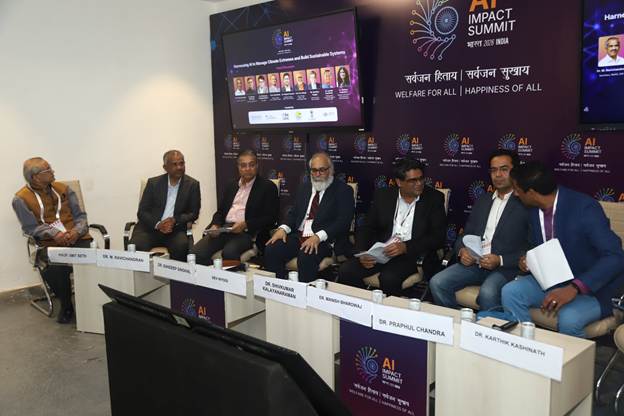
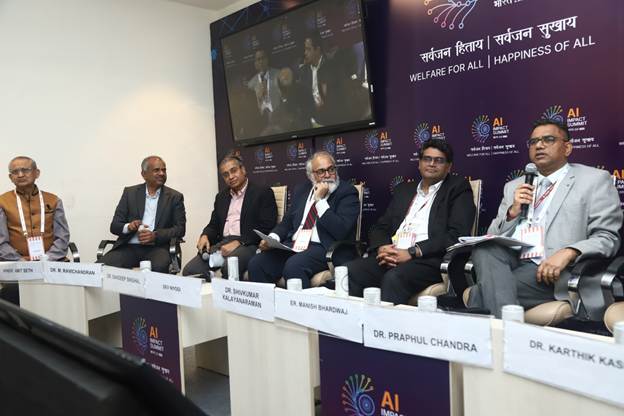
Speaking at the high-level panel discussion titled “Harnessing AI to Manage Climate Extremes and Build Sustainable Systems” during the final day of the India AI Impact Summit 2026 at Bharat Mandapam, Dr. Ravichandran highlighted that while traditional models excel at broad spatial forecasting, AI is essential for mastering the "time series" and localized nuances of modern weather patterns.
The “Elephant and the Ant” Analogy
In a compelling address, Dr. Ravichandran used a vivid metaphor to describe the current challenge facing scientists.
“Earlier, we just had to track the 'elephant'—the large-scale weather systems. But today, because of climate change, we need to track the 'ant' sitting on that elephant. We need to see both the spatial movement and the hyper-local time series,” he remarked.
He explained that while physics-based numerical models are effective for spatial mapping, AI outperforms them in local, time-sensitive rhythms. The solution, he noted, lies in fusing both to predict high-impact events like cloudbursts, which currently remain notoriously difficult to forecast.
Key Highlights from the Address:
- Reducing Model Assumptions: Dr. Ravichandran noted that numerical models rely on numerous assumptions that lead to error growth. AI can be utilized to minimize these errors and improve "initial conditions," leading to significantly more accurate forecasts.
- Unlocking 150 Years of Legacy Data: India possesses a massive treasure trove of data from the India Meteorological Department (IMD) spanning 150 years. The Secretary called for this data to be "opened up" to a wider pool of young researchers and multi-disciplinary experts.
- The Power of Downscaling: He identified AI’s ability to "downscale" large-scale models to a 1-kilometer resolution as a game-changer for localized weather protection.
- Building Trust through Validation: Addressing the ethics of AI, he emphasized that trust is the cornerstone of any forecast system. He advocated for rigorous validation and verification processes to ensure AI-generated insights are reliable for public safety.
A Call for Multi-Disciplinary Collaboration
Dr. Ravichandran concluded by urging the scientific community to break out of departmental silos. “We shouldn't just think in one way. We need biology experts, data scientists, and researchers from multiple disciplines to look at our data through different lenses. This data-driven approach is the only way forward for building a climate-resilient India.”
This Panel Discussion was organized by Indian Al Research Organisation (IAIRO), Atria University, C-DAC, IITM/MOES and LokNeeti.
Other than Dr. M. Ravichandran the panelists of this discussion were - Er. Manish Bhardwaj (Secretary, National Disaster Management Authority (NDMA), Dr. Shivkumar Kalyanaraman( CEO, Anusandhan National Research Foundation ), Prof. Amit Sheth (Founding Director, IAIRO & Professor, University of South Carolina), Dr. Praphul Chandra (Professor and Dean (Research), Atria University), Dr. Karthik Kashinath (Distinguished Scientist & Engineer, NVIDIA, Santa Clara, USA), Prof. Dev Niyogi ( William Stamps Farish Chair Professor and UNESCO Chair, University of Texas at Austin, Jackson School of Geosciences), Sandeep Singhal ( Senior Adviser & Investment Committee Member, Avaana Capital) and Dr. Akshara Kaginalkar ( Professor of Practice, Centre for Climate Change, Atria University) .
*******
NKR/JP/SG