Introduction
Digital Public Infrastructure (DPI) is reshaping how nations govern, transact and deliver services. In this transformation, India has moved from being a large user of digital systems to a builder of population scale digital architecture. What distinguishes India’s approach is scale, openness and integration. Identity, payments and data exchange have been connected through interoperable public rails that support welfare delivery, economic activity and state capacity.
As countries around the world search for trusted and inclusive digital pathways, India’s experience is drawing sustained attention. The model demonstrates that digital infrastructure can be designed as a public good rather than a closed platform. It shows that inclusion and efficiency can advance together. In doing so, India is steadily shaping the global conversation on how digital systems should be built and governed in the twenty first century.
The Global Digital Moment: Why DPI Matters
Infrastructure today is no longer limited to roads, ports and power grids. It is digital. The United Nations defines Digital Public Infrastructure as a set of foundational digital systems that form the backbone of modern societies. These systems enable secure and seamless interaction between people, businesses and governments. From verifying identity and opening bank accounts to enabling instant digital payments and safe data exchange, DPI shapes everyday life. Like railways once connected regions to opportunity, digital infrastructure now determines who can access services, markets and rights in the modern economy.
For digital infrastructure to deliver public value, it must be inclusive, interoperable and governed in the public interest. A well designed digital identification system can support subsidy delivery, voter registration and secure banking. When linked with payments and data exchange frameworks, it creates a unified architecture that strengthens state capacity and widens opportunity.
Against this backdrop, India’s experience offers a working demonstration of what population scale digital public infrastructure can achieve. India has built digital public infrastructure for over 1.4 billion people at very low cost. It is an open and accessible network, backed by regulation and a wide range of applications that modernise the economy, reform governance and transform lives. In India’s case, the principles of inclusion, innovation and trust are operational realities of its DPI ecosystem. At population scale, and with measurable impact, India has demonstrated that digital systems can deepen democracy while accelerating development.
Foundations of India’s DPI: The JAM Trinity
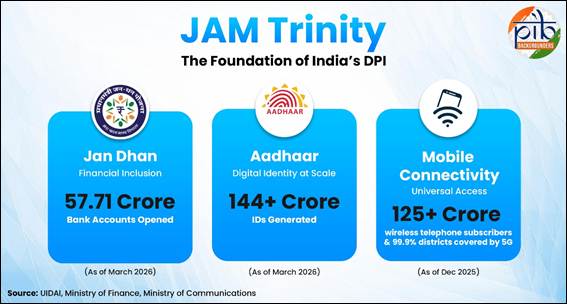
India’s digital public infrastructure did not emerge overnight. It was seeded through a deliberate convergence of identity, banking and connectivity. This convergence took shape as the JAM trinity. Jan Dhan bank accounts, Aadhaar enrolment and widespread mobile phone penetration created the base layer for India’s digital transformation. Together, they connected individuals to the state in a direct and verifiable manner. Through JAM, welfare benefits began to move straight into bank accounts. Intermediaries were reduced. Delays narrowed. Leakage declined. The scale of this integration laid the foundation for what would later evolve into a comprehensive DPI ecosystem.
Aadhaar
Aadhaar introduced a biometric based digital identity platform for residents across the country. It enabled unique identification and secure authentication for efficient service delivery. As of March 2026, more than 144 crore Aadhaar numbers had been generated. Usage reflects deep integration into everyday systems. In 2024-25 alone, over 2,707 crore authentication transactions were carried out. Identity became portable. Verification became near instant. Access to services became more reliable and transparent.
The Pradhan Mantri Jan Dhan Yojana, launched as the National Mission for Financial Inclusion, set out to give every unbanked adult in India a bank account, a financial identity and access to essential services such as credit, insurance and pensions. Launched in August 2014, it evolved into one of the largest financial inclusion initiatives in the world. The number of accounts grew from 14.72 crore in 2015 to 57.71 crore as of March 2026. Deposits increased from ₹15,670 crore in March 2015 to ₹2.94 lakh crore by March 2026. A total of 39.98 crore RuPay debit cards were issued to beneficiaries. Financial participation widened. Savings entered the formal system strengthening economic agency.
Mobile Phones and Connectivity
Connectivity completed the triangle. With 85.5 percent of Indian households owning at least one smartphone, the mobile phone became a bank, a classroom and a gateway to public services. The number of wireless telephone subscribers reached 125.87 crore at the end of December 2025. Fifth generation (5G) mobile services are now available in 99.9 percent of districts, covering 85 percent of the population. As of December 2025, 5.18 lakh 5G base transceiver stations had been installed nationwide. This extensive digital reach ensured that identity and banking were not confined to urban centres. They became accessible across rural and urban India alike.
The JAM trinity created the foundational rails on which India’s broader DPI ecosystem was built, linking identity, finance and connectivity at unprecedented scale.
The Rise of India’s DPI Stack
India’s DPI Stack grew from a few foundational digital systems into a connected national framework built on open APIs (Application Programming Interface) and public digital goods. Known as India Stack, it unlocks the core building blocks of identity, data and payments at population scale. What began with digital identity and financial inclusion gradually expanded into payments, welfare delivery, health, education, skilling and governance platforms. These systems are designed to work together through interoperable digital rails. The result is not a collection of standalone portals, but an integrated digital backbone that supports economic activity and public service delivery. While developed in India’s context, the model is modular and adaptable, making it relevant beyond national boundaries.
This is how the stack evolved across key sectors:
Digital Economic Infrastructure
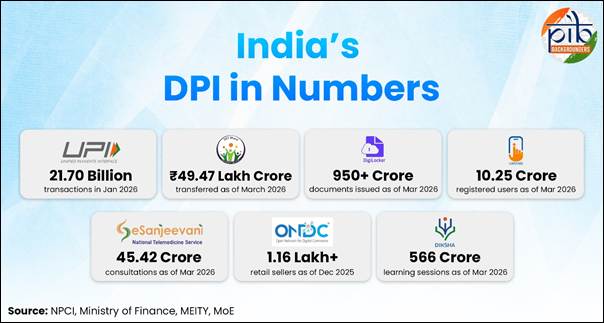
- Unified Payments Interface (UPI): UPI has transformed retail payments into a seamless digital experience. It enables instant, interoperable and secure transactions between individuals and merchants in real time. In January 2026, it processed 21.70 billion transactions worth over ₹28.33 lakh crore, reflecting its deep integration into everyday commerce. A total of 691 banks are live on the UPI platform, underscoring its broad institutional adoption. The International Monetary Fund, in its June 2025 report on growing retail digital payments, recognised UPI as the world’s largest retail fast payment system by transaction volume. The 2024 ACI Worldwide report titled Prime Time for Real Time noted that UPI accounts for around 49 percent of global real time payment transaction volume. Within India, 81 percent by volume of total retail payment transactions are processed on UPI rails, making it the preferred mode for person to person as well as person to merchant payments.

- Public Financial Management System (PFMS): PFMS has strengthened transparency and control in public expenditure. It is a web based online transaction system that enables end to end monitoring of government funds and electronic payments to implementing agencies and beneficiaries. In December 2014, it was mandated for payment, accounting and reporting under Direct Benefit Transfer. This reform helped remove duplicate and fake beneficiaries and reduce leakages. As a result, the government saved more than ₹4.31 lakh crore between 2015 and March 2024. As of January 2026, the cumulative amount transferred through Direct Benefit Transfer has crossed ₹49.09 lakh crore, signalling a shift towards targeted and accountable welfare delivery.

- Open Network for Digital Commerce (ONDC): Launched in 2022, ONDC is an open network designed to democratise digital commerce by connecting buyers and sellers through interoperable platforms rather than a single marketplace. It expands market access, reduces entry barriers and enables wider participation, particularly for small businesses. As of December 2025, there are a total of 1.16 lakh+ retail sellers live on ONDC from over 630+ cities and towns across India.
- Government eMarketplace: The Government eMarketplace has digitised public procurement and widened participation in government contracting. It provides an online platform for transparent and efficient procurement of goods and services by government entities. As of November 2025, nearly 3.27 crore orders had been processed with a cumulative Gross Merchandise Value exceeding ₹16.41 lakh crore, including ₹7.94 lakh crore in services and ₹8.47 lakh crore in products. The platform supports over 10,894 product categories and 348 service categories, with more than 1.67 lakh buyer organisations onboard. Over 24 lakh sellers and service providers have completed their profiles, including more than 11 lakh Micro and Small Enterprises, which contribute 44.8 percent of the cumulative order value and have received orders worth over ₹7.35 lakh crore.
Citizen Service Delivery Platforms

- DigiLocker: Launched in 2015, DigiLocker introduced a secure digital document wallet for citizens. It allows individuals to store, access and share authenticated electronic documents with consent-based access. The platform ensures authenticity and reduces the use of fake documents. Citizens can retrieve critical lifelong records anytime and from anywhere. As of 5 March 2026, DigiLocker had 67.63 crore users. By March 2026, over 950 crore documents had been issued through the platform, reflecting its growing role in public administration.

- UMANG: Launched in 2017, UMANG, or the Unified Mobile Application for New age Governance, was designed to advance mobile governance in India. It provides a single window mobile and web platform to access services from central, state and local government bodies. Citizens can use UMANG to access services such as EPFO balance and claims, PAN and Aadhaar services, DigiLocker access, utility bill payments, pension services, scholarship applications, passport related services, driving licence services, exam results, etc. As of March 5 2026, it recorded 10.25 crore user registrations and 723.36 crore transactions. More than 2,400 government services are available on the portal, making it a key interface between citizens and the state.
- e-Courts: The e-Courts project is a pan India Mission Mode initiative under the Department of Justice, Ministry of Law and Justice. It seeks to make judicial processes more efficient, transparent and accessible through the use of Information and Communication Technology (ICT). Phase I from 2011 to 2015 focused on basic computerisation and internal connectivity. As a result, 14,249 courts were computerised and Local Area Networks were installed in 13,683 courts. Phase II from 2015 to 2023 shifted towards ICT enabled service delivery for citizens. It introduced Wide Area Network connectivity, stakeholder training, eSewa Kendras, and computerisation of District Legal Services Authorities and Taluka Legal Committees. Advanced Case Information System software, the National Judicial Data Grid and systems for digital filing and online payments transformed public access to judicial services.
In September 2023, the Union Cabinet approved Phase III for the period 2023 to 2027 with an outlay of ₹7,210 crore. This phase advances digital and paperless courts and comprehensive digitisation of legacy records and pending cases. It expands video conferencing facilities across courts, jails and hospitals and widens the scope of online courts beyond traffic violations. The integration of emerging technologies such as Artificial Intelligence and Optical Character Recognition supports case pendency analysis and forecasting of litigation trends. The initiative marks a structural shift towards data enabled judicial administration.
Health & Nutrition Ecosystem
- CoWIN: On 16 January 2021, CoWIN was launched as the digital backbone of India’s COVID 19 vaccination programme. It connected vaccine manufacturers, administrators, healthcare workers and beneficiaries across public and private sectors on a single platform. Managing over 220 crore doses, CoWIN brought
 transparency and efficiency to one of the world’s largest vaccination drives. Real time data tracking improved coordination and public trust. Its design and execution have drawn international interest, with several countries examining it as a model for digital public health systems.

- eSanjeevani: Launched in November 2019, eSanjeevani expanded access to healthcare through telemedicine. It enables remote doctor to patient consultations, particularly in rural and underserved regions. The platform reduces travel costs and waiting time while extending specialist advice to distant communities. As of 5 March 2026, it has served 45.42 crore patients and onboarded 2.3 lakh healthcare providers.Teleconsultation has moved from pilot to mainstream public health service.

- eHospital and ORS: As part of the Digital India initiative, the National Informatics Centre developed eHospital, e-BloodBank and the Online Registration System. The ORS portal was launched on 1 July 2015 to provide online access to hospital services.[19] The eHospital application functions as a Hospital Management Information System that digitises internal workflows, appointments, diagnostics and billing. It is available to central, state, autonomous and cooperative hospitals through a cloud-based service model. The e-BloodBank application supports end to end blood bank management. Together, these systems connect patients, hospitals and doctors on a unified digital platform and integrate services with the Ayushman Bharat Health Account.
 Aarogya Setu: On 2 April 2020, Aarogya Setu was launched to support efforts to limit the spread of COVID 19. It enabled Bluetooth based contact tracing, hotspot mapping and dissemination of health advisories. The application has since evolved into a National Health App powered by the Ayushman Bharat Digital Mission. Users can register for an Ayushman Bharat Health Account and access digital lab reports, prescriptions and diagnoses from verified providers. It also allows scheduling of online doctor consultations through the eSanjeevani OPD service, strengthening continuity of care.
- National Non-Communicable Diseases Platform (NCD): The National Non-Communicable Diseases Platform supports screening, diagnosis and management of major lifestyle diseases. Developed in collaboration with the Ministry of Health and Family Welfare and Tata Trusts, it facilitates population based screening and long-term disease management. As of December 2025, 74.97 crore beneficiaries had been enrolled on the system. Over 8.64 crore patients are under treatment for hypertension and diabetes.[20] The platform is operational across 31 states and union territories, enabling systematic tracking of high-risk populations.
- POSHAN Tracker: The Poshan Tracker, rolled out on 1 March 2021 by the Ministry of Women and Child Development through the National e Governance Division, serves as a governance tool for nutrition monitoring. It leverages technology for dynamic identification of stunting, wasting and underweight prevalence among children. It also enables last mile tracking of nutrition service delivery. As of January 2026, 14.03 lakh Anganwadi Centres were onboard and 8.90 crore eligible beneficiaries were registered on the system, strengthening data driven nutrition interventions.

- DIKSHA: Launched in 2017, DIKSHA is the national platform for school education. It is an initiative of the National Council for Educational Research and Training under the Ministry of Education. The platform has been adopted by almost all States and Union Territories, along with central autonomous bodies and boards including CBSE. DIKSHA aims to build a learning ecosystem that responds to the needs of the twenty first century. Education is designed to be accessible, engaging and tailored to individual learners. It extends beyond classrooms and supports teachers, students and administrators alike. As of 5 March 2026, 566 crore learning sessions had been delivered through the platform. It has 2.11 crore registered users. Course enrolments stand at 18.52 crore, with 14.71 crore completions and 12.69 crore certificates issued.

- Skill India Digital Hub: Launched in 2023, the Skill India Digital Hub was created to support skilling, reskilling and upskilling through a comprehensive digital platform. It combines online training with trusted skill credentials delivered through APIs, alongside payment and job discovery layers. The upgraded platform integrates Udyam, e Shram, National Career Service and ASEEM portals to enable government to citizen, business to citizen and business to business services. It connects learners with employers and helps align training with industry demand. Educational institutions can adapt curricula based on emerging workforce needs. The platform acts as a bridge between skill development and employment, strengthening India’s human capital ecosystem.
Digital Systems for Governance Capacity & Coordination

- e-Office: e-Office has enabled paperless functioning across government departments. It supports electronic file management and digital decision making. The platform aims to create a simplified, responsive and transparent administrative system. Built on open architecture, it is designed for replication across central, state and district levels. It integrates independent functions within a unified digital framework, improving efficiency and reducing procedural delays.

- API Setu: MeitY initiated API Setu, also known as the Open API Platform project, in March 2020. It enables secure and standardised sharing of government data and services through application programming interfaces. The platform manages the full API lifecycle from publishing to consumption and supports both public and private ecosystems. As of March 2026, the platform currently hosts 8,036 APIs, with 6,592 consumers, 2,559 publishers and 10,530 organisations onboard.[23] By facilitating structured and secure data exchange, API Setu strengthens interoperability and innovation across India’s digital governance landscape.

- PM GatiShakti: Launched on 13 October 2021, the PM GatiShakti National Master Plan provides a GIS based digital platform for integrated planning and coordinated implementation of infrastructure projects. It aims to enable multimodal connectivity across economic zones and improve synchronisation among ministries and agencies. The Network Planning Group, constituted under this framework, evaluates critical infrastructure proposals at the planning stage to ensure multimodality, inter modality, last mile connectivity and data driven decision making. As of February 10, 2026, 352 infrastructure projects with a total estimated cost of ₹16.10 lakh crore have been evaluated through this mechanism. Of these, 201 projects have been sanctioned and 167 are under implementation.[24] The platform brings coherence and transparency to large scale infrastructure governance.
Together, these interconnected platforms illustrate how India’s DPI Stack has evolved into a comprehensive digital backbone powering governance, economic growth and citizen empowerment at scale.
India’s DPI Diplomacy
India’s engagement on DPI draws from a deeper civilisational ethos. Vasudhaiva Kutumbakam means the world is one family. It reflects an outlook that encourages shared progress beyond borders, languages and ideologies. In the digital age, this philosophy has found new expression through India’s engagement on DPI. Technology is viewed not as a closed asset, but as a public good that can support inclusive development. India is not only sharing technology but also assisting other nations in developing and adapting it to their own contexts. As countries search for trusted digital pathways, India’s experience has steadily entered global policy conversations.
The following initiatives show how this approach is being operationalised internationally:
Strategic Partnerships on Digital Infrastructure
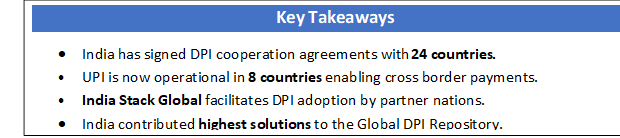
As of February 2026, Government of India has signed Memoranda of Understanding (MoU) and agreements with 24 countries for cooperation on India Stack and Digital Public Infrastructure. These partnerships focus on sharing technical knowledge and supporting replication of digital governance platforms. Areas of cooperation include digital identity, digital payments, data exchange frameworks and service delivery systems. The objective is not export of a product, but collaboration on architecture and design principles. This engagement has positioned India as a practical partner for countries seeking to build population scale digital systems.
|
S. No.
|
Countries with MoUs on India Stack / Digital Public Infrastructure
|
|
1
|
Republic of Armenia
|
|
2
|
Republic of Sierra Leone
|
|
3
|
Republic of Suriname
|
|
4
|
Antigua and Barbuda
|
|
5
|
Papua New Guinea
|
|
6
|
Republic of Trinidad and Tobago
|
|
7
|
United Republic of Tanzania
|
|
8
|
Republic of Kenya
|
|
9
|
Republic of Cuba
|
|
10
|
Republic of Colombia
|
|
11
|
Lao People's Democratic Republic
|
|
12
|
Saint Kitts and Nevis
|
|
13
|
Ethiopia
|
|
14
|
Jamaica
|
|
15
|
Gambia
|
|
16
|
Fiji
|
|
17
|
Guyana
|
|
18
|
Venezuela
|
|
19
|
Sri Lanka
|
|
20
|
Brazil
|
|
21
|
Lesotho
|
|
22
|
Maldives
|
|
23
|
Mongolia
|
|
24
|
Malaysia
|
Cross Border Expansion of UPI
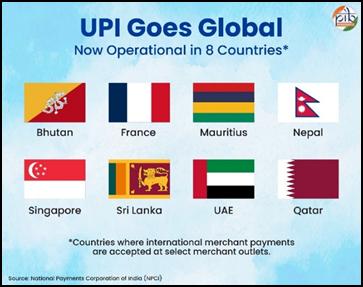
India’s payment infrastructure has crossed national boundaries. UPI is now live in 8 countries including the United Arab Emirates, Singapore, Bhutan, Nepal, Sri Lanka, France, Mauritius and Qatar.[25] Its international adoption is easing remittances, improving payment efficiency and expanding financial inclusion. By enabling seamless cross border transactions, UPI has strengthened India’s presence in the global fintech landscape. The scale and reliability of the system have drawn attention from policymakers and regulators worldwide.
India Stack Global
To facilitate structured cooperation, India Stack Global was established as a dedicated platform to showcase India’s DPI solutions and support adoption by partner countries. The portal provides access to key digital platforms and technical resources. It serves as a bridge between India’s experience and the requirements of friendly nations. Through this initiative, digital public goods are presented as adaptable building blocks rather than fixed templates.
G20 Declaration and the Global DPI Repository
During its G20 Presidency in 2023, India placed Digital Public Infrastructure at the centre of the development agenda. The G20 New Delhi Leaders’ Declaration explicitly recognised DPI as a development accelerator. India articulated the idea that DPI is not proprietary technology, but digital rails for inclusive growth, particularly for the Global South. The Global Digital Public Infrastructure Repository was launched under the Indian Presidency as a knowledge platform to share lessons and practices. It is designed to bridge information gaps around designing and deploying population scale DPI. India contributed the highest number of DPI solutions to the repository, reinforcing its role in shaping the discourse.
CoWIN as an Open Digital Public Good
India extended its digital health platform beyond national borders by offering CoWIN as open-source software to the world at no cost.[27] The platform’s success in managing over 220 crore vaccine doses demonstrated the ability to coordinate complex public health logistics at scale. By making the technology freely available, India signalled that its digital experience is meant to be shared. Its use of technology and policy for public good, inclusive development and social empowerment offers practical lessons for developing nations seeking resilient digital systems.
MOSIP and Sovereign Digital Identity
The Modular Open-Source Identity Platform (MOSIP), developed in India, represents another important example. MOSIP provides a configurable and open-source framework for countries seeking to build sovereign digital identity systems. More than 25 nations are adopting or exploring the platform for their national identity programmes.
Collectively, these initiatives reflect a diplomacy anchored in shared capability, where India is helping shape a more inclusive and interoperable global digital architecture.
Conclusion
India’s journey with Digital Public Infrastructure reflects a broader shift in how development and governance are conceived in the digital age. What began as an effort to expand financial inclusion and identity access has matured into a comprehensive, interoperable architecture that underpins economic activity, public service delivery and institutional capacity. The model demonstrates that scale need not compromise trust, and that openness can coexist with security and regulation. By linking technology with public purpose, India has shown that digital systems can strengthen democracy while accelerating growth. As more nations look to build resilient and inclusive digital foundations, India’s experience stands not merely as a case study, but as a reference point for the future of public digital infrastructure.
References:
Ministry of Electronics & IT:
Ministry of Communications:
MoFHW:
Ministry of Commerce & Industry:
Ministry of Law and Justice:
UNDP:
MEA:
PMO:
Click here to see pdf
PIB Research