Post‑Budget Webinar on Agriculture & Rural Transformation Charts Roadmap for Accelerated Sectoral Growth
A Post‑Budget Webinar was organised today in hybrid mode by the Ministry of Agriculture & Farmers’ Welfare on the theme “Agriculture & Rural Transformation.” The webinar forms part of the Government of India’s annual post‑Budget exercise aimed at ensuring timely, coordinated and outcome‑oriented implementation across Ministries and Departments.
Hon’ble Prime Minister Shri Narendra Modi in his address highlighted that India is the world’s second-largest fish producer and underscored the contribution of Fisheries sector in India’s export share. Hon'ble Prime Minister stressed the need for scientific mapping of reservoir potential, cluster-based planning, and stronger coordination between local communities and State Fisheries Departments. He underscored the importance of developing new business models across the fisheries value chain - spanning hatcheries, feed, processing, branding, exports, and logistics to fully harness the reservoir’s potential.
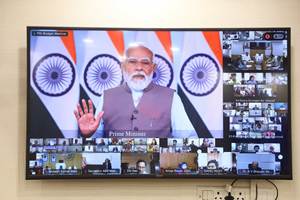
Hon’ble Union Minister, Fisheries Animal Husbandry and Dairying and Panchayati Raj Shri Rajiv Ranjan Singh participated in the Inaugural session from Krishi Bhawan along with Hon’ble Minister of State for Fisheries, Animal Husbandry & Dairying and Panchayati Raj, Prof. S. P. Singh Baghel and Hon’ble Minister of State, Fisheries, Animal Husbandry & Dairying and Minority Affairs, Shri George Kurian.
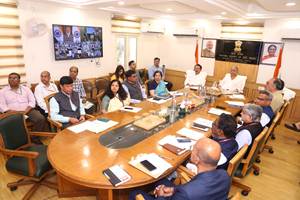
In concluding session of the webinar, Hon’ble Minister of State for Fisheries, Animal Husbandry & Dairying and Panchayati Raj, Prof. S. P. Singh Baghel highlighted that for the first time, reservoir fisheries have been included under a national framework with scientific guidelines under Budget 2026-27. This will unlock the immense potential of India’s reservoirs, strengthen technology‑led aquaculture, and ensure greater participation of communities.
Hon’ble Minister of State for Fisheries, Animal Husbandry & Dairying and Minority Affairs, Shri George Kurian during the concluding session underscored the role of fisheries sector in strengthening the rural livelihoods and enhancing export potential. He further emphasised that Budget 2026-27 significantly strengthens coastal fisheries and value chains through investments in post‑harvest infrastructure, market access, and women‑led value addition and branding.
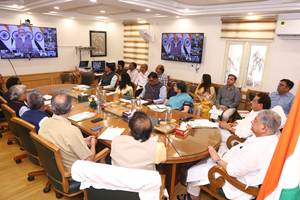
Breakout Session – Deliberations of Fisheries stakeholders
During the Breakout session, the Department of Fisheries, Ministry of Fisheries, Animal Husbandry & Dairying, Government of India, organized a Breakout session on Sub-theme of “Integrated Development of Reservoirs and Amrit Sarovars for fisheries & Strengthening of Coastal fisheries value chain” in Krishi Bhawan, New Delhi under the Chairmanship of Dr. Abhilaksh Likhi, Union Secretary, Department of Fisheries.
Dr Abhilaksh Likhi, Union Secretary, Department of Fisheries, Gol in his address during the breakout session highlighted the integrated approach i.e. promotion of Cage and pen culture supported by modern technology; wider adoption of geospatial tools for scientific planning; diversification of species; reservoir‑specific management frameworks; cluster‑based organisation of production systems; ensuring backward-forward linkages, and deeper community participation including FFPOs, SHGs, Startups, Fisheries cooperatives etc.
Shri Sagar Mehra, Joint Secretary welcomed the stakeholders who joined and delivered a presentation on “Integrated Development of Reservoirs and Amrit Sarovars for Fisheries & Strengthening Coastal Fisheries Value Chain”. He highlighted that India's reservoirs are the largest inland water resource globally, and play a vital role in enhancing fish production, nutritional security, and employment generation. Shri Mehra, Joint Secretary presented the Implementation plan with clear timelines, and Plan of action. The expected outcomes are increased production, community engagement with FFPOs, cooperatives, SHGs, Startups and generation of one lakh livelihood opportunities, positioning fisheries as a key driver of rural prosperity.
The session witnessed participation of diverse Panellists including Shri Dipankar Mandal (Mandal Manit Aqua Genetics, Chhattisgarh), Dr. Gouri Shankar Rath (Falcon Feed, Odisha), Shri Benugopal Panigrahi (Sreyasri Integrated Farming, Odisha), Ms. Snehal Verma (Nature Dots), Smt. Paulina Kisku (women‑led SHG, Jharkhand), Shri Suvo Sircar (Fishmongers), Shri Vijay Pal (Uttar Pradesh), Shri Chandrasen Iswar Rao Patil (Cooperative Leader, Maharashtra), Mr. Ganesh Nakhawa (BLUCATCH, Mumbai), Shri Harsh Agarwal (Das & Kumar) and Ms. Kadambari Durga (My Bharat). Field‑level insights were further contributed by Ms. Sangita Kaivart (Jharkhand), Mr. Nishant Kumar (Ranchi) and Shri Chandra Prakash (Uttar Pradesh).
The session generated more than 60 recommendations across four key focus areas of fisheries value chain including Pre-production, Production, Post-production and Technology adoption.
On Pre-production stage, Establishment of stock improvement/genetic improvement programme to produce quality Broodstock and Seed, Promotion of regional brood stock banks, hatchery clusters, satellite nurseries & reservoir‑based seed‑rearing, Standardization of fingerling quality and stocking norms using certified seed of prescribed size, and prioritisation of genetically improved species and ensure high‑quality seed with proper nursery rearing was recommended. For the Production stage, scaling up of cage and pen culture using strong HDPE cages; adoption of automated feeding systems to boost growth, strengthening on‑farm water quality monitoring, stocking density, oxygen levels & stress indicators and enabling women led SHGs, FFPOs and cooperatives to participate more effectively was recommended.
For the post-production, strengthening cold chain and landing site infrastructure, ensuring quality and branding through FSSAI‑aligned testing and verified standards, expanding market access through direct linkages with urban buyers & organised e‑platforms/quick commerce, and establishment of value‑addition units, traceability and establishment of chain of fish kiosks was recommended. On Technology adoption aspect, traceability, real time water quality monitoring, leveraging AI, IoT and geospatial tools for higher productivity and climate‑resilient operations, digitised harvest and logistics systems to promote efficiency and on boarding of fisheries startups and their innovations in the integrated development of reservoirs and Amrit Sarovars was recommended.
The deliberations are expected to significantly accelerate the integrated development of reservoirs and Amrit Sarovars, strengthen scientific practices such as stocking, cage and pen culture, seed production and community‑based aquaculture models, and guide measures to enhance coastal fisheries value chains through improved aggregation, cold‑chain access, processing and traceability. These insights will support the Department of Fisheries in finalising implementation frameworks, timelines and monitoring mechanisms for inclusive and sustainable sectoral development.
The Post-Budget webinar witnessed the participation of more than 15000 participants including Officials from all States/UTs, NITI Aayog, RBI, NAFED, MoRD, NCDC, MPEDA, EIC, ICAR Fisheries Institutes, Subordinate Offices of DoF viz. FSI, CIFNET, NIFPHATT, and CICEF; FFPOs, Industry Associations, Fisheries Cooperatives, Startups, Exporters, Fisheries Associations, Fisheries Colleges and Universities, KVKs, SFAC, and other stakeholders across the fisheries value chain.
Background
India’s aquatic ecosystems include 32 lakh ha of reservoirs, 12 lakh ha of brackishwater, over 68,000 Amrit Sarovars, and 11,099 km of coastline, providing substantial opportunities for fisheries expansion. India is the second‑largest fish‑producing nation, with production reaching 197.75 lakh tonnes (2024–25) and contributing 1.1% to the national economy. The Department of Fisheries continues to support the sector through PMMSY, FIDF, PM‑MKSSY, KCC and convergence with Mission Amrit Sarovar.
**********
JP.