“Strengthening One Health Preparedness: DAHD Hosts National Workshop to Address Gaps Identified in Mock Drills”
The Department of Animal Husbandry & Dairying (DAHD) organized a One-Day Sensitization Workshop on “Addressing Gaps Identified during Mock Drills” on 20th March 2026 at the NASC Complex, Pusa, New Delhi, in line with the recommendations of the 4th Scientific Steering Committee on One Health.
As part of preparedness-strengthening efforts under the National One Health Mission, two national-level mock drills—“Vishanu Yudh Abhyas” (August 2024) and “Viral Sankraman Abhyas” (November 2025)—were conducted to evaluate operational readiness, inter-sectoral coordination, laboratory response systems, biosafety and biosecurity practices, and emergency communication protocols.
The primary objective of the workshop was to sensitize stakeholders across sectors on the key lessons learned from these mock drills and to facilitate a structured and time-bound approach for addressing identified gaps, thereby further strengthening India’s preparedness and response framework under the One Health approach.
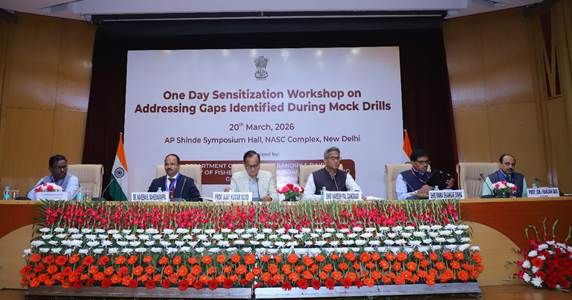
The workshop was graced by Prof. Ajay Kumar Sood, Principal Scientific Adviser to the Government of India, as the Chief Guest. Other dignitaries present at the inaugural session included Shri Naresh Pal Gangwar, Secretary, DAHD; Dr. Naveena B. Maheswarappa, Animal Husbandry Commissioner, DAHD; Shri Rama Shankar Sinha, Additional Secretary (Livestock Health), DAHD; Dr. Muthukumarasamy B., Joint Secretary, DAHD; and Prof. (Dr.) Ranjan Das, Director, National Centre for Disease Control, New Delhi.
In his address, Prof. Sood highlighted that nearly 60–70 percent of emerging infectious diseases in humans are of zoonotic origin. He underscored the need for a unified framework integrating veterinary sciences, human health, environmental science, and data-driven policymaking. He emphasized that the National One Health Mission—emanating from the recommendations of the Prime Minister’s Science, Technology and Innovation Advisory Council—provides an institutional mechanism for coordinated, cross-sectoral action to address emerging health threats. He further stressed that pandemic preparedness requires a whole-of-government approach involving multiple Ministries, Departments, and States.
He noted that the deliberations of the workshop would significantly contribute to strengthening preparedness for future health emergencies. Emphasizing the importance of awareness, targeted capacity building, and effective communication strategies at all levels, he also drew attention to the critical human dimension in outbreak response. He outlined key priority areas, including institutionalizing mock drills and preparedness assessments; strengthening integrated surveillance and laboratory networks, including the BSL-3 ecosystem; enhancing Centre–State coordination; improving governance frameworks; investing in continuous capacity building; and leveraging science and technology for predictive and responsive systems. Prof. Sood appreciated the efforts of DAHD and reiterated that mock drills serve as vital stress tests for strengthening coordination and operational readiness and quoted “the more you sweat in peace the less you bleed in war”.
Shri Naresh Pal Gangwar, Secretary, DAHD, emphasized the importance of mock drills in identifying and addressing critical preparedness gaps. Drawing on lessons from COVID-19 and recurring influenza outbreaks, he highlighted the role of simulation exercises in strengthening surveillance systems, laboratory networks, and coordinated response mechanisms. He noted that the workshop aims to clearly define roles and responsibilities while enhancing inter-agency coordination for effective management of future public health emergencies.
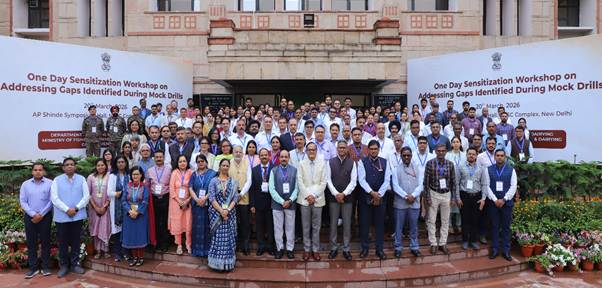
The workshop witnessed participation from over 200 experts representing key Ministries and organizations, including the Office of the Principal Scientific Adviser, ICMR, National Institute of One Health, NCDC, ICAR, veterinary universities, DAHD, NSCS, NDMA, BSL 3 Network, State Nodel Officers of One Health, State Animal Husbandry Departments, State Surveillance Officers under IDSP as well as postgraduate and doctoral students for veterinary universities/ colleges.
The workshop featured a Table Top Exercise on disease outbreak response—“Sankraman Pratirodh Abhyas (SPA)”—and a Simulation Exercise titled “Ex Kitanu Sankraman – Vaishvik Suraksha: Swadhyay se Abhyas Tak (KS-VS-SAT)”, coordinated by the National Security Council Secretariat, Government of India.
The workshop concluded with a strong collective commitment from all key stakeholders to address identified gaps in a time-bound manner, strengthen inter-sectoral coordination, and further reinforce India’s preparedness and response architecture under the One Health framework.
***********
JP