|
The Sacred Exposition of the holy relics of Tathagata Buddha is an initiative that enables public viewing of sacred Buddhist relics. The relics symbolise the teachings and spiritual presence of Tathagat, the fully enlightened Buddha. These relics are preserved at the National Museum, New Delhi, under strict conservation protocols. Sacred expositions of the holy relics have been held in several countries. The exposition in Ladakh from May 1-14, 2026 highlights the region’s role as a living centre of Buddhist heritage and spiritual engagement. It provides a major boost to cultural tourism in the region, while reinforcing Buddhist values of peace and non-violence. The initiative reflects India’s civilisational role as a custodian of Buddhist heritage and its wider efforts in global Buddhist engagement and cultural exchange.
|
A Civilisational Continuum
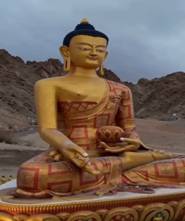 Buddhism is practiced by an estimated 500 million people worldwide. It remains one of humanity’s most enduring spiritual traditions. The relics of Buddha are held as deeply sacred by people across the world. Public viewing or sacred expositions of these relics are held in various countries from time to time. In this connection, the sacred exposition of the Holy Relics of Tathagata Buddha will be organised in Ladakh from May 1–14, 2026 as a very significant cultural festival. The term Tathāgata refers to Gautama Buddha as the Enlightened One, who attained complete liberation from birth and death.
|
Theme of the Ladakh Sacred Exposition (May 1st-14th)
Peace in Times of Conflict”
|
This exposition offers a rare opportunity for people to view these sacred relics, which are otherwise preserved at the National Museum in New Delhi.
It promotes global peace, harmony, and ethical living through Lord Buddha’s teachings. The initiative highlights non-violence, compassion, and India’s role in preserving Buddhist heritage.
Sacred Relic Exposition in Ladakh: A Journey of Faith and Culture
The sacred exposition of the Holy Relics of the Tathagata in Ladakh offers a powerful moment of spiritual reflection. It reaffirms the Buddha’s timeless message of compassion, wisdom, and hope, more than 2,500 years after his teachings began.
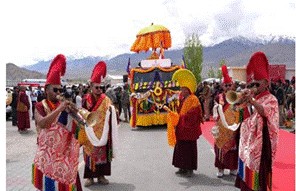
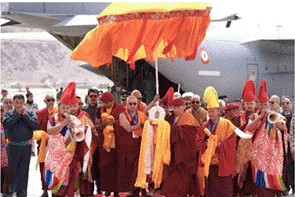 The relics arrived in Leh on April 29, 2026 via Indian Air Force aircraft. They were transported under high-level security. This was followed by a grand ceremonial procession. The relics are now enshrined at the Jivestal Site.
The opening coincides with the 2569th Buddha Purnima celebrations, featuring monastic prayers, lighting ceremonies, and cultural performances.
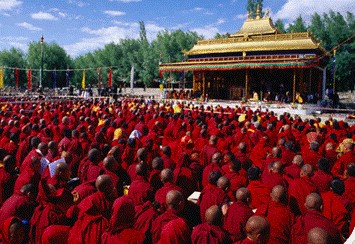
Public veneration is taking place from May 1–10, 2026 in Leh. Devotees, monks, scholars, and pilgrims from across the world will pay homage. The exposition will then extend to the Zanskar Valley from May 11–12. It will return to Leh for enshrinement at the Dharma Centre on May 13. The relics will finally depart for Delhi on May 15, 2026 after a concluding procession.
Alongside the exposition, multiple cultural and academic programmes are being organised. Key institutions include the National Museum, IBC, Ladakh Buddhist organisations, and others.
Key activities include:
- Meditation sessions and interfaith dialogues
- Conferences on Himalayan Buddhism
- Lectures on Buddhism and science
- Film screenings on Kushok Bakula Rinpoche
- Cultural illumination of Leh market
A special photo exhibition titled “Beyond the Pass: The Shared Spirit and Ethnic Tapestry of Ladakh” is being held at Leh Palace. It showcases collections from major Indian institutions. It also highlights Ladakh’s role as a historic centre of trans-Himalayan cultural exchange.
Historical Roots of Sacred Relics of Tathagata Buddha
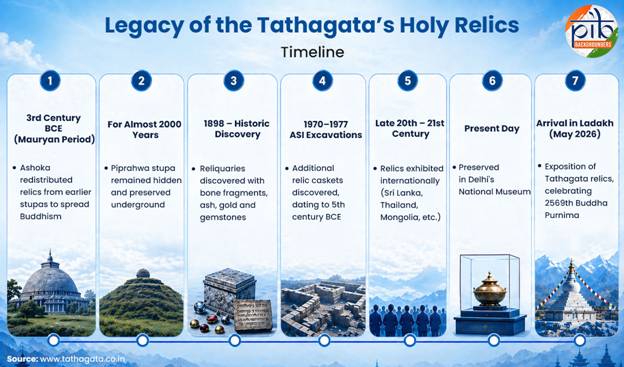
The sacred relics of the Tathāgata Buddha, part of the Piprahwa relics, are among the most revered remains of Gautama Buddha. For Buddhists worldwide, they are not mere archaeological artifacts but living symbols of devotion and enlightenment.
These relics (Sarira-Dhatu), featured in the Ladakh exposition, are preserved at the National Museum, New Delhi. They originate from excavations at the Piprahwa stupa in Siddharthanagar district, Uttar Pradesh. The site is associated with two major discoveries. The first was in 1898 by William Claxton Peppe. The second took place between 1971 and 1977 under K.M. Srivastava, conducted by the Archaeological Survey of India. These findings strengthened its identification with the Buddha’s legacy.
 The 1898 excavation revealed a stone coffer containing five urns. These urns held bone fragments, ashes, precious stones, and gold sheets. The gold sheets were intricately carved with sacred motifs. Among the notable finds were a crystal casket with a fish-shaped handle and a soapstone casket inscribed in Mauryan Brahmi. The inscription identified the relics as those of the Buddha. It also linked the site to ancient Kapilavastu, the Shakya capital. A significant portion of these relics was later dispersed. Some remained in private collections. Others were transferred to the Indian Museum, Kolkata.
The second excavation uncovered two uninscribed soapstone caskets. These contained 22 bone relics. They are dated to the 5th century BCE. They are believed to be part of the original stupa. The stupa was built by the Sakyan clan after the Buddha’s Mahaparinirvana. Today, 20 relics are housed in the National Museum, New Delhi. The remaining two are preserved in the Indian Museum, Kolkata. Additional discoveries included terracotta sealings and Brahmi inscriptions. These further confirmed Piprahwa as ancient Kapilavastu. They also strengthened its historical and spiritual significance.
India Strengthening Unity Across the Buddhist World
The Ministry of Culture has played a key role in fostering unity across the Buddhist world. By organizing international expositions and curated exhibitions of the sacred relics of Bhagwan Buddha, the National Museum actively promotes Buddhism’s cultural heritage and strengthens spiritual connections among nations. These initiatives have supported the spread of Buddha Dhamma and the preservation of shared cultural traditions.
In recent years, sacred relics have travelled to Mongolia, Thailand, Vietnam, Russia, Bhutan, and Sri Lanka, reinforcing spiritual and cultural ties across Asia. The Piprahwa relics from the National Museum were exhibited in Mongolia (2022). Relics of the Buddha and his two disciples from Sanchi were displayed in Thailand (2024). In 2025, relics from Nagarjunkonda, preserved by the Mahabodhi Society of Sarnath, were taken to Vietnam. That same year, relics from the National Museum were exhibited in Elista, Kalmykia (Russia) and Thimphu (Bhutan). In February 2026, the sacred Devnimori relics, enshrined at The Maharaja Sayajirao University of Baroda, were displayed in Colombo, Sri Lanka. Each of these journeys reflects India’s civilizational role as the birthplace of Buddhism and strengthens enduring spiritual, cultural, and people-to-people bonds across Asia.
Continuing this mission, the year began with the landmark exhibition “The Light and The Lotus – Relics of the Awakened One,” inaugurated by the Prime Minister at the Rai Pithora Cultural Complex, New Delhi. For the first time, the exhibition reunited Buddha’s relic jewels, taken to the United Kingdom during the colonial era, with the Piprahwa relics, reliquaries, and jewels preserved at the Indian Museum, Kolkata, and the National Museum, New Delhi. Their return after 127 years has revitalized spiritual and cultural connections within India and reconnected global audiences with the enduring wisdom of the Buddha’s teachings.
Eternal Legacy of the Tathagata
The sacred exposition of the holy relics of Tathagata Buddha stands as a profound expression of India’s enduring civilisational ethos and its commitment to preserving and sharing Lord Buddha’s teaching globally. Far beyond a ceremonial observance, the exposition reflects the living continuity of Buddhist heritage. It links ancient traditions with contemporary global concerns of peace, compassion and ethical living. By enabling public veneration under secure conditions, the initiative reaffirms the relics’ enduring spiritual significance.
At a macro level, the exposition reflects India’s use of shared heritage to foster international understanding. It complements ongoing efforts in repatriation, conservation, legal protection and Buddhist circuit development. Together, these initiatives show that preserving the past can help build a more connected and harmonious future.
References
Minister of EXTERNAL AFFAIRS
https://www.mea.gov.in/loksabha.htm?dtl/40696/QUESTION+NO+1270+INDIAS+BUDDHIST+DIPLOMACY
Ministry of Tourism
https://www.google.com/url?sa=i&source=web&rct=j&url=https://tourism.gov.in/sites/default/files/2026-04/usq.5037%2520for%252023.03.2026.pdf%23:~:text%3D(a)%2520to%2520(d):%2520Development%2520and%2520promotion%2520of,(CBDD)%27%2520%25E2%2580%2593%2520a%2520sub%252D%2520scheme%2520of%2520SD2.&ved=2ahUKEwio2czF34-UAxUxRmcHHebAGbEQqYcPegQICBAJ&opi=89978449&cd&psig=AOvVaw1y8R0g7nCLaNQhq7pMdL3Q&ust=1777438233890000
https://tourism.gov.in/whats-new/buddhist-sites-india
Rajya Sabha Questions
https://www.google.com/url?sa=t&source=web&rct=j&opi=89978449&url=https://sansad.in/getFile/annex/270/AU4471_QT4UTs.pdf%3Fsource%3Dpqars&ved=2ahUKEwiesL7F34-UAxWASWwGHYIEERYQFnoECCcQAQ&usg=AOvVaw1Xt0_Ro3m9wNnZPLwAnKzW
Ministry of Culture
https://www.indiaculture.gov.in/sites/default/files/pdf/Re(ad)dress_Return_of_Treasures_16012024.pdfhttps://indianculture.gov.in/retrieved-artefacts-of-india/artefact-chronicles/bronze-idols-ram-sita-and-lakshaman
UNESCO
https://www.unesco.org/en/fight-illicit-trafficking/about#:~:text=of%20the%20Convention-,States%20Parties,been%20ratified%20by%20148%20states.
Press Information Bureau
https://www.pib.gov.in/PressReleseDetailm.aspx?PRID=2237052®=3&lang=2
https://static.pib.gov.in/WriteReadData/specificdocs/documents/2024/feb/doc2024220313101.pdf
https://static.pib.gov.in/WriteReadData/specificdocs/documents/2025/aug/doc2025811604701.pdf
https://www.pib.gov.in/PressReleasePage.aspx?PRID=1673771
https://pib.gov.in/PressReleasePage.aspx?PRID=2177324
https://www.pib.gov.in/PressReleseDetail.aspx?PRID=2181063
https://www.pib.gov.in/PressReleaseIframePage.aspx?PRID=2150352#:~:text=Relics%20of%20Immense%20Spiritual%20and,archaeological%20discoveries%20in%20India's%20history.
https://www.pib.gov.in/PressNoteDetails.aspx?id=154972&NoteId=154972&ModuleId=3#:~:text=In%20a%20post%20on%20X,year%2C%20thanks%20to%20concerted%20efforts.
Others
https://sansad.in/getFile/annex/263/AS68.pdf?source=pqars
Click here to see PDF
************
PIB Research