Rail Safety Strengthened Through Modern Technology, Infrastructure and Enhanced Maintenance; Only Two Consequential Train Accidents Recorded in 2026-27 till Now
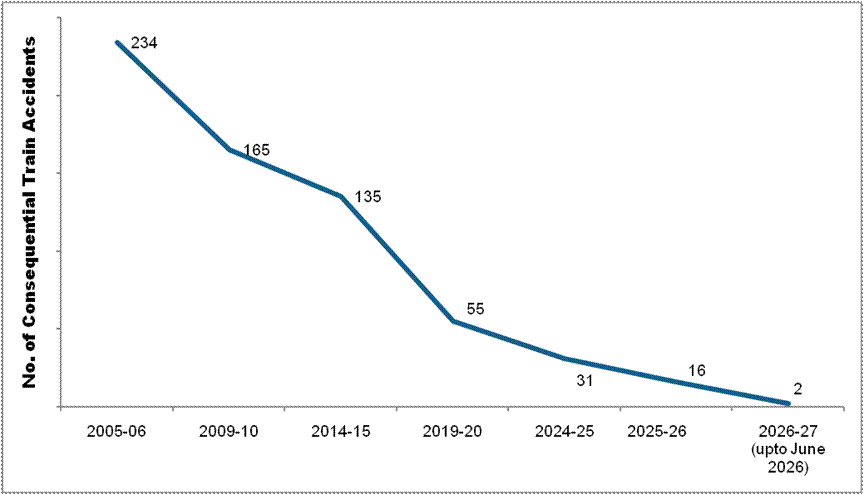
Safety is accorded the highest priority on Indian Railways. As a consequence of various safety measures taken over the years, there has been a steep decline in the number of accidents which includes collisions and train derailments also.
Number of Consequential Train Accidents has reduced as shown in the table below:-
|
Year
|
Consequential Accidents
|
|
2014-15
|
135
|
|
2025-26
|
16 (88% lesser)
|
|
2026-27 ( upto June 2026)
|
2
|
Another important index showing improvement in safety in train operations is Consequential Accident Index, the details of which are as under:-
Consequential Accident Index:-
|
Year
|
Accident Index
|
|
2014-15
|
0.11
|
|
2025-26
|
0.01(91% lesser)
|
This index measures number of consequential accidents as a ratio of total running kilometers of all trains.
Accident Index = No. of consequential accidents / No. of trains X million kilometers
The causes of the accidents that took place over Indian Railways broadly include track defects, loco/coach defects, equipment failures, human errors, etc.
Consequential Train Accidents on Indian Railways and casualties (including railway passengers and railway personnel) therein are as follows:-
|
Period
|
No. of Consequential Train Accidents
|
No. of Deaths
|
No. of Injuries
|
|
2004-05 to 2013-14
|
1,711
|
904
|
3,155
|
|
2014-15 to 2023-24
|
678
|
748
|
2,087
|
|
2024-25
|
31
|
18
|
92
|
|
2025-26
|
16
|
17
|
27
|
The various safety measures taken to enhance safety in train operations are as under:-
1. On Indian Railways, the expenditure on Safety related activities has increased over the years as under:-
|
Year
|
Expenditure/Budget on Safety related activities (Rs. in Cr.)
|
|
2013-14
|
39,200
|
|
2022-23
|
87,336
|
|
2023-24
|
1,01,662
|
|
2024-25
|
1,14,022
|
|
2025-26
|
1,17,693
|
|
2026-27
|
1,20,389
|
2. Electrical/Electronic Interlocking Systems with centralized operation of points and signals have been provided at 6,671 stations up to 30.06.2026 to reduce accidents due to human failure.
3. Interlocking of Level Crossing (LC) Gates has been provided at 10,395 Level Crossing Gates up to 30.06.2026 for enhancing safety at LC Gates.
4. Complete Track Circuiting of stations to enhance safety by verification of track occupancy by electrical means has been provided at 6,671 stations up to 30.06.2026.
5. Detailed instructions on issues related with safety of Signalling, e.g. mandatory correspondence check, alteration work protocol, preparation of completion drawing, etc. have been issued.
6. System of disconnection and reconnection for S&T equipment as per protocol has been re-emphasized.
7. All locomotives are equipped with Vigilance Control Devices (VCD) to improve alertness of Loco Pilots.
8. Retro-reflective sigma boards are provided on the mast which is located two OHE masts prior to the signals in electrified territories to alert the crew about the signal ahead when visibility is low due to foggy weather.
9. A GPS based Fog Safety Device (FSD) is provided to loco pilots in fog affected areas which enables loco pilots to know the distance of the approaching landmarks like signals, level crossing gates, etc.
10. Modern track structure consisting of 60kg, 90 Ultimate Tensile Strength (UTS) rails, Prestressed Concrete Sleeper (PSC) Normal/Wide base sleepers with elastic fastening, fan shaped layout turnout on PSC sleepers, Steel Channel/H-beam Sleepers on girder bridges is used while carrying out primary track renewals.
11. Mechanisation of track laying activity through use of track machines like PQRS, TRT, T-28 etc. to reduce human errors.
12. Maximizing supply of 130m/260m long rail panels for increasing progress of rail renewal and avoiding welding of joints, thereby improving safety.
13. Ultrasonic Flaw Detection (USFD) testing of rails to detect flaws and timely removal of defective rails.
14. Laying of longer rails, minimizing the use of Alumino Thermic Welding and adoption of better welding technology for rails i.e., Flash Butt Welding.
15. Monitoring of track geometry by OMS (Oscillation Monitoring System) and TRC (Track Recording Cars).
16. Patrolling of railway tracks to look out for weld/rail fractures.
17. The use of Thick Web Switches and Weldable CMS Crossing in turnout renewal works.
18. Inspections at regular intervals are carried out to monitor and educate staff for observance of safe practices.
19. Web based online monitoring system of track assets viz. Track database and decision support system has been adopted to decide rationalized maintenance requirement and optimize inputs.
20. Detailed instructions on issues related with safety of Track, e.g. integrated block, corridor block, worksite safety, monsoon precautions, etc. have been issued.
21. Preventive maintenance of railway assets (Coaches & Wagons) is undertaken to ensure safe train operations.
22. Replacement of conventional ICF design coaches with LHB design coaches is being done.
23. All unmanned level crossings (UMLCs) on Broad Gauge (BG) route have been eliminated by January 2019.
24. Safety of Railway Bridges is ensured through regular inspection of Bridges. The requirement of repair/rehabilitation of Bridges is taken up based upon the conditions assessed during these inspections.
25. Indian Railways has displayed Statutory “Fire Notices” for widespread passenger information in all coaches. Fire posters are provided in every coach so as to educate and alert passengers regarding various Do’s and Don’ts to prevent fire. These include messages regarding not carrying any inflammable material, explosives, prohibition of smoking inside the coaches, penalties etc.
26. Production Units are providing Fire detection and suppression system in newly manufactured Power Cars and Pantry Cars, Fire and Smoke detection system in newly manufactured coaches. Progressive fitment of the same in existing coaches is also underway by Zonal Railways in a phased manner.
27. Regular counselling and training of staff is undertaken.
28. Concept of Rolling Block introduced in Indian Railways (Open Lines) General Rules vide Gazette notification dated 30.11.2023, wherein work of integrated maintenance/ repair/replacement of assets is planned up to 52 weeks in advance on rolling basis and executed as per plan.
The details of the Safety related works related to better maintenance practices, Technological improvements, better infrastructure and rolling stock etc. undertaken by Railways are tabulated below:-
|
S.No.
|
Item
|
2004-05 to 2013-14
|
2014-15 to
2025-26
|
2014-26 Vs. 2004-14
|
|
|
Technological Improvements
|
|
1.
|
Use of high-quality rails (60 Kg) (Km)
|
57,450 Km
|
1.63 Lakh Km
|
More than 2.8 times
|
|
2.
|
Longer Rail Panels (260m) (Km)
|
9,917 Km
|
87,219 Km
|
Nearly 9 times
|
|
3.
|
Electronic Interlocking (Stations)
|
837 Stations
|
3,691 Stations
|
More than 4 times
|
|
4.
|
Fog Pass Safety Devices (Nos.)
|
As on 31.03.14:
90 Nos.
|
As on 31.03.26: 31,693 Nos.
|
352 times
|
|
5.
|
Thick Web Switches (Nos.)
|
Nil
|
35,971 Nos.
|
|
|
|
Better Maintenance Practices
|
|
1.
|
Primary Rail Renewal (Track Km)
|
32,260 Km
|
57,583 Km
|
1.78 times
|
|
2.
|
USFD (Ultra Sonic Flaw detection) Testing of Welds (Nos.)
|
79.43 Lakh
|
2.25 Crore
|
More than 2.8 times
|
|
3.
|
Weld failures (Nos.)
|
In 2013-14: 3,699 Nos.
|
In 2025-26:
272 Nos.
|
93 % reduction
|
|
4.
|
Rail fractures (Nos.)
|
In 2013-14: 2,548 Nos.
|
In 2025-26:
208 Nos.
|
92% reduction
|
|
|
Better Infrastructure and Rolling Stock
|
|
1.
|
New Track KM added (Track Km)
|
14,985 Km
|
36,429 Km
|
Almost 2.5 times
|
|
2.
|
Flyovers (RoBs)/Underpasses (RUBs) (Nos.)
|
4,148 Nos.
|
14,362 Nos.
|
More than 3 times
|
|
3.
|
Unmanned Level crossings
(Nos.) on BG
|
As on 31.03.14:
8,948
|
As on 31.03.26: Nil (All eliminated by 31.01.19)
|
Removed
|
|
4.
|
Manufacture of LHB Coaches (Nos.)
|
2,337 Nos.
|
49,366
|
More than 21 times
|
Implementation of Kavach:-
1. Kavach is an indigenously developed Automatic Train Protection (ATP) system. Kavach is a highly technology intensive system, which requires safety certification of highest order (SIL-4).
2. Kavach aids the Loco Pilot in running of trains within specified speed limits by automatic application of brakes in case Loco Pilot fails to do so and also helps the trains to run safely during inclement weather.
3. The first field trials on the passenger trains were started in February 2016. Based on the experience gained and Independent Safety Assessment of the system by Independent Safety Assessor (ISA), three firms were approved in 2018-19, for supply of Kavach Ver 3.2.
4. Kavach was adopted as National ATP system in July, 2020.
5. Implementation of Kavach System involves following Key Activities:-
a. Installation of Station Kavach at each and every station, block section.
b. Installation of RFID Tags throughout the track length.
c. Installation of telecom Towers throughout the section.
d. Laying of Optical Fibre Cable along the track.
e. Provision of Loco Kavach on each and every Locomotive running on Indian Railways.
6. Based on deployment of Kavach version 3.2 on 1465 RKm on South Central Railway and experience gained, further improvements were made. Finally, Kavach specification version 4.0 was approved by RDSO on 16.07.2024.
7. Kavach version 4.0 covers all the major features required for the diverse railway network. This is a significant milestone in safety for Indian Railways. Within a short period, IR has developed, tested and started deploying Automatic Train Protection System.
8. Major improvement in Version 4.0 includes increased Location Accuracy, Improved Information of Signal Aspects in bigger yards, Station to Station Kavach interface on OFC and Direct Interface to existing Electronic Interlocking System. With these improvements, Kavach Ver.4.0. is planned for large scale deployment over Indian Railways.
9. After extensive and elaborate trials, Kavach Version 4.0 has been successfully commissioned on 2490 Route Kilometres as on 13.07.2026, covering the high density Delhi- Mumbai and Delhi-Howrah routes as below:-
|
S. No.
|
Section
|
Progress (RouteKm)
|
|
(1)
|
Delhi-Mumbai route: 1344 Rkm
|
|
i
|
Tilak Bridge – Junction cabin – Palwal – Mathura – Nagda – Vadodra – Virar section
(Except Mangalmhudi – Panchpipliya)
|
1248
|
|
ii
|
Vadodara – Ahmedabad section
|
96
|
|
(2)
|
Delhi – Howrah route: 1146 Rkm
|
|
i.
|
Chipyana – Tundla– Kanpur – Subedarganjsection
|
563
|
|
ii.
|
Kanpur – Lucknow section
|
71
|
|
iii.
|
DDU(FOC) –Bhabua Road section
|
50
|
|
iv.
|
Sasaram – Pheser section
|
43
|
|
v.
|
Gaya – Sarmatarn – Nimiaghat section
|
159
|
|
vi.
|
Chota Ambana - Bardhaman – Howrah section
|
260
|
10. In addition, track side Kavach implementation work is being taken up on 21,937 RKM covering all GQ,GD,HDN and identified sections of Indian Railways.
11. The total progress of key items of Kavach on Indian Railway sections are as under:-
|
S. No.
|
Item
|
Progress
|
|
i
|
Laying of Optical Fibre Cable
|
11,253 Km
|
|
ii
|
Installation of Telecom Towers
|
1,668 Nos.
|
|
iii
|
Station Data Centre
|
958 Station
|
|
iv
|
Installation of Track side equipment
|
7,721RKm
|
|
v
|
Provision of Kavach in Loco
|
6,045 Nos.
|
12. In addition, work for installation of Kavach in 7,435 Locomotives and 1,200 EMU/MEMU has been taken up.
13. Specialized training programmes on Kavach are being conducted at centralized training institutes of Indian Railways to impart training to all concerned officials. By now more than 94,000 technicians, operators and engineers have been trained on Kavach technology. This includes about 57,000 Loco Pilots & Assistant Loco Pilots. Courses have been designed in collaboration with IRISET.
14. The funds utilized on Kavach works so far up to Jun’26 is Rs.3874.9 cr. The allocation of funds during the year 2026-27 is Rs.2066.24 crore. Requisite funds are made available as per the progress of works.
Inquiries into the rail accidents are carried out by the statutory bodies, the Commission of Railway Safety (CRS) under Ministry of Civil Aviation and the Departmental Inquiry Committees also as per laid down norms.
CRS of respective circles after due deliberations submit their findings and recommendations in accidents. Appropriate action is taken by the respective Railway administration on the recommendations, suggested by the CRS in their reports. The action taken reports address the deficiencies found and hence help avoiding recurrence of similar accidents.
This information was provided by the Union Minister for Railways, Information & Broadcasting and Electronics & Information Technology, Shri Ashwini Vaishnaw, in a reply to a question in Lok Sabha today.
*****
Dharmendra Tewari/ Dr. Nayan Solanki/ Ritu Raj/ Manik Sharma