Economy
New Labour Codes Transforming Plantation Workers’ Rights
प्रविष्टि तिथि:
07 DEC 2025 10:35 AM
Key Takeaways
- New Labour Codes create uniform standards that strengthen worker protections and simplify compliance in the plantation sector.
- The move from the old framework to the new Labour Codes replaces fragmented provisions with comprehensive reforms for the plantation sector.
- Improved worker and family well-being through stronger welfare, safer workplaces, and expanded social security provisions.
- Women, migrants, and seasonal workers gain greater access, stability, and opportunity under an inclusive, modernised protective framework.
|
Introduction
Plantation workers form a vital part of India’s labour force, supporting agricultural production, export earnings, and rural livelihoods. For decades, their working conditions, housing, welfare, and medical facilities were shaped by the Plantations Labour Act, 1951, which laid the foundation for worker protections in the sector. However, even as it provided important safeguards for its time, the framework remained limited in coverage, with fragmented social security measures and little support for seasonal and migrant workers.
With the implementation of the new Labour Codes, particularly the Code on Wages 2019 (WC), the Occupational Safety, Health and Working Conditions (OSH&WC) Code 2020 and the Social Security (SS) Code 2020, the framework governing Plantation Workers has been renewed, widened and strengthened. These Codes retain relevant existing safeguards and also expand them, aligning them with modern labour requirements, placing plantation labour under a unified national system of protection. They bring Plantation Workers into a wider & uniform system that covers health, safety, welfare, social security and portability of benefits.
Changing Landscape for Plantation Labour
Protections Under the Plantations Labour Act, 1951
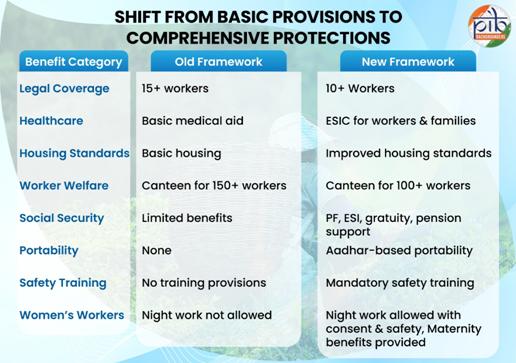
The Plantations Labour Act, 1951 created the first comprehensive framework to regulate protections such as medical care, housing, canteens, crèches, and hours/leaves in plantations. However, over the years, gaps became evident: limited coverage, fragmented social-security systems, and minimal support for seasonal and migrant workers. The Act covered the following key provisions:
- Legal Applicability: The Act applied only to plantations with less than or equal to 15+ workers or 5 hectares and above of land.
- Facilities & Welfare Provisions: Employers had to provide medical aid, drinking water, sanitation, and housing in plantations; welfare facilities included canteens for establishments with 150+ workers, crèches for establishments with 50+ women workers along with support for education.
- Working Hours, Leave & Social Security: Daily/ weekly working hours were fixed with provisions for overtime and annual leave with wages. Social security was limited to gratuity (after 5 years) and maternity leave was covered under a separate Act. Moreover, provisions of Employee State Insurance (ESI) and Provident Fund (PF) were not universally applicable.
- Women Workers & Migrant/ Seasonal Workers: Women were barred from working between 7 PM and 6 AM, and migrant/ seasonal workers had no portability of benefits.
- Training & Safety Standards: There were no specific legal provisions for training or safety measures related to chemical handling.
Coverage and Recognition Under a Wider Legal Umbrella
With the new Labour Codes, Plantation Workers’ protections have evolved, from limited, fragmented safeguards to a consolidated, expanded and welfare-based system. Coverage has been extended to include all plantations employing 10 or more workers or spread across 5 hectares or more.
This brings plantation workers into a unified labour ecosystem where all major aspects such as, wages, safety, working conditions, benefits, and social security, are governed together.
Labour Codes Strengthening Worker and Family Well-Being
The Codes introduce stronger health and welfare standards that directly improve living conditions for Plantation Workers and their families. These provisions improve well-being and create a healthier, more balanced environment for workers.
- Mandatory ESIC Coverage: Employees’ State Insurance (ESI) coverage has been extended for plantation workers, ensuring that both workers and their families receive medical facilities either from the employer or through ESIC.
- Improved Housing Standards: The employer must provide housing with water, a kitchen, and toilet facilities for the worker and their family, either directly or through government/ municipal schemes.
- Welfare Facilities for Families: A canteen must be provided in plantations employing 100 or more workers, including contract labour.
- A crèche facility is required where 50 or more employees are engaged, availed through common crèche facilities or pooled resources.
- Educational facilities must be provided for children aged 6-12 years, where 25 or more children of workers are present.
Employer must provide these welfare facilities directly or through govt/municipal schemes.
Harmonised, Safer, and More Regulated Workplaces
The Labour Codes create a safer, more consistent, and worker-friendly environment across plantations.
- Working Hours & Leave: Standard working hours, overtime pay, rest intervals, and leave with wages are now harmonised across industries.
- Safety & Training Requirements: Under the OSH&WC Code, employers must provide protective equipment to prevent accidents/exposure along with mandatory training on the safe handling, storage, and use of chemicals, along with protective equipment to prevent accidents and exposure.
Plantation workers benefit from clearer and more predictable work schedules, ensuring a healthier work balance. Also, with improved safety standards and better training support, overall workplace well-being and security have become more stable.
Expanded Social Security & Portability
- Integrated Social-Security Coverage: Under the Social Security Code, social-security benefits have been expanded to include Provident Fund (PF) and pension/old-age protection. Gratuity is payable after five years of service, or after one year in the case of fixed-term employment.
- Portability for Migrant & Seasonal Workers: Portability of benefits is enabled through Aadhaar-linked registration for migrant and seasonal workers. Aadhaar-based digital registration ensures that PF, ESI, and gratuity can be carried across states and employers.
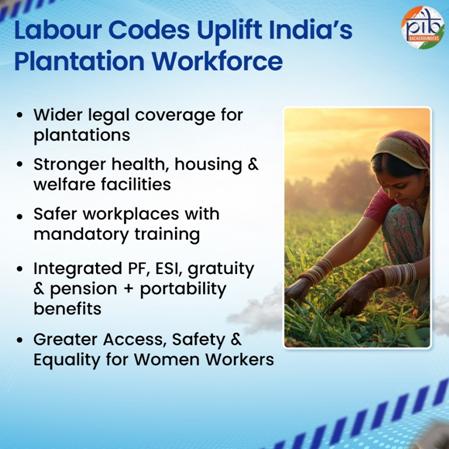
The new provisions ensure long-term financial security and greater stability for plantation workers. Seamless continuity of entitlements also allow migrant and seasonal workers to access their benefits wherever they work.
Greater Access, Safety & Equality for Women Workers
The Labour Codes significantly strengthen opportunities and support systems for women in plantation work by recognising women’s needs at every stage of work and family life.
- Expanded Work Opportunities: Women workers are allowed to work at night, before 6 a.m. and beyond 7 p.m, with their consent, subject to adequate safety measures ensured by employer.
- Supportive Infrastructure: Crèche and maternity protections are guaranteed for women workers. Maternity benefits include 26 weeks of leave and nursing breaks.
Women now have greater access to a wider & safe range of work opportunities. Enhanced support for maternity and childcare helps women balance work and family, ensuring stability in livelihood.
Conclusion
The new Labour Codes mark a major turning point for those who have sustained the nation’s fields. With better health care, safer workplaces, improved housing, and inclusive protections, the Codes bring opportunity and security, for families, women and migrants, building a more equal workforce.
These changes mark the beginning of a more secure and confident journey for Plantation Workers, where improved protections bring not just safety, but a sense of progress and possibility for the years ahead.
See in PDF
***
M
(तथ्य सामग्री आईडी: 150543)
आगंतुक पटल : 284
Provide suggestions / comments