Farmer's Welfare
Paramparagat Krishi Vikas Yojana (PKVY): Nurturing Organic Farming in India
Posted On: 07 OCT 2025 4:10PM
Summary
- Paramparagat Krishi Vikas Yojana (PKVY) was launched in 2015 under the National Mission for Sustainable Agriculture.
- As of 30.01.2025, ₹2,265.86 crore released under PKVY (2015–25).
- ₹205.46 crore released for PKVY under RKVY in FY 2024–25.
- Around 15 lakh hectares under organic farming; 52,289 clusters formed; 25.30 lakh farmers benefitted (as of February 2025).
- By December 2024, 6.23 lakh farmers, 19,016 local groups, 89 input suppliers, and 8,676 buyers registered on Jaivik Kheti portal.
Q1. What is Paramparagat Krishi Vikas Yojana (PKVY)?
The Paramparagat Krishi Vikas Yojana (PKVY) is a government initiative introduced in 2015 as part of the National Mission for Sustainable Agriculture. PKVY’s objective is to foster organic farming through a cluster-based approach, thus restoring ecological balance and improving the livelihood of farmers. The scheme aims to advance a scalable model of eco-agriculture integrating low-cost, chemical-free techniques with farmer collectives, enhancing food safety, income generation, and environmental sustainability.
Eligibility for PKVY extends to all farmers and institutions possessing up to 2 hectares of land. The initiative mobilizes farmers into clusters of 20 hectares each to adopt organic farming collectively, ensuring uniform standards, reducing costs through shared resources, and encouraging diversified farming systems.
Q2. What are the key benefits of PKVY?
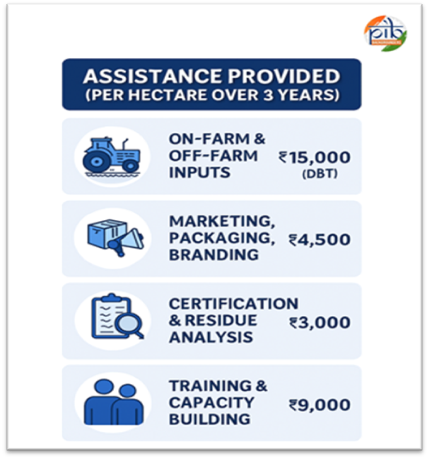
Under Paramparagat Krishi Vikas Yojana (PKVY), farmers adopting organic farming practices are being assisted with ₹31,500 per hectare for a three-year period. The support is structured as follows:
- On-farm & off-farm organic inputs
- Marketing, packaging & branding
- Certification & residue analysis
- Training & capacity building
PKVY assists farmers in branding and linking with markets, including facilitating direct sales through digital platforms. PKVY has built trust in Indian organic products in both domestic and international markets. Farmers are now better positioned to capture price premiums, access niche consumers, and strengthen local brands rooted in organic identity.
The Jaivik Kheti Portal enables the direct sale of organic products from farmers to consumers, promoting transparency and market access.
Q3. How is PKVY implemented at the ground level?
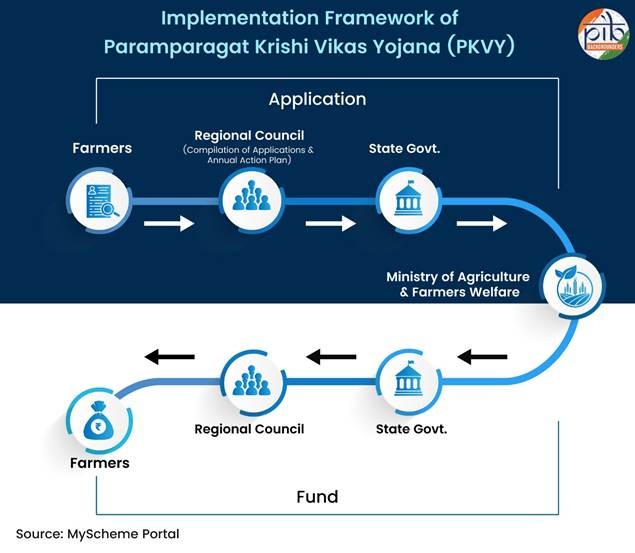
Farmers begin the process by approaching their Regional Councils, which are responsible for guiding them through enrolment and certification. These Regional Councils compile the individual applications into an Annual Action Plan, which is then submitted to the Ministry of Agriculture & Farmers Welfare for approval.
Upon approval of the Annual Action Plan, the Central Government allocates funds to the State Government, which then passes them on to the Regional Councils. The Councils, in turn, disburse assistance directly to farmers through the Direct Benefit Transfer (DBT) mechanism. This is to ensure that PKVY’s financial support for inputs, training, certification, and marketing reaches recipients in a transparent and prompt manner.
Q4. What certification does PKVY offer to organic farmers?
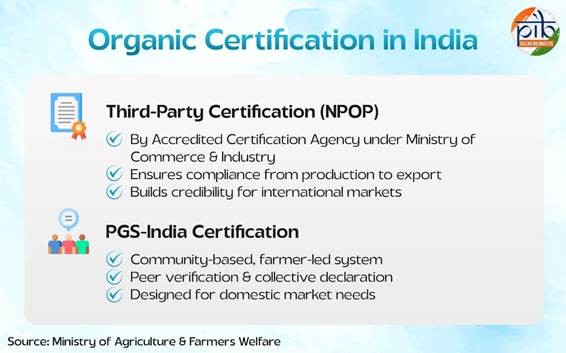
PKVY facilitates two systems — third-party certification under NPOP for international markets, and the Participatory Guarantee System of India (PGS-India), a community-based certification for domestic markets.
NPOP is an accreditation system that ensures Indian organic products comply with international standards covering production, processing, trading, and exports.
PGS-India is a farmer-centric, community-based certification system involving peer inspections and mutual verification, mainly serving small and marginal farmers for the domestic market.
Q5. What is Large Area Certification (LAC) under PKVY?
In 2020–21, the Government launched the Large Area Certification (LAC) programme to fast-track certification in regions where chemical farming has never been practiced (tribal belts, islands, eco-preserved zones). The LAC reduces the conversion period from 2 to 3 years to a few months, enabling quicker certification, higher incomes, and enhanced global competitiveness for India’s organic sector.
Q6. How has the scheme benefited North-East India?
Under the PKVY, Assam has brought 4,400 hectares under organic farming, engaging 9,740 farmers in the initiative. In Sikkim, the scheme has supported organic farming on 63,000 hectares under the Large Area Certification (LAC), making Sikkim the only fully organic state in the world recognized under LAC. Collectively, the states of Arunachal Pradesh, Mizoram, Manipur, Nagaland, Tripura, and Meghalaya have covered a total of 4,140 hectares through this scheme. In terms of financial support, Assam has received approximately ₹3,013 crore, Sikkim has been allocated ₹1,849 crore, while the other North-eastern states have collectively received about ₹2,337 crore under PKVY.
Reference
PIB Backgrounder:
https://www.pib.gov.in/PressNoteDetails.aspx?NoteId=155346&ModuleId=3
(Faq ID: 155374)
Visitor Counter: 5913
Provide suggestions / comments
इस विज्ञप्ति को इन भाषाओं में पढ़ें:
Assamese