Others
100 days of Modi 3.0: Accelerating Infrastructure and Economic Growth
Posted On:
18 SEP 2024 4:10PM
In the first 100 days of Prime Minister Shri Narendra Modi's third term, the Indian government has unveiled a series of transformative initiatives aimed at bolstering the nation's infrastructure, economic growth, and innovation. Key infrastructure projects worth Rs. 3 lakh crores have been launched, including the construction of a mega port in Vadhavan, Maharashtra, poised to become one of the world's top 10 ports. Significant investments in expanding road networks, upgrading airports, and advancing metro projects reflect a comprehensive strategy to enhance connectivity and tourism. At the same time, policies focused on economic growth, such as reducing corporate tax rates for foreign companies and launching a Rs. 1,000 crore Venture Capital Fund for space startups, showcase India's commitment to fostering innovation and attracting global investment.
Union Budget 2024-2025
Significant announcements have been made in relation to the infrastructure sector in the Union Budget 2024-25, presented by the Union Minister of Finance and Corporate Affairs Smt. Nirmala Sitharaman. The Finance Minister emphasised the Central Government's significant investment in building and improving infrastructure over the years, which has had a strong multiplier effect on the economy. The government will maintain strong fiscal support for infrastructure over the next five years, while balancing other priorities and fiscal consolidation. An allocation of ₹11,11,111 crore for capital expenditure, which is 3.4 per cent of GDP, has been made this year.
Ports, Shipping and Waterways
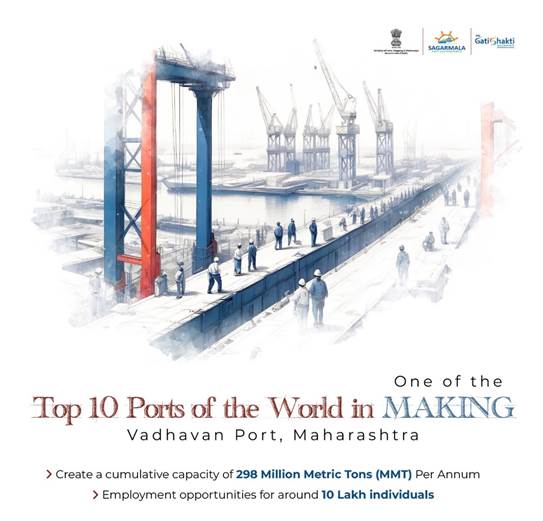
Foundation stone laid for Vadhavan Port in Maharashtra
The Prime Minister laid the foundation stone for Vadhavan Port in Maharashtra, a ₹76,000 crore all-weather port set to become one of the world's top 10 ports. It aims to establish a world-class maritime gateway to boost the country’s trade and economic growth by catering to large container vessels, offering deeper drafts, and accommodating ultra-large cargo ships.
Vadhvan Port, located near Dahanu town in Palghar district, will be one of India’s largest deep-water ports and will provide direct connectivity to international shipping routes, reducing transit times and costs. Equipped with state-of-the-art technology and infrastructure, the port will feature deep berths, efficient cargo handling facilities, and modern port management systems. The port is expected to generate significant employment opportunities, stimulate local businesses, and contribute to the region's overall economic development.
The Vadhvan Port project incorporates sustainable development practices focusing on minimising environmental impact and adhering to stringent ecological standards. Once operational, the port will enhance India's maritime connectivity and strengthen its global trade hub position. The deployment of emerging technologies and logistics solutions in developing the all-weather deep-draft Vadhavan Port shall stimulate startups and industries working in the maritime domain and help in knowledge creation while promoting Make in India in the process.
Road Connectivity
On August 02, 2024, the Cabinet Committee on Economic Affairs, chaired by Prime Minister Shri Narendra Modi, approved the development of eight National High-Speed Corridor projects across the country with a length of over 900 km at a cost of Rs. 50,655 crores. Implementation of these eight projects will generate an estimated 4.42 crore man-days of direct and indirect employment.
- 6-Lane Agra - Gwalior National High-Speed Corridor
The 88-km high-speed corridor will be developed on Build-Operate-Transfer (BOT) mode as a fully access-controlled 6-lane corridor at a total capital cost of Rs. 4,613 Crore. The project will supplement the existing 4-lane National Highway to increase the traffic capacity by more than 2 times in the Agra - Gwalior section of the North South Corridor (Srinagar - Kanyakumari). The corridor will enhance connectivity to key tourist destinations in Uttar Pradesh (e.g., Taj Mahal, Agra Fort, etc) and Madhya Pradesh (e.g., Gwalior Fort, etc). It will reduce the distance between Agra and Gwalior by 7% and the travel time by 50%, thereby bringing in a substantial reduction in logistics cost. The 6-lane access-controlled Agra- Gwalior greenfield highway will be starting from design km 0.000 (near village Deori in district Agra) to design km 88-400 (near village Susera in district Gwalior) in the states of Uttar Pradesh, Rajasthan and Madhya Pradesh including the overlay/strengthening and other road safety and improvement works on existing Agra-Gwalior section of NH-44.
- 4-Lane Kharagpur - Moregram National High-Speed Corridor
The 231-km 4-lane access-controlled high-speed corridor between Kharagpur and Moregram will be developed in Hybrid Annuity Mode (HAM) at a total capital cost of Rs. 10,247 Crore. The new corridor will supplement the existing 2-lane National Highway to increase the traffic capacity by about 5 times between Kharagpur and Moregram. It will provide efficient connectivity for traffic between states such as West Bengal, Odisha, Andhra Pradesh etc. on one end and North-Eastern part of the country on the other. The corridor will enable reduction in travel time from existing 9 to 10 hours to 3 to 5 hours for freight vehicles between Kharagpur and Moregram, thereby reducing logistics cost.
3. 6-Lane Tharad - Deesa - Mehsana - Ahmedabad National High-Speed Corridor
The 214-km 6-Lane High-Speed Corridor will be developed in Build - Operate - Transfer (BOT) mode at a total capital cost of Rs. 10,534 Crore. The Tharad - Ahmedabad corridor will provide connectivity between two key National Corridors in the state of Gujarat, viz., Amritsar - Jamnagar Corridor and Delhi - Mumbai Expressway, thereby providing seamless connectivity for the freight vehicles originating from industrial regions of Punjab, Haryana, and Rajasthan to the major ports in Maharashtra (JNPT, Mumbai and newly-sanctioned Vadhavan port). The corridor will also connect key tourist destinations in Rajasthan (e.g., Mehrangarh Fort, Dilwara Temple, etc.) and Gujarat (e.g., Rani ka Vav, Ambaji Temple, etc.). It will further reduce the distance between Tharad and Ahmedabad by 20% and the travel time by 60%, thereby improving logistics efficiency.
- 4-lane Ayodhya Ring Road
The 68-km 4-lane access-controlled Ayodhya Ring Road will be developed in Hybrid Annuity Mode (HAM) at a total capital cost of Rs. 3,935 Crore. The Ring Road will reduce congestion on National Highways passing through the city, viz., NH 27 (East West Corridor), NH 227 A, NH 227B. NH 330, NH 330A, and NH 135A, thereby enabling fast movement of pilgrims visiting the Rama Mandir. The Ring Road will also provide seamless connectivity to national and international tourists arriving from Lucknow International Airport, Ayodhya Airport and major railway stations in the city.
5. 4-Lane Section between Pathalgaon and Gumla of Raipur-Ranchi National High-speed Corridor
The 137-km 4-lane access-controlled Pathalgaon - Gumla section of Raipur - Ranchi Corridor will be developed in Hybrid Annuity Mode (HAM) at a total capital cost of Rs. 4,473 Crore to complete the whole corridor. It will enhance connectivity between mining areas in Gumla, Lohardaga, Raigarh, Korba and Dhanbad and industrial and manufacturing zones located in Raipur, Durg, Korba, Bilaspur, Bokaro, and Dhanbad. The 4-lane Pathalgaon-Kunkun-Chhattisgarh/Jharkhand Border-Gumla-Bharda section of National Highway-43 will start from the end point of National Highway-130A near the Turua Ama village and end at Chainage 82+150 of Palma-Gumla Road near Bharda village as part of Raipur-Dhanbad Economic Corridor.
- 6-Lane Kanpur Ring Road
The 47-km 6-Lane Access-controlled section of Kanpur Ring Road will be developed in Engineering, Procurement and Construction Mode (EPC) at a total capital cast of Rs. 3,298 crores. This section will complete the 6-lane National Highway Ring around Kanpur. The Ring Road will enable segregation of long-distance traffic on the key National Highways, viz., NH 19 - Golden Quadrilateral, NH 27 - East West Corridor, NH 34 and upcoming Lucknow - Kanpur Expressway and Ganga Expressway from the city-bound traffic, thereby improving logistics efficiency for freight travelling between Uttar Pradesh, Delhi, Bihar, Jharkhand and West Bengal.
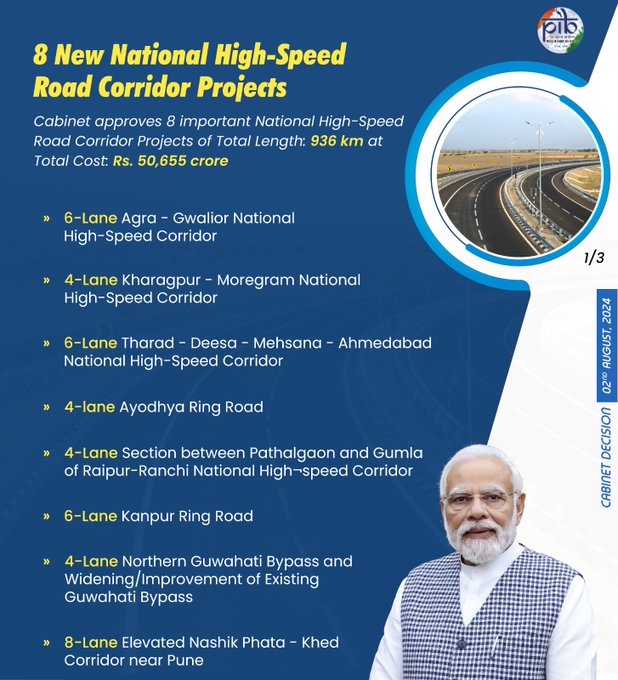
- 4-Lane Northern Guwahati Bypass and Widening/Improvement of Existing Guwahati Bypass
121-km Guwahati Ring Road will be developed in Build Operate Toll (BOT) mode at a total capital cost of Rs. 5,729 crores in three sections viz., 4-lane Access-Controlled Northern Guwahati Bypass (56 km), widening of the existing 4-lane bypass on NH 27 to 6 lanes (8 km), and improvement of existing bypass on NH 27 (58 km). A major bridge over river Brahmaputra will also be constructed as a part of the project. The Guwahati Ring Road will provide seamless connectivity to long-distance traffic plying on National Highway 27 (the East West Corridor), which is the gateway to North-East Region of the country. The Ring Road will ease congestion on major National Highways around Guwahati, connecting major cities/ towns in the region - Siliguri, Silchar, Shillong, Jorhat, Tezpur, Jogigopha, and Barpeta.
- 8-Lane Elevated Nashik Phata - Khed Corridor near Pune
30-km 8-Lane elevated National High-Speed Corridor from Nashik Phata to Khed near Pune will be developed on Build-Operate-Transfer (BOT) at a total capital cost of Rs. 7,827 Crore. The elevated corridor will provide seamless high-speed connectivity for traffic originating from/ heading to industrial centers of Chakan, Bhosari etc. on NH-60 between Pune and Nashik. The corridor will also alleviate serious congestion around Pimpri-Chinchwad. The 8-Lane Elevated Flyover at Tier - 1 on Single Pier including Upgradation of Existing Road to 4/6 Lane with 2 Lane Service Road on both sides of Nashik Phata to Khed will be completed on section of NH-60 in the state of Maharashtra.
Shinkhun La Tunnel
Shinkhun La Tunnel, which will become the world's highest tunnel upon completion, ensuring year-round connectivity between Ladakh and Himachal Pradesh. It consists of a 4.1 km long Twin-Tube tunnel to be constructed at around 15,800 feet on the Nimu – Padum – Darcha Road to provide all-weather connectivity to Leh. Shinkun La tunnel will not only ensure swift and efficient movement of our armed forces and equipment but also foster economic and social development in Ladakh.[3]
Railway & Metro Connectivity
The Cabinet Committee on Economic Affairs, chaired by Prime Minister Narendra Modi, approved eight projects under the Ministry of Railways, with an estimated total cost of approximately ₹24,657 crore. These projects are expected to be completed by the 2030-31 fiscal year. These new railway line proposals are designed to provide direct connectivity, improve mobility, minimize logistics cost, reduce oil imports and lower CO2 emissions. Aligned with Prime Minister Shri Narendra Modi’s vision of a New India, these initiatives aim to empower the region's people, making them "Atmanirbhar" (self-reliant) through comprehensive development, which will improve employment and self-employment opportunities.
The eight projects cover 14 districts across seven states - Odisha, Maharashtra, Andhra Pradesh, Jharkhand, Bihar, Telangana, and West Bengal- and will extend the Indian Railways
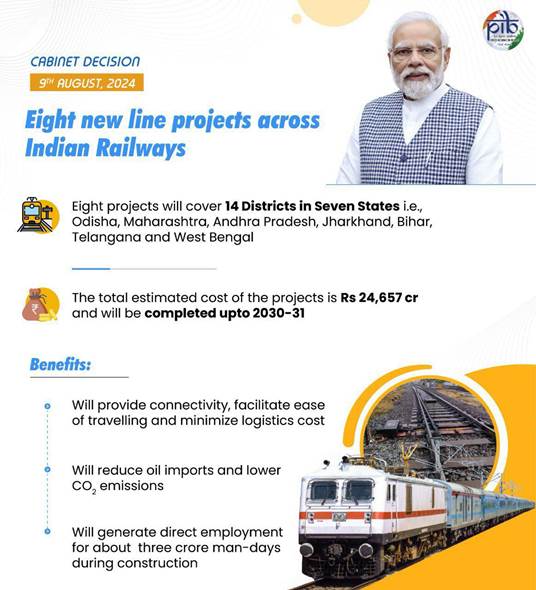
network by 900 kilometres. In addition, 64 new stations will be constructed as part of the projects, improving connectivity to six Aspirational Districts (East Singhbum, Bhadradri Kothagudem, Malkangiri, Kalahandi, Nabarangpur, and Rayagada), approximately 510 villages, and around 40 lakh people.
These routes are crucial for transporting commodities such as agricultural products, fertilizers, coal, iron ore, steel, cement, bauxite, limestone, aluminium powder, granite, ballast, containers, etc. The capacity augmentation works will result in additional freight traffic of 143 MTPA (Million Tonnes Per Annum). The Railways, being an environmentally friendly and energy-efficient mode of transportation, will help achieve climate goals, minimize the country's logistics costs, reduce oil imports by 32.20 crore liters, and lower CO2 emissions by 0.87 million tonnes, which is equivalent to planting 3.5 crore trees. Ajanta Caves, a UNESCO World Heritage site, will be connected to the Indian Railway Network, facilitating a large number of tourists. These projects are a result of the PM-Gati Shakti National Master Plan for multi-modal connectivity, made possible through integrated planning, and will provide seamless connectivity for the movement of people, goods, and services.
Metro Connectivity
Metro projects in Pune, Thane and Bengaluru worth Rs. 30,700 crores to strengthen public transport and reduce travel time.
Phase-3 of Bangalore Metro Rail Project
The Union Cabinet, chaired by the Prime Minister Shri Narendra Modi, approved the Phase-3 of Bangalore Metro Rail Project with two elevated corridors for a length of 44.65 Km with 31 stations on August 16 2024. Corridor-1 from JP Nagar 4th Phase to Kempapura (along Outer Ring Road West) for a length of 32.15 Km with 22 stations and Corridor-2 from Hosahalli to Kadabagere (along Magadi Road) for a length of 12.50 Km with 9 stations. On operationalization of Phase-3, Bengaluru city will have 220.20 Km of active Metro Rail Network. The total completion cost of the project is Rs.15,611 crore. The Phase-3 of Bangalore Metro Rail Project represents a significant advancement in the city's infrastructure development. Phase-3 is a major expansion of the Metro Rail Network in the city.
Thane Integral Ring Metro Rail Project corridor
The Union Cabinet, chaired by the Prime Minister Narendra Modi, approved the Thane Integral Ring Metro Rail Project corridor, Maharashtra on August 16, 2024. The 29-km corridor will run along the periphery of west side of Thane city with 22 Stations. The network is encompassed by Ulhas River on one side and Sanjay Gandhi National Park on the other. This connectivity would provide a sustainable and efficient mode of transport, facilitating the city to realize its economic potential and ease traffic congestion on the roads. The project is also expected to contribute to reduction of greenhouse gas emissions. The estimated cost of the project is Rs.12,200.10 crore, with equal equity from the Government of India and the Government of Maharashtra as well as part-funding from bilateral agencies. Funds would also be raised through innovative financing methods such as by selling station naming and access rights for corporate, monetization of assets, Value Capture Financing route.
The corridor that connects major business hubs would provide an effective transport option for large section of employees. The project is likely to be completed by 2029. More importantly, the Metro line would benefit thousands of daily commuters, especially students and those commuting every day to office and work area by providing faster and economical transport options. The project would result in total daily ridership on the metro corridors for the years 2029, 2035 and 2045 by 6.47 lakh, 7.61 lakh & 8.72 lakh passengers respectively. Maha Metro will execute the project, along with civil, electromechanical, other associated facilities, works and related assets. Maha-Metro has already started the pre-bid activities and preparation of Tender documents. The contracts will be floated immediately for bidding.
Pune Metro Phase-I project
The Union Cabinet, chaired by the Prime Minister Narendra Modi, approved the Swargate to Katraj Underground Line Extension of the existing PCMC-Swargate Metro Line of Pune Metro Phase-I project on August 16, 2024. This new extension is known as the Line-l B extension. It will span 5.46 km and will include three underground stations, connecting key areas such as Market Yard, Bibwewadi, Balaji Nagar, and the Katraj suburbs. The project, aimed at providing seamless connectivity in Pune, is set to be completed by February, 2029. The project's estimated cost is Rs. 2954.53 crore, with funding to be equally shared by the Government of India and the Government of Maharashtra, along with contributions from bilateral agencies, etc.
This extension will integrate with the Swargate Multimodal Hub, which includes the Metro Station, the MSRTC Bus Stand, and the PMPML Bus Stand, providing seamless connectivity for commuters within and outside Pune City. This extension will enhance connectivity between the southernmost part of Pune, the northern parts of Pune and the eastern and western regions via the District Court interchange station, providing seamless connectivity for commuting within and outside Pune City. The Swargate to Katraj Underground Line will significantly alleviate road traffic congestion and provide a safer, more comfortable travel experience by minimizing the risk of accidents, pollution, and travel time, thus supporting sustainable urban development. The new corridor will link various bus stops, railway stations, recreational centers like the Rajiv Gandhi Zoological Park, Taljai hillock (tekdi), malls, etc., various residential areas, educational institutions, colleges, and major business hubs. It will provide a faster and more economical transport option, benefiting thousands of daily commuters, especially students, small business owners and professionals traveling to offices and business centers. The projected daily ridership on the Swargate-Katraj Line for the years 2027, 2037, 2047, and 2057 is estimated to be 95,000,1.58 lakh, 1.87 lakh, and 1.97 lakh passengers, respectively.
The project will be executed by Maha-Metro, which will oversee civil, electro-mechanical, and other associated facilities and works. Maha-Metro has already begun pre-bid activities and is preparing tender documents, with contracts expected to be floated for bidding shortly. This strategic expansion is expected to unlock Pune's economic potential, significantly boosting the city's infrastructure and contributing to its sustainable development.
Airways Connectivity
Lal Bahadur Shastri International Airport, Varanasi
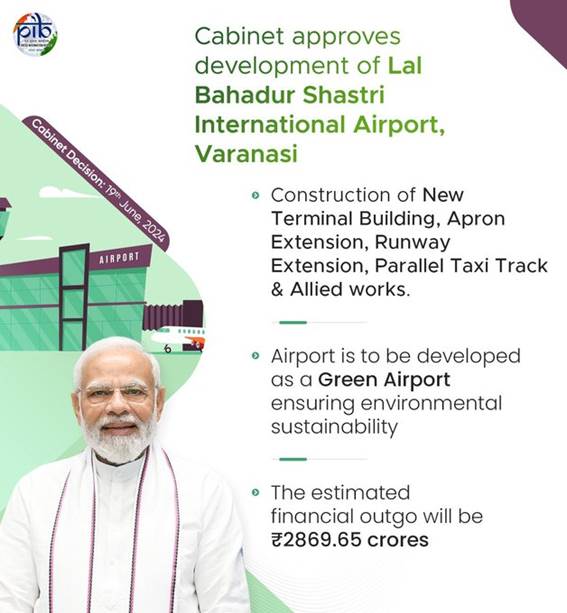
The Union Cabinet chaired by Prime Minister Shri Narendra Modi approved the proposal of the Airports Authority of India (AAI) for the development of Lal Bahadur Shastri International Airport, Varanasi, including the Construction of a New Terminal Building, Apron Extension, Runway Extension, Parallel Taxi Track and Allied works. The estimated financial outgo will be Rs. 2869.65 Crore for enhancing the airport's passenger handling capacity to 9.9 million passengers per annum (MPPA) from the existing 3.9 MPPA. The New Terminal Building, which encompasses an area of 75,000 sqm is designed for a capacity of 6 MPPA and for handling 5000 Peak Hour Passengers (PHP). It is designed to offer a glimpse of the vast cultural heritage of the city. The proposal includes extending the runway to dimensions 4075m x 45m and constructing a new Apron to park 20 aircrafts. Varanasi airport will be developed as a green airport to ensure environmental sustainability through energy optimization, waste recycling, carbon footprint reduction, solar energy utilization, and incorporation of natural daylighting, alongside other sustainable measures throughout the planning, development, and operational stages.
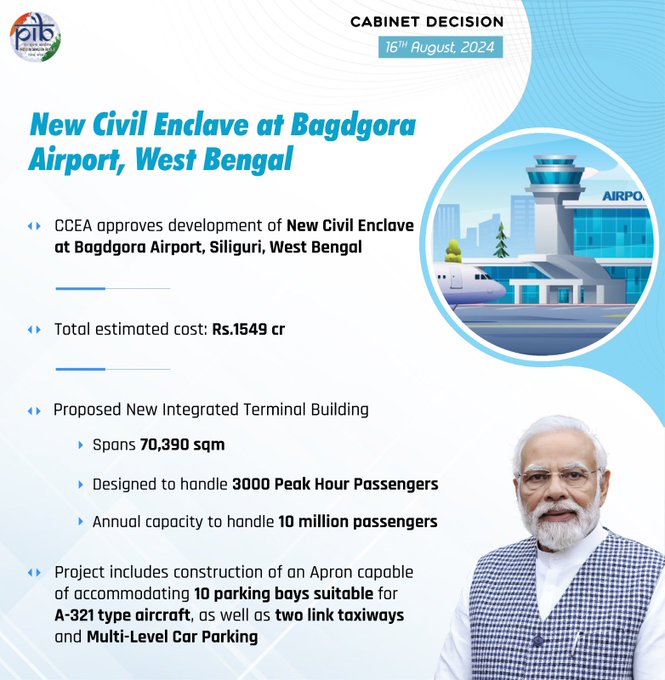
The New Civil Enclave at Bagdogra
The Cabinet Committee on Economic Affairs (CCEA) approved the development of new civil enclaves at Bagdogra and Bihta airports on August 16, 2024. The New Civil Enclave at Bagdogra, with an investment of ₹1549 Crore, will feature a 70,390 square meter terminal designed to accommodate 3,000 Peak Hour Passengers (PHP) and an annual capacity of 10 million passengers. This project includes the construction of an Apron with 10 parking bays for A-321 type aircraft, two link taxiways, and a Multi-Level Car Parking facility. The terminal will be a Green Building, incorporating renewable energy sources and maximizing natural light, in line with our commitment to sustainability.
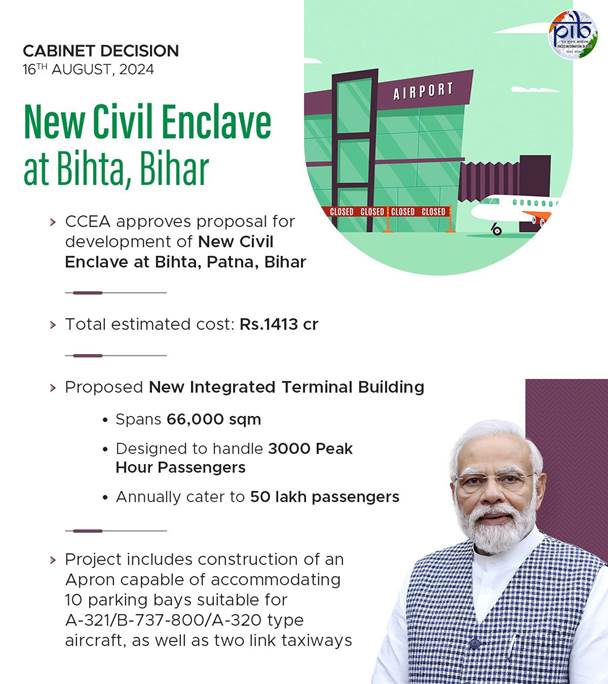
The New Civil Enclave at Bihta Airport
The development of a New Civil Enclave at Bihta Airport, approved with an investment of ₹1413 crore, is a strategic response to the growing congestion at Patna Airport. The new terminal at Bihta will span 66,000 square meters, initially handling 3,000 Peak Hour Passengers (PHP) and 5 million passengers annually, with the potential to expand capacity to 10 million. The project will also include an Apron with 10 parking bays for A-321/B-737-800/A-320 type aircraft and two link taxiways.
Expansion of Agatti airfield and new airfield at Minicoy for island infrastructure development.
The Government’s decision to expand the Agatti airfield and construct a new air field at Minicoy is part of the overall development of the Lakshadweep islands. These airfields will accommodate both military operations and civil aircrafts. Being strategically placed, these airfields would enable the armed forces to play a key role in the Indian Ocean region. These airfields will significantly improve our armed forces' logistical support and operational flexibility. This will also lead to improvement in connectivity with the mainland and also boost the local economy through increased avenues of tourism related activities.
Other Initiatives
Abolition of Angel tax to ignite innovation and fuel India's startup ecosystem.
The Union Minister for Finance and Corporate Affairs, Smt. Nirmala Sitharaman proposed to abolish ‘angel tax’ for all classes of investors, in her Budget 2024-25 address. The move is aimed to bolster the Indian start-up eco-system, boost the entrepreneurial spirit and support innovation. Section 56(2)(viib) related to taxation of share premium in excess of the fair market value. This provision was introduced in 2012 and applied to share premiums received from resident investors.
The provision was extended to non-residents in the year 2023. However, there were many exceptions to the provision, notable being the share premium received by eligible startups recognised by DPIIT. So as far as eligible startups were concerned, the provision had no application in their cases. There were concerns raised by stakeholders regarding the negative sentiment relating to the provision and also regarding valuations adopted by the taxpayers which were questioned by the Revenue. With a view to bolster the startup ecosystem, boost entrepreneurial spirit and support innovation the Government decided to sunset the provision with effect from AY 2025-26. The Finance Act, 2012 introduced section 56(2) (viib) in the IT Act which taxes any investment, received by any unlisted Indian company, valued above the fair market value by treating it as income. The investment in excess of fair value is characterised as ‘Income from other sources and the tax imposed on it was known as Angel Tax since it largely affected angel investors investing in startups.
Reduction of Corporate Tax to support Make in India
India has implemented several forward-looking policies to boost economic growth, foster innovation, and encourage foreign investment. Reducing corporate tax rates from 40% to 35% for foreign companies is designed to attract overseas investments and support the Make in India initiative, making India an appealing destination for global businesses. This move is strategically designed to enhance India’s global competitiveness, making it an attractive destination for multinational corporations. By lowering the tax burden, the government aims to encourage higher inflows of foreign direct investment (FDI), which in turn supports job creation, industrial development, and technological advancements across sectors. This tax cut is also a pivotal part of the Make in India initiative, which seeks to boost domestic manufacturing and to position India as a global hub for production.
Venture Capital Fund for Space Start-ups & GENESIS
A Rs. 1,000 crore Venture Capital Fund for space startups has been launched to catalyze growth in the burgeoning space sector, positioning India as a key player in the global space economy. To further boost entrepreneurship, the Gen-Next Support for Innovative Startups (GENESIS) initiative is focused on strengthening startup ecosystems in Tier-II and Tier-III cities, unlocking new opportunities for innovation beyond major urban centers.
MeitY approved the ‘Gen-Next Support for Innovative Startups (GENESIS)’ Scheme with a budgetary outlay of Rs. 490 Crore for a duration of 5 years to accelerate and enhance the fast-rising tech startup ecosystem. The scheme aims to boost the startup ecosystem in Tier-II & Tier-III cities and upcoming towns in the country, emphasising collaborative engagement among startups, government and corporates. GENESIS envisages further scaling up and sustaining the tech ecosystem especially to discover, support, grow and make successful startups. The scheme aims to directly support 1500+ startups from Tier-II and Tier-III cities.
BioE3 Policy to boost bio-manufacturing
The BioE3 Policy promotes sustainable, high-performance bio-manufacturing, aligning with goals of economic growth, environmental protection, and job creation. The Union Cabinet, chaired by Prime Minister Narendra Modi, approved the proposal ‘BioE3 (Biotechnology for Economy, Environment and Employment) Policy for Fostering High-Performance Biomanufacturing’ of the Department of Biotechnology on August 24, 2024.
The salient features of BioE3 policy include innovation-driven support to R&D and entrepreneurship across thematic sectors. This will accelerate technology development and commercialization by establishing Biomanufacturing & Bio-AI hubs and Biofoundry. Along with prioritizing regenerative bioeconomy models of green growth, this policy will facilitate expansion of India’s skilled workforce and provide a surge in job creation.
Overall, this Policy will further strengthen Government’s initiatives such as ‘Net Zero’ carbon economy & ‘Lifestyle for Environment’ and will steer India toward accelerated ‘Green Growth’ by promoting ‘Circular Bioeconomy’. The BioE3 Policy will foster and advance future that is more sustainable, innovative, and responsive to global challenges and lays down the Bio-vision for Viksit Bharat. High performance biomanufacturing is the ability to produce products from medicine to materials, address farming and food challenges, and promote manufacturing of bio-based products through integration of advanced biotechnological processes. To address the national priorities, the BioE3 Policy would broadly focus on the following strategic/thematic sectors: high value bio-based chemicals, biopolymers & enzymes; smart proteins & functional foods; precision biotherapeutics; climate resilient agriculture; carbon capture & its utilization; marine and space research.
Credit Guarantee Scheme
The government’s credit guarantee scheme for machinery and equipment purchases aims to empower small businesses by providing collateral-free loans, facilitating modernization and expansion. Credit Guarantee Scheme for Micro and Small Enterprises, under which Credit Guarantee Fund Trust for Micro and Small Enterprises provides guarantee to its Member Lending Institutions (MLIs) for the credit extended by them to Micro and Small Enterprises. Collateral free loan up to a limit of Rs. 500 lakhs to Micro and Small Enterprises, with a guarantee coverage up to 85 % for various categories of loan is provided under Credit Guarantee Scheme. Since inception of the scheme till 30.06.2024, 91.76 lakh guarantees were approved involving an amount of Rs. 6.78 lakh crore.
e-Commerce Exports Hub
Establishing e-Commerce Export Hubs under a Public-Private Partnership (PPP) model will enable MSMEs and traditional artisans to access international markets, bolstering exports and enhancing global competitiveness. The Finance Minister in the Union Budget 2024-25 proposed that the E-Commerce Export Hubs will be set up in public-private-partnership (PPP) mode to enable MSMEs and traditional artisans to sell their products in international markets. These hubs, under a seamless regulatory and logistic framework, will facilitate trade and export related services under one roof.
Conclusion
These bold initiatives underscore the government's dedication to driving sustainable development and fostering economic progress. Infrastructure advancements, combined with forward-looking policies like the GENESIS initiative for startups and the BioE3 Policy for bio-manufacturing, are paving the way for India’s emergence as a global leader in innovation and industry. With efforts to boost MSME competitiveness, support small businesses through credit guarantees, and promote international trade via e-Commerce Export Hubs, India's future promises a dynamic and inclusive growth trajectory, positioning the nation as a key player on the global stage.
References
https://pib.gov.in/PressNoteDetails.aspx?NoteId=151952&ModuleId=3
https://pib.gov.in/PressReleseDetailm.aspx?PRID=2049776
https://pib.gov.in/PressReleaseIframePage.aspx?PRID=2041027
https://x.com/PIB_India/status/1819394873705091353
https://pib.gov.in/PressReleasePage.aspx?PRID=2037312
https://www.pib.gov.in/PressNoteDetails.aspx?NoteId=152010&ModuleId=3
https://x.com/narendramodi/status/1821957315748036694
https://pib.gov.in/PressReleseDetailm.aspx?PRID=2046079
https://pib.gov.in/PressReleseDetailm.aspx?PRID=2046082
https://pib.gov.in/PressReleaseIframePage.aspx?PRID=2026702#:~:text=2869.65%20Crore%20for%20enhancing%20the,Peak%20Hour%20Passengers%20(PHP).
https://pib.gov.in/PressReleasePage.aspx?PRID=2038380
https://pib.gov.in/PressReleseDetailm.aspx?PRID=2035589
100 days of Modi 3.0: Accelerating Infrastructure and Economic Growth
*******
Santosh Kumar/ Ritu Kataria/ Aswathy Nair
(Explainer ID: 152155)
आगंतुक पटल : 3714
Provide suggestions / comments