Farmer's Welfare
Union Budget FY 2026-2027: Chemical Parks
Strengthening India’s Chemical Manufacturing
Posted On:
04 FEB 2026 10:38AM
Key Takeaways
- Union Budget 2026–27 announces a new scheme to support States in establishing three dedicated Chemical Parks through a challenge-based route.
- The parks will follow a cluster-based, plug-and-play model with shared infrastructure and standard environmental compliance facilities.
- Rs 600 crore has been allocated in the BE FY 2026–27 to support the establishment of these Chemical Parks.
- The initiative seeks to strengthen domestic chemical manufacturing, reduce reliance on imports, and enhance global competitiveness.
- An allocation of Rs 20,000 crore has been announced to support the development and deployment of Carbon Capture, Utilisation and Storage (CCUS).
Introduction
India ranks as the world’s sixth-largest chemical producer. It holds significant potential to further strengthen its presence in global chemical value chains, particularly in higher-value and specialty segments. The chemical sector remains a key driver of industrial growth and exports, supported by established hubs and clusters across Gujarat, Odisha, Andhra Pradesh, and Tamil Nadu that have attracted investment and generated substantial employment. Building on this foundation, there is a growing opportunity to enhance competitiveness by addressing infrastructure integration, streamlining regulatory processes, and strengthening environmental compliance frameworks.
In this context, the Government’s proposal in the Union Budget 2026-27 to establish dedicated Chemical Parks represents a forward-looking, infrastructure-led, and supply-side initiative, with a budgetary allocation of Rs 600 crore in BE FY 2026–27. By offering integrated, plug-and-play (ready-to-use) facilities and coordinated governance, these parks are expected to reduce project timelines and costs, foster cluster-based synergies, and create globally competitive chemical manufacturing ecosystems that support sustainable and inclusive growth.
Union Budget 2026–27: Boost to Domestic Chemical Manufacturing
The Union Budget 2026–27 has introduced a new scheme to assist States in setting up three dedicated Chemical Parks through a challenge-based selection mechanism, with a budgetary allocation of Rs 600 crore in BE FY 2026–27. These parks are envisaged as cluster-based, plug-and-play manufacturing ecosystems, supported by common infrastructure and shared facilities. This initiative represents the first instance of dedicated budgetary support for chemical park infrastructure. It is intended to strengthen domestic manufacturing capabilities, enhance supply-chain integration, and reduce import dependence in the chemicals sector.
Chemical Industry: At a Glance
India’s chemical industry is a cornerstone of the manufacturing ecosystem, supplying critical inputs to key sectors such as agriculture, pharmaceuticals, textiles, automobiles, and construction, while contributing about 7 percent to national GDP. As the sixth-largest chemical producer globally and third in Asia, India manufactures over 80,000 products spanning bulk and specialty chemicals, agrochemicals, petrochemicals, polymers, and fertilisers. Within this broad spectrum, specialty chemicals have emerged as a segment of sustained strength, underpinned by India’s process capabilities, cost competitiveness, and growing innovation capacity. Reflecting its structural importance, the Economic Survey 2025–26 notes that the chemical sector accounted for 8.1 percent of manufacturing Gross Value Added in FY24, alongside a steady rise in output over the past decade. Production of major chemicals and petrochemicals increased from 45,638 thousand metric tonnes in FY16 to 58,617 thousand metric tonnes in FY25, translating into a CAGR of 2.8 percent.
What are Chemical Parks?
Chemical parks are planned industrial clusters explicitly designed for chemical and petrochemical manufacturing, where multiple units operate together, sharing world-class infrastructure and common services.
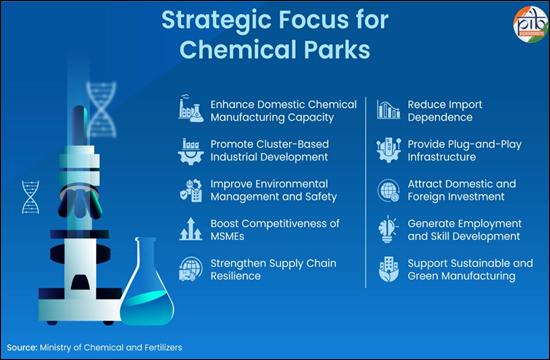
Strategic Focus of Chemical Parks
The Chemical Parks is conceived as a comprehensive, infrastructure-led supply-side initiative to strengthen the foundations of the chemical sector.
Current Landscape and Rationale for Chemical Parks
India’s chemical industry has already gained from cluster-based development models such as Plastic Parks, Bulk Drug Parks, and Petroleum, Chemicals and Petrochemicals Investment Regions (PCPIRs), which have demonstrated the benefits of shared infrastructure, anchor investments, and coordinated planning. Building on these successful experiences, the proposed Chemical Parks are envisioned as an integrated approach encompassing the wider chemical value chain, including bulk, specialty, and downstream segments.
By providing plug-and-play industrial infrastructure, common utilities, logistics support, and streamlined regulatory facilitation within a single location, the initiative is expected to
- reduce project gestation timelines and capital costs,
- enable economies of scale and stronger backward and forward integration,
- improve environmental management and industrial safety through shared facilities, and
- enhance India’s competitiveness in both domestic and global chemical markets.
Together, the proposed Chemical Parks and existing cluster-based initiatives, such as Plastic Parks, Bulk Drug Parks, and PCPIR, establish an integrated policy architecture for cluster-led industrial development in the chemical sector. Backed by targeted policy support and measures to encourage technology adoption, innovation, and sustainability, this integrated approach is expected to deepen domestic manufacturing capabilities and enhance India’s integration into global chemical value chains in the coming decade.
Scheme for setting up Plastic Parks
Plastic Parks have emerged as an integral part of India’s strategy to manage plastic waste, promote recycling, and support the chemical industry. A plastic park is an industrial zone designed explicitly for plastic-related businesses and industries. The Department of Chemicals & Petrochemicals formulated this scheme (2013-2014) with a view to consolidating and synergizing the capacities of the plastic processing industry, promoting investment, production, and exports while generating employment. To encourage research and development in polymer and plastics, the department has established 13 Centres of Excellence in various national-level institutes. The scheme has provided central grant support of up to 50 per cent of project cost, capped at Rs 40 crore per park. 10 Plastic Parks have been approved so far across different States, including Assam, Madhya Pradesh, Odisha, Jharkhand, Tamil Nadu, Uttarakhand, Chhattisgarh, Karnataka, and Uttar Pradesh.
Scheme for Promotion of Bulk Drug Parks
Drugs are central to the delivery of healthcare in the country, and ensuring their uninterrupted availability is essential to providing affordable, high-quality care to citizens. As the pharmaceutical sector continues to expand, its sustained growth increasingly depends on the ability to secure a reliable supply of high-quality bulk drugs and rapidly scale up manufacturing capacity during emergencies.
In this context, strengthening domestic capabilities and achieving self-reliance in bulk drug manufacturing have assumed strategic importance. With a view to reducing manufacturing costs, enhancing competitiveness, and addressing infrastructure gaps in the bulk drug segment, the Government launched the Promotion of Bulk Drug Parks Scheme in 2020. The scheme has emerged as a key enabler of pharmaceutical resilience, facilitating access to common infrastructure, standard testing facilities, and shared utilities, thereby supporting cost-efficient, scalable, and secure domestic bulk drug production. It also enables industry to meet environmental standards at lower cost through innovative common waste management systems, while facilitating resource optimisation and economies of scale.
The Promotion of Bulk Drug Parks scheme supported the establishment of three Bulk Drug Parks in Gujarat, Himachal Pradesh, and Andhra Pradesh, with a total outlay of ₹3,000 crore, to reduce the cost of bulk drug manufacturing by creating world-class common infrastructure facilities.
Under the scheme, financial assistance has been provided for the creation of Common Infrastructure Facilities (CIF) like
- Central Effluent Treatment Plant(s) (CETP)
- Solid waste management
- Stormwater drainage network
- Common Solvent Storage System, Solvent recovery and distillation plant
- Common Warehouse
- Dedicated power sub-station and distribution system with the necessary transformers at the factory gate
- Raw, Potable, and Demineralized Water
- Steam generation and distribution system
- Common cooling system and distribution network
- Common logistics
- Advanced laboratory testing Centre, suitable for even complex testing/ research needs of APIs, including microbiology laboratory and stability chambers
- Emergency Response Centre
- Safety/ Hazardous operations audit centre, and
- Centre of Excellence, etc., in any upcoming Bulk Drug Park promoted by the State Government/State Corporation.
Petroleum, Chemicals, and Petrochemical Investment Regions (PCPIRs).
A petroleum, chemicals, and petrochemical investment region (PCPIR) is a specifically delineated investment region designed for domestic and export-led chemical and petrochemical manufacturing. The region integrates production units, utilities, logistics, environmental protection systems, and administrative services, enabling holistic and coordinated industrial development. The approach leverages co-location, shared infrastructure, and integrated planning to boost manufacturing, exports, and employment while supporting regional development. At present, three PCPIRs have been designed in the States of Andhra Pradesh (Vishakhapatnam), Gujarat (Dahej), and Odisha (Paradeep).
Together, Plastic Parks, Bulk Drug Parks, PCPIRs, and the Chemical Parks reflect India’s strategic shift towards cluster-based industrial development anchored in scale, efficiency, and sustainability. While Plastic Parks and Bulk Drug Parks have demonstrated the benefits of shared infrastructure, cost efficiencies, and improved environmental compliance in specific segments, Chemical Parks assume greater importance by extending this integrated, plug-and-play model across the wider chemical value chain.
As India scales its chemical manufacturing capacity, the environmental impact and industrial safety risks become increasingly important. To support long-term growth, it is essential to have robust environmental management systems and to ensure high safety standards in large industrial clusters.
Strengthening Environmental Management and Industrial Safety
Green initiatives such as Carbon Capture, Utilization, and Storage (CCUS), launched in December 2025, play a critical role by reducing industrial carbon emissions by capturing, reusing, or securely storing carbon dioxide before it enters the atmosphere. The Union Budget 2026–27 underscores a big push to adopt low-carbon technologies in emissions-intensive sectors. An allocation of Rs 20,000 crore has been announced to support the development and deployment of Carbon Capture, Utilisation and Storage (CCUS) technologies across key industries, including the chemicals sector, over the next five years.
In this context, integrated Chemical Parks offer a complementary and enabling platform for translating this climate ambition into practice. Chemical Parks aims to provide common environmental infrastructure, shared utilities, and coordinated governance frameworks that are critical to the cost-effective deployment of CCUS and other clean technologies. The clustering of units within a single park enables the implementation of emissions management, waste treatment, and energy-efficiency measures at scale, reducing per-unit costs and improving compliance.
Conclusion
The establishment of three dedicated Chemical Parks represents a significant advancement in strengthening India’s domestic chemical manufacturing ecosystem through a targeted, infrastructure-led approach. By offering cluster-based, plug-and-play facilities supported by shared utilities and common infrastructure, the initiative addresses long-standing structural constraints that have impeded scale, value chain integration, and competitiveness in the sector.
Aligned with the priorities articulated in the Union Budget 2026–27, the Chemical Parks initiative is expected to catalyse investment, facilitate import substitution, integrate MSMEs into organised and efficient value chains, generate employment, and promote environmentally sustainable manufacturing practices. In parallel, the Budget’s support for Carbon Capture, Utilisation and Storage (CCUS) complements the Chemical Parks. At the same time, CCUS funding supports low-carbon innovation, while Chemical Parks provide the infrastructure and support needed for cost-effective deployment. Therefore, the Chemical Parks initiative is positioned to enhance supply-chain resilience and reinforce India’s emergence as a globally competitive and reliable hub for chemical manufacturing.
References
Budget 2026-27
https://www.indiabudget.gov.in/doc/Budget_at_Glance/budget_at_a_glance.pdf
IBEF
https://www.ibef.org/blogs/how-the-chemical-industry-is-preparing-for-a-sustainable-future
https://www.ibef.org/industry/chemical-industry-india
Lok Sabha and Rajya Sabha
https://sansad.in/getFile/annex/269/AU245_FPMAK0.pdf?source=pqars
Ministry of Chemicals and Fertilizers
https://chemicals.gov.in/pcpir
https://chemicals.gov.in/sites/default/files/Policies/PCPIRPolicy.pdf
https://pharmadept.gov.in/sites/default/files/Gazettee%20notification%20of%20bulk%20drug%20schemes_0_2.pdf
https://www.pib.gov.in/Pressreleaseshare.aspx?PRID=1845023®=3&lang=2
https://www.pib.gov.in/PressReleasePage.aspx?PRID=2221676®=3&lang=2
Ministry of Science and Technology
Carbon Capture, Utilisation and Storage (CCUS) | Department Of Science & Technology
Niti Aayog
https://niti.gov.in/sites/default/files/2025-07/NITI-Aayog-Chemical-industry-report.pdf
PIB
https://www.pib.gov.in/PressReleasePage.aspx?PRID=2120876®=3&lang=2
Click here to see pdf
****
PIB Research
(Explainer ID: 157186)
आगंतुक पटल : 5855
Provide suggestions / comments