Ministry of Jal Shakti
DDWS Holds a National Level Review Meeting with Deputy Commissioners/ District Magistrates/ Collectors on Jal Jeevan Mission 2.0 and Solid Waste Management Rules 2026 under Swachh Bharat Mission (Grameen)
Review meeting reinforces PM’s vision of safe water and sanitation services, and urges districts to strengthen service delivery, water sustainability and rural sanitation governance
प्रविष्टि तिथि:
22 MAY 2026 6:42PM by PIB Delhi
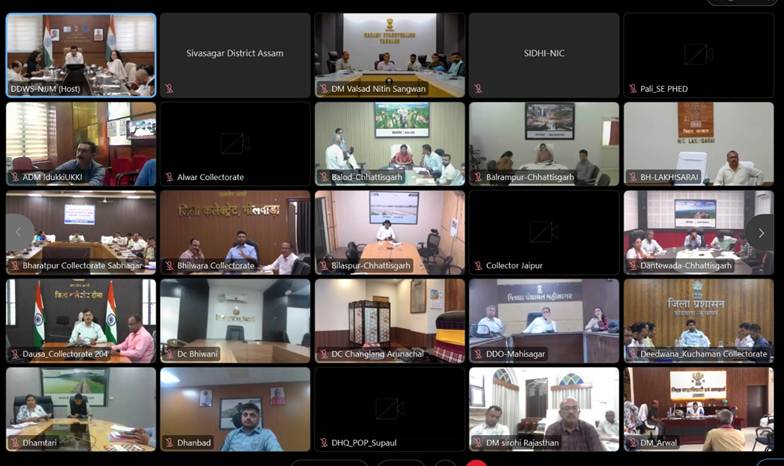
The Department of Drinking Water & Sanitation (DDWS), Ministry of Jal Shakti, today convened a review meeting with Deputy Commissioners, District Magistrates and District Collectors from across the country through video conference to deliberate on the implementation framework of Jal Jeevan Mission (JJM) 2.0 and the effective enforcement of Solid Waste Management (SWM) Rules, 2026 in rural areas. The review was attended by about 759+ DC/ DMs from across the country.
The National Review Meeting was chaired by Shri Ashok K.K. Meena, Secretary, DDWS. Shri Kamal Kishore Soan, Additional Secretary & Mission Director, National Jal Jeevan Mission, Ms. Aishvarya Singh, Joint Secretary and Mission Director, SBM(G), Smt. Swati Meena Naik, Joint Secretary (Water) and other senior officials of the Department of Drinking Water & Sanitation were present in the meeting.
In his opening remarks, Shri Ashok K.K. Meena, Secretary, DDWS emphasised that both Jal Jeevan Mission (JJM) and Swachh Bharat Mission-Grameen (SBM-G) have now reached a stage where the focus must move beyond infrastructure creation towards reliable service delivery, functionality, sustainability and community ownership.
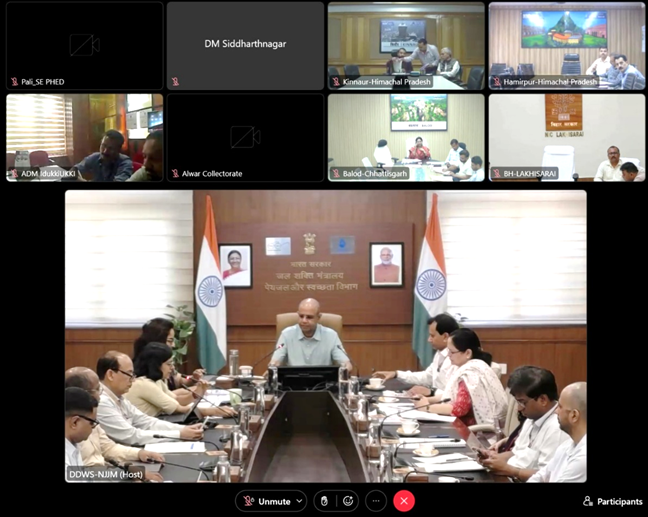
Highlighting the recent approval of the extension of Jal Jeevan Mission till December 2028 by the Union Cabinet, the Secretary stated that JJM 2.0 marks a transition from asset creation to sustained drinking water service delivery in rural India. He underlined that the role of district administration and Public Health Engineering Departments (PHEDs) has become even more central under the renewed framework.
In line with this, Secretary, DDWS highlighted the importance of the dedicated District Water and Sanitation Mission (DWSM) dashboard for monitoring service delivery at the district level. He urged the district administrators to regularly review dashboard status, upload meeting minutes and address gaps related to drinking water services, including regularity, adequacy, water quality, grievance redressal and Operation and Maintenance (O&M) of schemes.
Further, emphasising on sanitation and waste management as critical components of village hygiene, drinking water sustainability and overall public health, he advised the officials to ensure segregation, collection, processing and scientific disposal of waste in line with the Solid Waste Management Rules, 2026. He also noted that implementation of the Rules is also being reviewed in an ongoing PIL before the Supreme Court.
Referring to powers delegated under the Environment Protection Act, he urged District Collectors to strengthen enforcement and promote decentralised waste management systems at the Gram Panchayat level. He further stressed the GPs must be aware about segregation, procession and understanding of waste management.
Addressing the meeting, Shri Kamal Kishore Soan, Additional Secretary & Mission Director, National Jal Jeevan Mission emphasised the importance of District Collectors role in the implementation and monitoring of JJM and SBM (G). Highlighting the mission’s scale, he outlined that JJM covers approximately 5.91 lakh villages, 2.62 lakh Gram Panchayats, over 16 lakh habitations and over 19.41 crore rural households, benefiting nearly 96 crore people.
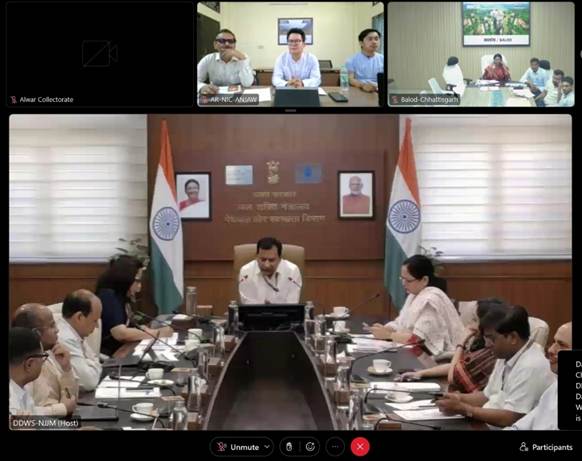
He highlighted that the Mission has created extensive asset across rural India and will require substantial O&M support going forward. Referring to the Sustainable Development Goal of universal access to potable drinking water, he said that India is set to achieve it ahead of 2030, by December 2028. In this the role of district administration is quite important.
Emphasising PM JANMAN/ DA-JUGA having Tribal and PVTG households, he stresses that it needs to be ensured that no one is left out and called for saturation of all Tribal and PVTG habitations by 2027.
He also informed that State-level review meetings with District Collectors are being planned to strengthen JJM implementation. The first meeting will be held in Maharashtra on 27 May under the chairpersonship of the Union Minister of Jal Shakti and the Chief Minister of Maharashtra. All States and UTs will be covered in next six months to review district-wise progress, address gaps and guide implementation from the State level.
He informed that the progress of both the Missions may be reviewed in the Pro-Active Governance And Timely Implementation (PRAGATI), meeting.
The address further highlighted that the role of District Collectors and Panchayats in taking forward the second phase of Jal Jeevan Mission is quite crucial. It was also noted that the Mission has been reviewed and discussed at high-level inter-governmental platforms, including State-Zonal Council meetings, where effective implementation of the mission was identified as a key priority for States.
He further stated that, in the 26th Central Zonal Council meeting held in Chhattisgarh on 19 May 2026, it was emphasised that states should focus on JJM 2.0 and make necessary arrangements to provide tap water to every rural household.
He also emphasised that the progress of JJM and SBM (G) should be regularly presented in the District Development Coordination and Monitoring Committee (DISHA) meetings chaired by the Members of Parliament. District Collectors were requested to include key updates on household tap water coverage, scheme progress, Har Ghar Jal certification, functionality of rural water supply schemes, water quality monitoring, Third Party Inspection, administrative oversight by DWSM and progress under SBM (G). This will enable elected representatives to review district-level progress, identify gaps and provide necessary guidance for improving drinking water and sanitation services.
The National Review Meeting featured presentations on JJM 2.0 and SBM-G 2.0. Smt. Swati Meena Naik, Joint Secretary (Water) made detailed presentation on the reform-oriented implementation framework of Jal Jeevan Mission 2.0, with emphasis on sustainable service delivery, community ownership and district-level governance. She highlighted that mission now focuses on every rural household receives safe and adequate water on a sustained basis with structural reform. The systems must be remained functional for the next 25 to 30 years.
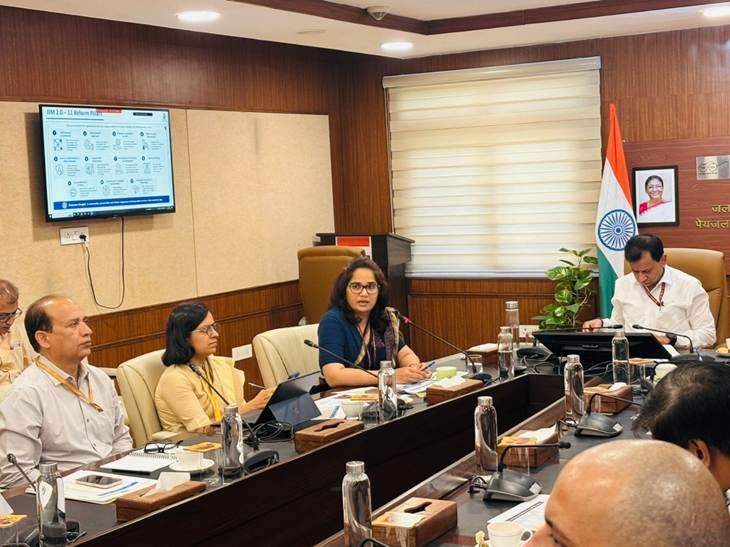
The presentation centred on these core thematic areas:
- The 11 structural reforms under Jal Jeevan Mission 2.0 – It focuses on creating a governance-led, technology-enabled and quality-assured rural drinking water system.
- Institutional Architecture: Strengthening multi-tier governance with clearly defined roles, accountability and citizen-responsive oversight.
- Utility-Based Approach: Promoting village-level micro-utilities and regional bulk water utilities for professional and reliable service delivery.
- Technical Framework for Gram Panchayats: Supporting GPs in commissioning, handover, asset records and regular operation and maintenance of water supply systems.
- Water Quality Governance: Ensuring regular water testing, community surveillance, accredited laboratories and rapid response mechanisms.
- Source Sustainability and Water Security: Promoting aquifer planning, groundwater recharge, source protection, budgeting and convergence with related programmes.
- Digital Data Governance: Using Sujalam Bharat, Sujal Gaon IDs, dashboards and decision-support systems for real-time monitoring and data-based planning.
- Participatory Governance, Jan Bhagidari: Encouraging community ownership through IEC activities, Gram Sabha disclosures and digital feedback mechanisms.
- Capacity Building: Training Gram Panchayats, VWSCs, district officials and State functionaries through a hub-and-spoke training model.
- Human Resource Skilling: Strengthening local technical support through Nal Jal Mitras, multi-skilled technicians and SHG-based Sujalam Shakti engagement.
- Operational and Financial Sustainability: Ensuring O&M budgeting, preventive maintenance, cost recovery and efficient use of resources.
- Research, Innovation and Knowledge: Promoting R&D, pilots projects, start-up support and evidence-based climate-resilient solutions.
- Sujalam Bharat Digital Public Infrastructure: Detailed implementation updates on the rollout of the unique GIS-based tracking systems, sequential hydraulic flow mapping, and the allocation progress of unique Sujalam Bharat IDs and habitation-level Sujal Gaon IDs across performing and non-performing states. An audio-visual video on Sujal Gram ID was also played during the presentation to explain the concept, purpose and detailed process.
- Strict Four-Phase Commissioning & Handover Protocols: Certification of Gram Panchayats as Har Ghar Jal through community validation by Gram Sabhas, a minimum 15-day mandatory trial run, and formal handover to community through Jal Arpan Diwas as per the suggested step by step IEC process.
- Jal Utsav: The presentation highlighted the three-level Jal Utsav strategy to strengthen community ownership of water. At the national level, Jal Mahotsav is observed every year from 8th March to 22nd March, linking International Women’s Day with World Water Day. During this period, States, districts and Gram Panchayats review water assets, promote tank cleaning, leakage reduction, operation and maintenance and convergence with other departments. At the State level, Rajya Jal Utsav focuses on water conservation, surface water protection, groundwater recharge and local water traditions. At the Gram Panchayat level, Lok Jal Utsav uses local festivals, fairs and community gatherings to discuss water security, safe drinking water, conservation practices and responsible use. Jal Mahotsav 2026, graced by the President of India, was also highlighted as a key milestone, with emphasis on strengthening wider participation in future editions.
- Upgraded Water Quality Governance Matrix: Institutionalising strict, routine testing frequencies for surface water, groundwater sources and local distribution points at the household, school, and Anganwadi levels.
- Empowering Jan Bhagidari: Strategies to scale up community-level governance by training and deploying Sujalam Shakti groups and Nal Jal Mitras to manage operations, water quality surveillance, and tariff collection.
- Targeted Saturation in Priority Topographies: Performance review, risk identification, and data-gap reconciliation across key national developmental sub-programs, including:
- PM-JANMAN for Particularly Vulnerable Tribal Group (PVTG) villages.
- Aspirational Districts and Aspirational Blocks Programmes.
- Vibrant Villages Programme (VVP 1.0 & 2.0) for remote international border areas.
- Data-Driven Accountability Tools: Training administrators on the active use of specialised digital interfaces like the Comprehensive Implementation and Reform Plan (CIRP) Module, Artificial Intelligence-backed Decision Support Systems (DSS) for source sustainability, and citizen feedback loops via the Jal Seva Aankalan.
Ms. Aishvarya Singh, Joint Secretary and Mission Director, SBM (G) made the presentation on the Solid Waste Management (SWM) Rules 2026. She said that the Swachh Bharat Mission (Grameen) SBM(G) Phase II aims for ODF Plus (Model) achievement, with a focus on validating reported assets and conducting impact assessments. She pointed out that District Collectors are tasked with implementing new mandates, including mandatory source segregation, identification and registration of bulk waste generators, and remediation of legacy waste. She added that District Collectors have been granted sweeping powers for effective implementation of these rules, with strict monitoring and reporting requirements.
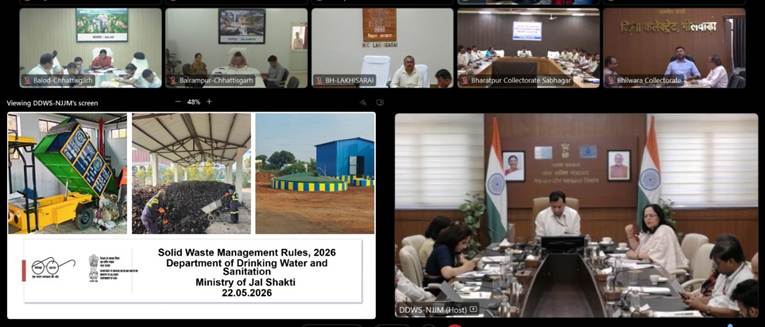
The States and districts were also advised to validate all assets reported on the system and ensure that they are functional. The presentation also highlighted that only twin-pit toilets should be sanctioned under individual household latrine construction during the current year. Districts were further directed to ensure adequate sanitation coverage and ODF sustainability for PM JANMAN/ PVTG households. District Water and Sanitation Mission meetings should be fully leveraged to review both SBM(G) progress and SWM Rules compliance, ensuring sustained sanitation outcomes and long-term environmental cleanliness in rural areas
A major focus of the presentation was implementation of Solid Waste Management Rules, 2026, which are being closely monitored by the Supreme Court. District collectors have been designated as the single point authority for enforcement at the district level. The rules require phased implementation of source segregation, identification and registration of bulk waste generators, certification by gram panchayats, and rural mapping of legacy waste sites.
Districts have been instructed to complete the identification of all legacy waste sites by 31 October and proceed with remediation in accordance with the prescribed timelines. The need for accurate reporting, strict compliance, and close coordination with local bodies was strongly emphasised.
During the interaction, District Collectors from Sidhi (Madhya Pradesh), Valsad (Gujarat) and Sivasagar (Assam), raised queries on key implementation issues under JJM 2.0. The issues included handover of completed water supply schemes to local bodies, O&M planning, qualification criteria for village-level operators, mapping of old and non-JJM water supply assets on Sujalam Bharat and user charge collection for long-term sustainability. These queries were responded to by AS&MD, NJJM who clarified that districts must plan O&M arrangements in advance, use Sujalam Bharat as a common platform for mapping all rural water supply assets, examine practical concerns related to trained local operators and work with States and Gram Panchayats to strengthen user charge systems and community ownership.
In his concluding remarks, Shri Kamal Kishore Soan, AS&MD, NJJM exhorted to work in tandem to fulfil the mission of providing drinking water to every rural household. He stated that this interaction marked the beginning of a regular review process for JJM and SBM (G). He informed that the presentation and district-wise performance details will be shared with District Collectors and Chief Secretaries for follow-up and monitoring.
He urged District Collectors to review the key action points, address local implementation gaps and improve drinking water and sanitation services in their districts. He emphasised that the leadership of District Collectors will be crucial for strengthening service delivery under both Missions.
***
AMK/AK
(रिलीज़ आईडी: 2264288)
आगंतुक पटल : 2274