Ministry of Cooperation
Regional Workshop at Raipur reviews progress of World’s Largest Grain Storage Plan, White Revolution 2.0 and formation of 2 lakh new cooperative societies
Secretary, Ministry of Cooperation says cooperative sector is the backbone of rural economy and White Revolution 2.0 will open new avenues of prosperity in Eastern and Central India
Dairy Cooperatives are transforming women from homemakers into entrepreneurs and strengthening rural financial ecosystems through cooperation among cooperatives
Ministry of Cooperation reviews the target for formation of 75,000 new Dairy Cooperative Societies in next five years
Sustainability and Circular Economy models in the cooperative sector will guide India towards a self-reliant and resilient rural economy amid global energy imbalances and the ongoing energy crisis
प्रविष्टि तिथि:
22 MAY 2026 9:11PM by PIB Delhi
In line with the vision of Hon’ble Prime Minister Shri Narendra Modi for building a prosperous and self-reliant India through the mantra of “Sahkar se Samriddhi” and under the leadership of Hon’ble Union Home and Cooperation Minister Shri Amit Shah, the Ministry of Cooperation is continuously working towards strengthening the cooperative ecosystem through modern infrastructure, technology-enabled systems and farmer-centric initiatives.
As part of these efforts, a Regional Workshop on “Formation and Strengthening of 2 lakh new M-PACS, Dairy & Fisheries Cooperative Societies” and “World’s Largest Grain Storage Plan in Cooperative Sector” was organized today at Raipur, Chhattisgarh. Senior officials from Bihar, Chhattisgarh, Jharkhand, Madhya Pradesh, Odisha and West Bengal along with representatives from NABARD, FCI, NAFED, NCCF, NDDB and Warehousing Corporations participated in the workshop.
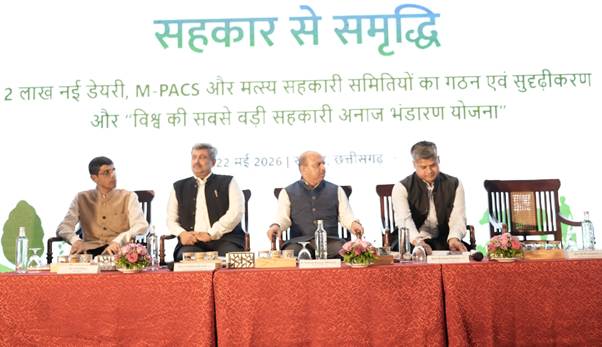
Addressing the workshop, Dr. Ashish Kumar Bhutani, Secretary, Ministry of Cooperation, Government of India said that the cooperative sector is the backbone of the rural economy. He stated that the dairy sector has played a transformative role in women empowerment, nutrition security and economic prosperity in States such as Gujarat. Highlighting the immense potential of Eastern and Central Indian States, he said that the abundance of water resources, fertile land and livestock provides a strong foundation for taking the dairy sector to new heights in these regions.
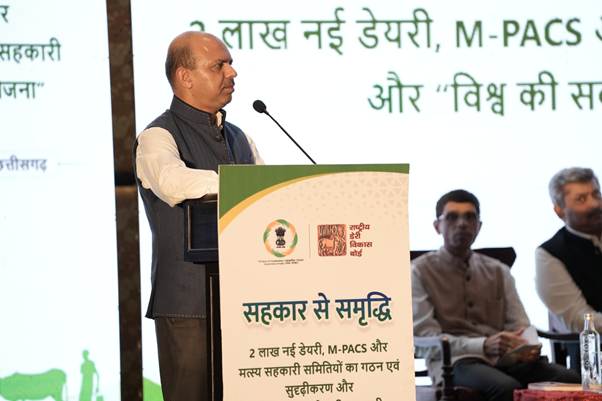
Dr. Bhutani urged all participating States to openly discuss challenges, share innovative ideas and work collectively towards practical solutions. He emphasized that the Central Government is fully committed to extending every possible support to the States and coordination at the highest level would be ensured wherever required.
The workshop also highlighted how the dairy cooperative movement is emerging as a powerful instrument of women-led rural transformation by enabling women to move from the role of homemakers to entrepreneurs and active contributors to the rural economy. Through participation in dairy cooperative societies, women are gaining access to organized markets, financial inclusion, livelihood opportunities and decision-making platforms, thereby strengthening the grassroots cooperative financial ecosystem. The deliberations further emphasized that one of the key objectives of the conference is to promote “cooperation among cooperatives” so that the benefits of the cooperative movement, including access to finance, technology, storage infrastructure, dairy value addition and market linkages, can be effectively dispersed to larger sections of society in an inclusive and sustainable manner.
Ministry of Cooperation reviewed the progress of White Revolution 2.0 and the target for formation of 75,000 new Dairy Cooperative Societies (DCS) and strengthening of 46,000 existing societies over the next five years. Stressing upon sustainability and circularity in the dairy sector, Ministry of Cooperation informed that the dairy ecosystem should not remain limited only to milk production, but should also expand into sectors such as bio-gas, organic fertilizers, whey protein and carbon credits to create additional income opportunities for farmers and cooperative institutions.
The Ministry of Cooperation emphasized the importance of sustainability and circular economy models in the cooperative sector, stating that in the present global scenario marked by global energy imbalances, energy crises, supply-chain disruptions and economic uncertainties arising out of international disturbances, initiatives such as Compressed Bio Gas (CBG), organic fertilizers, bio-energy generation, carbon credits and GOBARdhan-based models can provide a sustainable and resilient future for rural livelihoods. The Ministry stated that these initiatives would promote optimum utilization of agricultural and dairy waste, reduce dependence on imported energy resources, create additional income opportunities for farmers and cooperative institutions, and further strengthen India’s framework of energy security, environmental sustainability and self-reliance during this period of global energy crisis.
Dr. C.R. Prasanna, Secretary, Cooperation Department, Government of Chhattisgarh expressed gratitude for organizing the workshop and highlighted the development initiatives being undertaken in the cooperative sector in the State. He said that the State Government is giving priority to dairy development, bio-gas projects and grain storage infrastructure.
Representatives from NABARD, FCI, NAFED, NCCF and Warehousing Corporations also actively participated in the deliberations.
The workshop included detailed technical sessions on the World’s Largest Grain Storage Plan, implementation strategies for achieving storage targets, onboarding of PACS under WDRA framework, formation and strengthening of Multipurpose PACS, Dairy and Fisheries Cooperative Societies, diversification of cooperative business activities, revival of non-functional cooperative societies and implementation of White Revolution 2.0. Deliberations were also held on sustainability initiatives such as solar rooftops, bio-gas, GOBARdhan scheme, fodder and cattle-feed business, flavoured milk products, dairy value addition and cooperation among cooperatives.
The workshop further reviewed progress related to Bharatiya Beej Sahakari Samiti Limited (BBSSL), National Cooperative Exports Limited (NCEL), National Cooperative Organics Limited (NCOL), Multi-purpose Village Cooperative Societies, Aatmanirbharta Abhiyan and banking-related issues concerning cooperatives.
In the concluding session, speakers emphasized the importance of regular review, better coordination, mission-mode implementation, removal of entry-level barriers and exchange of best practices among States and cooperative institutions.
***
AK
(रिलीज़ आईडी: 2264361)
आगंतुक पटल : 1116