PIB Backgrounder
From Job Seekers to Job Creators The ASPIRE Story
प्रविष्टि तिथि:
26 JUN 2026 2:41PM by PIB Delhi
|
ASPIRE: Turning Rural Ambition into an Enterprise
|
On a rain-soaked morning in Mawsynram, Meghalaya, Mr. Banshailang Marbaniang stood watching dark clouds roll across the hills. The rain fell steadily, as it often does in the world's wettest place. Yet it was not the weather that occupied his thoughts; it was the question that had followed him for years: how does a young man from one of the remotest corners of the country build a future when opportunities are as scarce as the rain is abundant?
For years, Mr. Marbaniang had watched friends and neighbours leave Mawsynram in search of work elsewhere. Resources were limited, and starting a business of his own seemed beyond reach. Financial constraints made the dream feel even more distant. Yet the thought refused to leave his mind. Surrounded by the region's rich agricultural produce, he wondered whether these local resources could become the basis of an enterprise.
The turning point came when he got to know about the entrepreneurship training and skill development support being provided by the Indian Institute of Entrepreneurship (IIE) in Guwahati. IIE is a mentor institute under the Ministry of MSME's ASPIRE scheme (A Scheme for Promotion of Innovation, Rural Industries and Entrepreneurship). It helps aspiring entrepreneurs acquire the skills, confidence and business knowledge needed to transform ideas into enterprises.

For Mr. Marbaniang, the training opened new possibilities. Armed with technical know-how and entrepreneurial skills, he established a food-processing enterprise that transformed locally available resources into economic opportunity, demonstrating that an opportunity can be created anywhere with guided support and skills.
Creating Opportunities Closer to Home
Mr. Marbaniang’s story reflects a larger transformation taking place across rural India.
Access to business development services, technology support, and enterprise promotion has largely remained concentrated in some urban centres. While rural India possessed talent, skills and resources, aspiring entrepreneurs often lacked the training, mentoring and institutional support needed to convert ideas into sustainable enterprises.
Recognising this gap, the Ministry of MSME launched the ASPIRE Scheme in 2015 to promote entrepreneurship and employment generation, particularly in rural and agro-based sectors.
Over the years, the scheme has evolved to meet changing needs. The operational guidelines issued in 2018 strengthened the incubation framework. The revised guidelines of 2023 sharpened the focus on livelihood creation, enterprise development and measurable outcomes. Today, ASPIRE is centred around a growing network of Livelihood Business Incubators (LBIs) that help individuals move from skill acquisition to enterprise creation.
By providing training, mentoring and incubation support, ASPIRE enables aspiring entrepreneurs in agro-rural sectors and promotes innovations for strengthening the competitiveness in the MSME sector.
Where Enterprises Take Shape
At the heart of ASPIRE's success are its LBIs or the Livelihood Business Incubators. The objective is not merely skill development, but the creation of formal, scalable micro-enterprises that generate livelihoods and employment opportunities.
These incubators provide access to modern equipment, business mentoring and technology support. Entrepreneurs are also assisted with product development, branding, accreditation, regulatory compliance, market linkages and access to finance, helping them navigate the journey from idea to enterprise.
ASPIRE’s institutional framework ensures that entrepreneurs receive sustained support long after their training is completed. The scheme operates through a three-tier architecture comprising the Scheme Steering Committee, designated Mentor Institutes and Host Institutions that operate the LBIs. Mentor Institutes play a crucial role in identifying incubators, preparing project plans, designing incubation programmes, strengthening implementation and monitoring outcomes.
The incubation ecosystem brings together a diverse range of institutions, including the Indian Institute of Entrepreneurship (IIE), Guwahati, agricultural universities, technical institutes and premier institutions such as IIT Jodhpur. These centres are also designed to foster entrepreneurship and promote startups in the agro-industry.
Across the country, LBIs are supporting enterprises in areas such as food processing, honey production, bamboo products, mushroom cultivation, spice processing, handicrafts and coir products. The importance of this approach is reflected in the growing contribution of value-added rural industries to India's economy. For many rural communities, enterprise creation offers an opportunity not only to generate income but also to participate in larger value chains. By promoting entrepreneurship in sectors linked to agriculture and local resources, ASPIRE encourages individuals to move beyond primary production towards processing, manufacturing and value addition.
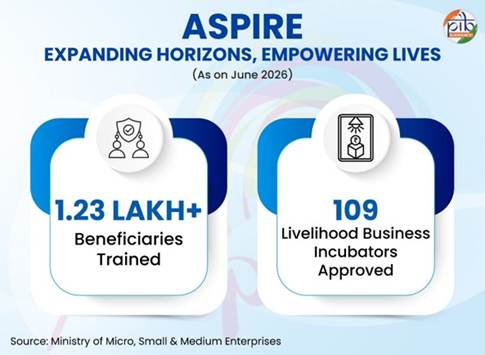
The network has expanded steadily over the years. As of June 2026, 109 LBIs had been approved across 27 States and Union Territories. Together, these incubators have trained more than 1.23 lakh beneficiaries. Since systematic tracking began in FY 2022-23, ASPIRE-supported incubators have also facilitated the establishment of more than 1,200 micro-enterprises across the country.
Empowering India’s Aspiring Entrepreneurs
The success of ASPIRE is ultimately measured not by the number of incubators it supports, but by the people whose lives it helps transform.
Since FY 2022-23, the scheme has enabled entrepreneurship opportunities for more than 28,500 women across the country, reflecting its growing role in expanding women's participation in enterprise creation. At the same time, ASPIRE has reached over 8,700 SC beneficiaries, above 9,600 ST beneficiaries and more than 17,600 OBC beneficiaries, helping make entrepreneurship more inclusive and accessible.
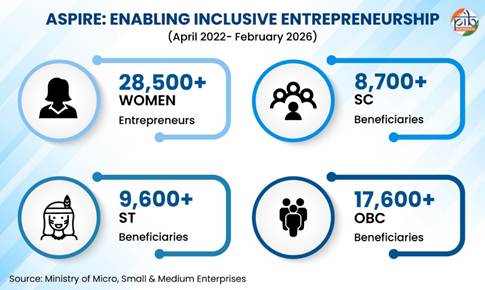
These numbers represent far more than statistics. By extending entrepreneurship support to diverse social and economic groups, ASPIRE is helping ensure that enterprise creation is no longer confined to metropolitan centres. Instead, it is increasingly emerging as a pathway to growth, self-reliance and livelihood generation in villages, small towns and underserved communities across India.
From Mawsynram to Kartavya Path
Years later, Mr. Marbaniang’s journey earned recognition on a national stage.
He was among ten entrepreneurs from the North-East invited as Special Guests to the 75th Republic Day celebrations at Kartavya Path in New Delhi. Representing diverse sectors, they embodied a new generation of entrepreneurs emerging from India's villages, small towns and remote regions. Their presence at one of the country's most important national events was more than a personal honour. It reflected the growing success of initiatives that are helping transform job seekers into job creators and local aspirations into thriving enterprises.
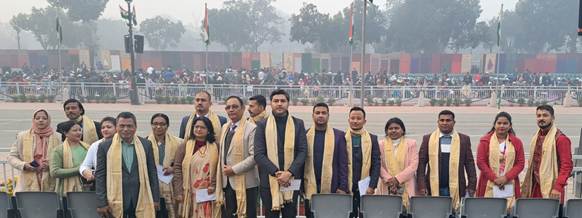
While the distance from the rain-soaked hills of Mawsynram to Kartavya Path is measured in kilometres, the journey from uncertainty to entrepreneurship is measured in opportunity. Through ASPIRE, thousands of Indians are gaining access to the support, skills and resources needed to transform aspirations into enterprises. By nurturing innovation and promoting entrepreneurship, ideas are transformed into businesses, skills into livelihoods and ambition into economic opportunity.
In doing so, ASPIRE is not only creating enterprises but also empowering communities, generating employment and contributing to a more inclusive and self-reliant India.
References
MINISTRY OF SKILL DEVELOPMENT AND ENTREPRENEURSHIP
https://iie.gov.in/news-and-events/iie-trained-ne-entrepreneurs-invited-to-republic-day-parade-as-symbol-of-skill-development-push467#gsc.tab=0
https://iie.gov.in/pr/projects/a-scheme-for-promotion-of-innovation--rural-industries---entrepreneurship---aspire-#gsc.tab=0
MINISTRY OF MICRO, SMALL, MEDIUM ENTERPRISES
https://aspire.msme.gov.in/ASPIRE/AFHome.aspx
https://dashboard.msme.gov.in/aspire.aspx
https://www.pib.gov.in/newsite/PrintRelease.aspx?relid=133532®=48&lang=2
https://aspire.msme.gov.in/WriteReadData/DocumentFile/New_Operational_Guidelines_ASPIRE_2018.pdf
https://aspire.msme.gov.in/WriteReadData/DocumentFile/ASPIRE_New_21112023.pdf
https://aspire.msme.gov.in/WriteReadData/DocumentFile/Annexure-I.pdf
LOK SABHA
https://sansad.in/getFile/loksabhaquestions/annex/187/AS550_07VFJm.pdf?source=pqals
INDIAN INSTITUTE OF ENTREPRENEURSHIP
https://www.iie.gov.in/pdf/IIE-Annual-Report-2024-25.pdf
Click here to see in PDF
PIB RESEARCH
(रिलीज़ आईडी: 2278172)
आगंतुक पटल : 2429