Ministry of Railways
India’s Largest Rail Tunnel Boring Machine To Starts Excavation from Vikhroli for Mumbai –Ahmedabad Bullet Train Project
प्रविष्टि तिथि:
05 JUL 2026 3:29PM by PIB Ahmedabad
The first Tunnel Boring Machine (TBM) will commence tunnelling from the Vikhroli shaft towards the under-construction Mumbai Bullet Train station for the Mumbai–Ahmedabad Bullet Train Project, today.
Of the total 21 km long underground tunnel section, 16 km between Sawli (Ghansoli) and Bandra Kurla Complex (BKC) in Mumbai will be constructed using Tunnel Boring Machines. The remaining 5 km section has already been completed using NATM. (Tunnel Graphic)
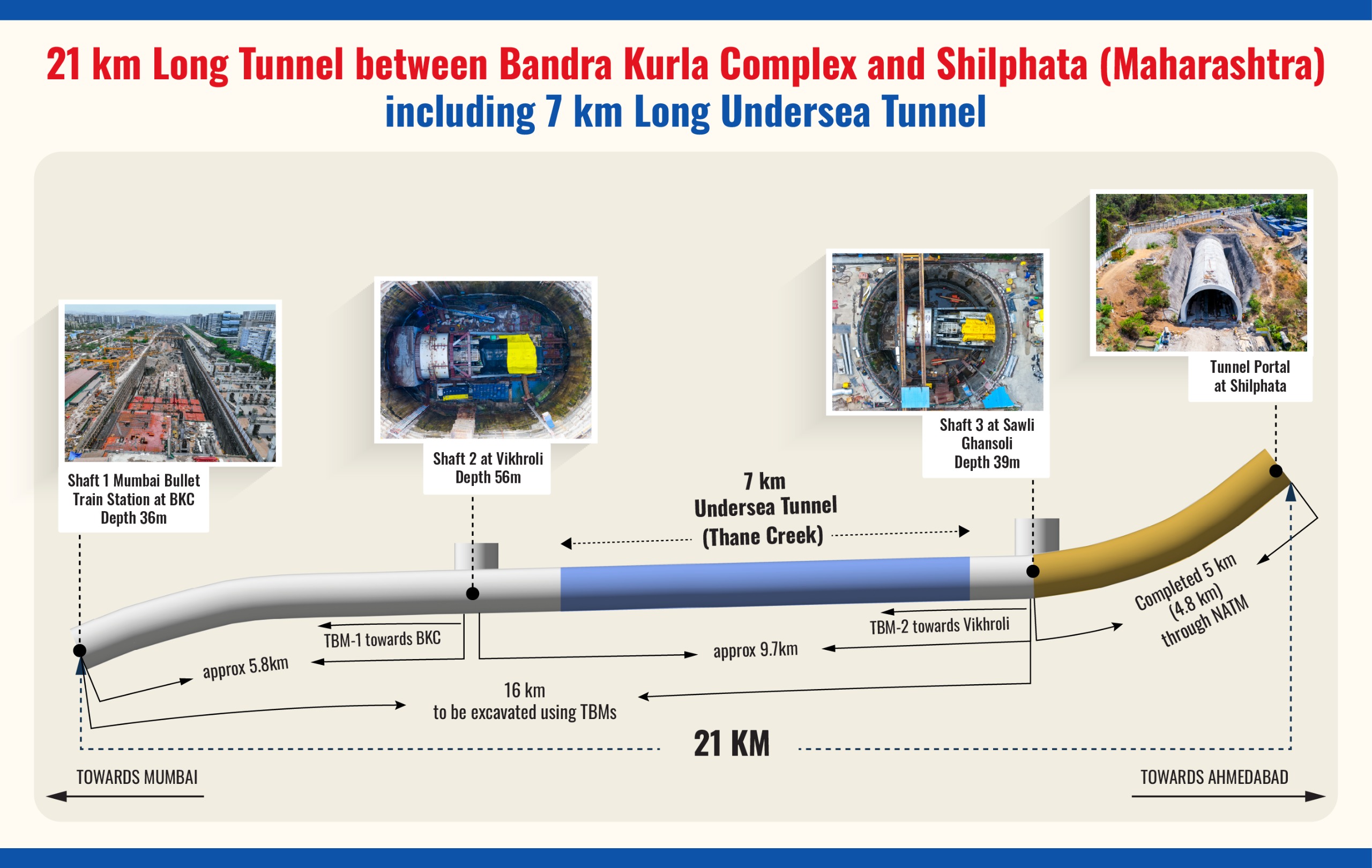
The TBM launched from Vikhroli will excavate a 6 km long single-tube tunnel designed to accommodate both up and down tracks of the Bullet Train. During its journey, the machine will pass beneath dense urban areas, including multi-storeyed buildings, roads, the Mithi River, and other critical infrastructure.
This TBM is among the largest ever deployed for rail tunnel construction in India. It features a massive cutterhead with a diameter of 13.6 metres (equivalent to height of a 4 storey building), weighs 3,100 tonnes (equivalent to 500 Asian elephants), and has a total length of 96 metres (comparable to the length of a football ground (105m).
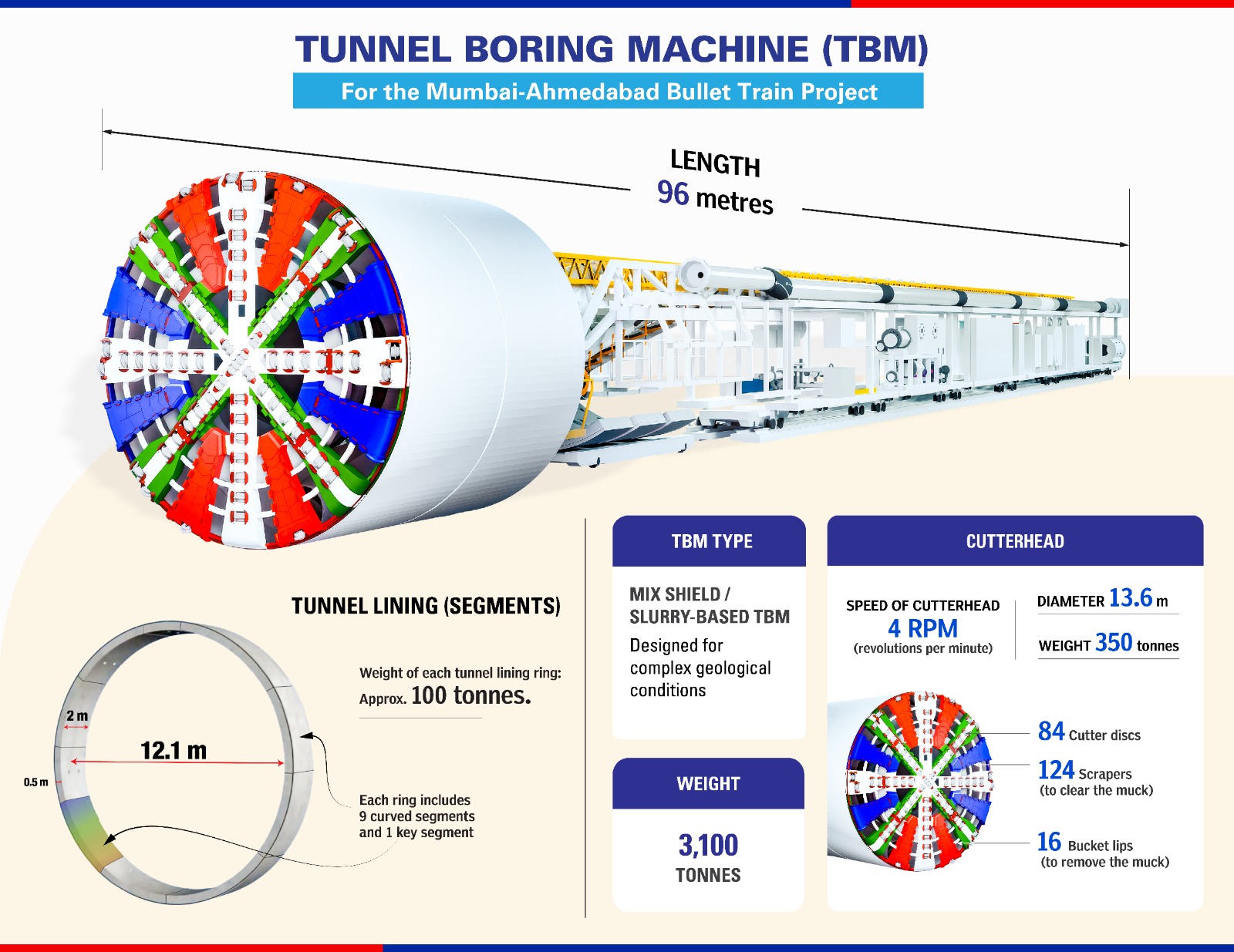
The machine comprises several key components including the cutter wheel/head, main bearing, jaw crusher, erector, main shield, tail shield, and four specialised gantries that support tunnelling operations. (TBM Graphic)
The cutter wheel rotates with a speed of 4RPM (revolutions per minute), i.e 4 revolutions per minute.
The machine being used is a Mixshield TBM, an advanced slurry-type tunnelling system specially designed for large-diameter tunnel excavation in mixed ground and high groundwater pressure conditions.
The Mixshield technology uses pressurised bentonite slurry to stabilize the tunnel face during excavation. This proven technology is particularly suitable for complex geological conditions and challenging urban environments.
This advanced tunnelling method has been specifically selected for the Mumbai suburban section due to its superior capability to control ground settlement and minimize surface disruption in densely populated areas.
One of the key advantages of this TBM is its ability to carry out tunnel excavation and segment ring installation simultaneously. This parallel operation enhances safety and significantly improves tunnelling speed, helping accelerate project execution.
To facilitate TBM launch, a 56-metre deep shaft—equivalent to a 20-storey building below ground level—has been constructed at Vikhroli in Mumbai.
The shaft area is equipped with multiple support systems essential for TBM operations, including: Water treatment plant, Slurry treatment plant, Bentonite storage tanks, Dedicated power substation, Backup generator sets, Ready-mix concrete plant for grouting, Slurry transport system, Sewage treatment plant, Backup gantries and other logistics infrastructure.
A comprehensive real-time monitoring system has been installed to ensure safe tunnelling and protect nearby structures. The instruments being used include: Surface Settlement Points (SSP), Optical Displacement Sensors (ODS) / Tilt Meters, Bi-Reflective Target (BRT/3D Targets), Strain Gauges, Seismographs for monitoring vibration and seismic waves.
A dedicated casting yard spread across 11.17 hectares at Mahape in Thane district is already operational for manufacturing tunnel lining segments for the 16 km TBM section.
A total of 77,000 concrete segments are being cast to form 7,700 tunnel rings. Each ring consists of nine curved segments and one key segment. Each segment is 2 metres wide and 500 mm thick, while one complete tunnel ring weighs approximately 100 tonnes.
The tunnel section excavated using TBMs is being designed as a fully waterproof structure. Continuous real-time monitoring systems for structural performance, groundwater behaviour, and overall construction safety are also installed.
To prevent water ingress, the tunnel lining is protected using double-layer Ethylene Propylene Diene Monomer (EPDM) gaskets combined with hydrophilic seals, ensuring long-term structural durability and safety.
(रिलीज़ आईडी: 2281288)
आगंतुक पटल : 253
इस विज्ञप्ति को इन भाषाओं में पढ़ें:
Gujarati