Ministry of Education
Researchers from IIT Gandhinagar and Nirma University Develop Novel Hydrogel to Accelerate Wound Healing
Multifunctional injectable hydrogel featuring the first reported cerium–rutin nanocomplex promotes tissue repair through sustained antioxidant and antibacterial activity
प्रविष्टि तिथि:
14 JUL 2026 6:15PM by PIB Ahmedabad
Any minor cut or scrape sets the body’s natural healing process in motion. However, deep wounds are far more vulnerable to bacterial infection and the accumulation of harmful molecules called reactive oxygen species (ROS) that damage cells and disrupt normal repair mechanisms. These factors can significantly delay healing and increase the risk of complications. With this in mind, researchers from Indian Institute of Technology Gandhinagar (IITGN) and Nirma University have developed an antibiotic-free multifunctional injectable hydrogel designed to accelerate wound healing.
At the heart of this approach is a metal-phenolic network (MPN), a class of advanced biomaterials formed through interactions between metal ions and plant-derived molecules called polyphenols. Their stability, versatility, and ability to integrate multiple therapeutic functions have made them emerging platforms for biomedical applications. Building on these advantages, the researchers developed a novel MPN featuring the first reported cerium–rutin nanocomplex for wound healing. Cerium is a metal ion that mimics antioxidant enzymes present in the body and scavenges the excess ROS, while rutin is a naturally occurring antioxidant, known for its antibacterial and anti-inflammatory properties. Together, the two components work synergistically to counter cell damage and promote tissue repair.
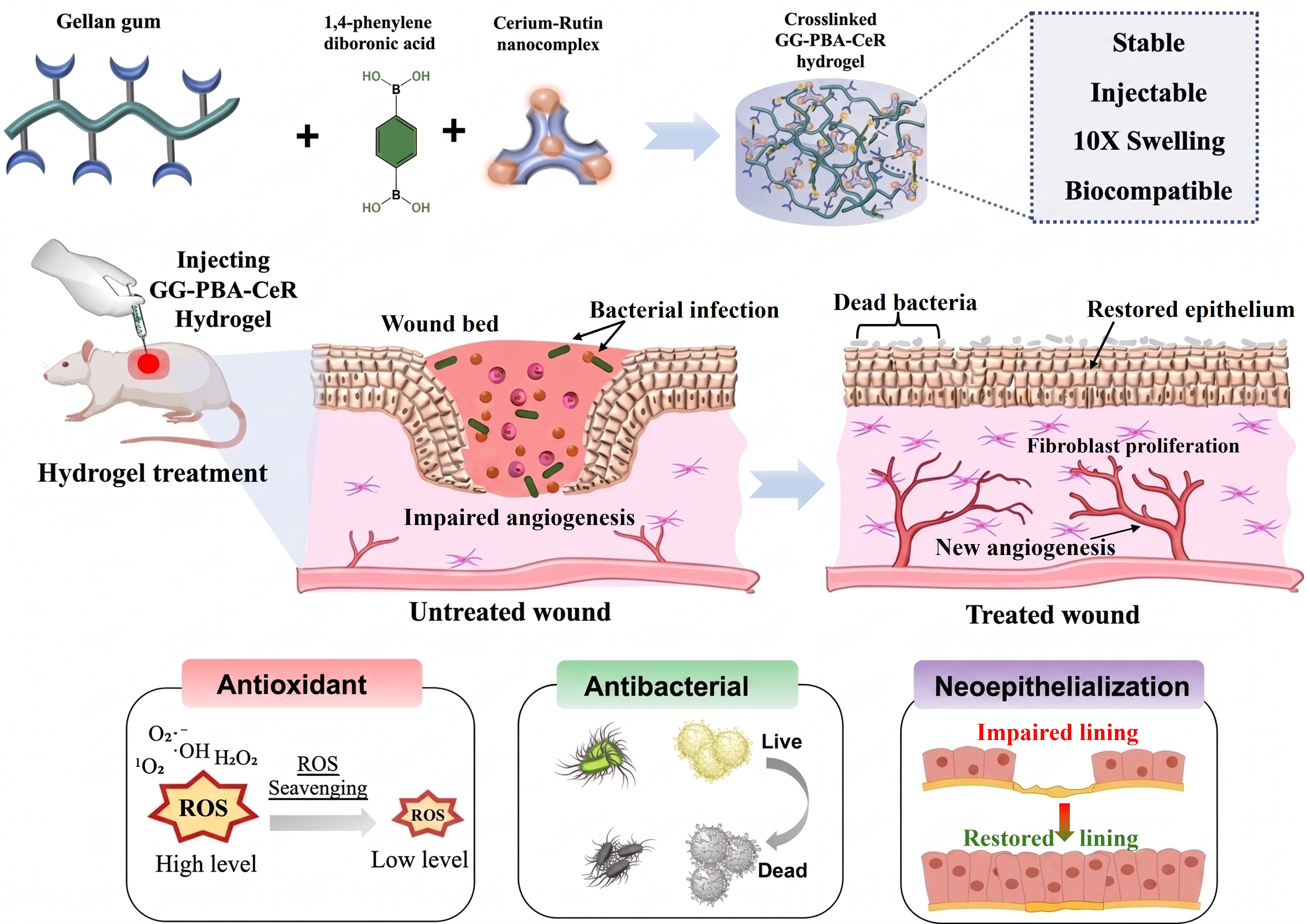
The study was published in ACS Applied Bio Materials, in a paper titled, ‘Nanocomplex-Integrated Multifunctional Hydrogel for Fast-Tracked Wound Repair Application: A Preclinical Evaluation’. Explaining its impact, the corresponding author Prof Mukesh Dhanka, Assistant Professor at IITGN’s Department of Biological Sciences and Engineering, said, “As wound care continues to evolve, there is a growing need for biomaterials that do more than just serve as a protective covering for wounds. This work reflects how thoughtful material design can help overcome the key challenges that delay healing. We hope it inspires further advances in regenerative medicine and encourages the design of smarter therapeutic platforms.”
To evaluate the hydrogel’s performance, the team extensively characterised it through laboratory experiments and preclinical animal studies, assessing its safety and wound healing potential. The results revealed that the hydrogel showed compatibility with blood and surrounding tissues, a critical requirement for wound care. They also discovered that, once injected at the wound site, the hydrogel could deliver therapeutic agents in a controlled and sustained manner. This prolonged release enabled continuous and enhanced antioxidant and antibacterial activity, promoting faster wound closure compared to untreated wounds.
Another important feature is its high swelling capacity, enabling it to absorb the fluid that naturally seeps out from a wound, up to ten times its own weight. While a moderate amount is beneficial, excess fluid can delay recovery, increase the risk of infection, and cause the surrounding healthy tissue to become soft and fragile. By maintaining moist yet controlled conditions and combining antioxidant, antibacterial, and sustained therapeutic release within a single platform, this integrated treatment strategy supports tissue regeneration.
Reflecting on the scientific thinking behind these findings, the first author Shreyash Apotikar, who completed his MTech at IITGN, shared, “Healing is a complex biological process, and deep wounds rarely fail to heal because of a single factor; multiple biological challenges must be addressed simultaneously to support effective repair. This understanding guided us to design a material in which each component complements the others, creating a coordinated therapeutic response rather than relying on a single mechanism.”
By actively addressing some of the major biological barriers that delay healing, the hydrogel emerges as a promising candidate for the treatment of deep and difficult-to-heal wounds. This study demonstrates how advances in biomaterials and nanotechnology can be combined to develop smarter wound care solutions that go beyond traditional dressings. While further studies will be needed before clinical application, the work represents an encouraging step towards next-generation therapies capable of improving patient outcomes and reducing recovery time for complex wounds. Looking ahead, patented technology has potential applications in both human and veterinary wound care, and the research team is seeking industry partners for large-animal studies, clinical translation, commercialisation, and technology licensing.
The team includes Prof Mukesh Dhanka, Shreyash Apotikar, Aniruddha Dan, Sebika Panja, Rishi Suri, Deepa Garg, Hitasha Vithalani, and Efftesum Rahaman from IITGN in collaboration with Prof Sriram Seshadri, Aneri Joshi, and Devanshi Gajjar from Nirma University.
(रिलीज़ आईडी: 2284556)
आगंतुक पटल : 8
इस विज्ञप्ति को इन भाषाओं में पढ़ें:
Gujarati