Ministry of Railways
Second Tunnel Boring Machine Starts to Excavate India’s First Undersea Tunnel beneath Thane Creek in Maharashtra for Mumbai–Ahmedabad Bullet Train Project
प्रविष्टि तिथि:
18 JUL 2026 6:48PM by PIB Ahmedabad
The second Tunnel Boring Machine (TBM) has commenced tunnelling today from the Sawli (Ghansoli) towards the Vikhroli in Maharashtra for the Mumbai–Ahmedabad Bullet Train Project. Out of 10 km stretch, 7 km will be an undersea tunnel at Thane Creek. This will be India’s first undersea tunnel for any rail corridor.
Of the total 21 km long underground tunnel section of the project 16 km between Sawli (Ghansoli) and the Bandra Kurla Complex (BKC) in Mumbai will be constructed using Tunnel Boring Machines. The first TBM has already started its 6 km drive from Vikhroli towards BKC on 05 July 2026. The remaining 5 km section has already been completed using the NATM.
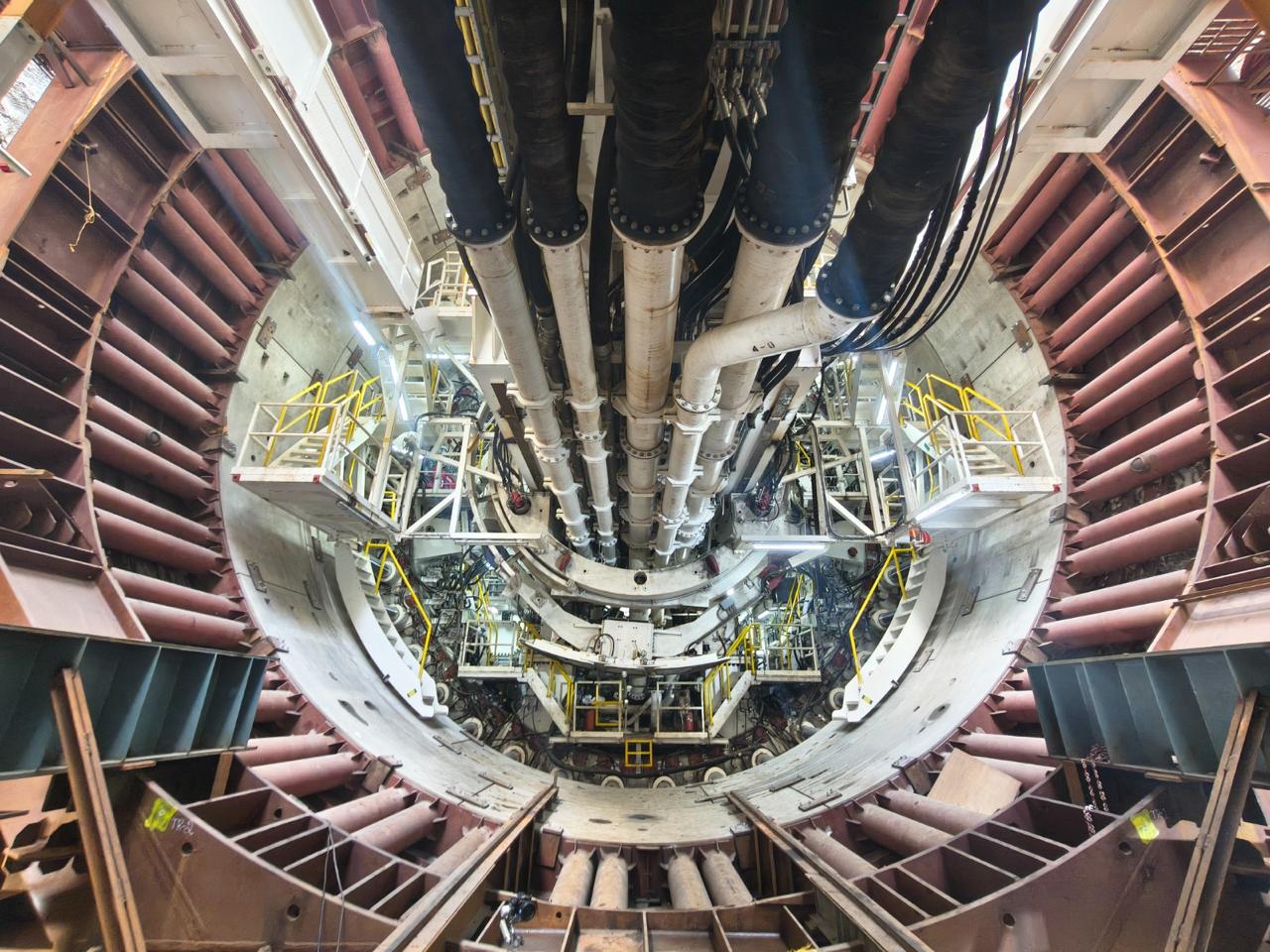
The TBM
This TBM is among the largest ever deployed for rail tunnel construction in India. It features a massive cutterhead with a diameter of 13.6 meters (equivalent to the height of a 4-story building), weighs 3,200 tonnes (equivalent to 500 Asian elephants), and has a total length of 96 meters (comparable to the length of a 105-meter football pitch).
The machine comprises several key components, including the cutter wheel/head, main bearing, jaw crusher, erector, main shield, tail shield, and four specialized gantries that support tunnelling operations.
RL4Y.jpeg)
The machine is configured as a Mixshield type, semi-automatic, slurry-based TBM. The Mixshield method utilizes a pressurized liquid bentonite slurry circuit to actively stabilize the tunnel face during excavation, providing a highly reliable and proven technology for driving through complex and challenging geological conditions.
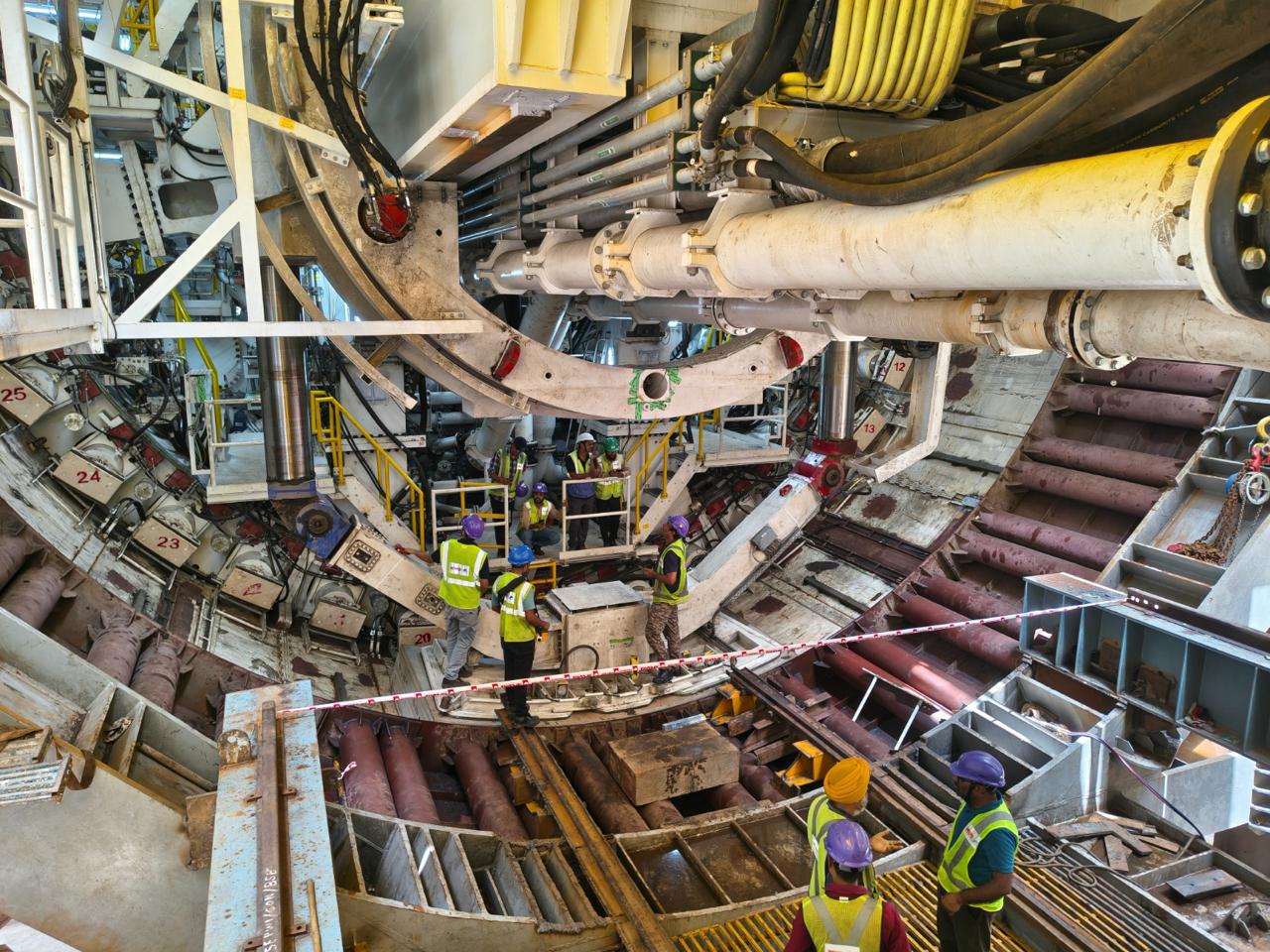
This Mixshield technology has been specifically adopted for tunnelling within the urban Mumbai Suburban sector due to its superior capability to tightly control ground settlement and minimize surface disruption.
Integrated with an advanced Semi-Continuous Advance (SCA) system, the TBM allows segment ring-building operations and tunnel face excavation to proceed simultaneously and safely. This concurrent processing maximizes the net advance rate, optimizing the construction schedule to ensure accelerated work completion.
EZ3V.jpeg)
The challenge
To facilitate the TBM launch, a 39-meter deep shaft—equivalent to a 12-story building below ground level—has been constructed at Sawli in Mumbai.
To optimise the limited space available in the shaft, the TBM was lowered in parts. The gantries were lowered first and pushed inside the pushed in the already constructed NATM tunnel. Then the main shield and cutterhead were lowered.
Additional Details:
The trailing backup system consists of 4 double-story gantries supporting operations behind the shield. These gantries are typically 18–20 meters in length and house secondary support systems behind the TBM shield, such as the roller crusher, primary slurry pump, primary machine hydraulics, operator cabin, primary grouting pumps/tank, and the power systems, emergency refuge chambers, an air duct cassette, an open workshop area with a workbench, cable trays, and hose reels etc.
The TBM is fitted with a multi-gas real-time monitoring system tracking Methane (2 sensors), Oxygen (1 sensor), Carbon Monoxide (1 sensor), and Carbon Dioxide (1 sensor). Fire safety comprises of an automatic fire detection system, an automatic extinguishing system deployed directly on the main electrical distribution panels and hydraulic power packs, a safety water curtain, and an active sprinkler network along the designated escape route.
The shaft area is equipped with multiple support systems essential for TBM operations, including: Water treatment plant, Slurry treatment plant, Bentonite storage tanks, Dedicated power substation, Backup generator sets, Ready-mix concrete plant for grouting, Slurry transport system, Sewage treatment plant, and other logistics infrastructure.
A comprehensive real-time monitoring system has been installed to ensure safe tunnelling and protect nearby structures. The instruments being used include: Surface Settlement Points (SSP), Optical Displacement Sensors (ODS) / Tilt Meters, Bi-Reflective Target (BRT/3D Targets), Strain Gauges, Seismographs for monitoring vibration and seismic waves
The tunnel section excavated using TBMs is being designed as a fully waterproof structure. Continuous real-time monitoring systems for structural performance, groundwater behaviour, and overall construction safety are also installed.
To prevent water ingress, the tunnel lining is protected using double-layer Ethylene Propylene Diene Monomer (EPDM) gaskets combined with hydrophilic seals, ensuring long-term structural durability and safety.
(रिलीज़ आईडी: 2286128)
आगंतुक पटल : 15
इस विज्ञप्ति को इन भाषाओं में पढ़ें:
Gujarati