PIB Backgrounder
GOBARdhan: Fuelling Clean Energy and Rural Growth
प्रविष्टि तिथि:
06 AUG 2026 8:13PM by PIB Delhi
GOBARdhan: Turning Waste into the Engine of India's Growth
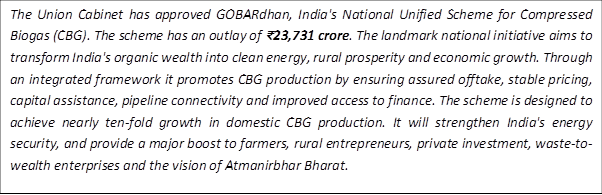
India currently meets nearly 50 per cent of its natural gas requirement through imports, making energy security a strategic priority. Recent geopolitical developments and disruptions along the Strait of Hormuz, a route that carries nearly 55 to 60 per cent of India's Liquefied Natural Gas (LNG) imports, have underscored the importance of strengthening domestic energy production. In this context, the Union Cabinet approved GOBARdhan, the National Circular Bioenergy Scheme, with a total outlay of ₹23,731 crore on 06 August 2026.
Galvanizing Organic Bio-Agro Resources Dhan (GOBARdhan) was originally launched under the Swachh Bharat Mission (Grameen) in 2018 as an integral component of Solid and Liquid Waste Management (SWM), converting bio-waste - animal waste, kitchen leftovers, crop residue and market waste, into biogas and bio-slurry, thereby ensuring cleanliness in villages and improving rural lives.
Earlier, the Compressed Biogas (CBG) ecosystem was spread across four different ministries. To ensure better coordination and accelerate the sector's growth, the Government has consolidated the entire scheme under the Ministry of Petroleum and Natural Gas. This reform enables a unified approach to policy, implementation and sectoral development.
The Scheme will be implemented from FY 2026-27 to FY 2035-36 and will establish Compressed Biogas as a major pillar of India's future energy mix.
Through assured demand, remunerative and stable pricing, capital assistance, pipeline infrastructure, credit guarantee and technology development, GOBARdhan will be providing the strong framework to scale up India's CBG sector nationwide.
Aim:
· To increase nearly ten-fold domestic CBG production
· mobilize large-scale private investment
· create a vibrant circular bioeconomy across the country.
Nodal Ministry: Ministry of Petroleum and Natural Gas (MoPNG)
Implementation Period: FY 2026-27 to FY 2035-36
Total Outlay: ₹23,731 crore
Vision:
· India's waste will fuel India's growth.
· India's villages will become centres of clean energy production.
· India's farmers will become partners in the nation's energy security.
From a Strong Foundation to National Scale
Over the past several years, the Government of India has systematically built the foundations of the CBG sector through:
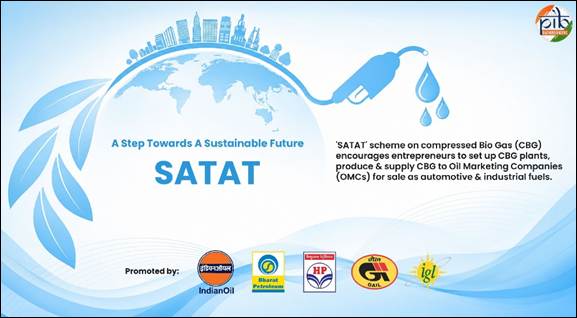
· Sustainable Alternative Towards Affordable Transportation (SATAT) initiative
· Market Development Assistance (MDA) Scheme for organic manure
· Biomass Aggregation Machinery (BAM) Scheme
· Development of Pipeline Infrastructure (DPI) Scheme
- Central Financial Assistance (CFA) for CBG plants under the National Bioenergy Programme
The Ministry of Petroleum and Natural Gas (MoPNG) is implementing the Biomass Aggregation Machinery (BAM) Scheme to support Compressed Biogas producers in procuring biomass aggregation equipment. The scheme has a total outlay of ₹564.75 crore. As on 16 March 2026, 37 proposals have been approved, with financial assistance of nearly ₹248 crore.
To strengthen CBG evacuation and market access, MoPNG is also implementing the Development of Pipeline Infrastructure (DPI) Scheme with a total outlay of ₹994.5 crore for the period FY 2024-25 to FY 2028-29. So far, ₹56.31 crore has been sanctioned under the scheme.
The Department of Fertilizers was implementing the MDA Scheme to promote organic fertilizers produced from GOBARdhan and CBG plants by providing ₹1,500 per metric tonne for Fermented Organic Manure, Liquid Fermented Organic Manure and Phosphate Rich Organic Manure.
As on 4 March 2026, 120 CBG/Biogas plants were registered on the Integrated Fertilizer Management System portal, and 44 MoUs had been signed between Fertilizer Marketing Companies and Compressed Biogas operators. Between February 2025 and January 2026, 24 Fertilizer Marketing Companies organised 15,690 Kisan Sangoshthis and awareness camps.
A two-year Indian Council of Agricultural Research (ICAR) project worth ₹11.79 crore is supporting field demonstrations, while NITI Aayog is evaluating the scheme's overall impact. Under the scheme, ₹111.72 crore has been released as Market Development Assistance up to 28 February 2026, including ₹28 crore in 2024-25 and ₹83.72 crore in 2025-26.
GOBARdhan now takes this progress to the next level. Administered by the Ministry of Petroleum and Natural Gas, the Scheme creates one integrated platform across the entire CBG value chain.
A Strategic Opportunity for India
India's demand for natural gas is expanding across transport, households, industry and commercial sectors. CBG can meet a growing share of this demand through domestic renewable production. It will further strengthen energy resilience and reduce dependence on imported fossil fuels. Reduced energy import dependence will save over ₹40,000 Crore in forex.
CBG is chemically equivalent to natural gas and can be seamlessly integrated into the existing gas ecosystem, combining the benefits of a renewable fuel with the reach and utility of India's expanding gas infrastructure.
Each CBG plant also creates a local circular economy around agricultural residue, cattle dung and other organic resources, generating opportunities in feedstock supply, transportation, plant operations and organic manure production, while supporting cleaner waste management and lower greenhouse gas emissions.
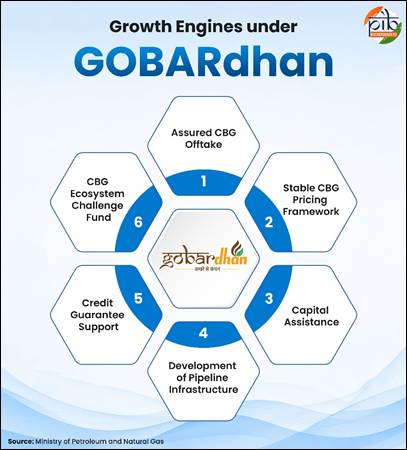
Six Growth Engines under GOBARdhan
To translate the vision of GOBARdhan into measurable outcomes on the ground, the scheme has been structured around six integrated components.
Component 1: Assured CBG Offtake
GOBARdhan establishes a dedicated CBG Offtake Assurance framework to provide a reliable and predictable market for producers. Procurement by City Gas Distribution (CGD) entities will support achievement of the notified CBG Obligation trajectory:
· 3% in FY 2026-27
· 4% in FY 2027-28
· 5% from FY 2028-29 onwards in CNG (Transport) and PNG (Domestic) segments
The framework converts the blending obligation into a clear, long-term demand signal for the industry. Consistent implementation across CGD networks will improve project bankability, support capacity utilization and encourage long-term private investment.
Component 2: Stable CBG Pricing Framework
GOBARdhan introduces a government-backed administered price of ₹2,110 per Metric Million British Thermal Unit (MMBTU), equivalent to ₹105 per kilogram of CBG, ensuring stable and remunerative pricing.
The framework provides long-term revenue visibility while protecting consumer affordability through a combination of Government support and a market-based cost-sharing mechanism.
With a minimum ten-year horizon, the pricing framework will provide producers with durable revenue certainty, commercially attractive returns and a stronger business case for investment and capacity expansion.
Component 3: Capital Assistance
Eligible greenfield CBG projects will receive capital assistance of up to ₹2 crore per ton per day (TPD) of installed CBG capacity.
The support extends beyond core plant machinery to critical value-chain assets for feedstock aggregation, organic manure processing and value addition. Brownfield projects expanding their production capacity will also be eligible.
This component will lower the initial capital burden, accelerate financial closure and expand participation by private developers, MSMEs, cooperatives and rural entrepreneurs.
Component 4: Development of Pipeline Infrastructure
The Scheme supports both cluster-based and standalone pipeline infrastructure connecting CBG plants with trunk pipelines and City Gas Distribution networks. Greater pipeline connectivity will reduce evacuation costs, improve reliability, expand market reach and enable higher utilization of domestically produced CBG.
Component 5: Credit Guarantee Support
A dedicated Credit Guarantee Mechanism will enhance lender confidence and facilitate greater access to institutional finance for eligible MSME based compressed biogas projects. The mechanism will provide credit guarantee coverage of up to 85 per cent on eligible loans for such projects.
By sharing a portion of lending risk, the mechanism will improve access to affordable finance, reduce collateral requirements and support faster project development, widening participation by MSMEs, women entrepreneurs and first-time developers, and helping build a broad, competitive and entrepreneurial CBG industry.
Component 6: CBG Ecosystem Challenge Fund
GOBARdhan establishes a dedicated CBG Ecosystem Challenge Fund to accelerate district-level implementation and strengthen local value chains across the CBG ecosystem.
The Fund will support:
· Feedstock resource assessment and mapping
· Feedstock aggregation infrastructure
· District-level CBG development planning
· Technology adoption and process improvement
· Value addition of organic manure
· Capacity building and stakeholder awareness
Expected Outcomes of GOBARdhan
GOBARdhan builds on the strong foundation laid in recent years to scale up CBG production across the country. The scheme is expected to deliver:
· Nearly ten-fold growth in domestic CBG production, creating a new pillar of India's clean gas economy.
· Greater energy security through increased domestic production of renewable gaseous fuel and lower dependence on imported fossil fuels.
· A new wave of private investment supported by stronger project viability, stable pricing and improved access to institutional finance.
· Stronger rural livelihoods through new income opportunities for farmers, feedstock aggregators, cooperatives and rural entrepreneurs.
· Scientific waste management through productive use of agricultural residue, cattle dung, municipal organic waste and other biomass resources.
· Lower greenhouse gas emissions through replacement of fossil fuels and productive utilization of organic waste.
· A larger organic manure economy through greater production, value addition and utilization of FOM and LFOM.
· Faster and easier project implementation through one national framework, digital governance and simplified institutional arrangements.
GOBARdhan will deliver measurable gains, tracked across a full ten-year horizon.
· CBG production will grow ten-fold over the decade, attracting strong private investment.
· Reduced import dependence will save over ₹40,000 crore in forex.
· Clean, home-grown gas will displace 10 MMT of fossil fuel use.
· This industry will add more than ₹75,000 crore to national GDP.
· Over 1.5 lakh jobs will be generated across the value chain.
· Diverting waste from landfills will cut more than 40 MT of CO₂ emissions.
· Production of 250 MMT of organic fertilizer.
GOBARdhan Unified Registration Portal
Anyone operating or intending to set up a CBG/Bio-CNG plant in India can obtain a registration number through the GOBARdhan Unified Registration Portal (gobardhan.eil.co.in). The registration number is required to avail benefits and support from MoPNG.
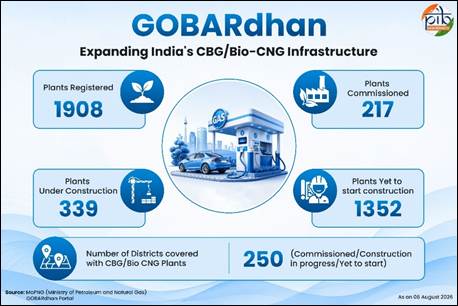
According to the GOBARdhan Unified Registration Portal, as on 06 August 2026, a total of 1,908 Compressed Biogas (CBG)/Bio-CNG plants have been registered across the country. Of these, 217 plants have already been commissioned producing 0.4 Million Standard Cubic Meters per Day (MMSCMD), while 339 plants are under construction.
GOBARdhan: Taking India's Circular Bioeconomy to Scale
GOBARdhan marks a decisive step in transforming India's abundant organic resources into clean energy, rural prosperity and economic value. By bringing assured demand, stable pricing, capital assistance, pipeline connectivity, credit support and ecosystem development under one national framework, the Scheme creates the conditions for CBG to grow at scale.
Building on the progress already achieved, GOBARdhan will take India's CBG journey from a strong foundation to a nationally scaled clean energy industry, reflecting the Government's commitment to energy security, farmers and rural enterprises, waste-to-wealth, Atmanirbhar Bharat and the vision of Viksit Bharat.
References:
Ministry of Petroleum & Natural Gas
Ministry of Jal Shakti
Ministry of Chemicals and Fertilizers
Ministry of Electronics and Information Technology
Ministry of Information and Broadcasting
- https://www.youtube.com/watch?v=LkdCb8khJJs&t=1121s
(रिलीज़ आईडी: 2295738)
आगंतुक पटल : 425