PIB Backgrounder
The Micro, Small and Medium Enterprises Development (Amendment) Bill, 2026
प्रविष्टि तिथि:
11 AUG 2026 6:05PM by PIB Delhi
Reforms for a Growing MSME Sector
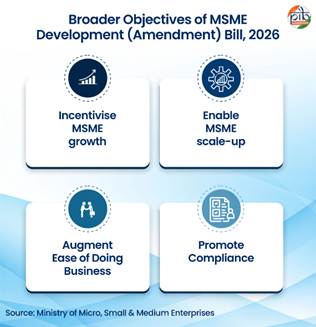
The Micro, Small and Medium Enterprises Development (Amendment) Bill, 2026, was passed by the Parliament in August 2026. It updates the existing MSMED Act, 2006 to align its provisions with the requirements of the MSME sector. The amendments seek to reduce payment-related constraints, make dispute resolution more time-bound and simplify compliance. Their broader objective is to facilitate the growth, development and competitiveness of MSMEs while promoting Ease of Doing Business.
|
Introduction
The MSME Development (Amendment) Bill, 2026 was passed by the Parliament in August 2026. The importance of this amendment stems from the sector’s growing role in India’s economy. The Micro, Small and Medium Enterprises Development Act (MSMED Act) was notified in 2006. Since then, the MSME ecosystem has expanded in scale, diversity and digital reach.
According to the Economic Survey 2025-26, MSMEs account for 31.1% of GDP, 35.4% of manufacturing output and 48.58% of exports. As on August 2026, 9.16 crore MSMEs are registered on the Udyam platform, employing more than 40 crore people. Technological advances and IT-enabled systems have further transformed the MSME landscape. These enterprises now operate across rural, semi-urban and urban areas and participate more actively in formal supply chains.
The MSME Development (Amendment) Bill, 2026 builds on this foundation. It aims to align the legal framework with the sector’s changing needs and its growing economic significance.
Changes introduced in the Bill
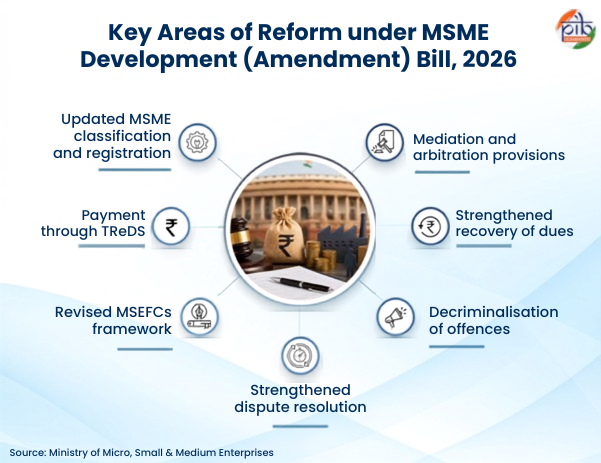
The 2026 Bill revises certain specific provisions under the MSMED Act, 2006. Details of key areas of reform are highlighted below:
|
Areas of Reform
|
The Micro, Small and Medium Enterprises Development Act, 2006
|
The Micro, Small, and Medium Enterprises Development (Amendment) Bill, 2026
|
|
MSME Classification
|
MSMEs are classified on the basis of prescribed investment thresholds for:
- plant and machinery in manufacturing; and
- equipment in services.
|
MSMEs are classified on the basis of:
- investment in plant and machinery or equipment; and
- turnover.
|
|
MSME Registration
|
Medium enterprises engaged in manufacturing are required to file a memorandum with specified authority. Filing of memorandum is voluntary for other MSMEs.
|
The Bill makes filing of the memorandum free and voluntary for all MSMEs.
The Central Government shall notify a national platform for the purpose. State governments may also notify State digital platforms.
State scheme benefits may be extended to MSMEs registered on the national and state-level platform.
|
|
Payments through Trade Receivables Discounting System (TReDS)
|
Addressed through introduction of a new provision in the Bill.
|
All Central Public Sector Enterprises (CPSEs) are required to settle invoices for goods and services procured from MSMEs through the TReDS platform. This aims to address payment-related issues faced by MSMEs.
States may mandate their Public Sector Enterprises (PSEs), authorities, or entities to use TReDS for invoice settlement.
|
|
Micro and Small Enterprises Facilitation Councils (MSEFCs) Framework
|
State Governments may establish one or more MSE Facilitation Councils.
|
State Governments can establish multiple MSEFCs to enable faster resolution of payment-related disputes. They are also empowered to provide adequate infrastructure and resources, including physical infrastructure, digital systems and trained manpower, as may be necessary.
|
|
Mediation and Arbitration
|
The MSEFCs or referred mediation service providers are authorised to settle payment disputes by mediation.
Where a mediation is not successful, the dispute may be referred for arbitration.
|
Central Government may establish an online mechanism for conducting online mediation or arbitration.
Specific timelines have been introduced for mediation and arbitration:
- The MSEFC or mediation service provider must complete mediation within 90 days from the date fixed for the first appearance.
- If mediation is terminated, the MSEFC are required to refer the matter for arbitration within 30 days.
- The MSEFC or an institution or centre providing alternative dispute resolution services must make the arbitral award within 90 days from the completion of pleadings.
|
|
Dispute Resolution
|
Application to set aside a Council’s order/ award may be filed in court after depositing 75% of the awarded amount.
|
The Bill also allows such applications. While the application is pending, the court may direct that a reasonable portion of the deposited amount be paid to the MSME supplier.
Courts shall direct payment to MSE suppliers when an application to set aside a decree, award or order remains pending for more than six months. The payment must be at least 50% of the awarded amount.
|
|
Recovery of Dues
|
Addressed through introduction of a new provision in the Bill.
|
Mediated settlement agreement or arbitral award can be recovered as ‘arrears of land revenue’. This applies to agreements or awards made under Section 18 by the Facilitation Council, a mediation service provider or an alternative dispute resolution institution.
Recovery may be undertaken through the District Collector, Deputy Commissioner or another notified authority. The notified authority must have jurisdiction over the location of the buyer’s assets.
|
|
Decriminalisation of Offences
|
Wilfully providing false registration information attracts a fine of up to ₹1,000 for the first conviction and ₹1,000-₹10,000 for subsequent convictions.
Failure to report unpaid dues to MSME suppliers in annual accounts attracts a fine of at least ₹10,000.
|
Non-filing of registration or non-supply of information: Earlier, these violations attracted conviction and a fine. The penal provisions have now been decriminalised.
Furnishing incorrect information: A warning will be issued for the first instance, followed by a penalty for the second and subsequent instances.
Non-disclosure of unpaid dues by buyers: It now attracts a warning for the first instance, a penalty for the second and a fine for the third and subsequent instances.
|
Digital and Institutional Support
The reforms introduced by the Bill are supported by digital platforms and institutional mechanisms established across the MSME ecosystem.
Expanding Formal Recognition: The Udyam Registration Portal gives MSMEs official recognition through a free, paperless and self-declaration-based online process. The Udyam Assist Platform complements this initiative by formally recognising informal micro enterprises. This includes enterprises without GST registration or coverage under the Income Tax system, based on data verified by authorised partners.
Improving Access to Financing: TReDS is an electronic platform that enables MSMEs to finance or discount trade receivables. It operates in accordance with guidelines issued by the Reserve Bank of India. The value of invoices discounted through the platform rose from ₹40,000 crore in 2022-23 to ₹3.47 lakh crore in 2025-26.
Enabling Online Dispute Resolution (ODR): The ODR Portal was launched in June 2025. It offers MSEs a low-cost, end-to-end digital mechanism for resolving delayed payment disputes, including small-value claims.
Strengthening the MSEFC Network: 161 MSEFCs have been established across States and Union Territories. MSEFCs are set up to adjudicate disputes arising from payment delays faced by Micro and Small Enterprises.
Conclusion
The MSME Development (Amendment) Bill, 2026 seeks to strengthen the foundations of an MSME’s journey from a small enterprise to a growing business. It provides for a stronger regulatory framework to help MSMEs operate and expand in an evolving business environment.
References:
Rajya Sabha:
https://sansad.in/rs/legislation/bills
Ministry of Micro, Small & Medium Enterprises:
https://www.pib.gov.in/PressReleasePage.aspx?PRID=2296358®=48&lang=1
https://www.pib.gov.in/PressReleasePage.aspx?PRID=2209712&lang=1®=3
https://www.pib.gov.in/PressReleasePage.aspx?PRID=2284414®=3&lang=1
Ministry of Finance:
https://www.pib.gov.in/PressReleasePage.aspx?PRID=2219984®=48&lang=2
PIB Archives:
https://www.pib.gov.in/PressReleasePage.aspx?PRID=2278107®=48&lang=2
https://www.pib.gov.in/PressReleasePage.aspx?PRID=2260904&lang=1®=3
Others:
https://prsindia.org/billtrack/the-micro-small-and-medium-enterprises-development-amendment-bill-2026
Click here to see pdf
****
PIB Research
(रिलीज़ आईडी: 2297792)
आगंतुक पटल : 649
इस विज्ञप्ति को इन भाषाओं में पढ़ें:
Gujarati