Ministry of Agriculture &
Farmers Welfare
National Symposium on Next-Generation Plant Health Strategies Begins at ICAR-CPRI, Shimla
Over 250 scientists, researchers and academicians deliberate on climate resilience, emerging plant diseases, artificial intelligence and sustainable agriculture
प्रविष्टि तिथि:
22 OCT 2026 12:03PM by PIB Shimla
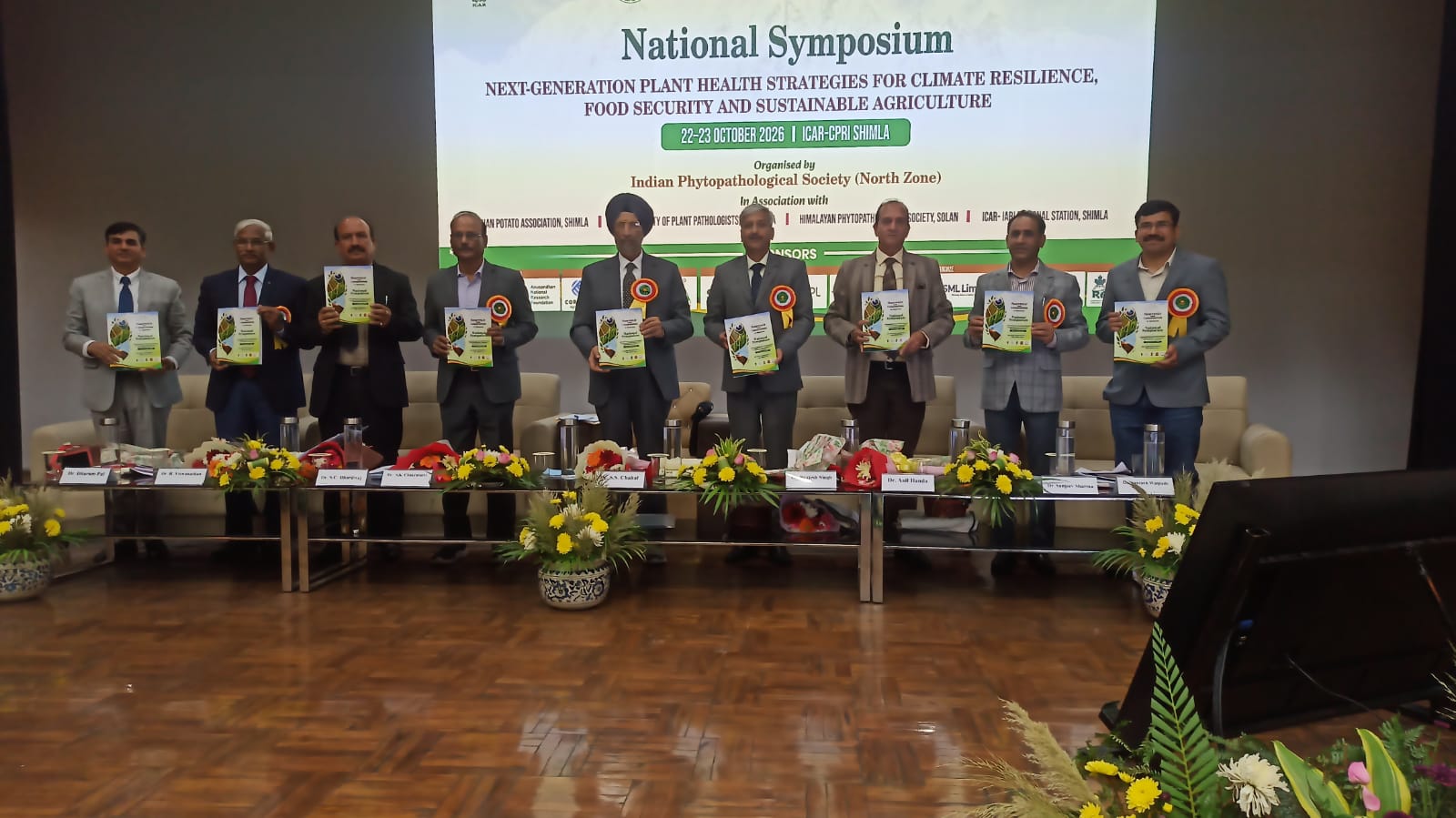
Shimla. A two-day National Symposium on “Next-Generation Plant Health Strategies for Climate Resilience, Food Security and Sustainable Agriculture” started at ICAR-Central Potato Research, Shimla. The symposium is being organized under the aegis of the Indian Phytopathological Society (IPS), in collaboration with the Indian Potato Association, Indian Society of Plant Pathologists, Himalayan Phytopathological Society and ICAR-Indian Agricultural Research Institute (IARI), Regional Station, Shimla.
The symposium was inaugurated by Dr. S. S. Chahal, former Vice-Chancellor of Maharana Pratap University of Agriculture and Technology, Udaipur, as Chief Guest, in the presence of Dr. Swarup Kumar Chakrabarti, former Vice-Chancellor of Uttar Banga Krishi Viswavidyalaya, West Bengal, as Guest of Honour. The programme began with the ceremonial lighting of the lamp. The inaugural ceremony was attended by Dr. Brajesh Singh, Director, ICAR-CPRI, Shimla, and President, Indian Potato Association; Dr. R. Viswanathan, President, Indian Phytopathological Society; Dr. Anil Handa, President, Himalayan Phytopathological Society; Dr. S. C. Bhardwaj, President, Indian Society of Plant Pathologists; Dr Sanjeev Sharma, Convenor, National Symposium 2026; Dr. Dharampal, Head, ICAR-IARI Regional Station, Shimla; and Dr. Santosh Watpade, Senior Scientist, ICAR-IARI Regional Station, Shimla.
Addressing the gathering, Dr. S. S. Chahal emphasized the urgent need to strengthen India's plant health security against emerging and invasive pests and diseases, particularly in the context of climate change, expanding international trade and evolving agricultural production systems. He expressed concern over structural and technological gaps in plant biosecurity, inadequate screening at international entry points, weak post-entry quarantine surveillance and vulnerabilities associated with agricultural imports. He stressed that conventional plant protection approaches must be complemented by advanced surveillance, modern diagnostic technologies and coordinated institutional mechanisms to minimize agricultural losses and safeguard national food security. Highlighting the growing importance of Artificial Intelligence (AI) in plant disease detection and management, Dr. Chahal underlined the need for reliable, field-oriented AI solutions supported by comprehensive datasets, multidisciplinary expertise and effective coordination among research institutions. He observed that limited datasets, crop-specific applications and technological constraints continue to restrict the wider adoption of AI-based plant health solutions. He also emphasized the importance of environmentally responsible technologies that balance agricultural productivity with ecological sustainability.
The technical deliberations commenced with Plenary Session-I, chaired by Dr. S. S. Chahal and co-chaired by Dr. Mamta Sharma of the International Crops Research Institute for the Semi-Arid Tropics (ICRISAT), Patancheru. The session featured the prestigious Dr. T. S. Thind Distinguished Plant Pathologist Award Lecture, followed by keynote presentations by eminent experts.
Dr. Swarup Kumar Chakrabarti delivered a keynote address on “Plant Disease Management under Regenerative Agriculture: A One Health Perspective for India,” highlighting the importance of integrating plant, environmental and ecosystem health into sustainable disease management strategies. Dr. R. Viswanathan, former Director of ICAR-Indian Institute of Sugarcane Research, Lucknow, and President of the Indian Phytopathological Society, addressed “Genome Editing for Disease-Resilient Crops: Advances, Opportunities and Future Prospects,” focusing on emerging biotechnological approaches for strengthening crop resistance against diseases. Dr. V. P. Sharma, former Director of ICAR-Directorate of Mushroom Research, Solan, presented a keynote lecture on “Mushrooms-The Untapped Treasure: Growth, Nutrition and Future Prospects,” highlighting the potential of mushrooms in nutritional security, livelihood diversification and sustainable agriculture.
The symposium also features technical and invited lectures covering emerging plant diseases, innovative disease management approaches, climate-resilient agriculture, advanced diagnostic technologies and sustainable crop production systems. An award ceremony is scheduled to recognize outstanding contributions to plant pathology through prestigious honours, including the M. J. Narasimhan Academic Award, INSOP Award, Dr. S. S. Kang Ph.D. Thesis Award and Dr. S. S. Chahal Best Master's Thesis Award.
More than 250 scientists, academicians, researchers and students from 17 states of India are participating in the two-day symposium. The event provides a national platform for sharing scientific advancements, promoting interdisciplinary collaboration and developing innovative plant health strategies to strengthen climate resilience, ensure food security and advance sustainable agriculture in India.
SS/NK
(रिलीज़ आईडी: 2327147)
आगंतुक पटल : 5