Ministry of Mines
LONAR LAKE IMPACT CRATER, BULDHANA DISTRICT, MAHARASHTRA IN THE THIRD 100 IUGS GEOLOGICAL HERITAGE SITES
IUGS extends its Prestigious List of Key Geological Heritage Sites of Earth with a New Surprising Selection of Sites
प्रविष्टि तिथि:
13 NOV 2026 1:14PM by PIB Kolkata
Kolkata, November 13, 2026
IUGS Geological Heritage Sites are recognised by the International Union of Geological Sciences (IUGS) for their outstanding scientific value as exceptional examples of geological features, processes and discoveries. They represent some of the world’s most significant places for understanding the Earth and its history. Located across the globe, they offer a surprising journey through the most important geological sites of the Earth.
The selection of the Third 100 builds on the success and global impact of the First 100, announced in Zumaia, Spain, in 2022, and the Second 100, announced during the 37th International Geological Congress (IGC 2024) in Busan, Republic of Korea. Since 2022, more than 1000 experts from 90 countries and 20 international organisations have contributed to this programme by proposing sites, participating in the selection process and evaluating their scientific quality. With 74 active national members, IUGS is one of the World´s largest scientific organisations. It encourages international cooperation and participation in the Earth sciences in relation to human welfare.
Of late, Lonar Lake Impact Crater has been included in this prestigious list owing to its unique geological heritage. It is one of the youngest (approximately 12,000 years old) and best-preserved bowl-shaped hypervelocity impact structures on Earth. With a diameter of approximately 1.88 km, it is uniquely situated within the extensive Deccan Traps, a succession of tholeiitic continental flood basalts formed around 65 million years ago. It is particularly significant as one of the rare terrestrial impact craters formed in basaltic rocks and is considered one of the five known hypervelocity meteorite impact craters on Earth developed in a basaltic target. The crater hosts a saline-alkaline lake at its centre, creating a distinctive geological and ecological setting. Its circular morphology, depth-to-diameter ratio, exposed basaltic lava flows along the inner slopes, brecciated subsurface rocks, outward-dipping country rocks, debris mounds and extensive ejecta deposits containing fragmented breccia and suevite provide compelling evidence of its meteoritic impact origin. Impact-related materials, including impact glass, spherules and melt rocks, offer important evidence for understanding the physical and geochemical processes associated with hypervelocity impacts. Geological Survey of India (GSI), through its sustained efforts in geoheritage conservation in India took up the initiative to submit this proposal to IUGS for consideration under this prestigious international initiative.
The Third 100 Geological Heritage Sites are distributed across 47 countries and include 11 sites in Africa, 22 in the Americas, 22 in the Asia-Pacific region, 6 in the Middle East, 34 in Europe, 2 in Antarctica and 3 in the High Seas. Iconic geological sites like Mount Fuji (Japan), the Fjords of Norway, San Andreas fault (USA), Mount Aconcagua (Argentina) and the Chocolate Hills (Philippines) have been now included in this surprising list of geological wonders of the Earth. Sites like The Grand Canyon, Kilimanjaro volcano, Mount Everest or Namib desert were included in previous editions together with many other fundamental but less popular sites like Siccar Point (UK) where the concept of deep time was first recognized or Ediacara Hills (Australia), where the first multicellular life was described. The full list of IUGS GEOLOGICAL HERITAGE SITES can be found at: https://iugs-geoheritage.org/
IUGS recognition gives visibility to those sites. It identifies them as being of the highest scientific value. They are sites that served to develop the science of geology. They are the world’s best demonstrations of geologic features and processes. They are the sites of fabulous discoveries of the Earth and its history.
Many of the “Third 100” are well protected in national parks, geoparks, and natural reserves, but many are not. Recognition and visibility of the “Third 100” IUGS Geological Heritage Sites can lead to their further appreciation, to their use as educational resources, and, most importantly, to their preservation.
See the complete list and download the book “The Third 100” at https://iugs-geoheritage.org. The books can be downloaded free or purchased at the website.
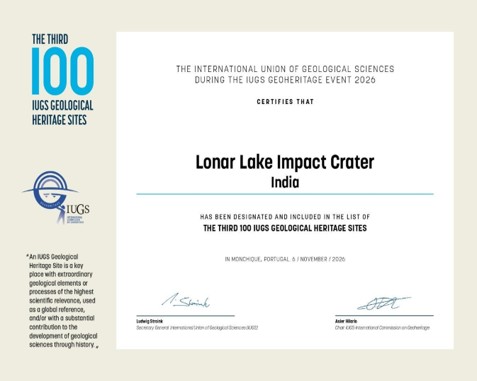
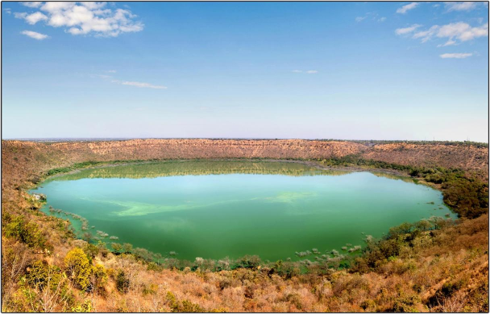
IUGS Certificate Panoramic view of the Lonar Lake Impact Crater
********
SSS/Kol
(रिलीज़ आईडी: 2335748)
आगंतुक पटल : 22
इस विज्ञप्ति को इन भाषाओं में पढ़ें:
Bengali