Posted On:
10 DEC 2024 10:16PM by PIB Chennai
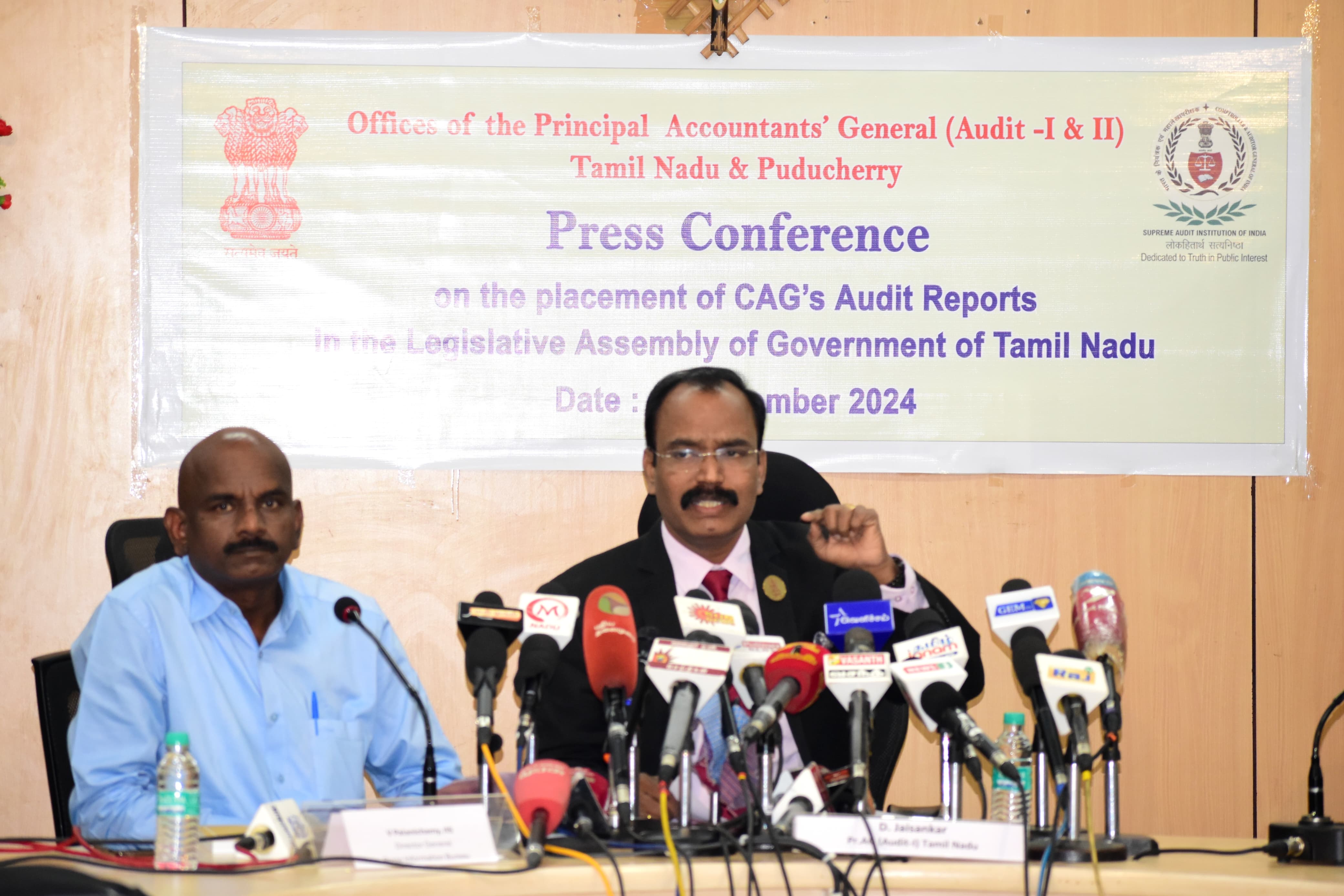
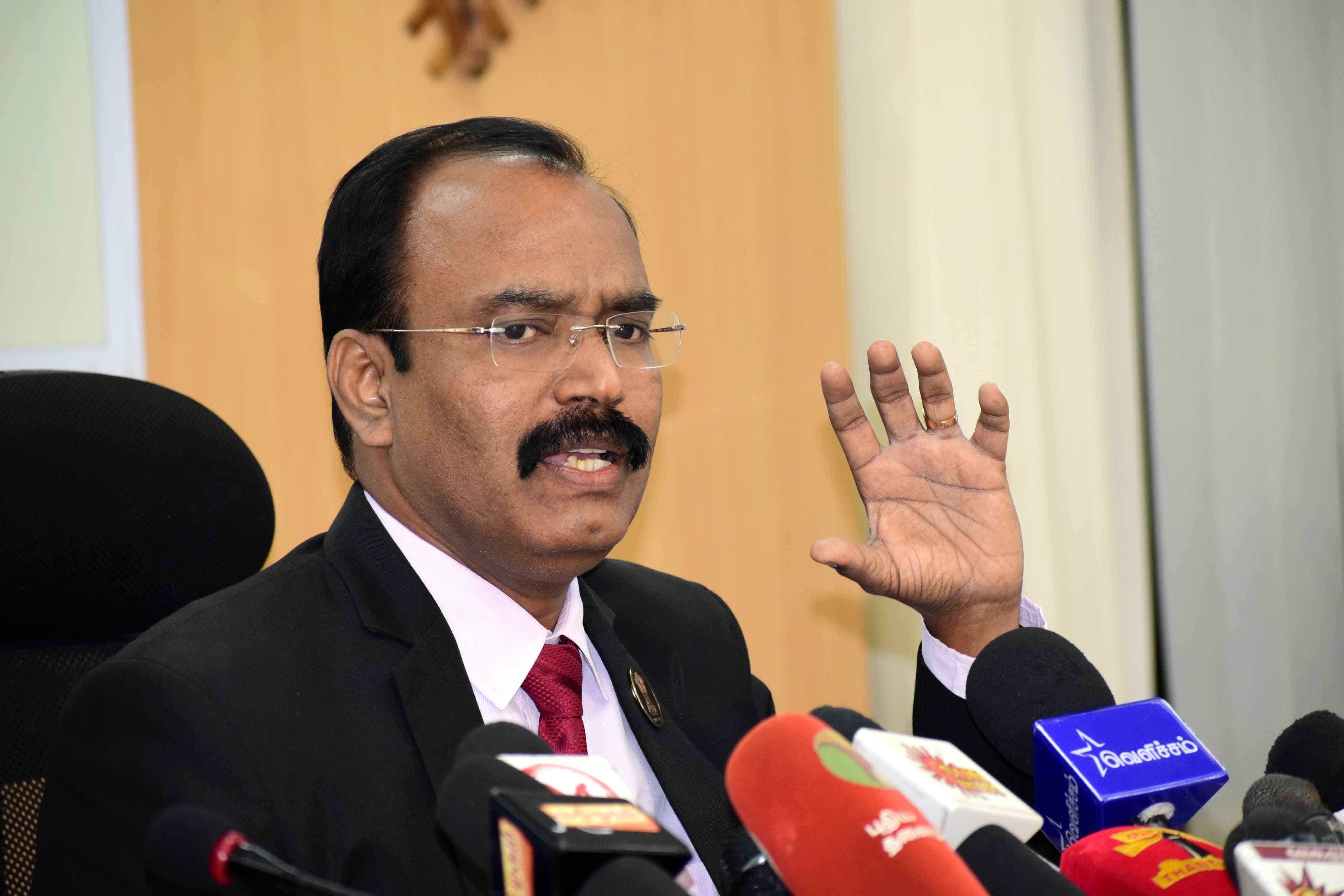
The Report of the Comptroller and Auditor General of India (Compliance Audit (Local Government)) for the year ended 31 March 2022 on Government of Tamil Nadu was placed in the Legislative Assembly on 10 December 2024
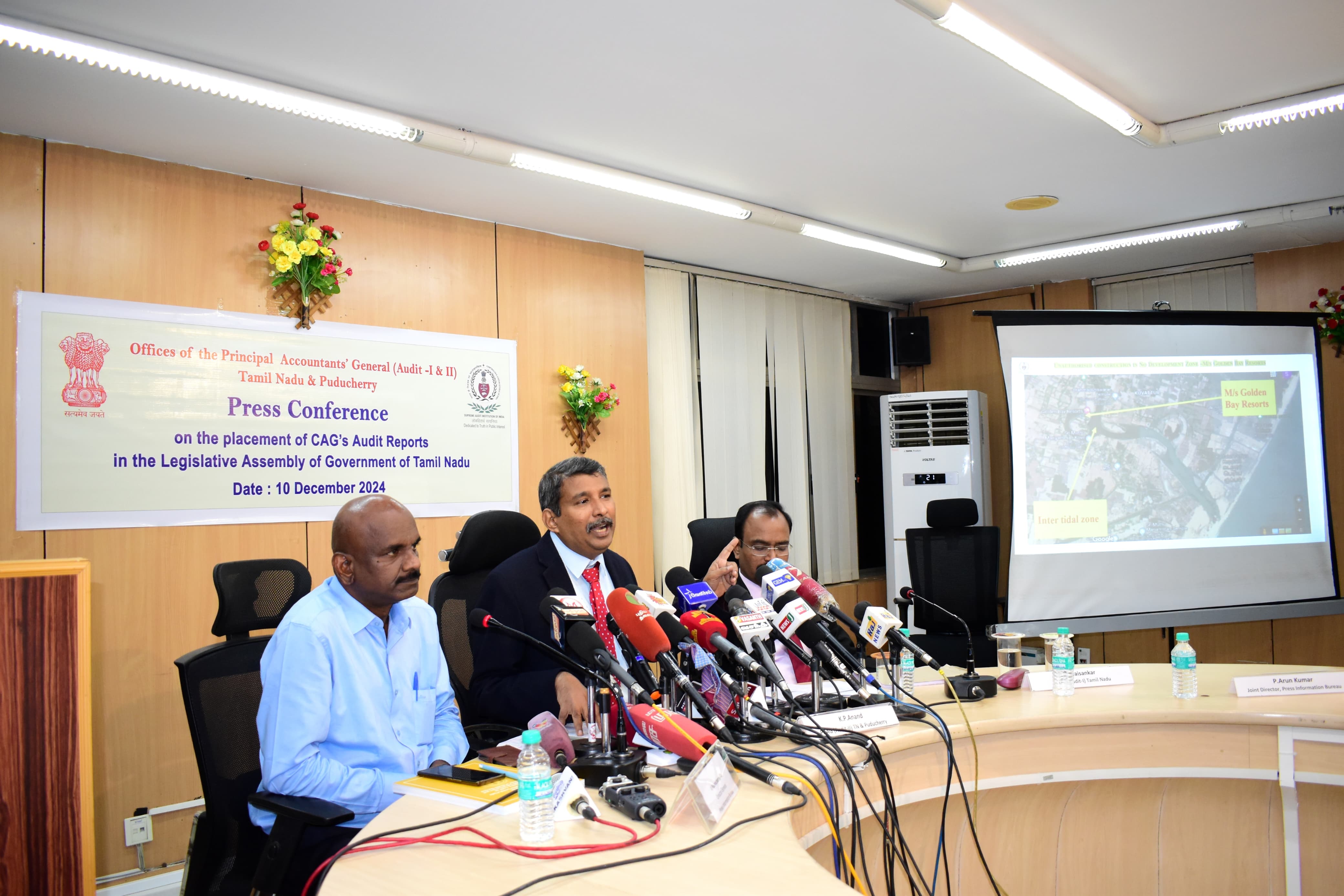
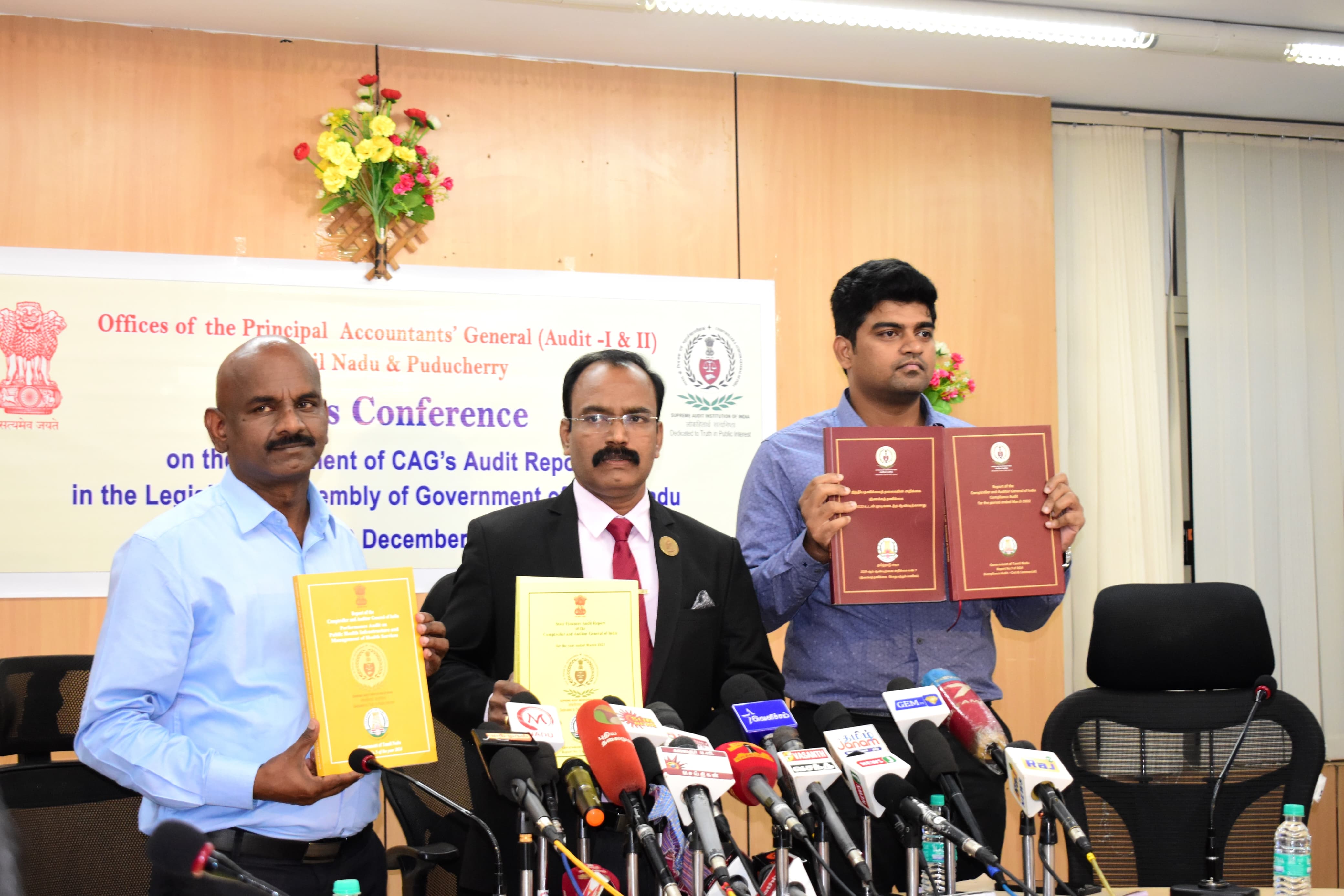
Following are the major audit findings highlighted in the Report.
Subject Specific Compliance Audit
Chief Minister’s Solar Powered Green House Scheme
Government of Tamil Nadu launched (2011) the ‘Chief Minister’s Solar Powered Green House Scheme’, with an objective to provide
pucca houses with basic amenities to all the rural poor along with
solar photovoltaic home lighting system.
The Scheme has not made any substantial contribution towards providing a pucca home to the vulnerable rural poor as only 7.42 per cent of the eligible rural poor (10,887 families) in the sampled villages benefitted under this Scheme. The unit cost of ₹1.80 lakh for construction was not revised since 2013-14, in spite of significant increase in the price of construction materials like sand for mortar, bricks, and cement between 2012-13 and 2019-20. Out of 653 beneficiaries in the 57 sampled Village Panchayats (VPs), only 154 beneficiaries (24 per cent) were from the Participatory Identification of Poor’ list, indicating that the annual targets for construction of houses were set without linking with the list.
The field level officers did not adhere to the Scheme guidelines. Block Development Officers (BDOs) issued work orders without ensuring patta in respect of 429 beneficiaries (66 per cent) during 2017-21. In
27 sampled VPs (47 per cent), allotment of houses to 135 persons was made by the BDOs without the approval of the Grama Sabhas. Eighty-eight beneficiaries (13 per cent) allotted houses during 2017-21 had expanded their houses into large dwelling units with additional rooms, floor and parking slot for four wheelers indicating that these beneficiaries were not rural poor but wealthy people who misused this Scheme. There was short supply of cement in sampled districts as supply ranged between 21.21 per cent (Salem) and 84.64 per cent (Kanyakumari). Short supply of steel was between 47.74 per cent in (Tiruchirappalli) and 100 per cent (Cuddalore). Belated finalisation of Model Tender Document delayed the installation of solar powered LED lights in green houses and multiple violations of tender procedures stained the award of contracts and impacted the quality of solar photovoltaic home lighting systems supplied.
(Paragraph 2.1; Page 13)
Scheme Component of Pooled Assigned Revenue (SCPAR)
Government of Tamil Nadu decided (2007) to pool the ‘Assigned Revenue’ of Rural Local Bodies at the State level and apportion 1/3rd to Rural Local Bodies in line with State Finance Commission norms and 2/3rd to a Fund, ‘Scheme Component of Pooled Assigned Revenue’, for creating basic infrastructure in rural areas. The Fund is maintained by the Directorate of Rural Development and Panchayat Raj.
Out of 12,525 Village Panchayats (VPs) in the State,
9,503 (76 per cent) VPs were not allocated works under SCPAR. Out of the remaining 3,022 VPs, 241 VPs (i.e. 7.97 per cent) were sanctioned ₹549.60 crore (41 per cent) of the total value of works during 2018-22 indicating disproportionate allocation of SCPAR funds. Scheme guidelines did not spell out modalities for identifying and proposing priority works to be taken up under the scheme.
Failure to verify the proceeds of surcharge on stamp duty reported by Registration Department resulted in short allocation of ₹32.65 crore of pooled Assigned Revenue to Rural Local Bodies in 2018-19. Between December 2020 and March 2021, there was diversion of ₹256.00 lakh, ₹439.42 lakh and ₹400.00 lakh from SCPAR account to other scheme accounts in Namakkal, Salem and Villupuram districts respectively. Scheme related cash book maintained in the Directorate was not closed and reconciled with bank account every month. As a result, the Directorate could not identify the unspent funds of previous years in the closing balance of SCPAR account (₹850.23 crore as of March 2022).
Department did not initiate action to levy penalty on the contractor or to cancel the agreement for delays in completing the work. Road works taken up under the scheme were not executed as per Indian Road Congress Guidelines and Government instructions. Scheme works were not monitored for quality.
(Paragraph 2.2; Page 37)
Working of Micro Composting Centres established in
peri-urban and bigger Village Panchayats in rural areas
Government of Tamil Nadu formulated (2020) the scheme for establishing Micro Composting Centres (MCCs) for effective management of solid waste in peri-urban and bigger Village Panchayats (VPs).
Out of 64 test-checked VPs, MCCs in 35 VPs collected less than 0.05 MT waste per day on an average, against the eligibility norms of 0.5 MT waste per day, indicating that the district authorities overstated the average
bio-degradable waste in the proposals for establishment. District authorities failed to ensure availability of suitable site away from water bodies for MCC work. In 13 VPs, MCCs were established on lands classified as water bodies. In three VPs, each in Kanyakumari, Virudhunagar and Salem districts, the site proposals was cleared unilaterally without involving the Grama Sabhas, which contributed to public agitation and time over-run in establishing MCCs.
Out of 64 test-checked MCCs, 40 MCCs were completed with delays ranging from 3 to 19 months beyond the agreed contract period. Shortcomings in infrastructure facilities such as lack of provision for
Air Vents, non-installation of sanitary napkin burning machines etc., were noticed in some of the test-checked MCCs in sampled districts Poor capacity utilisation of MCCs were noticed. In the test checked MCCs, the capacity utilisation was below 20 per cent in 39 MCCs, between
20 per cent and 50 per cent in 20 MCCs and had reached the half-way mark i.e. 50 per cent only in three MCCs. There were deficiencies in monitoring by the implementing authorities as social audit and inspection of MCCs were not conducted in sampled districts.
(Paragraph 2.3; Page 54)
Compliance Audit Paragraphs (Panchayat Raj Institutions)
Non-utilisation of power rollers for compaction of earth fill over bund resulted in excess payment of ₹2.25 crore. Non-verification of genuineness of bills presented by contractors to Block Development Officer/Block Panchayat resulted in fraudulent payment of ₹45.25 lakh to contractors.
(Paragraph 3.1.1; Page 67)
Failure of District Rural Development Agency, Tiruvannamalai to invoke the agreement condition against defaulting contractor resulted in additional expenditure of ₹1.66 crore to the Government due to
non-recovery of differential cost on retendering the work.
(Paragraph 3.1.2; Page 69)
Failure on the part of Panchayat Unions to adopt open tender process in procurement of Chlorination Units for Over Head Tanks and Ground Level Reservoirs for disinfection purpose led to avoidable additional expenditure of ₹1.54 crore. Lapses in monitoring resulted in non-working of the installed Chlorination Units.
(Paragraph 3.1.3; Page 71)
Failure of tender processing authorities to adhere to provisions of
Tamil Nadu Transparency in Tender Act, 1998 and bid conditions while finalising tenders for supply and installation of gym equipment in two districts resulted in excess expenditure of ₹69.18 lakh.
(Paragraph 3.1.4; Page 76)
Failure to avail electricity connection under appropriate tariff resulted in avoidable expenditure of ₹1.29 crore as electricity charges during August 2017 to March 2023.
(Paragraph 3.2.1; Page 79)
Non-adherence to the provisions of the Tamil Nadu Transparency in Tenders Act, 1998 resulted in an avoidable expenditure of ₹74.94 lakh in procurement of Reverse Osmosis Plants.
(Paragraph 3.2.2; Page 81)
Improper planning resulted in idle investment of ₹1.51 crore on construction of a rural bus stand, lying idle for more than six years at Pudur Village, Erode District.
(Paragraph 3.3.1; Page 83)
Compliance Audit Paragraphs (Urban Local Bodies)
Community Assets viz., Community Toilets (42), Community Halls (3) and Slaughterhouses (5), created at a cost of ₹6.33 crore by the Urban Local Bodies did not reach the public as these assets were not put to use and hence the intended objective of construction and utilisation of these 1assets by the respective Urban Local Bodies were not fulfilled.
(Paragraph 4.1.1; Page 85)
Construction of Resource Recovery Centre in water body by Dhaliyur Town Panchayat led to demolition of the same on a direction from Hon’ble High Court and subsequent redevelopment of the water body has resulted in wasteful expenditure of ₹1.05 crore.
(Paragraph 4.1.2; Page 89)
Tax on Profession though payable as per the provisions of the Act was not paid to the Urban Local Bodies by M/s. Tamil Nadu State Transport Corporation Limited, even though the same was collected by them from their employees. Further, the Urban Local Bodies also failed to take effective action to collect the same resulting in non-remittance of tax on profession of ₹7.04 crore.
(Paragraph 4.2.1; Page 91)
Vacant land tax amounting to ₹3.95 crore was not levied by two City Municipal Corporations between the period 2007-08 and 2021-22 in respect of land held by M/s. Electronics Corporation of Tamil Nadu Limited.
(Paragraph 4.2.2; Page 92)
Failure on the part of the Coimbatore City Municipal Corporation to assess the Super Speciality Hospital under Special Buildings as envisaged by the Government of Tamil Nadu guidelines resulted in loss of revenue on property tax amounting to ₹1.61 crore for six half years.
(Paragraph 4.2.3; Page 95)
Reduction in rate of Goods and Services Tax of seven per cent was not passed by the suppliers to the Urban Local Bodies, for 524 Battery Operated Vehicles, resulting in undue benefit of ₹57.76 lakh to the suppliers.
(Paragraph 4.3.1(a); Page 96)
Cost difference due to supply of Lead Acid Battery instead of Lithium Ion Battery in nine Urban Local Bodies for 334 Battery Operated Vehicles purchased resulted in undue benefit of ₹51.56 lakh to the contractor.
(Paragraph 4.3.1(b); Page 97)
The State Finances Audit Report of the Comptroller and Auditor General of India for the year ended 31st March 2023 - Government of Tamil Nadu was placed in the Legislative Assembly on 10/12/2024.
The Report provides an overview of the Finances, Budgetary Management and Quality of accounts, Financial reporting practices and other matters relevant to State Finances.
Finances of the State
Revenue Deficit: The revenue deficit had decreased from ₹46,538 crore in 2021-22 to ₹36,215 crore in 2022-23, which was largely attributable to increase in the revenue receipts by 17 per cent over the previous year. (Para 1.6, Table No.1.2)
Fiscal Deficit: The fiscal deficit of the State increased to ₹81,886 crore (3.46 per cent of GSDP) in 2022-23 from ₹ 47,335 crore (2.90 per cent of GSDP) in 2018-19. (Para 1.8 , Table 1.4 under Para 1.8)
Outstanding liability to GSDP was 28.64 per cent as against limit of 29.30 per cent. Further, if the quantum of the off-budget borrowings (₹1,184.69 crore) is included as part of debt, the overall liability (Includes Public Debt and Public Account Liabilities) of the Government was 28.73 per cent of the GSDP. (Para 2.6.1 and Table 2.29)
During the current year, except for revenue deficit all other targets set under TNFR Act had been achieved. (Table 1.4)
GSDP: It grew by 14 per cent over previous year. Industry & Services Sectors were the main contributors. Per capita GSDP of the state was nearly 56 per cent higher than the national average. (Para 2.3.2.1 and Table 2.4)
As regards the resources of the State Government, Revenue Receipts increased by 17.47 per cent during 2022-23, when compared to previous year. This was because of increase in both tax revenue and non-tax revenue. (Para 2.3.2.1 and Table 2.4)
The own tax revenue constituted major part of the Revenue Receipts (62 per cent). This includes State Goods and Service Tax of ` 53,823 crore and ` 59,143 crore as Taxes on Sales, Trade etc. There was increase in non-tax revenue by 41 per cent (`4,944 crore) when compared to previous year. (Para 2.3.2.2, Table 2.5)
In respect of the application of Resources, Revenue Expenditure increased by 10 per cent over the previous year. This was mainly due to increase in Pensions and Retirement Benefits (23 per cent ), General Education (16%) and Interest Payments (13 per cent ) during the year. (Para 2.4.2)
The committed expenditure on interest payments, salaries and pensions constituted 50-56 per cent of revenue expenditure during 2018-19 (56 per cent) and 2022- 2023 (52 per cent). The Committed expenditure increased at an average rate of 9.99 per cent over the period. (Para 2.4.2.2 and Table 2.16)
The Capital expenditure was 12.10 per cent of the total expenditure in the year 2022-23 and the Capital expenditure was 39 per cent of the borrowings, The borrowed funds were being used mainly for meeting current consumption and repayment of borrowings instead of capital creation/development activities. (Exhibit 2.13, Para 2.4.3)
Outstanding Debt: Market borrowings continued to be the major chunk of liabilities. From previous year, the outstanding debt grew by 14%. However, Fiscal and Domar Analysis revealed that the debt is sustainable. (Para 2.7, Table 2.31 and Table 2.35)
As per the debt stabilisation analysis, the public debt of the Government of Tamil Nadu had grown on an average at a rate of 15.86 per cent annually of the outstanding public debt between 2018-19 to 2022-23. Public debt-GSDP ratio has increased from 20 per cent in 2018-19 to 25 per cent in 2022-23. (Table 2.35 below Para 2.7)
Budgetary Management
The Government of Tamil Nadu had provided total budget provision of ₹ 3,94,255.72 crore (original provision for ₹ 3,64,107.02 crore and a supplementary provision of ₹.30,148.70 crore) and an expenditure of ₹ 3,59,166.33 crore (including Public Debt repayments for
₹ 27104.39 crore and recovery of previous year expenditure for ₹ 5306.72 crore) was made for the year. (Exhibit 3.1 & Table 3.15)
In 2022-23, supplementary provisions of ₹441 crore in 59 cases under 27 grants (more than ₹50 lakh in each case) proved unnecessary, as the expenditure did not come up even to the level of original provisions. (Para 3.5.1.4 and Appendix 3.2(a))
Excess expenditure of ₹2,854.07 crore relating to 2014-22 is yet (September 2023) to be regularised by the State Legislature. (Para 3.5.1.8)
In 34 cases, there were savings each exceeding ₹100 crore and above under 26 grants amounting to ₹33,183.15 crore. Large unspent provisions, i.e., more than ₹1000 crore were in the areas of Revenue Voted under Adi Dravidar and Tribal Welfare Department, Housing and Urban Development Department, Municipal Administration and Water supply Department, Rural Development and Panchayat Raj Department. (Para 3.5.1.7)
The State Government incurred an expenditure of ₹3,802.84 crore of the total expenditure of ₹3,59,166.33 crore during March 2023 alone indicating rush of expenditure at the fag end of the year. (Para 3.5.2.3)
In respect of Gender Budget, there was an increasing trend in last 05 years. While 1.82 per cent of the total original budget was provided for Category A (women specific schemes with 100 per cent allocation), 10.59 per cent was allocated for Category B (pro-women schemes with allocations between 30 to 99 per cent). (Para 3.3)
Quality of Accounts and Financial Reporting Practices
Completeness
Off-budget borrowings – In 2022-23, the Off Budget Borrowings of the State Government amounts to ₹1,184.69 crore, and the State had provided ₹128.11 crore for repayment and servicing of the off-budget borrowing. (Table 2.30 below para 2.6.1.1)
During the year 2022-23, GoI transferred ₹ 27,816.54 crore directly to the state implementing agencies, bypassing Government accounts. (Para 4.3)
Transparency
The amount of ₹4,264.61 crore being the electricity tax collected by TANGEDCO was not remitted into the consolidated fund as of 31 March 2023. (Para 4.4)
Despite the requirement of submitting Utilization Certificates (UCs) against conditional grants within a stipulated time period, 48 outstanding UCs of ₹1,435.43 crore were pending as on 31 March 2023. Out of the total UCs pending, 48 per cent pertained to Tamil Nadu Slum Clearance Board. (Para 4.5 and Appendix 4.1)
As of March 2023, there were 693 unadjusted temporary advances amounting to ₹ 296.97 crore drawn by various DDOs. The unadjusted amount include ₹ 14.73 crore with a period of pendency for more than five years. (Para 4.7)
Indiscriminate use of Minor Head 800 was observed in 11.45 per cent of the total expenditure and in 3.75 per cent of the total receipts (Para 4.10)
Measurement
There were large number of transactions under suspense and remittance heads (₹ 265.80 crore), which were shown as outstanding debit balance. (Para 4.11)
The State Government did not reconcile 5.21 per cent of the total expenditure and 6.14 per cent of the receipts. (Para 4.12)
Disclosure
The Annual Accounts of 219 substantially financed Autonomous Bodies, due upto 2022-23 were not submitted to Audit by the heads of concerned departments. Pendency was more than 05 years in 25 cases. (Para 4.16)
There were 393 cases of misappropriation and losses amounting to ₹ 30.81 crore as at the end of 2022-23 on which final action is pending. Out of these, in 24 cases pertaining to Commissioner of Treasury and Accounts, departmental actions were pending for more than 20 years. (Para 4.18)
CAG’s Audit Report on Performance Audit of
‘Public Health Infrastructure and Management of Health Services’ for the year ended 31 March 2022 – Government of Tamil Nadu, was placed in the Legislative Assembly on 10 December 2024.
Following are the major audit findings highlighted in the Report.
Performance Audit of ‘Public Health Infrastructure and Management of Health Services’
As of March 2022, while the vacancy percentage of manpower across the different Directorates under the Health and Family Welfare Department was 28 per cent, the vacancy percentage of Doctors, Nurses and Paramedical Staff in all Government Medical College Hospitals in the State was 22, 6 and 44 per cent respectively.
(Paragraphs 2.1 and 2.2)
Recruitment of medical manpower lagged despite constituting a separate Board for recruitment of medical manpower. Under the Directorate of Family Welfare, the vacancy in certain posts like Block Extension Educator, Family Welfare Assistant/Educator, Lady Health Visitor, Maternity Child Health Officer etc., was more than 75 per cent. Further, large number of vacancies under the Directorate of Indian Medicine and Homoeopathy would not augur well for popularizing alternative medicines, which is a policy of Government.
(Paragraphs 2.6 to 2.8)
Analysis of 108 Ambulance call records for the year 2021 revealed that GPS was not used in 2.75 lakh instances (25 per cent) out of 10.74 lakh emergency calls, resulting in non-availability of details of ambulances that were in the vicinity of the accident / emergency site on a real-time basis.
(Paragraph 3.3.5.1)
The percentage of Lower Segment Caesarean Section (LSCS) in the State stood at 45 per cent against the national average of 22 per cent. In Government HCFs, the percentage was 36 per cent against the national average of 14 per cent, while in private facilities, it was 64 per cent against the national average of 47 per cent.
(Paragraph 3.5.3)
During 2016-21, drugs and medicines costing ₹11.12 crore had expired while in stock due to shorter shelf line and TNMSC failed to fix responsibility on the suppliers for their belated supply. Further, TNMSC incurred an additional expenditure towards emergency procurement of drugs worth ₹1.47 crore in the open market due to suppliers’ failure to supply them as per Purchase order.
(Paragraphs 4.5.3 and 4.5.4)
A ‘Stop Issue’ order is issued to all TNMSC warehouses to stop issue of a drug to HCFs and to retrieve the quantity already issued to HCFs if that drug fails in the quality test of any empanelled analytical Lab / Government Lab,. However, during 2016-21, the warehouses issued 15.92 lakh quantity of 17 drugs worth ₹16.02 lakh to various HCFs across the State resulting in issue of non-standard quality drugs to the patients by HCFs.
(Paragraph 4.6.5)
The equipment at HCFs did not have a subsisting Annual Maintenance Contract (AMC). The Heads of the sampled hospitals did not monitor the performance of Bio-Medical Engineers and failed to furnish the list of equipment to TNMSC for arranging AMC.
(Paragraph 4.7.1)
In the sampled 47 HCFs, residential accommodation was available only in 26 HCFs, out of which 15 per cent of available residential accommodation was vacant and 19 per cent under repair.
(Paragraph 5.3.2)
During 2016-22, the Budget allocation for Health sector ranged from 3.89 per cent to 5.90 per cent of the total budget of the State, against eight per cent stipulated by the National Health Policy.
(Paragraph 6.1.2)
Government healthcare facilities were not proactive in getting certified under National Accreditation Board for Hospitals and Healthcare Providers and National Quality Assurance Standards, leading to non-institution of systems for ensuring the quality of service.
(Paragraphs 7.4.1 and 7.4.2)
Financial assistance under Janani Suraksha Yojana (JSY) was not paid to 26 per cent mothers at the time of their discharge after delivery. During 2016-21, only 46 per cent of mothers who gave birth in Government HCFs in the State, were provided transport to their residences by Government / outsourced vehicle under Janani Shishu Suraksha Karyakram (JSSK) scheme.
(Paragraphs 7.11 and 7.12)
There was an inordinate delay of 21 years in framing Rules under the Tamil Nadu Clinical Establishments (Regulation) Act, 1997, leading to slackness in monitoring the working of private medical institutions.
(Paragraph 8.1.1)
GoTN did not adequately monitor the performance indicators of targets set under the Sustainable Development Goal - 3 on ‘Good Health and Wellbeing’.
(Paragraph 9.2)
*****
AD/DL