Ministry of Environment, Forest and Climate Change
Two days 12th Sustainable Mountain Development Summit Begins in Dehradun
- Need for Nature-Aligned, People-Centric Development in Himalayan Regions: Sh Subodh Uniyal
- The Himalayan region’s critical role in providing nearly 60 percent of India’s water supply, even as it continues to face recurring climate disasters
प्रविष्टि तिथि:
26 SEP 2025 8:44PM by PIB Dehradun
Dehradun : The 12th Sustainable Mountain Development Summit (SMDS-XII), organized by the Integrated Mountain Initiative (IMI), began today at Dr. Dayanand Auditorium, Doon University. The two-day summit was inaugurated by Uttarakhand’s Minister for Forests, Language, and Technical Education, Mr. Subodh Uniyal, with the ceremonial lighting of the lamp.
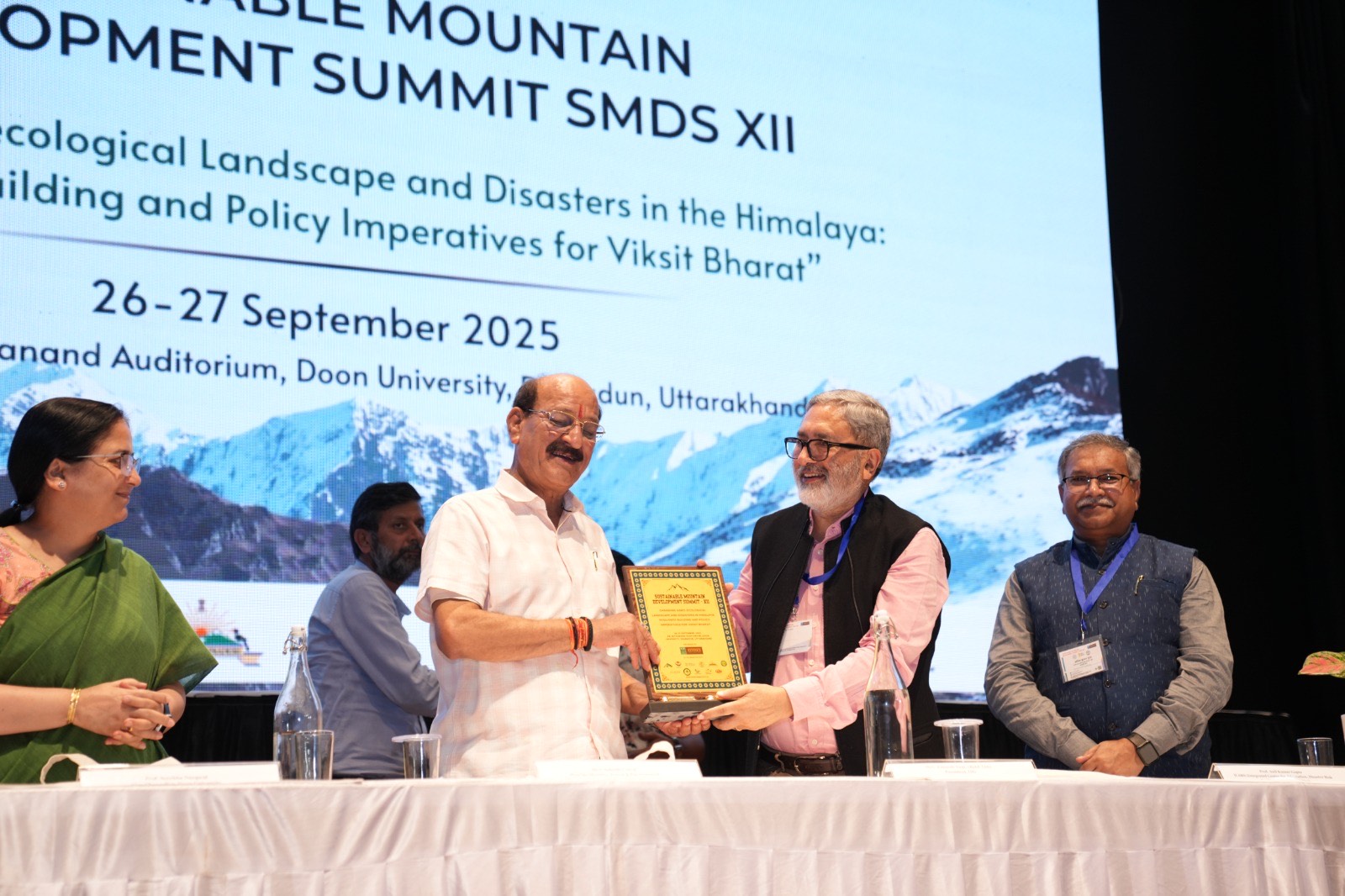
The inaugural session was attended by keynote speaker Prof. Anil Kumar Gupta (ICAR, Roorkee); Prof. Surekha Dangwal, Vice-Chancellor of Doon University; Dr. I.D. Bhatt, Director of the G.B. Pant National Institute of Himalayan Environment (Almora); IMI President and former IAS officer Mr. Ramesh Negi; IMI Secretary Mr. Roshan Rai; and IMI Treasurer Mrs. Binita Shah.
In his address, Chief Guest Mr. Uniyal highlighted the Himalayan region’s critical role in providing nearly 60 percent of India’s water supply, even as it continues to face recurring climate disasters. Expressing deep concern over the heavy loss of lives and property caused by this year’s monsoon across Himalayan states, he called for a coordinated, nature-aligned, and community-driven development plan.
He emphasized that while science and technology must form the foundation of such a plan, it cannot succeed without the direct involvement of local communities. “Our water, forests, and land are the foundation of life. The deep bond that local residents share with nature has always ensured both its preservation and sustainable use,” he said.
Citing examples from Uttarakhand, Mr. Uniyal noted that local communities are being encouraged to supply offerings at the shrines of Badrinath and Kedarnath. Villagers are now earning income by collecting and selling pine needles, a measure that has also helped reduce forest fire incidents. He added that eco-homestay initiatives are yielding positive results in curbing outmigration from hill villages. Ecological traditions are being reinforced with mandatory plantation of 50 percent fruit-bearing trees during the Harela festival and 20 percent plantation in forest areas.
On agriculture, the Minister said Uttarakhand is making significant strides in organic farming, with branding and international marketing of organic produce helping farmers gain recognition and better incomes. Concluding his remarks, he said, “Development in the Himalayas must be both scientifically sound and people-friendly to ensure a sustainable, safe, and prosperous future for generations to come.”
Focus on Science, Tradition, and Community-Centered Policies
Delivering the keynote address, Prof. Anil Kumar Gupta observed that although policies often mention environmental priorities, in practice they rarely reflect truly nature-compatible approaches. He stressed that sustainable development in the Himalayas requires combining modern science and technology with traditional wisdom.
Prof. Gupta also raised concerns over the growing pressure of religious and leisure tourism, warning that “while tourism generates income, it is leaving the mountains choked with plastic waste and pushing them into ecological vulnerability.” He proposed key measures for mountain sustainability, including:
• Using Artificial Intelligence in disaster management
• Leveraging traditional knowledge for livelihoods and disaster risk reduction
• Promoting agro-ecological practices through capacity building
• Encouraging innovation-driven entrepreneurship in the Himalayan region
Vice-Chancellor Prof. Surekha Dangwal welcomed the participants and emphasized the importance of institutional collaboration. “If we work collectively, our shared experiences, ideas, research, and suggestions can shape strong policies and meaningful outcomes,” she said.
Former IAS officer and IMI President Mr. Ramesh Negi remarked that the Himalayas can no longer withstand unplanned development. “We must adopt a path that is both scientifically sound and ensures the safety of our people,” he said. IMI Secretary Mr. Roshan Rai highlighted the organization’s initiatives, while Treasurer Mrs. Binita Shah proposed the vote of thanks.
The programme began with lamp lighting and a traditional welcome song presented by the women of Niti Valley, Uttarakhand. Participants also observed two minutes of silence in memory of those who lost their lives in this year’s devastating monsoon. The session was conducted by Dr. ___ (name).
The summit will conclude tomorrow with Assembly Speaker Mrs. Ritu Khanduri addressing the participants, while MP and former Chief Minister Mr. Trivendra Singh Rawat will join as Special Guest.
Around 250 officials, scientists, farmers and social workers participated in the inaugural session of the summit. Farmers, both men and women, from remote Himalayan regions of Sikkim, Himachal Pradesh and Uttarakhand took active part in the proceedings. An exhibition of local products was also set up at the venue, which drew considerable attention from participants.
On the first day, three parallel sessions were held, focusing on grassroots issues and possible solutions for mountain communities.
(रिलीज़ आईडी: 2171954)
आगंतुक पटल : 273
इस विज्ञप्ति को इन भाषाओं में पढ़ें:
Hindi_Ddn