|
PIB Backgrounder
Labour Reforms & IT Sector: A Modern Framework for Growth & Welfare
Posted On:
02 DEC 2025 1:45PM by PIB Delhi
Key Takeaways
- Workforce flexibility & employment models give employers workforce agility and cost optimization.
- Flexible Work Arrangements, including Work from Home provisions provide a legal foundation for hybrid and remote work models, ensuring compliance.
- Single digital interface for all registrations aligns digitized HR and compliance systems.
- Social Security Coverage for Gig and Platform Workers
- Legal protection combined with safety norms empowers women professionals to pursue leadership and international roles.
|
Modern Labour Rules for a Smarter IT Sector
India’s Information Technology (IT) sector has emerged as a cornerstone of the country’s economic growth and global competitiveness. Over the past few decades, India has transformed into a global IT hub, providing software services, digital solutions, and business process outsourcing (BPO) to clients worldwide.
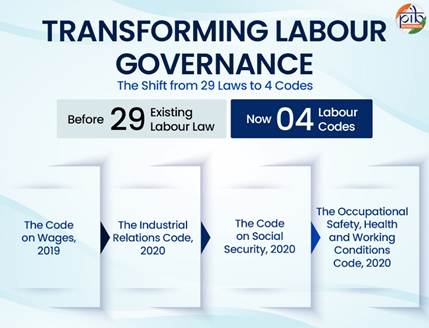
In order to create a foundation for a future-ready workforce in India, the new Labour Codes viz The Code on Wages 2019 (WC) , The Industrial Relations Code, 2020 (IR), The Code on Social Security, 2020 (SS), The Occupational Safety, Health and Working Conditions Code, 2020 (OSH &WC), aim to simplify compliance, promote flexibility, and provide social security to all types of workers, including contract and gig employees. For IT sector, these reforms are particularly significant as they provide clarity on wages, fixed-term employment, work-from-home arrangements, and workplace safety standards. By streamlining regulatory processes, enhancing gender inclusivity, and encouraging digital record-keeping, the Codes help IT companies manage their workforce efficiently while safeguarding employee welfare, ultimately contributing to sustainable growth and global competitiveness.
Labour Reforms Boost Ease of Doing Business in IT Sector
The IT sector not only generates significant revenue but also creates millions of direct and indirect employment opportunities, contributing to skill development, innovation, technological advancement. Given the scale and complexity of the IT workforce, labour regulations play a crucial role in ensuring a balanced and productive work environment.
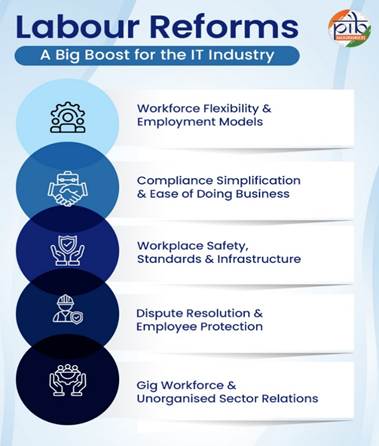
Workforce Flexibility & Employment Models
- Fixed Term Employment (FTE)- Employers can hire employees for a fixed term with the same wages, benefits, and social security as permanent workers. This provision allows IT firms to hire skilled professionals for time-bound projects, pilot programs, or seasonal global assignments without committing to long-term contracts. It gives employers workforce agility and cost optimization, aligning employment cycles with project timelines, while retaining access to experienced talent.
- Flexible Work Arrangements, including Work from Home- These provisions included in the Codes enable governments to frame rules for flexible work, home-based work, or remote employment for specific sectors. Such provisions provide a legal foundation for hybrid and remote work models, which became standard post-pandemic. It helps IT employers formalize flexible work, manage liability and working-hour records and ensure compliance even when employees work remotely- critical for business continuity and global competitiveness.
- Flexibility in Working Hours & Women’s Employment- The OSH Code empowers the Central and State Governments to frame rules allowing women to work in all types of establishments and during night hours, subject to adequate safety, transport, and rest facilities. IT and ITeS companies often operate on global time zones requiring 24×7 support and night shifts. This provision legitimizes night work for women with clear compliance norms, helping firms maintain gender diversity and meet international service obligations.
Compliance Simplification & Ease of Doing Business
- Single Licensing, Registration, and Returns- The Codes introduce single registration, single return filing, and a single licence valid across India, replacing multiple registrations under different Acts. For IT companies operating across multiple states or campuses, this reduces compliance duplication, administrative costs, and bureaucratic delays. A single digital interface for all registrations (factories, shops, EPFO, ESIC) aligns perfectly with the IT sector’s digitized HR and compliance systems.
- Digitization and Self-Certification- The Codes encourage digitized record-keeping, online filing of returns, web-based inspections, and self-certification mechanisms. The provisions for digitization streamline HR audits and enables paperless compliance. IT/ITeS companies- already technology-driven- can integrate these systems into existing HRMS (Human Resource Management System) or ERP (Enterprise Resource Planning) platforms, reducing manual errors and inspection hassles. Self-certification builds a trust-based compliance regime, reducing “inspector raj” and allowing management to focus on business growth.
- Decriminalization of Offences and Introduction of “Improvement Notices”- The Codes provide for monetary penalties instead of criminal prosecution for minor procedural violations. Employers get 30 days to rectify non-compliance before penalties apply. Such provisions encourage a cooperative compliance environment. IT companies dealing with complex employment structures (onsite–offshore, global mobility) gain relief from fear of criminal charges for inadvertent delays or technical lapses, enhancing ease of doing business.
Workplace Safety, Standards & Infrastructure
- National Occupational Safety Standards and Third-Party Audit Provision- The Codes empowers the Government to frame uniform national safety standards and allows third-party certification of establishments. Such provisions will ensure clarity and uniformity in workplace safety norms- like ergonomic workstations, indoor air quality, or fire safety- across all offices in India. Third-party audits will reduce subjective inspections and allow certified IT parks and SEZs to demonstrate compliance to global clients demanding workplace safety assurance.
- Provision for Common Welfare Facilities- Provisions in OSH&WC Code, allow establishments in the same vicinity or park (e.g., IT SEZs or Tech Parks) to share welfare facilities such as crèches, canteens or rest areas. These provisions reduce infrastructure duplication and operational costs, while ensuring statutory compliance. This especially will be useful in large IT campuses housing multiple companies.
Dispute Resolution & Employee Protection
- Simplified Dispute Resolution and Grievance Handling- The Codes provide for establishing Internal Grievance Redressal Committees (IGRCs) for establishments employing 20 or more workers; introduce time-bound conciliation and arbitration. This provision will reduce litigation risk and facilitate quick, in-house resolution of workplace disputes (e.g., termination, pay issues, harassment complaints). It will also help in maintaining harmony and minimize disruptions in project delivery or client relationships.
- Reskilling Fund for Retrenched Employees- The IR Code, 2020 mandates employers to contribute 15 days’ wages for retrenched employees to a reskilling fund, which is then paid to the worker within 45 days. This provision facilitates ethical downsizing during business restructuring or automation phases. It will enhance corporate image and meets global ESG (Environmental, Social, Governance) expectations.
Gig Workforce & Unorganised Sector Linkages
- Social Security Coverage for Gig and Platform Workers- The Code allows framing of welfare schemes for gig and platform workers through aggregators’ contributions. The IT firms are increasingly engaging freelancers and contract professionals for cloud, cybersecurity, and analytics projects. This provision formalizes such engagements, providing social protection to freelancers and reducing reputational risk for companies working with large gig workforces.
- National Database for Unorganized Workers- The SS Code, 2020 provides for creating a national digital platform (NDUW) with registration and skill details of unorganized workers. IT firms can access a verified pool of skilled candidates for non-core tasks (data entry, BPO support, etc.) without long hiring cycles. This will promote transparent, efficient workforce sourcing and reduce attrition from unverified temp hiring channels.
How Labour Reforms Empower IT Sector Workers
The labour reforms hold particular importance for India’s rapidly expanding IT sector and its workers. By combining efficient talent management with stronger worker protections, these reforms drive sustainable industry growth and elevate India’s competitive position globally.
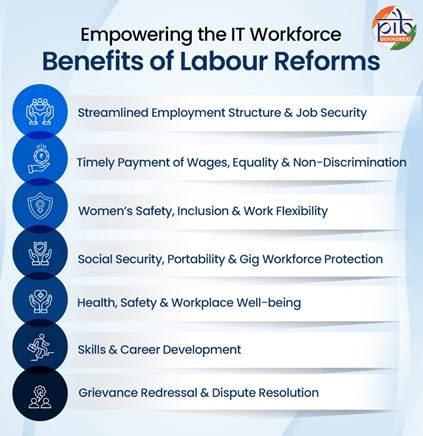
Employment Structure & Job Security
- Fixed Term Employment with Equal Pay & Benefits- Fixed-term employees are entitled to the same wages, allowances, working conditions and statutory benefits (including gratuity on a pro-rata basis) as permanent employees doing the same work. This provision will enable professionals hired for project-based assignments to enjoy full employment benefits- EPF, ESIC, gratuity, and leave- even for short stints. IT workers on fixed-term or contractual projects gain job dignity, continuity of service benefits, and protection against exploitative contracts.
- Formalization through Appointment Letters and Written Terms of Employment- The Codes provide that every employee must receive a written appointment letter specifying job details, category, wages, and social security benefits. This provision will provide contractual clarity and proof of employment- critical for IT staff working across multiple project engagements or through service providers. It will also prevent disputes on pay, notice period, or service continuity.
- Re-skilling Fund for Retrenched Employees- This provision will ensure skill renewal and employability for those laid off due to automation or restructuring. The fund provides financial assistance and retraining opportunities in emerging technologies.
Wages, Equality & Non-Discrimination
- Timely Payment of Wages and Protection from Unauthorised Deductions- The Codes provide that wages must be paid within seven days of the following month (for monthly employees), and no deductions may be made except as legally permissible. The protection now applies to all employees, irrespective of wage ceiling. These provisions will ensure timely salary credit and transparency in deductions (e.g., tax, provident fund, or notice pay). This will particularly benefit lower-tier IT/BPO staff and contractual workers often affected by delayed payments.
- Equal Remuneration and Non-Discrimination: Provisions in the Codes prohibit gender-based discrimination in recruitment, wages, and employment conditions for the same or similar work. These will promote pay equity in an industry with rising female participation. It encourages gender-neutral hiring and growth, closing the gender pay gap and strengthening inclusivity across job roles.
Women’s Safety, Inclusion & Work Flexibility
- Permission for Women to Work in All Establishments, Including Night Shifts: Provisions in OSH & WC Code allows women to work in all types of employment, including night hours, provided safety, transport, and rest facilities are ensured by the employer. Such provisions expand opportunities for women in global support and development projects that operate across time zones. Legal protection combined with safety norms empowers women professionals to pursue leadership and international roles.
- Flexible and Remote Work Arrangements: The Code empowers governments to notify rules enabling flexible working hours or work-from-home arrangements for specific sectors. This provision will legalize hybrid and remote work- now a defining feature of IT employment. It will provide formal recognition, ensuring employees retain social security, wage, and leave entitlements even when working remotely.
- Welfare Facilities: Common Crèches and Restrooms: The OSH & WC Code, 2020 mandates provision of crèches, restrooms, and canteens in establishments, with an option for shared facilities among multiple employers in the same area. These provisions will encourage family-friendly work environments in IT parks and SEZs. Women employees benefit from childcare support, improving work-life balance and career retention.
Social Security, Portability & Gig Workforce Protection
- Social Security Coverage for All Workers (Including Gig/Platform Workers): The Code on Social Security, 2020 has provisions to extend EPF, ESIC, gratuity, and maternity benefits universally. It introduces welfare schemes for gig and platform workers engaged in digital services. This provision will expand protection beyond traditional full-time roles to freelancers, IT consultants, and remote developers. Notably, this ensures financial security and inclusion for the growing digital gig workforce in tech.
- Portability of Benefits via Universal Account Numbers (UAN) and Aadhaar linkage: The SS Codes provides to establish a centralized database and Aadhaar-linked UAN to ensure portability of PF, ESIC and other benefits across employers and states. This provision will facilitate seamless transfer of social security benefits for professionals switching jobs or moving between cities- a common feature in IT careers. It ensures continuity of service records and simplifies compliance.
- Portability and Pan-India ESIC Coverage: This provision in SS Code extends ESIC coverage to all of India, removing the “notified area” restriction, with portability of medical and insurance benefits. It will assure access to medical facilities anywhere in India- useful for mobile tech professionals, remote workers, and relocated employees.
Health, Safety & Workplace Well-being
- Annual Health Check-ups and Workplace Safety Standards: OSH & WC Code, 2020 provides that every employee is entitled to free annual health check-ups. Employers must ensure safe, healthy, and ergonomic workplaces. Such provisions will protect employees from occupational health issues like eye strain, back pain, or stress-related ailments common in desk-based work. Regular health screening and safety audits promote well-being and productivity.
- Inclusion of Commuting Accidents under Employee Compensation: As per this provision, the accidents occurring while commuting to or from the workplace are deemed to arise out of and in the course of employment. It will facilitate an insurance coverage and compensation for tech employees who commute long distances or travel to client sites.
Skills & Career Development
- Recognition of Skills and National Skill Qualification Framework (NSQF): This provision of the Code on Wages allows wage fixation based on skill levels certified under the NSQF. Such a provision will recognize professional skills formally, rewarding certification and skill advancement with higher pay and career progression. It will also encourage continuous upskilling in new technologies.
Grievance Redressal & Dispute Resolution
- Grievance Redressal and Dispute Resolution Committees: This provision of the IR Code will create a structured, time-bound system for addressing workplace issues- such as discrimination, harassment, or wage disputes- internally and efficiently, without fear of retaliation.
Conclusion
The new Labour Codes mark a transformative shift in India's labour framework, offering a balanced blend of flexibility, protection, and modernization. For the IT sector, one of India’s most dynamic and globally competitive industries, these reforms strengthen both employer capabilities and employee welfare. By simplifying compliance, formalizing diverse work arrangements, expanding social security, and enhancing workplace safety, the Codes create an enabling ecosystem that supports innovation, productivity, and inclusive growth.
Click here for pdf file.
****
M
(Release ID: 2197479)
|