PIB Backgrounder
New Labour Codes to Empower India’s Mine Workers
Posted On:
06 DEC 2025 10:49AM by PIB Delhi
Key Takeaways
- New Labour Codes create uniform standards that strengthen worker protections and simplify compliance in the mining sector.
- Working conditions improve with flexible schedules, regulated hours, assured rest intervals, and fair compensation.
- Health, safety, and welfare provisions are strengthened with annual examinations, notified occupational diseases, and improved facilities.
- Social security is expanded through wider coverage, portable benefits, and stronger long-term protection for workers and their families.
- Unified registration, streamlined inspections, and digital processes promote ease of doing business.
|
Introduction
India’s Mining sector plays a major role in the country’s economic development, providing important raw materials, employment opportunities, export promotion and revenue for the Government. With the sustained growth of Indian economy, the demand for mineral and mining resources continues to rise.
India has long prioritized strong safeguards to ensure the health, safety, and welfare of mine workers. Until recently, the Mines Act, 1952 and related regulations governed mining labour conditions, providing the foundational framework for worker protection that is now being modernized. The new Labour Codes, particularly the Occupational Safety, Health and Working Conditions (OSH&WC) Code, 2020 and the Social Security (SS) Code, 2020, have subsumed several laws including the old Mines Act.
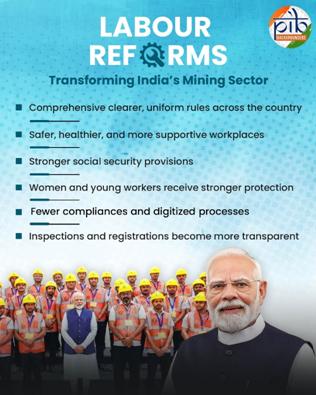
These new Codes introduce transformative reforms to empower mine workers and simultaneously promote ease of doing business in the mining industry. They bring standardization in the statutory norms for occupational safety, health and working conditions for mine workers. By addressing long-standing issues, the codes empower workers with better rights and safety while also simplifying regulatory burdens for employers.
Evolution of Worker Protections
Prior to the implementation of the new Labour Codes, the mining sector was governed primarily by the Mines Act, 1952 and other old laws. Under this regime:
- Safety, health, working hours and welfare were regulated and applied to all mines, both underground and opencast.
- Health and safety standards were limited to ventilation, dust, explosives, and machinery.
- The “above ground” working hours were fixed at 9 hours per day, while it was 8 hours for “underground workers”, with maximum working hours capped at 48 per week.
- Annual leave was allowed only after 240 days of work “above ground” and after 190 days of “underground work”.
- Welfare facilities such as canteens, first-aid rooms, ambulance rooms, crèches, were provided for establishments with 250+ workers.
- Women were prohibited from working in underground mines and were limited in “above-groundwork”.
- Medical examinations were required only at entry and check-ups were done periodically.
- Training was required, but enforcement was weak.
- Benefits such as PF, ESI, gratuity, and maternity were fragmented and dependent on thresholds. Such social security benefits were also not portable tied to the employer.
- Inspection was conducted under the Mines Inspectorate system.
While these provisions laid out the initial foundation, they were fragmented and outdated, no longer aligning with modern standards of worker safety, social security, or the ease of doing business in a globally integrated economy.
Comprehensive Reforms for Safer, Fairer Workplaces
The OSH&WC Code, 2020 and the SS Code, 2020 consolidate and strengthen the earlier provisions. They create uniform standards across India, simplify compliance, extend social security coverage, increase worker protections, and provide more flexibility in working conditions.
Flexible and Fair Working Conditions
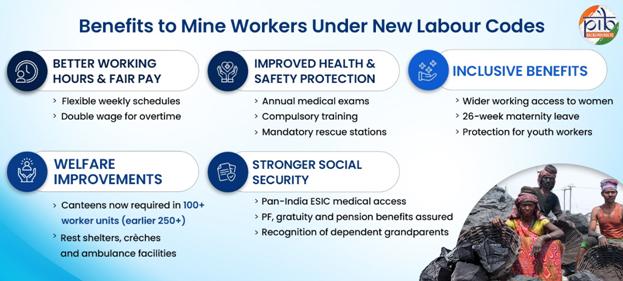
- Flexibility of Working Schedule: Workers may be engaged for 5 or 6 days a week, with one or two weekly holidays accordingly.
- There will be flexibility of working hours with spread over up to ten and half hours per day, including the rest interval.
- No worker can be required to work more than five hours continuously without a minimum rest interval of 30 minutes.
- Working hours are uniformly fixed at 8 hours per day for both “underground and above-ground workers”, with maximum weekly hours capped at 48.
- Overtime is payable at double the normal rate of wages.
These provisions offer workers better balance through flexible weekly schedules and assured rest intervals. They also improve welfare by preventing fatigue, ensuring regulated working hours, and guaranteeing fair compensation.
Health and Occupational Safety Provisions
- Annual Health Examination: Employees are now entitled to a free annual health check-up by a qualified medical practitioner; earlier it was once in five / three years.
- Occupational Diseases: A total of 29 occupational diseases have been notified under the new Provisions, covering free medical facilities and compensation to workers.
- Other Provisions: Pre-employment, periodic, and post-exposure medical check-ups have been made compulsory.
These provisions enable early detection of diseases, help reduce medical expenses, and support the development of a healthier, more productive workforce. They also promote preventive healthcare and significantly reduce long-term occupational risks.
Improved Facilities and Leave Entitlements
- Welfare Facilities: The OSH&WC Code retains key welfare requirements, including the provision of canteens, rest shelters, ambulance facilities, crèches in establishments (reduced from 250+ workers to 100 or more workers, including contract labour.)
- Paid Leave Entitlement: The workers employed in an establishment are entitled to paid leave in a calendar year on working for 180 days or more in such calendar year (working days being reduced from 240 days to 180 days).
These measures improve worker well-being by creating a more supportive and comfortable workplace, strengthening access to essential facilities. They also make it easier for workers to qualify for paid leave, allowing adequate rest and recovery.
Strengthened Safety Framework
- Training and Certification: The OSH&WC Code mandates compulsory safety training and certification for workers handling machinery, explosives, and chemicals, along with periodic safety drills to ensure safe and competent operations.
- Safety Facilities & Standards: Dust and gas control standards have been strengthened, and protective equipment has been made compulsory. Standards for ventilation, dust control, explosives, and machinery have been upgraded. Additionally, rescue stations with trained personnel will now be required in all establishments.
- Constitution of Safety Committees: Provisions have been made for constitution of Safety Committee in mines (having 100 or more workers ordinarily employed) comprising of representatives of the employer and the workers.
These provisions emphasize on health, safety and welfare of the workers employed in a mine. By creating uniform standards across India, it also reduces compliance requirements for employers, improving ease of doing business. It also ensures that workers receive consistent and reliable safety and welfare protections nationwide.
Social Security Reforms Enhancing Welfare and Dignity
The new Labour Codes strengthen financial and social protection for mine workers through clearer entitlements, expanded coverage, and portable benefits. They promote transparency and uniform welfare standards across the sector.
Stronger Social Protection
- Mandatory Appointment letter: Every employee must now receive an appointment letter on their appointment in mines; earlier, no such provision existed.
- Employees' State Insurance Coverage (ESIC): Mine workers and their families can now access ESIC medical facilities pan-India; earlier, medical services were provided only by mine management.
- Provident Fund (PF): PF coverage applies to all industries employing 20 or more workers.
- Portability: Aadhaar-linked registration ensures nationwide portability of PF and ESI benefits.
- Gratuity: Gratuity is payable after five years of service, and for fixed-term employees after one year.
- Social Security Fund: A dedicated Social Security Fund has been created for unorganized workers, which did not exist under the previous Mines Act.
- Revised definition of family: The definition of family now includes dependent grandparents of the worker, formally recognizing them as eligible family members for social-security and welfare benefits.
- Additional Benefits: Workers receive pension, old-age protection, and employment injury compensation.
These provisions benefit employees by ensuring transparency in employment, wages, designation, and social security, helping avoid disputes or misunderstandings regarding wages and work hours. They collectively improve medical access, financial security, and long-term protection for mine workers and their families, while ensuring social-security benefits across India.
Women’s Safety and Youth Welfare
- Women’s Working Hours: Women are now allowed to work in all types of work, including “below ground” mines. They can also work before 6 AM and beyond 7 PM with their consent and subject to conditions on safety, holidays, and working hours.
- Maternity Benefits: Maternity benefit of 26 weeks is provided.
- Prohibition on Child Labour: Children below 18 years cannot be employed.
This helps in expanding safe employment opportunities for women, support maternal health through extended maternity benefits, and strengthen protection for the youth.
Streamlined Compliance and Ease of Doing Business
The new Codes simplify compliance processes, reduce administrative and legal burdens, and make regulatory requirements more transparent. They support smoother inspections, faster resolution of issues, and a digital compliance environment, improving processes for employers and mine management.
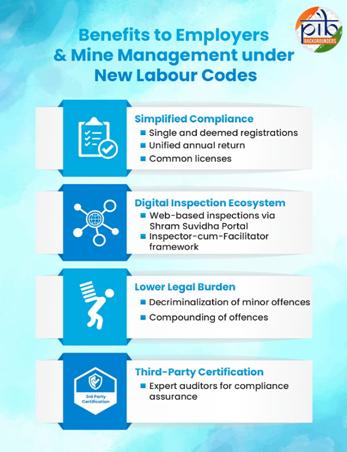
- Unified Single Registration & Single Annual Return: The provisions reduce the burden on employers by enabling digital registration. Further, deemed registration is granted after a specified period, an option that did not exist earlier.
- New provisions for common licences have been introduced to further ease compliance.
- Submission of unified Annual return for all establishments has been introduced.
- Inspection Reforms for Compliance: The role of inspecting officers has been redefined as Inspector-cum-Facilitators, incorporating proactive activities as part of their core function. This supports e-compliance and stronger monitoring.
- Additionally, a web-based inspection mechanism through the Shram Suvidha Portal has been introduced, with prior intimation to the employer before inspections.
- Third party audit and certification provide the opportunity to the employer to get certification from the expert/auditor for ease of doing business.
- Decriminalization: The Code decriminalized some minor, un-intentional offences by compounding them with monetary penalties, shifting from criminal liability to trust based approach. This new provision encourages compliance and improves the ease of doing business, as no such mechanism existed earlier.
- Compounding of offences through authorized officers also reduces legal burden and speeds up resolution.
- Employers can avoid prolonged litigation by paying a prescribed penalty and ensuring compliance.
Conclusion
Building on a regime of comprehensive benefits and uniform safeguards, India is laying the foundation for sustained development in the mining sector. The new Labour Codes have created a holistic framework that empowers mine workers through better working hours, health and safety standards, social security, and gender-inclusive practices, while also providing employers with the flexibility and clarity needed to maintain these standards.
These reforms exemplify how worker empowerment and ease of doing business can go hand in hand, ultimately contributing to the socio-economic progress of the country.
See in PDF
***
M
(Release ID: 2199738)
Visitor Counter : 2336