PIB Backgrounder
National Mission on Edible Oils
Strengthening India’s Edible Oil Ecosystem
Posted On:
08 DEC 2025 1:22PM by PIB Delhi
Key Takeaways
- According to a NITI Aayog report (August 2024), India ranks first globally in the production of rice bran oil, castor seed, safflower, sesame, and niger.
- National Mission on Edible Oils (NMEO) aims to strengthen the country’s oilseed ecosystem and achieve Atmanirbharta in edible oil production.
- The NMEO–OP (Oil Palm) aims to bring 6.5 lakh hectares under oil palm cultivation by 2025–26 and increase crude palm oil production to 28 lakh tonnes by 2029–30.
- By November 2025, 2.50 lakh hectares have been covered, bringing the total coverage of oil palm in the country to 6.20 lakh hectares. Crude Palm Oil (CPO) production has risen from 1.91 lakh tonnes in 2014-15 to 3.80 lakh tonnes in 2024-25.
- NMEO–OS (Oil Seeds) aims to increase oilseed production from 39 to 69.7 million tonnes by 2030–31 through cluster-based interventions and improved seed systems.
Introduction and Sector Overview
Edible oils form an essential component of India’s food and nutritional security, and oilseeds play a vital role in the livelihoods of millions of farmers. They are a major source of dietary fats, energy, and fat-soluble vitamins, helping to combat hidden hunger and improve calorie intake, particularly among underprivileged and malnourished populations. Oilseeds contribute not only to nutritional security but also to farmers’ welfare, serving as an important cash crop that sustains rural incomes and employment.
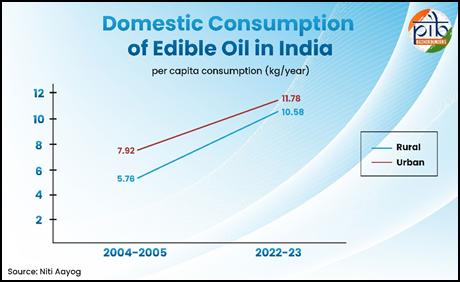
Despite this dual importance, the country’s growing demand for edible oils has outpaced domestic production. India’s per capita domestic consumption of edible oils increased substantially, from 5.76 kg/year in rural areas and 7.92 kg/year in urban areas in 2004–05 to 10.58 kg/year and 11.78 kg/year, respectively, in 2022–23. This reflects a growth of 83.68% in rural and 48.74% in urban consumption levels over the period.
India’s total edible oil production was recordedat 12.18 million tonnes during 2023-24. The country is able to meet only 44 percent of its domestic demand for edible oils through internal production. Despite being among the world’s largest producers of oilseeds, India remains substantially dependent on imports to bridge its edible oil deficit. Notably, import dependence on edible oils has declined from 63.2% in 2015-16 to 56.25% in 2023-24, reflecting a modest improvement in self-sufficiency from 36.8% to 43.74%. However, this progress is tempered by the sharp rise in overall consumption, which continues to exert significant pressure on the nation’s edible oil requirement.
Shifting Trends in India’s Edible Oil Ecosystem
Historically, India experienced a phase of self-sufficiency during the “Yellow Revolution”, spearheaded by the Technology Mission on Oilseeds (TMO) during the 1990s. This can be largely accrued to the government’s price support and import substitution policies. However, due to various WTO agreements, import duties and price support measures were substantially reduced or withdrawn. Consequently, per capita consumption grew at a pace surpassing domestic production, resulting in a sharp increase in edible oil imports, which reached 15.66 million tonnes in 2023–24, accounting for approximately 56% of total domestic demand. This dependence on global markets not only strains foreign exchange reserves but also exposes consumers to international price fluctuations and supply disruptions.
Globally, the edible oil sector has expanded significantly, driven largely by the production of soybean, palm, and rapeseed oils, alongside moderate growth in sunflower seed oil production. India ranks as the fourth-largest player in this global landscape, after the USA, China, and Brazil, contributing approximately 15–20% of the global oilseed area, 6–7% of total vegetable oil production, and 9–10% of global consumption. However, significant yield gaps and limited area expansion have prevented the country from matching its growing consumption levels.
This dependence poses challenges to both economic stability and agricultural self-reliance, leading the Government of India to launch the National Mission on Edible Oils (NMEO) to strengthen the country’s oilseed ecosystem and achieve the goal of Atmanirbharta (self-sufficiency) in edible oil production.
India’s Edible Oil and Oil Seeds Production
As per NITI Aayog’s report “Pathways and Strategies for Accelerating Growth in Edible Oils Towards the Goal of Atmanirbharta” (released on August 28, 2024):
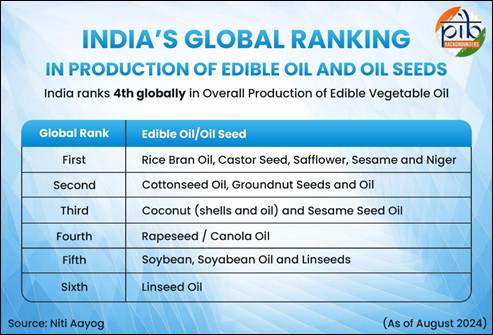
Domestically, oilseeds hold the second-highest acreage and production value in Indian agriculture after food grains. Nine major oilseeds, groundnut, soybean, rapeseed-mustard, sunflower, sesame, safflower, niger, castor, and linseed, occupy 14.3% of the gross cropped area, contribute 12–13% of dietary energy, and account for about 8% of agricultural exports. Yet, the majority of oilseed cultivation, around 76% of the total area, occurs under rainfed conditions, leaving production vulnerable to climatic variations and yield instability.
The production landscape is concentrated in a few key states. Rajasthan, Madhya Pradesh, Gujarat, and Maharashtra together contribute over 77.68% of India’s total oilseed output, reflecting regional dominance in specific crops, like Rajasthan in mustard and Madhya Pradesh in soybeans.
The National Mission on Edible Oils (NMEO) emerged from the necessity to tackle the twin challenges of import dependence and low productivity through a comprehensive, two-pronged approach:
- NMEO – Oil Palm (2021): focused on expanding oil palm cultivation and increasing domestic crude palm oil output.
- NMEO – Oilseeds (2024): aimed at improving productivity, seed quality, processing, and market linkages for traditional oilseed crops.
National Mission on Edible Oils - Oil Palm
Introduction to Oil Palm Production
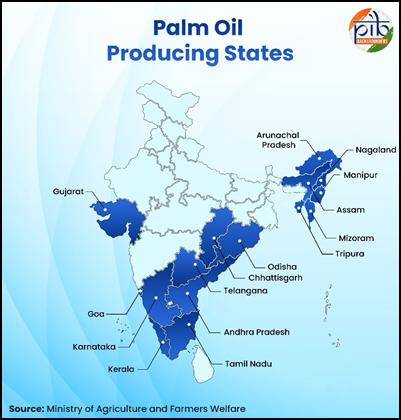
Oil Palm has highest vegetable oil yielding capability per hectare. It produces two distinct oils, i.e. palm oil and palm kernel oil, which are used for culinary as well as industrial purposes. In comparative terms, the yield of palm oil is 5 times the yield of edible oil obtainable from traditional oilseeds. Andhra Pradesh and Telangana are major Oil palm growing States and account 98% of total production. Karnataka, Kerala, Tamil Nadu, Odisha, Chhattisgarh, Gujarat, Goa, and Mizoram also have sizable areas under Oil palm cultivation. Recently, Arunachal Pradesh, Assam, Manipur, Tripura, and Nagaland have also initiated the Oil palm plantation program on a large scale.
NMEO – Oil Palm
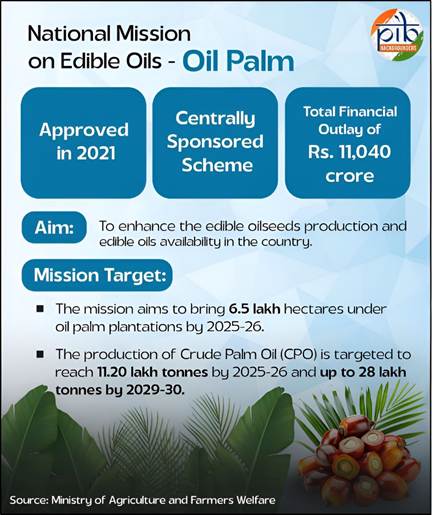
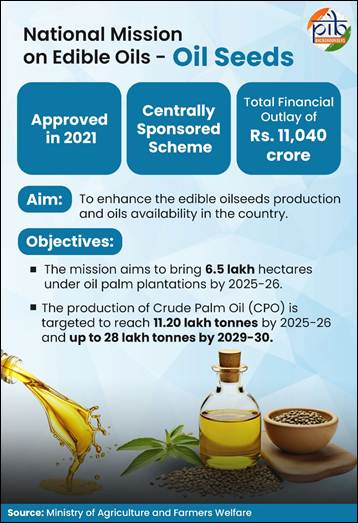
Considering the growing domestic demand for edible oils and the cost to the national exchequer due to imports, the National Mission on Edible Oils - Oil Palm (NMEO-OP) was approved in 2021, as a Centrally Sponsored Scheme, with the aim to enhance the edible oilseeds production and oils availability in the country by area expansion and increasing Crude Palm Oil (CPO) production. A financial outlay of Rs. 11,040 crore has been made for the mission, out of which Rs. 8,844 crore was the central share and Rs. 2,196 crore was the State share.
The mission aimed to immensely benefit the oil palm farmers, increase capital investment, create employment, reduce the import dependence and also increase the income of the farmers. Special emphasis is being placed on leveraging the agro-climatic potential of the North-eastern region and other oil palm-growing states.
The mission focusses on increasing production of seedlings by establishment of seed garden, and nurseries of oil palm in order to assure domestic availability of seedlings as per target fixed under NMEO-OP. Strategies like improving productivity of Fresh Fruit Bunches (FFBs), increasing drip irrigation coverage under oil palm, diversification of area from low yielding cereals crops to oil palm, inter-cropping during gestation period of 4 years, provides economic return to the farmers.
There are two major focus areas of the mission:
The oil palm farmers produce FFBs from which oil is extracted by the industry. The prices of these FFBs are linked to the international Crude Palm Oil (CPO) prices fluctuations. For the first time, the Government of India is giving a price assurance to the oil palm farmers for the FFBs. This is known as the Viability Price (VP). This protects the farmers from the fluctuations of the international CPO prices.
The second major focus of the mission is to substantially increase the assistance of inputs/interventions. A substantial increase has been made for planting material for oil palm, from Rs. 12,000 per hectare to Rs. 29,000 per hectare. Further substantial increase has been made for maintenance and inter-cropping interventions. Special assistance of Rs. 250 per plant is being given for rejuvenation of old gardens.
Targets of the Mission
- The mission aims to bring 6.5 lakh hectares under oil palm plantations by 2025-26.
- The production of Crude Palm Oil (CPO) is targeted to reach 11.20 lakh tonnes by 2025-26 and up to 28 lakh tonnes by 2029-30.
- Increase consumer awareness to maintain consumption level of 19.00 kg/person/annum till 2025-26.
Till November 2025, 2.50 lakh hectares area had been covered under NMEO-OP, taking the total coverage under oil palm in the country to 6.20 lakh hectares. CPO production has risen from 1.91 lakh tonnes in 2014-15 to 3.80 lakh tonnes in 2024-25.
Implementation of the Mission
The implementation of NMEO-OP is carried out through a structured, multi-tiered institutional framework involving central and state authorities.
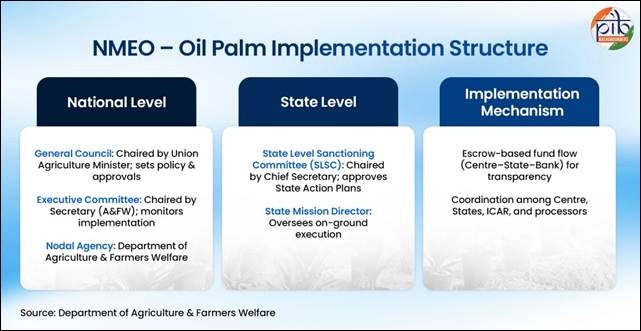
The Department of Agriculture & Farmers Welfare (DA&FW) serves as the nodal central authority, working in close coordination with State Departments of Agriculture/Horticulture, ICAR institutes, and processors.
Fund flow is regulated through an escrow account mechanism under a tripartite agreement among the Centre, State, and designated bank to ensure transparency and accountability in implementation. The cost for NMEO-OP will be shared as 60:40 between the Central and the State Government for General states and 90:10 for North East states and 100% for UTs and for central agencies.
National Mission on Edible Oils - Oilseeds
Introduction to Oilseeds Production in India
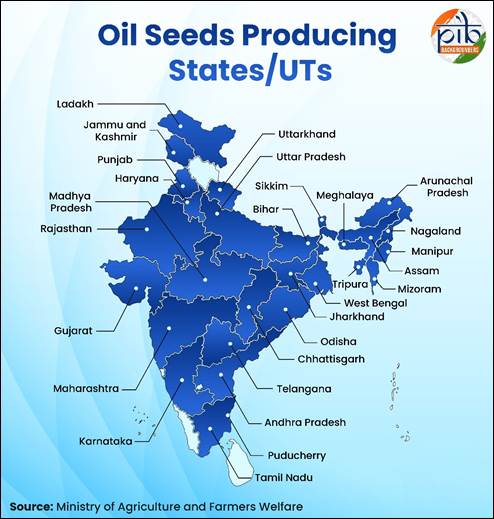
India contributes about 5-6% of the world oilseeds production. Export of oil meals, oilseeds and minor oils was about 5.44 million tons in the financial year 2023-24 valued at Rs. 29,587 crores. India's oilseed production reached a new high of 42.609 million tonnes (MT) as of May 2025.
Nine major oilseeds account for 14.3% of the yearly gross cropped area in India, contribute 12-13% to the dietary energy and account for about 8% of the agricultural exports. India ranks first in the production of castor, safflower, sesame and niger, second in groundnut, third in rapseed-mustard, fourth in linseed, and fifth in soybean. Rajasthan, Madhya Pradesh, Gujarat, and Maharashtra are the major oilseed-producing states, contributing to more than 77% of the total oil-seed production in the country.
NMEO - OS
The National Mission on Edible Oils - Oilseeds (NMEO-OS) was approved in 2024, for a seven-year period, from 2024-25 to 2030-31, to achieve Atmanirbharta (self-sufficiency) in edible oil production, with a financial outlay of Rs. 10,103 crore. NMEO-Oilseeds focuses on increasing production of key primary oilseed crops such as Rapeseed-Mustard, Groundnut, Soybean, Sunflower, Sesamum, Safflower, Niger, Linseed and Castor, as well as increasing collection and extraction efficiency from secondary sourceslike cottonseed, coconut, rice bran as well as Tree-Borne Oilseeds (TBOs).
The Mission specifically focuses on small and marginal farmers to improve their oilseed crop yields through various initiatives such as Frontline Demonstrations (FLDs) by ICAR/CGIAR, Cluster Frontline Demonstrations (CFLDs) by KVKs and Block-Level Demonstrations (BLDs) by State Agriculture Departments, to create awareness among farmers about the latest high-yielding varieties and advanced technologies in oilseed cultivation.
Objectives of the Mission
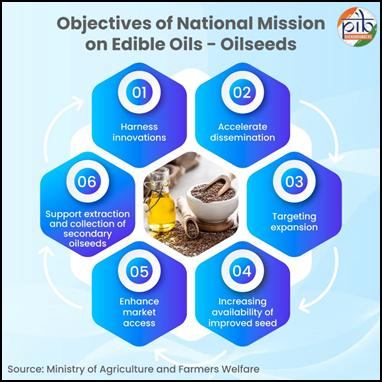
The mission aims to:
- Harness innovations: Utilizing already available and early-maturing innovations and technological breakthroughs for addressing the yield gap.
- Accelerate dissemination: Promoting the rapid dissemination of improved seed varieties and technologies within crop-specific clusters involving cooperatives, FPOs, and the private sector.
- Targeting expansion: Encouraging the expansion of oilseed cultivation in fallow areas specially in eastern states and promoting intercropping through demonstrations.
- Increasing availability of improved seeds: Addressing deficiencies in the seed production and distribution system to ensure availability and accessibility of quality seeds.
- Enhance market access: Linking oilseed farmers and value chain partners with processors to improve their market access and ensure better returns.
- Support extraction and collection of secondary oilseeds: Bolstering the production of secondary oilseeds and Tree Borne Oils through targeted interventions.
Targets of the Mission
- The mission targets increasing area coverage from 29 million ha (2022-23) to 33 million ha, primary oilseed production from 39 million tonnes (2022-23) to 69.7 million tonnes, and yield from 1,353 kg/ha (2022-23) to 2,112 kg/ha by 2030-31.
- Together with NMEO-OP, this mission targets domestic edible oil production at 25.45 million tonnes by 2030-31, meeting around 72% of our projected domestic requirement.
- The Mission also seeks to expand oilseed cultivation by an additional 40 lakh hectares by targeting rice and potato fallow lands, promoting intercropping, and promoting crop diversification.
Key Components of the Mission
- Under NMEO-OS, over 600 Value Chain Clusters have been identified across the country, covering more than 10 lakh hectares annually. These clusters are managed by Value Chain Partners (VCPs), including Farmer Producer Organizations (FPOs) and cooperatives.
- Farmers in these clusters are getting free high-quality seeds, training in Good Agricultural Practices (GAPs) and advisory services on weather and pest management.
- Furthermore, the mission provides support for setting up of post-harvest infrastructure to increase the efficiency of oilseed collection, oil extraction and recovery.
- To ensure the timely availability of quality seeds, the Mission introduced an online 5-year rolling seed plan through the ‘Seed Authentication, Traceability & Holistic Inventory (SATHI)’ Portal, enabling states to establish advance tie-ups with seed-producing agencies, including cooperatives, FPOs, and government or private seed corporations. 65 new seed hubs and 50 seed storage units are being set up in public sector to improve the seed production infrastructure.
- Additionally, an Information, Education, and Communication (IEC) campaign is being implemented to increase public awareness of recommended dietary guidelines for edible oils, thereby encouraging healthier consumption patterns across the country.
Implementation of the Mission
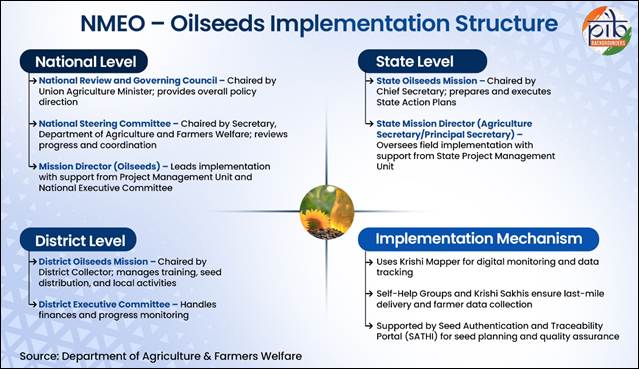
The NMEO-OS will be implemented in all States/UTs with the funding pattern of 60:40 in case of general States, Delhi & Puducherry and 90:10 in case of North-Eastern States and hill States, and 100% funding for UTs and Central Agencies. NMEO–OS is implemented through a three-tier structure:
To facilitate seamless data collection and ensure broad participation, Self-Help Groups (SHGs) are playing a pivotal role. These groups, particularly Krishi Sakhis, are being engaged to collect and update vital data on the Krishi Mapper platform.
Krishi Sakhi is a Community Agriculture Service Provider (CASP) who ensures last-mile support in rural areas where farm-based services are scarce or costly. Promotes awareness and builds community capacity in sustainable agriculture, while also facilitating the aggregation and marketing of agricultural produce to improve farmers’ incomes.
A comprehensive data tracking and monitoring system is being implemented using Krishi Mapper, a digital platform developed by the DA&FW. This system ensures accurate and real-time tracking of all activities related to the mission, enabling better decision-making and more effective implementation at the grassroots level.
Research and Development for Oil Seeds in India
The Indian Council of Agricultural Research (ICAR) is implementing the five, multi-disciplinary, All India Coordinated Research Projects (AICRPs) in collaboration with different central/state agricultural universities in the country to develop location-specific high-yielding varieties of nine oilseed crops along with corresponding package of practices. Additionally, ICAR is also implementing two flagship research projects on hybrid development and gene editing for the development of high yielding climate resilient varieties of oilseeds.
As a result, 432 high yielding varieties/hybrids of nine annual oilseeds comprising 104 of Rapeseed-Mustard, 95 of Soybean, 69 of Groundnut, 53 of Linseed, 34 of Sesame, 25 of Safflower, 24 of Sunflower, 15 of Castor and 13 of Niger were notified for commercial cultivation in the country during the last 11 years (2014-2025). Efforts are being made to enhance the Varietal Replacement Rate (VRR) and Seed Replacement Rate (SRR), so that genetic potential of the newly developed high yielding varieties could be utilised to enhance domestic production.
VRR: The Varietal Replacement Rate measures how frequently farmers adopt new crop varieties and is crucial for achieving genetic gains in crop productivity.
SRR: Seed Replacement Rate is the percentage of a crop's total sown area that uses certified or quality seeds instead of farm-saved seeds.
During FY 2019-20 to FY 2023-24, a total of about 1,53,704 quintals breeder seed of indented varieties of different oilseeds were produced and supplied to the public/private seed agencies for conversion into certified quality seed for farmers. The ICAR is also engaged in augmenting the availability of quality seeds of oilseeds for farmers through seed hubs on oilseeds.
Other Initiatives to make India Atmanirbhar in Oilseed Production
The following steps have also been taken to make the country self-reliant in oilseed production:
- The Government has approved the continuation of Pradhan Mantri Annadata Aay Sanrakshan Abhiyan (PM-AASHA) during 15thFinance Commission up to FY 2025-26. The scheme enables procurement of oilseeds at MSP by the Central Nodal Agencies like National Agricultural Cooperative Marketing Federation of India Ltd. (NAFED) & National Cooperative Consumers' Federation of India Ltd. (NCCF) etc. through the State Level Agencies under Price Support Scheme component.
- The Pradhan Mantri Fasal Bima Yojana (PMFBY) offers comprehensive crop insurance coverage, safeguarding farmers against risks of crop damage from pre-sowing to post-harvest. This includes food crops, oilseeds and commercial horticultural crops, which are specifically notified by the concerned State Government.
- To discourage the import of cheap edible oils, the government raised the effective customs duty on crude edible oils like palm, sunflower and soybean from 5.5% to 16.5%. Similarly, the duty on refined edible oils was increased significantly, from 13.75% to 35.75%. These measures aim to create a level playing field for domestic producers while reducing dependency on imports.
- The Minimum Support Price (MSP) for major oilseed crops such as soybean, mustard, groundnut and other oilseeds has been significantly increased to ensure better returns for farmers.
Conclusion
The National Mission on Edible Oils (NMEO) embodies India’s commitment to realizing the vision of Atmanirbhar Bharat by transforming the edible oil sector from an import-dependent to a self-reliant one. Through focused interventions in oil palm expansion, yield improvement in traditional oilseeds, assured pricing mechanisms, advanced seed technologies, and coordinated institutional implementation, the mission seeks to build a resilient and competitive domestic edible oil value chain.
By reducing import dependence, the mission not only conserves our foreign exchange but also strengthens rural economies by empowering farmers with better income opportunities, access to quality inputs, and market linkages. Moreover, it reinforces India’s long-term goals of achieving food and nutritional security, promoting rural development, and fostering sustainable agricultural growth.
In essence, the NMEO stands as a cornerstone of India’s agricultural transformation, bridging productivity gaps, fostering innovation, and advancing the country’s journey towards true Atmanirbharta in edible oil production.
References
Department of Agriculture and Farmers Welfare, Oilseeds Division
Ministry of Agriculture and Farmers Welfare
https://nmeo.dac.gov.in/Default.aspx
https://dfpd.gov.in/edible-oil-scenario/en
https://agriwelfare.gov.in/Documents/AR_Eng_2024_25.pdf
https://nfsm.gov.in/Guidelines/NMEO-OPGUIEDELINES.pdf
https://nmeo.dac.gov.in/nmeodoc/NMEO-OSGUIEDELINES1.pdf
https://www.pib.gov.in/PressReleseDetail.aspx?PRID=2090654
https://www.pib.gov.in/Pressreleaseshare.aspx?PRID=1746942
https://www.pib.gov.in/PressReleasePage.aspx?PRID=2149708
https://www.pib.gov.in/PressReleasePage.aspx?PRID=2061646
https://www.pib.gov.in/PressReleasePage.aspx?PRID=2149701
https://sansad.in/getFile/annex/267/AU3864_DVk2Lb.pdf?source=pqars
https://agriwelfare.gov.in/Documents/Time_Series_3rdAE_2024_25_En.pdf
https://www.gcirc.org/fileadmin/documents/Bulletins/B26/B26%205RKGupta.pdf
https://sansad.in/getFile/loksabhaquestions/annex/183/AS212_LDDIUr.pdf?source=pqals
https://desagri.gov.in/wp-content/uploads/2025/11/Agricultural-Statistics-at-a-Glance-2024_%E0%A4%95%E0%A5%83%E0%A4%B7%E0%A4%BF-%E0%A4%B8%E0%A4%BE%E0%A4%82%E0%A4%96%E0%A5%8D%E0%A4%AF%E0%A4%BF%E0%A4%95%E0%A5%80-%E0%A4%8F%E0%A4%95-%E0%A4%9D%E0%A4%B2%E0%A4%95-2024.pdf
Niti Aayog
https://www.niti.gov.in/sites/default/files/2024-08/Pathways_and_Strategy_for_Accelerating_Growth_in_Edible_Oil_towards_Goal_of_Atmanirbharta_August%2028_Final_compressed.pdf
ICMR
https://www.nin.res.in/downloads/DietaryGuidelinesforNINwebsite.pdf
To access Krishi mapper and SATHI portal
https://krishimapper.dac.gov.in/
https://seedtrace.gov.in/ms014/
Click here to see PDF
M
(Release ID: 2200287)
Visitor Counter : 27024