PIB Headquarters
Strengthening Protection for Contract Workers
प्रविष्टि तिथि:
08 DEC 2025 2:55PM by PIB Delhi
- Universalisation of minimum wages, introduction of floor wages, payment of overtime and bonus ensure Fair Compensation.
- Responsibility of payment of wages and dues, issuance of wage slips, timely payment of wages make the Employer Accountable.
- Accident compensation, coverage under ESIC, expansion of family definition, annual health checkup and worker re-skilling fund provide Social Security Welfare
- Annual leaves, fixed working hours, provisions for health and safety confirm Generous Workplace conditions.
- No gender discrimination promotes Fair Work Environment.
|
Introduction
India’s labour landscape has undergone a historic transformation with the consolidation of 29 labour laws into 4 simplified and modern Labour Codes viz. the Code on Wages, 2019, the Industrial Relations Code, 2020, the Occupational Safety, Health and Working Conditions (OSH) Code, 2020 and the Code on Social Security, 2020. By unifying definitions, simplifying procedures, and enhancing accountability, these codes promote both worker welfare and ease of doing business. Importantly, these reforms significantly improve protections for Contract Workers, by ensuring clearer rights, stronger wage safeguards, expanded social security, and better working conditions under a more transparent and enforceable system.
Enhanced Protection for Contract Workers
Contract workers form a significant part of India’s labour force, often engaged in essential yet vulnerable roles across industries. These reforms aim to create a more inclusive and equitable labour environment where contract workers receive stronger rights, improved working conditions, and enhanced socio-economic security.
Improved Wage Protections
Universalization of Minimum Wages: No employer shall pay any employee less than the minimum wage notified by the Government. Previously, minimum wages applied only to scheduled employments, but now it covers all employees. The Government shall review or revise minimum rates of wages ordinarily at interval not exceeding five years. Also, the Government shall fix minimum rate of wages for timework, piece work for different wage period i.e. by hours, day or by month based on the skill of employee and arduousness of work.
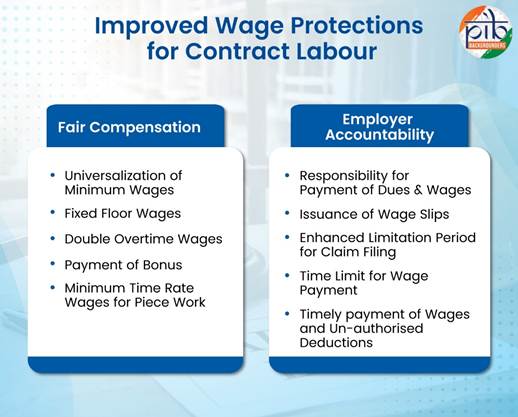
Floor Wage: Floor wage will be fixed by Government considering the minimum living standards of an employee including food, clothing etc. The same shall also be revised at regular interval, reducing the migration of labour from one state to another state.
Overtime Wages: Employers must pay employee at least twice the normal wage rate for any work beyond normal working hours.
Bonus: Bonus shall be paid to every employee, who has worked for at least 30 days in an accounting year, drawing wages not exceeding such amount as fixed by Government (Central/State). The annual bonus is paid minimum at the rate of eight and one-third % and maximum up to 20% of the wages earned by the employee.
Minimum Time Rate Wages for Piece Work: If an employee is employed on piece work where a minimum time rate (instead of a piece rate) is fixed, the employer must pay wages not less than this minimum time rate.
Responsibility for Payment of Dues: Employer shall pay wages to the employee employed by him. If such employer fails to make such payment in accordance with the Code, then, the company or firm or association or any other person who is the proprietor of the establishment, in which the employee is employed, shall be responsible for such unpaid wages.
Responsibility for payment of Wages: A contractor shall be responsible for payment of wages through bank transfer or electronic mode. In case the contractor fails within prescribed period, then, the principal employer shall be liable to make payment of the wages in full or the unpaid balance due, as the case may be, to the concerned contract labour employed by the contractor and recover the amount so paid from the contractor either by deduction from any amount payable to the contractor under any contract or as a debt payable by the contractor.
In case, contractor does not pay the wages, the appropriate Government (Central/State), shall pass the orders of making payment of such wages from the amount deposited by such contractor as security deposit under the licence issued by the licensing officer to the contractor.
Issuance of Wage Slips: Employers shall issue wage slips electronically or in physical form to the employee on or before payment of wages.
Limitation period: The period of limitation for filing of claims by an employee has been enhanced to three years, as against the existing time varying from six months to two years.
Time Limit for Payment of Wages: The employer shall pay or cause to be paid wages to all the employees, based on type of employment -
|
Type of Employment
|
Time of Payment
|
|
Daily Wage
|
End of Shift
|
|
Weekly
|
Before weekly holiday
|
|
Fortnightly
|
Within 2 days of end of fortnight
|
|
Monthly irrespective of strength
|
Within 7 days of next month
|
|
On termination or resignation
|
Within 2 working days
|
Timely payment of wages and un-authorised deductions: The provisions relating to timely payment of wages and un-authorised deductions from wages, earlier applicable only in respect of employees drawing wages upto twenty-four thousand rupees per month, is made applicable to all employees irrespective of wage ceiling.
Expanded Social Security for Contract Workers
Accidents while commuting included under the employee’s compensation: Accident occurring to an employee (while commuting from his residence to the place of employment for duty or returning from place of his employment to his residence after performing duty) arising out of and in the course of employment, are now covered under employee’s compensation.
Extension of coverage of ESIC throughout India: The ESIC coverage has been extended to pan India and the concept of notified area has been removed. Voluntary membership is also introduced with mutual consent of the employer and employee (where the establishment threshold is less than 10 persons).
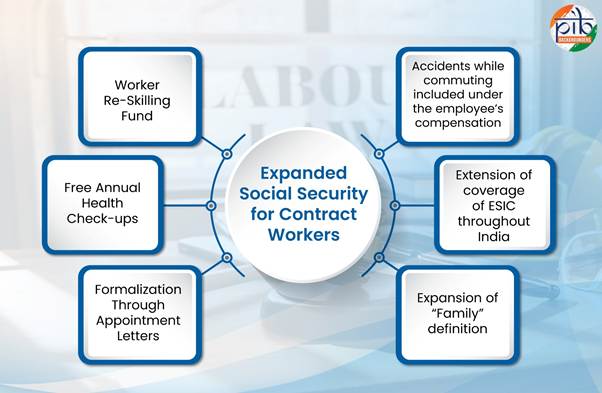
Expansion of “Family” definition: The definition of “family” has been extended to include spouse, children including adopted children of the worker who are dependent upon him and have not completed the age of eighteen years; and parents, grand-parents, widowed daughter and widowed sister dependent upon the worker. Dependents getting income from certain sources, as prescribed by the appropriate Government (Central/State) shall not be included.
Formalization through appointment letters: Every employee will get appointment letters in the prescribed format, within three months, with specifying the details of the employee, designation, category, details of the wages, details of social security etc.
Free annual health check-ups: Every employee will be eligible for free annual health check-ups.
Worker Re‑Skilling Fund: In case of any retrenchment of a worker by an employer, the employer will contribute last drawn wages, equivalent to 15 days’ of the retrenched worker, to the worker re-skilling fund within 45 days of retrenchment.
Stronger Workplace Standards
Annual Leave with wages: The workers employed in an establishment are entitled for paid leave in a calendar year on working for 180 days or more (earlier 240 days or more).
Fixing Hours of Work for a Normal Working Day: The provisions now limit normal working hours to prevent employee from being overworked without adequate compensation, thus protecting health and work-life balance. No employee shall be required to work for more than 8 hours in a day and 48 hours in a week.
Universal coverage of all establishments for Health & Safety of Workers: The OSH Code provides coverage of health & safety to all workers, including contract workers, across sectors. It includes provisions for cleanliness, drinking water, toilets, rest rooms, canteen etc.
Promoting Fairness and Non-Discrimination
Prohibition of Gender Discrimination: Employers shall not discriminate on ground of Gender in matters relating to recruitment, wages, or conditions of employment in respect of the same work or work of a similar nature done by employees.
Conclusion
By simplifying regulations and strengthening protections, the reforms particularly uplift welfare of Contract Workers. With clearer entitlements, broader social security, and improved working conditions, the new system ensures that contract workers receive fair treatment and meaningful safeguards. Overall, these changes reinforce India’s commitment to workers’ welfare while supporting a more efficient and transparent labour ecosystem.
Click here to see PDF
M
(रिलीज़ आईडी: 2200333)
आगंतुक पटल : 241
इस विज्ञप्ति को इन भाषाओं में पढ़ें:
Bengali