Ministry of Environment, Forest and Climate Change
Union Environment Minister Chairs Fourth High-Level Review Meeting on Delhi-NCR Air Pollution; Continuous Monthly Ministerial Reviews of finalised State Action Plans from January 2026
Take Necessary steps to Ensure Visible Improvement in the prevailing Air Quality situation across the NCR within One Week: Shri Yadav
Posted On:
19 DEC 2025 3:02PM by PIB Delhi
Union Minister for Environment, Forest and Climate Change, Shri Bhupender Yadav today chaired a high-level meeting to undertake a detailed review of Action Plans of the State Governments of NCT Delhi, Haryana and Uttar Pradesh, along with concerned Municipal Bodies, for tackling the prevailing adverse air pollution situation in Delhi-NCR. This was the fourth in a series of such review meetings, conducted on a structured set of parameters in the prescribed format, as directed by the Minister in the earlier meeting held on 03.12.2025. Also present in the meeting was the Union Minister of State (EFCC), Shri Kirti Vardhan Singh.
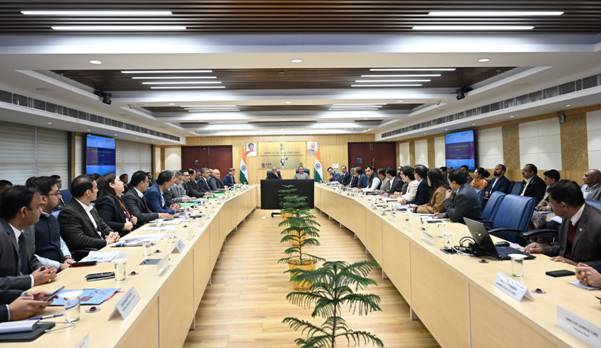
Expressing concern over the persistence of poor air quality in the Delhi-NCR, Shri Yadav announced that from January 2026 onwards reviews of action plans, being finalised now, will be held every month at the Ministerial level. State Governments were asked to integrate the action plans of all NCR cities under their jurisdiction for future presentations. The Minister assured that implementation-related bottlenecks would be addressed through regular inter-State coordination meetings at the highest level.
Shri Yadav reviewed the individual presentations on measures taken by the State Governments and Municipal Bodies to control air pollution in Delhi-NCR. He emphasised that the momentum of these actions must be sustained until there is a visible improvement in air quality across the NCR. The Minister further made it clear that strict measures must be taken against defaulters, but at the same time the general public must not get inconvenienced unnecessarily. Identified issues are to be addressed through corrective actions, with a review scheduled in 15 days.
Directions were issued to ensure smooth traffic management at 62 identified congestion hotspots, and to promote EV/CNG buses for employees by corporates and industrial units in Delhi-NCR. Staggered timings for offices, shopping malls and commercial complexes were also emphasised to reduce peak-hour congestion. Special measures were emphasised to provide end-to-end public transport on high-traffic routes, while strict directions were given to intensify action against illegal and polluting industrial units operating in the region. Gurugram, Faridabad, Ghaziabad and Noida were directed to fast-track the implementation of the Integrated Smart Traffic Management System (ITMS), while traffic police were asked to ensure that enforcement checks do not themselves lead to congestion.
The Minister underscored coordinated planning with DMRC and State authorities to improve last-mile metro connectivity across NCR cities. Directions were issued to remove encroachments causing traffic congestion within 10 days, ensure annual maintenance contracts for pothole-free roads, and provide proper drainage to prevent monsoon-related damage to the roads. Coordinated redressal of public grievances related to pollution was to be ensured under CAQM’s supervision, along with focused IEC activities for stakeholder engagement.
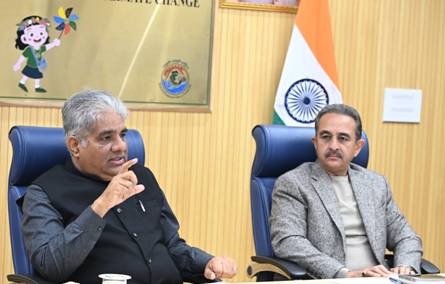
Shri Yadav emphasized on taking necessary steps to ensure visible improvement in the prevailing air quality situation across the NCR within one week. He directed the authorities to remove dust and construction and demolition (C&D) waste lying on roads, containment of biomass burning, and strict enforcement of construction bans during high pollution periods. Individual officers were asked to be assigned responsibility for Mechanical Road Sweeping Machines (MRSMs), supported by GPS tracking, to ensure efficient road cleaning and dust control. Public representatives were to be involved to strengthen accountability, he desired.
The CAQM was advised to issue guidance to Municipal Bodies to not permit demolition activities unless C&D waste collection sub-centres are available within a 10 km radius. C&D activities are to be banned during October–December, and CAQM was asked to explore engagement of start-ups and the private sector for innovative C&D waste management solutions through stakeholder consultations.
Haryana was directed to replace defunct Crop Residue Management (CRM) machines, ensure utilisation of paddy straw in power plants, brick kilns and crematoriums, and encourage setting up of pelletisation plants with Central financial assistance. Decentralised and in-situ solutions, including Compressed Bio-Gas (CBG) and ethanol plants, were to be explored to generate revenue and discourage stubble burning.
Specific directions were issued to seal illegal tyre-burning units and other non-permitted polluting establishments operating in Delhi-NCR. Further, it was directed to ensure installation of Online Continuous Emission Monitoring Systems (OCEMS) in all polluting units—particularly in Haryana—and enforce the 31st December deadline for compliance. The Minister also directed ensuring society-wise solid waste collection and joint disposal of Bandhwari legacy waste by Faridabad and Gurugram at a common facility.
In coordination with the Delhi Forest Department, the Minister directed exploration of plantation opportunities in the NDMC area, with a target of planting 11 lakh saplings on the World Environment Day 2026. NHAI was advised to reduce congestion at toll plazas through improved sensors and better Automatic Number Plate Recognition (ANPR) systems, and to ensure proper upkeep of major traffic-carrying roads.
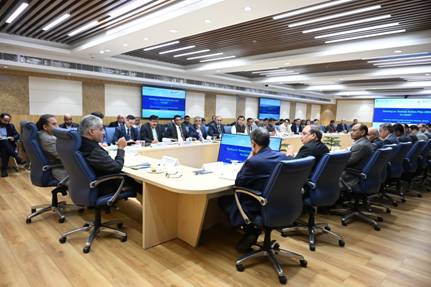
The meeting was attended by the Secretary (MoEFCC), Chairman, Commission for Air Quality Management (CAQM), Senior officers from Union Ministries of Environment, Forest and Climate Change; Road Transport and Highways; Heavy Industries and State Governments of NCT Delhi, Haryana and Uttar Pradesh. Also present in the meeting were MD (DMRC), senior officers of MCD, NDMC, Delhi Police, NHAI and DDA, besides Municipal Commissioners and DMs of Noida, Ghaziabad, Gurugram, Faridabad, along with senior officers from Central Pollution Control Board (CPCB), respective State Pollution Control Boards (SPCBs) and Delhi Pollution Control Committee (DPCC).
*****
VM
(Release ID: 2206502)
Visitor Counter : 1315