Ministry of Science & Technology
New study may redefine how the mass of the halo around galaxies is measured
Posted On:
19 DEC 2025 3:23PM by PIB Delhi
A new research study from Raman Research Institute (RRI), an autonomous institute of the Department of Science and Technology (DST) has revealed that contributions from matter in the intergalactic medium may be affecting measurements of the diffuse envelope surrounding a galaxy. The study has far-reaching implications, given that the envelope holds power to make or break galaxies and measuring the mass is crucial for tracing how galaxies form.
A galaxy evokes images of dust and stars sparkling within beautiful spirals. But beyond the galaxy’s outskirts lurks a diffuse, ghostly halo spreading out as far as 10-20 times the size of the galaxy. Most of the galaxy’s mass lies beyond the stars in this halo, composed of the mysterious dark matter — the invisible glue keeping the universe together — and gas. The gaseous component of the halo is called the circumgalactic medium or CGM. The region outside the CGM, constitutes the intergalactic medium or IGM.
Mapping the distribution of gas in CGM is essential because CGM connects the galaxy to the cosmic web — the filamentary scaffolding pervading the universe. In doing so, CGM plays a critical role in galaxy evolution by controlling the inflow of gas into the galaxy and outflow from it. By measuring the amount of highly ionized oxygen — oxygen with five of its electrons stripped off — contained in CGM, astronomers estimate the mass of CGM.
Observational astronomers use light from incredibly bright cores of distant galaxies to map the CGM. When light from such a background object passes through the gas in the CGM of a foreground galaxy, certain elements absorb particular wavelengths.
But there lies an inherent problem in the observational technique. When astronomers perform an observation, the measured ionized oxygen is the total integrated value along the line of sight.
As CGM and IGM both lie along the line of sight, there is no way to tell apart the contribution from CGM and IGM in the observed values. Current models take all of the ionized oxygen observed to be from the CGM.
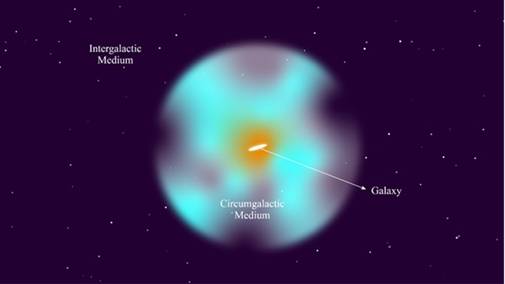
Fig 1. Artistic representation of the circumgalactic medium surrounding the galaxy
This new research from Raman Research Institute (RRI) uses models to suggest that a lot of the gas attributed to CGM could be coming from IGM.
Dr. Kartick Sarkar, astrophysicist in the Astronomy and Astrophysics division at RRI and an author on the new paper published in The Astrophysical Journal explains the relation between CGM and IGM drawing an analogy.
“Imagine a street magician showing their tricks. People would slowly start gathering around … and the crowd grows. Initially, people would rush in to see the show. However, as soon as they reach the boundary of the crowd, they stop,” said Dr Sarkar. The magician in Dr. Sarkar’s analogy is the galaxy, and the crowd is the CGM. “The bigger the magician, the bigger the crowd” he pointed out. The region outside the CGM, not gravitationally bound by the galaxy, constitutes the intergalactic medium or IGM.
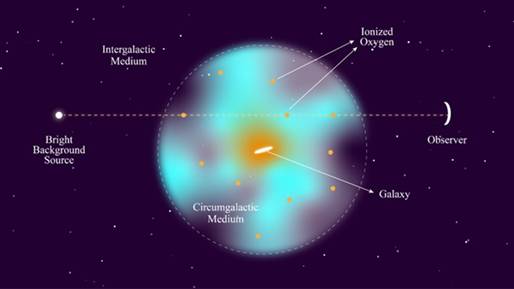
Fig 2. Artistic representation of the presence of ionised oxygen surrounding galaxies, and the principal of their observation
“We are challenging the notion that the entire ionized oxygen belongs to CGM,” says Dr. Sarkar. The team used a mathematical description of CGM and the gas falling into it from the IGM. They then calculated the amount of ionized oxygen (one of the most abundant elements in the universe) each of them contains and compared it with the observations.
“We’re suggesting that a relatively small fraction of the ionized oxygen is coming from CGM and that there’s a blanket of IGM around CGM which is contributing to the observed oxygen,” says Dr. Sarkar. This contamination of CGM by IGM could lead to overestimating CGM’s mass.

Fig 3. Artistic representation of the presence of ionised oxygen in the intergalactic medium in the case of low-mass galaxies
Dr. Sarkar and colleagues got their first hint of something being amiss when they noticed that the models for CGM mass disagree with the observations for low-mass galaxies. Their current theory of IGM confounding CGM measurements applies to galaxies across masses and can help explain the discrepancy observed in lower-mass galaxies.
"For high mass galaxies like our Milky Way, the CGM may contribute just 50% of the ionised oxygen, with the rest coming from the IGM. For lower mass galaxies, it can go down to 30%," says Dr. Sarkar. The study highlights the need to consider contributions from IGM when interpreting CGM observations.
The researchers from RRI along with those from the Hebrew University of Jerusalem, Israel, are working towards upgrading their basic model into a more realistic and comprehensive one encompassing more of the parameters involved. “We’re sure there’s a discrepancy. Now we’re trying to quantify this discrepancy exactly,” says Dr. Sarkar.
Publication Link: Intergalactic Absorption Confounding Circumgalactic Observations - IOPscience
****
NKR/AK
(Release ID: 2206521)
Visitor Counter : 1377