PIB Backgrounder
From Villages to Vision
How Good Governance is Changing Rural India’s Story
Posted On:
24 DEC 2025 3:55PM by PIB Delhi
On a quiet morning in Shripura village of Guna district, Madhya Pradesh, Mrs. Sarita Saini begins her day by sorting vegetables not only for immediate sale in local markets but also for drying and storage, enabling her produce to be marketed even during periods when cultivation activities are limited. As a member of the Ekta Self-Help Group, she initially faced constraints related to limited resources, inadequate technical knowledge, and income insecurity. Her inclusion under the programme implemented by the Madhya Pradesh State Rural Livelihoods Mission marked a significant transition. Through institutional support, capacity building, and convergence with Panchayati Raj Institutions, she received a solar dryer valued at Rs. 1 lakh. Currently, she integrates commercial vegetable cultivation with solar drying, ensuring year-round market access and generating a stable monthly income of approximately Rs. 20,000. Her journey demonstrates how well-designed governance frameworks can catalyse local entrepreneurship when opportunities are complemented by targeted support.
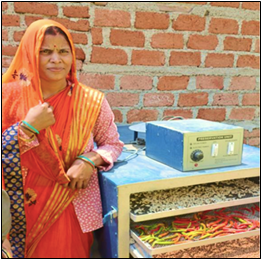
Narratives such as Sarita’s are rooted within a broader framework of rural governance that places people at the core of development processes. Decentralisation has long been a foundational principle of India’s rural transformation, premised on the understanding that local institutions possess the contextual knowledge required to address local needs effectively. By strengthening Gram Panchayats, Self-Help Groups, and community-based institutions, governance is brought closer to citizens, enabling participatory planning and more responsive outcomes. This paradigm shifts development from a top-down delivery of schemes to a collaborative model in which communities act as active partners, contributing to priority-setting and monitoring outcomes at the grassroots level.
Central to this rural development ecosystem are the flagship programmes of the Ministry of Rural Development, each designed to address specific dimensions of rural livelihoods while functioning in a mutually reinforcing manner. The Deendayal Antyodaya Yojana–National Rural Livelihoods Mission (DAY-NRLM) has emerged as one of the world’s largest livelihood initiatives, mobilizing over 10 crore rural households into Self-Help Groups and providing sustained handholding along with access to institutional finance. The Lakhpati Didi initiative under DAY-NRLM recognises SHG members whose households attain annual incomes of at least Rs. 1 lakh through diversified livelihood activities, reflecting a shift from subsistence-based livelihoods to greater economic stability. As of December 24, 2025, more than 10.29 crore rural households have been mobilized into SHGs under DAY-NRLM.
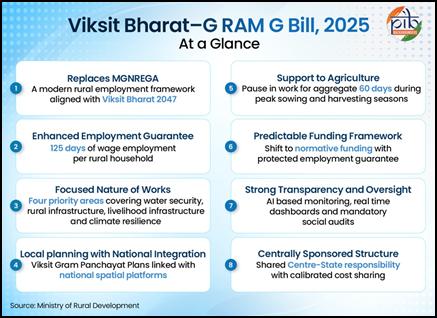
Employment security constitutes a critical pillar of rural resilience. The Mahatma Gandhi National Rural Employment Guarantee Act (MNREGA), 2005, was designed to provide a statutory guarantee of at least 100 days of wage employment to rural households willing to undertake unskilled manual work, thereby offering income support while simultaneously creating durable community assets. Since FY 2013–14, the programme has witnessed significant improvements, including an increase in women’s participation from 48% to 56.74%, Aadhaar-seeded active workers from 76 lakh to 12.11 crore, and an expansion of electronic wage payments from 37% to 99.99% by FY 2025-26, reflecting enhanced transparency and financial inclusion. In response to evolving rural economic conditions, the Government has introduced the Viksit Bharat–Guarantee for Rozgar and Ajeevika Mission (Gramin) Act, 2025, which proposes an enhanced statutory guarantee of 125 days of wage employment and anchors rural works within a convergence-driven, saturation-oriented planning framework aligned with the vision of Viksit Bharat @2047.
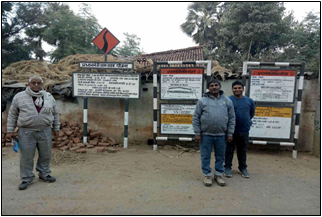
Secure housing and reliable connectivity are key determinants of quality of life in rural areas. As of December 24, 2025, under the Pradhan Mantri Awas Yojana–Gramin, 2.92 crore pucca houses have been constructed out of the 3.86 crore sanctioned houses. Under the Pradhan Mantri Gram Sadak Yojana, 1.84 lakh roads spanning 7.87 lakh kilometres have been constructed. Such infrastructure investments reduce physical isolation and translate connectivity into economic opportunity by facilitating mobility and access to services. An illustrative example is found in Godda district of Jharkhand, where a 5.68-km all-weather road constructed under the PMGSY at a cost of Rs. 285.45 lakh has significantly improved connectivity for previously unserved villages. The roads link habitations to major market corridors and adjoining PMGSY networks, directly benefiting over 10,000 residents. By enhancing access to markets, healthcare, and education, the intervention has strengthened livelihood opportunities, demonstrating the role of well-planned rural infrastructure in promoting local economic growth and social inclusion.
Skill development and social protection provide a comprehensive safety net for rural areas. The Deen Dayal Upadhyaya Grameen Kaushalya Yojana has trained 17.71 lakh candidates and facilitated placements for 11.51 lakh candidates till September 1, 2025, equipping rural youth with skills aligned to labor market demand. The National Social Assistance Programme provides critical income support to the elderly, widows, and persons with disabilities, strengthening social security during periods of vulnerability. In parallel initiatives, such as the Saansad Adarsh Gram Yojana and the Shyama Prasad Mukherji Rurban Mission, a model village and cluster-based approach is adopted, respectively, demonstrating how targeted interventions and rural-urban convergence can enhance service delivery and living standards in select geographies.
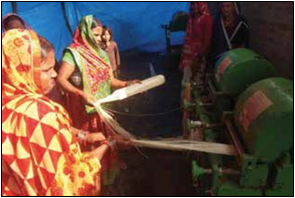
Digitalisation has emerged as a powerful enabler of this transformation. By listing their banana fibre products on IndiaMART and engaging with buyers online, the Maa Saraswati Village Organisation in Samaisa village, Uttar Pradesh, expanded its market reach beyond local confines, securing bulk orders from industrial hubs such as Surat, Ahmedabad, and Kanpur. Enhanced digital visibility and online market linkages enabled the SHG to command improved prices (Rs. 150–Rs. 200 per kg) and scale up operations, demonstrating the role of digital connectivity in integrating rural producers with wider markets. At the institutional level, Gram Panchayats across the country are increasingly adopting digital governance platforms, such as eGramSwaraj and SabhaSaar, to enhance transparency, efficiency, and inclusiveness. By FY 2024–25, more than 2.5 lakh Gram Panchayats had uploaded their development plans online, and over 2.4 lakh had completed digital transactions related to Finance Commission grants, reflecting a shift towards accountable local governance. Complementing these efforts, the BharatNet programme aims to provide affordable high-speed internet connectivity to every Gram Panchayat. As of December 24, 2025, more than 2.14 lakh panchayats have been connected to BharatNet.
The unifying principle underpinning these diverse initiatives is convergence, which involves aligning resources, planning processes, and implementation mechanisms. Mission Antyodaya embodies this approach through data-driven diagnostics that identify developmental gaps and inform targeted, multi-sectoral interventions. By integrating efforts across various domains, including women-led enterprises, waste-to-wealth initiatives, financial inclusion, and skill-based livelihoods, convergence transforms fragmented efforts into coherent pathways of development. Complementing this framework, participatory planning initiatives such as the People’s Plan Campaign and the formulation of Viksit Panchayat Development Plans institutionalise community-led decision-making. By positioning Gram Sabhas at the centre of planning, these mechanisms ensure that local priorities are articulated through collective consensus and implemented through coordinated and convergent action.
As India observes Good Governance Day, the rural development experience illustrates that governance achieves its greatest impact when it is inclusive, responsive, and oriented toward the future. Current efforts emphasize strengthening convergence across programmes, deepening decentralisation, and leveraging digital public infrastructure to build resilient rural economies. With enhanced employment guarantees, integrated planning frameworks, and sustained attention to transparency and accountability, rural development is being reconceptualized not as a set of isolated schemes, but as a continued focus on transparency and accountability. Rural development is being reimagined not as a collection of schemes, but as a coherent mission of shared prosperity. The story of Sarita Saini’s solar dryer in Shripura, though modest in scale, captures the essence of this journey, demonstrating how well-designed policies, when implemented with integrity and purpose, translate into tangible improvements in everyday livelihoods.
References
Ministry of Rural Development
https://pmgsy.dord.gov.in/
https://pmgsy.nic.in/pmgsy-success-stories
https://missionantyodaya.dord.gov.in/aboutUs.html
https://lakhpatididi.gov.in/lakhpati-didis/sarita-saini/
https://dashboard.dord.gov.in/dashboardnew/ddugky.aspx
https://www.pib.gov.in/PressNoteDetails.aspx?NoteId=155343
https://www.pib.gov.in/PressReleasePage.aspx?PRID=2170980®=3&lang=2
https://www.pib.gov.in/FeaturesDeatils.aspx?NoteId=156358
https://dashboard.dord.gov.in/dashboardnew/pmayg.aspx
https://nrlm.gov.in/dashboardForOuter.do?methodName=dashboard
https://www.dord.gov.in/static/uploads/2024/02/43f6d3ecbd0cf21b1a0c23d80d270e0c.pdf
https://www.nitiforstates.gov.in/public-assets/Best_Practices/Compendiums/75%20Inspirational%20Stories%20of%20Aatmanirbhar%20Rural%20Women.pdf
Ministry of Communications
https://usof.gov.in/en/usof-dashboard
Click here to see pdf
*****
PIB Research
(Release ID: 2208112)
Visitor Counter : 4038