Ministry of Panchayati Raj
Year End Review 2025: Ministry of Panchayati Raj
SVAMITVA Achieved Major Milestone with Generation of Over 2.75 Crore Rural Property Cards
From World Bank to GeoSmart India: India Demonstrates Leadership in Land Governance and Panchayat-Level Geospatial Planning
National Panchayat Awards-2025 Celebrates Climate-Smart and Financially Empowered Panchayats
AI-Enabled Tool SabhaSaar Launched to Ease Gram Sabha Record-Keeping
‘Fulera Ka Panchayati Raj’: OTT Outreach Targets Proxy Representation, Boosts Digital Governance and Panchayat Finances
National Model Youth Gram Sabha Initiative Rolled Out to Nurture Youth Engagement in Local Democracy
PESA Mahotsav to be an Annual Event; Chhattisgarh to Host the
Next Edition
Meri Panchayat’ mGovernance Platform Earned Global Recognition with WSIS Champion Award 2025
Several Initiatives undertaken to enhance Panchayat capacity, Advance Women-Friendly Governance, Promote Financial Self-Reliance
Posted On:
29 DEC 2025 6:41PM by PIB Delhi
The year 2025 marked a significant phase in the Ministry of Panchayati Raj’s sustained efforts to strengthen Panchayati Raj Institutions and enhance grassroots governance across rural India. During the year, the Ministry implemented a wide range of initiatives focused on capacity building, training, digital governance, institutional strengthening and community participation across States and Union Territories. Emphasis remained on improving Panchayat-level planning and service delivery, empowering elected representatives, promoting women’s participation and fostering greater citizen engagement. Aligned with the Localization of Sustainable Development Goals and the vision of Viksit Bharat, these initiatives reinforced the central role of Panchayats in sustainable rural development. Details of major activities undertaken and progress achieved during the year are given below.
1. SVAMITVA Property Card Distribution-Crossing a milestone of 2.75+ crore property cards generation
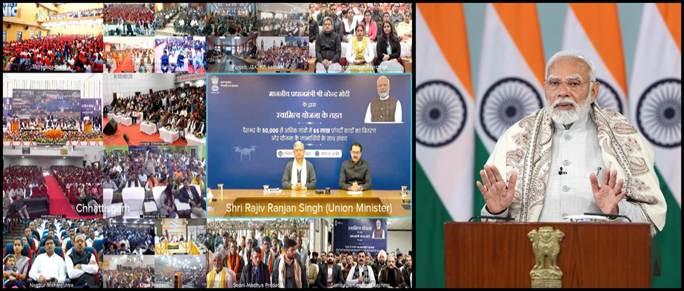
Prime Minister, Shri Narendra Modi presided over the distribution of property cards under the SVAMITVA Scheme on 18th January 2025, providing 65 lakh rural citizens with legal ownership documents in a single day. The distribution covered more than 50,000 villages across 10 States and 2 Union Territories, bringing the total number of property cards distributed under SVAMITVA to 2.25 crore. The ceremony witnessed participation of Union Ministers, Chief Ministers, Governors, Lieutenant Governors, and representatives across 237 Districts.
SVAMITVA Scheme: Empowering Rural India through Technology
Under the SVAMITVA (Survey of Villages and Mapping with Improvised Technology in Village Areas) Scheme, as on 16 December 2025, drone flying has been completed in 3.28 lakh villages, and about 2.76 crore property cards have been prepared for 1.82 lakh villages. Drone surveys have been completed in Madhya Pradesh, Uttar Pradesh, Chhattisgarh, Delhi, Arunachal Pradesh, Ladakh, and Assam. The scheme has achieved full saturation in Haryana, Uttarakhand, Puducherry, Dadra & Nagar Haveli and Daman & Diu, and the Andaman & Nicobar Islands.
1.2. International Recognition and Knowledge Sharing
World Bank Land Conference (5 – 8 May, 2025): India participated as a Country Champion at the World Bank Land Conference 2025 in Washington D.C., showcasing its leadership in inclusive land governance and grassroots empowerment. Shri Vivek Bharadwaj, Secretary, Ministry of Panchayati Raj, addressed the High-Level Plenary on “Good Practices and Challenges in Land Tenure and Governance Reform”, highlighting the impact of the SVAMITVA Scheme. The Ministry showcased Gram Manchitra, India’s GIS-based spatial planning platform, demonstrating its role in strengthening Panchayat-level decision-making for sustainable village development.

1.3 International Workshop on Land Governance (24 – 29 March, 2025)
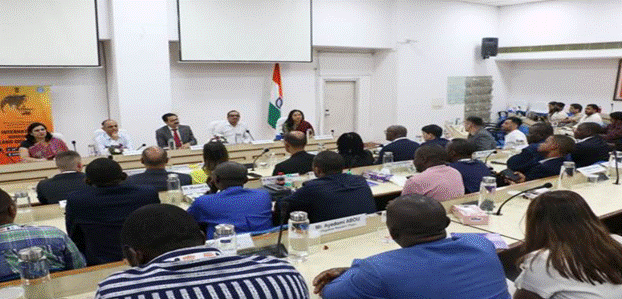
A six-day International Workshop on Land Governance was organized by the Ministry at Haryana Institute of Public Administration (HIPA), Gurugram, with support from the Ministry of External Affairs under the ITEC program. The workshop was attended by senior officials from 22 countries across Africa, Latin America, and South-East Asia, featuring interactive sessions on land governance and hands-on demonstrations. The workshop served as a global platform for knowledge exchange, with India showcasing innovations like drone-based land surveys and digital property records under the SVAMITVA Scheme.
2. Spatial Planning and Geospatial Technology Integration
2.1 “NaveenGram” National Workshop on Enhanced GPSDP
A two-day National workshop on Enhanced Gram Panchayat Spatial Development Plans (GPSDP) was conducted on 17 – 18 July 2025 at Bhopal, Madhya Pradesh, chaired by Secretary, MoPR Shri Vivek Bharadwaj. The workshop witnessed active participation by around 165 participants, including Gram Panchayat functionaries, Planning Institutes, and Government Officials from various States. The Enhanced GPSDP has been prepared in 36 Gram Panchayats of 14 States across India, with the help of 19 Partner Institutions of National Repute, including IITs, CEPT, SPAs, and NITs.
2.2 GeoSmart India 2025
The Ministry co-organized GeoSmart India 2025 (1 – 4 December 2025) in collaboration with Geospatial World. , Secretary, MoPR Shri Vivek Bharadwaj addressed the plenary session on "One Nation One Map,". The Ministry showcased its special pavilion themed "Digital Maps @ Gram Panchayat," attracting steady attention from visitors learning about key digital initiatives such as SVAMITVA, eGramSwaraj, Meri Panchayat, SabhaSaar, Panchayat NIRNAY, Gram Manchitra, and GPSDP.
3. National Panchayati Raj Day Celebrations
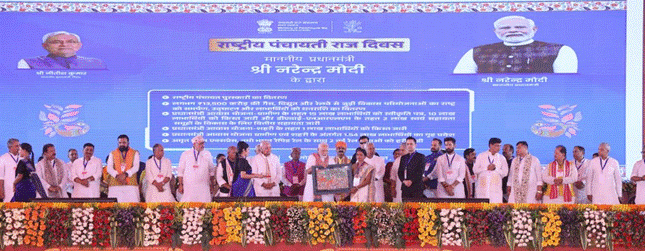
On 24th April 2025, National Panchayati Raj Day was commemorated at Lohna Uttar Gram Panchayat in Madhubani District, Bihar, in the presence of Prime Minister Shri Narendra Modi. On this occasion, National Panchayat Awards-2025 under special categories were conferred on six Gram Panchayats for their exemplary work on climate action and mobilization of own sources of revenue. Also, three institutions were awarded for their contribution towards capacity building of the Panchayat representatives and functionaries. The event saw the launch and foundation laying of development projects worth over Rs. 13,480 crores spanning housing, rural development, power, transportation, and connectivity sectors.

4. Digital Outreach through OTT Platform for Mass Awareness
The Ministry undertook an initiative to leverage popular digital platforms for mass awareness on key issues relating to Panchayati Raj. “Fulera Ka Panchayati Raj”, a Hindi web series extension of the popular show/ web-series “Panchayat”, was developed to communicate important governance messages through an engaging entertainment format. The series has garnered over 40 million views on YouTube, with an additional 7.9 million views on the Ministry’s YouTube channel. All episodes were produced in Hindi with English subtitles for wider accessibility. Three episodes were released during the year 2025, each addressing critical aspects of Panchayati Raj, namely:
“Asli Pradhan Kaun?” – Released on 4 March, 2025, this episode promotes genuine leadership by Women Elected Representatives of Panchayats and highlights the issue of proxy representation.

- “Fulera Mein Chori” – Released on 12 March, 2025, demonstrating how digital services like Meri Panchayat App and SVAMITVA enable transparent and accessible governance

- “Alhua Vikas” – Released on 24 April, 2025, conveying the message of making Panchayats self-reliant by enhancing Own Sources of Revenue (OSR) through citizen participation

This innovative approach of using infotainment media for governance awareness marks a significant step in reaching millions of citizens, particularly youth, with important messages about participatory democracy and digital governance at the grassroots level.
5. SabhaSaar: AI-Powered Meeting Documentation
The Ministry launched SabhaSaar, an AI-powered meeting summarizer tool that automatically generates structured minutes from video or audio recordings of Gram Sabhas. Leveraging Artificial Intelligence and Natural Language Processing, the tool supports 13 regional languages through AI-powered translation engines integrated with Bhashini, the Government's National Language Translation platform. As on 10th December 2025, 92,869 Gram Panchayats across 30 States/UTs have conducted 1,43,124 meetings and generated automated minutes using the SabhaSaar tool, significantly reducing documentation workload while enhancing transparency and accountability in local governance.

6. eGramSwaraj: Strengthening Financial Management
eGramSwaraj, the work-based accounting application now available in 22 Indian languages, continues to enhance Panchayat financial management:
- Over 2.52 lakh Gram Panchayats and 5,400 Block Panchayats uploaded their development plans (GPDP and BPDP)
- 2.52 lakh Gram Panchayats onboarded eGramSwaraj-PFMS integration for 2025-26
- 2.25 lakh Gram Panchayats commenced online payments in 2025-26, transferring nearly Rs. 34,573 crores to beneficiaries and vendors
- 93% of Gram Panchayats closed their year books for 2024-25
- 87% of Gram Panchayats closed month books for 2025-26
- 100% Gram Panchayats in States receiving Central Finance Commission Grants are LGD compliant
7. AuditOnline: Ensuring Financial Accountability
The AuditOnline application facilitates transparent online audit of Panchayat accounts. Key statistics for 2024-25 include:
|
Activity
|
Numbers
|
|
Auditors enlisted
|
12,136
|
|
Auditees enlisted
|
2,62,329
|
|
Audit plans prepared
|
1,67,218 Gram Panchayats
|
|
Audit reports generated
|
55,318
|
8. International Recognition
“Meri Panchayat - The mGovernance Platform for Panchayats of India” received the prestigious WSIS Champion Award 2025 at the WSIS High Level Event in Geneva (7–11 July 2025), recognizing India's innovation in rural e-governance. These initiatives align with the Government's vision of Digital India, Good Governance, and Atmanirbhar Bharat, supporting rural institutions with digital tools for participatory democracy and transparent governance.
9. Capacity Building and Institutional Strengthening
Strengthening Panchayat Infrastructure
The Ministry placed emphasis on strengthening Panchayat infrastructure and enhancing service delivery mechanisms through Panchayati Raj Institutions. To address infrastructure deficits, a saturation approach was adopted. Funds have been sanctioned for the construction of Gram Panchayat Bhawans in 1,638 locations, ensuring that all Gram Panchayats with a population of more than 3,000 will have dedicated office premises.
|
Sl.No.
|
States/UTs
|
Panchayat Bhawan Approved
|
|
1
|
Odisha
|
500
|
|
2
|
Punjab
|
500
|
|
3
|
Uttarakhand
|
200
|
|
4
|
Uttar Pradesh
|
200
|
|
5
|
Chhattisgarh
|
70
|
|
6
|
West Bengal
|
87
|
|
7
|
Tripura
|
61
|
|
8
|
Himachal Pradesh
|
18
|
|
9
|
Andaman & Nicobar Islands
|
2
|
|
Total
|
1,638
|
In addition to infrastructure development, the Ministry prioritized digital empowerment by sanctioning 19,472 computers for Gram Panchayats with established office buildings.
|
Sl.No.
|
States/UTs
|
Computers Approved
|
|
1
|
Chhattisgarh
|
4,585
|
|
2
|
Punjab
|
4,000
|
|
3
|
Uttarakhand
|
3,000
|
|
4
|
Bihar
|
2,000
|
|
5
|
Telangana
|
1,834
|
|
6
|
West Bengal
|
1,600
|
|
7
|
Maharashtra
|
680
|
|
8
|
Kerala
|
200
|
|
9
|
Odisha
|
200
|
|
10
|
Assam
|
868
|
|
11
|
Nagaland
|
344
|
|
12
|
Himachal Pradesh
|
75
|
|
13
|
Gujarat
|
43
|
|
14
|
Goa
|
25
|
|
15
|
Tripura
|
18
|
|
Total
|
19,472
|
10. Initiatives for Women-Led Development
10.1 Launch of ‘Sashakt Panchayat Netri Abhiyan’
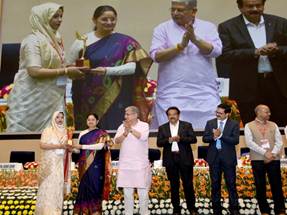
National Workshop of Women Elected Representatives (4-5 March, New Delhi): A gathering of over 1,200 women Panchayat leaders at Vigyan Bhawan featured the launch of a specialized training module aimed at strengthening leadership, communication, and decision-making skills. Exceptional women leaders from across India were felicitated for their contribution to grassroots governance.
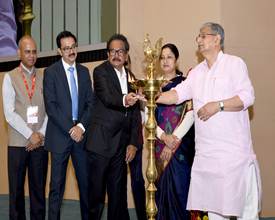
National Convention on Model Women-Friendly Gram Panchayats (5 March): With the vision of establishing one Model Women-Friendly Gram Panchayat in every district, the convention brought together 300 participants and launched two-day training for 1,200 ERs and officials.
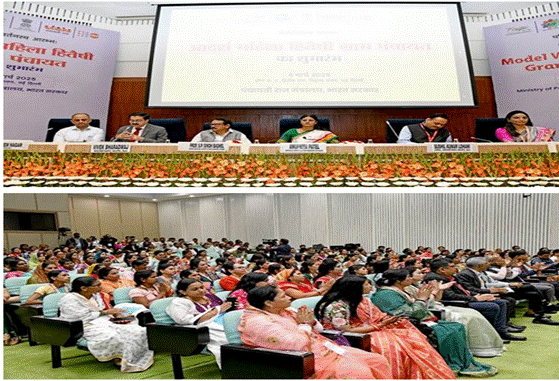
International Women's Day Activities (8 March): Training-cum-orientation programs were organized in identified GPs under the Model Women-Friendly Gram Panchayat (MWFGP) initiative. Mahila Sabhas were held nationwide to strengthen women's participation in Gram Sabha processes.
10.2 Capacity Building of Women Elected Representatives of Panchayats
Following the launch of the Sashakt Panchayat Netri Abhiyan, Training of Trainers (ToT) programs on “Championing Change: Empowering Women Leaders in Local Governance” was organized in collaboration with Transforming Rural India (TRI) foundation. During 2025-26, the Ministry successfully conducted eight capacity-building batches from April to August at premier Institutions including IIPA New Delhi (five batches), and SIRDs at Lucknow, Guwahati, and Tamil Nadu. A total of 252 State Level Master Trainers were equipped with enhanced leadership, governance, and participatory planning competencies. These 252 trainers further trained 8,408 District/Block Level Master Trainers (DLMTs/BLMTs) in a cascading mode, who subsequently trained 44,421 Women Elected Representatives as on 30th November 2025, reflecting the Ministry's commitment to strengthening grassroots governance and promoting inclusive participation within Panchayati Raj Institutions.
11. Making Panchayats Financially Atmanirbhar- Training Module on Own Source Revenue Generation
In line with the vision of Viksit Bharat, the Ministry promoted "Saksham" Panchayats initiative for augmenting Own Source Revenue (OSR) through intensive training for Elected Representatives and Panchayat functionaries. A comprehensive module for generation of Own Source Revenue by Gram Panchayats has been developed by Indian Institute of Management, Ahmedabad. The OSR training covered understanding OSR and its legal framework, strategic approaches to enhance OSR, behavioural science for revenue collection, utilization of OSR for LSDG-linked development, innovative financing and project management, and practical tools and case studies. At central level, three Training of Trainers (ToTs) on the OSR Module were conducted from June to August 2025 at IIPA New Delhi (two batches) and NIRDPR (one batch), training 170 State Level Master Trainers from 32 States/UTs. These trainers further trained 4,879 District/Block Level Master Trainers in a cascading mode, who subsequently trained 1,10,524 Elected Representatives, Officials, and Panchayat functionaries, significantly strengthening the financial self-reliance capacity of Panchayats across the country.
12. Implementation of Rashtriya Gram Swaraj Abhiyan (RGSA)
The Ministry implemented the Centrally Sponsored Scheme of revamped Rashtriya Gram Swaraj Abhiyan (RGSA), under which Annual Action Plans of 32 States/UTs were approved during 2025-26.
Key achievements under RGSA include:
- Released Rs. 911.52 crore during 1 January 2025 to 30 November 2025 to States and UTs for admissible activities including Capacity Building & Training, Institutional strengthening, Gram Panchayat Bhawans, and Computers
- Total expenditure under the scheme was Rs. 1,316.27 crore including Central and State share as on 30 November 2025
- Around 33.25 lakh participants were provided training during 1 January 2025 to 30 November 2025 for Capacity Building of Elected Representatives, Functionaries and other Stakeholders of Panchayats
- 1,638 Gram Panchayat Bhawans and 19,472 computers were approved under RGSA during 2025-26
12.2 Leadership/Management Development Programme through Institutes of Excellence
The Ministry organized Management Development Programme (MDP) trainings aimed at strengthening administrative and leadership capacities within the Panchayati Raj system. During FY 2025-26, five training programmes were conducted across premier national institutions including IIM Rohtak, IIT Dhanbad, IRMA Anand, IIM Jammu, and IIM Bodhgaya from April to November 2025. These trainings collectively engaged 160 participants and contributed significantly to enhancing managerial competencies and institutional efficacy within Panchayati Raj structures, demonstrating the Ministry's focus on leveraging India's leading academic institutions for capacity development at the grassroots level.
12.3 National Launch of Model Youth Gram Sabha
Recognizing the need to engage India's largest youth population in grassroots democracy, the Ministry launched the Model Youth Gram Sabha (MYGS) in collaboration with the Department of School Education and Literacy (DoSEL) and the Ministry of Tribal Affairs (MoTA). This initiative conducts Model Gram Sabha/Gram Panchayat meetings involving students of 9th and 10th standard of Jawahar Navodaya Vidyalayas (JNVs) and Eklavya Model Residential Schools (EMRS). A one-day event at Dr. Ambedkar International Center for the National launch of the Model Youth Gram Sabha (MYGS) initiative was organized on 30 October, 2025. Approximately, 800 participants, including students of JNV & EMRS, Elected Representatives and Panchayat officials from Haryana, Uttar Pradesh, and Uttarakhand, participated in the inaugural event.
These initiatives align with the Government's vision of Digital India, Good Governance, and Atmanirbhar Bharat, supporting rural institutions with digital tools for participatory democracy and transparent governance. The Ministry's efforts under RGSA continue to promote effective, accountable, and participatory local governance, bringing India closer to the vision of Viksit Bharat through empowered, self-reliant, and development-oriented Panchayats.


13. Empowering Tribal Communities through PESA Implementation
13.1 Centre of Excellence on PESA
To institutionalize PESA implementation, a Centre of Excellence on PESA (CoE-PESA) has been established at Indira Gandhi National Tribal University (IGNTU), Amarkantak, through an MoU signed on 24 July, 2025 between MoPR, the Government of Madhya Pradesh and IGNTU. A Programme Advisory Board approved the 2025-26 work plan, focusing on documentation of customary practices, development of model PESA Gram Sabhas, preparation of IEC and training material in tribal languages, and documentation of best practices.
The Provisions of the Panchayats (Extension to the Scheduled Areas) Act, 1996 (PESA Act) extends the provisions of Part-IX of the Constitution to Scheduled Areas across 10 States covering 77,564 villages, 22,040 Panchayats, and 664 Blocks in 45 fully covered and 63 partially covered districts. The Ministry made significant strides in 2025 to strengthen implementation of PESA and empower tribal communities through systematic capacity building, institutional support, and knowledge preservation. CoE-PESA is going to prove an effective platform for effective implementation of PESA.
13.2 Under the Rashtriya Gram Swaraj Abhiyan, the Ministry is supporting all 10 PESA States to appoint dedicated staff for PESA implementation at State, District, Block and Gram Panchayat levels. More than 16,000 dedicated staff are working across the States to implement PESA at the ground level.
13.3 The Ministry organized a two-day write-shop on 13-14 May 2025 at YASHADA, Pune, Maharashtra, with participation from experts, PESA officials and representatives across all PESA States. A compendium of 40 best practices from all 10 PESA States titled "PESA in Action: Stories of Strength and Self-Governance" was published in both English and Hindi and released on 24 July, 2025 in Bhopal, Madhya Pradesh. These success stories demonstrate that Gram Sabhas in PESA Areas are exercising the powers conferred to them by State PESA rules. Six short films / videos based on these success stories were produced and disseminated across Ministry’s social media platforms for wider awareness.
13.4 Capacity Building and Trainings under PESA
Capacity building of elected representatives, officials and community stakeholders remained a key focus area during 2025. As per data available on the Training Management Portal of the Ministry of Panchayati Raj, the details of trainings conducted on PESA during Financial Year 2025-26 (till 30 November 2025) are as follows:
- 594 training programmes were conducted across PESA States.
- A total of 32,892 participants were trained.
- This included 401 participants at State level, 2,863 at District level, and 29,628 at Block level.
- Jharkhand alone trained 31,434 participants, reflecting extensive on-ground capacity building efforts in Scheduled Areas.
In addition, the second round of State-level Master Trainer programmes on key PESA subjects such as Strengthening of Gram Sabha, Minor Forest Produce, Minor Minerals, Prevention of Land Alienation, Control over Money Lending, Regulation of Intoxicants and Customary Dispute Resolution was conducted during September–November 2025 across Anchor States.
13.5 Translation of Training Manuals
The Ministry is translating training manuals on PESA into local and tribal languages. Andhra Pradesh and Telangana completed translation of all seven manuals into Telugu, while Maharashtra completed translation of four manuals in Marathi. The Ministry collaborated with Bhashini for translations in Gujarati, Marathi, Odia, and Santhali, and with the Ministry of Tribal Affairs for translations in tribal languages including Santhali, Mundari, Gondi and Bhili through the Aadi Vaani Portal. Translations in Gondi, Bhili, and Mundari have been completed and sent to States for proofreading.
13.6 National-Level Outreach and Cultural Integration
During 2025, the Ministry of Panchayati Raj (MoPR) undertook focused initiatives to strengthen the implementation of the Panchayats (Extension to the Scheduled Areas) Act, 1996 (PESA), with emphasis on empowering Gram Sabhas and preserving tribal self-governance systems.
Envisioned and supported by MoPR, the “Hamari Parampara, Hamari Virasat” campaign was launched by the Department of Panchayati Raj, Government of Jharkhand on 26 January 2025 and has witnessed more than 3,000 villages pledging commitment to preserving traditional self-governance systems, cultural heritage and customary practices. The initiative aligns closely with the objectives of the PESA Act, which entrusts Gram Sabhas with safeguarding tribal customs, traditions and community institutions.
A special national-level event under the “Hamari Parampara, Hamari Virasat” programme was organised in conjunction with Sarhul Mahotsav 2025 on 4th April 2025 at New Delhi. The event, held during the 150th Birth Anniversary Year of Bhagwan Birsa Munda (Janjatiya Gaurav Varsh), was organised by MoPR in collaboration with the Government of Jharkhand and celebrated tribal heritage at the national level, in the presence of over 560 tribal representatives from Jharkhand.
13.7 PESA Mahotsav 2025
The Ministry of Panchayati Raj organized the two-day PESA Mahotsav on 23–24 December 2025 at Visakhapatnam, Andhra Pradesh, with participation from all ten PESA States. The Mahotsav brought together Panchayat representatives, tribal communities, youth, artisans and cultural groups, providing a national platform to showcase tribal sports, culture, food, crafts and traditional practices. Coinciding with PESA Day (24 December), the event marked the launch of key initiatives including the PESA Portal, PESA Indicators for assessing States on progress towards implementation, training modules on PESA in tribal languages, and the E-book on Kinnaur District of Himachal Pradesh, documenting the rich cultural heritage of the tribal region. Sports competitions, exhibitions, cultural programs and Gram Sabha activities held during the Mahotsav reflected people’s participation and ground-level priorities in Scheduled Areas.
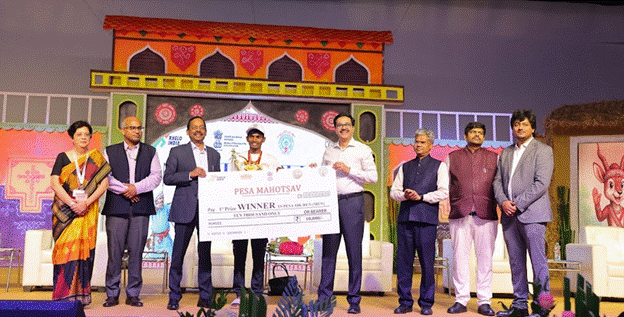
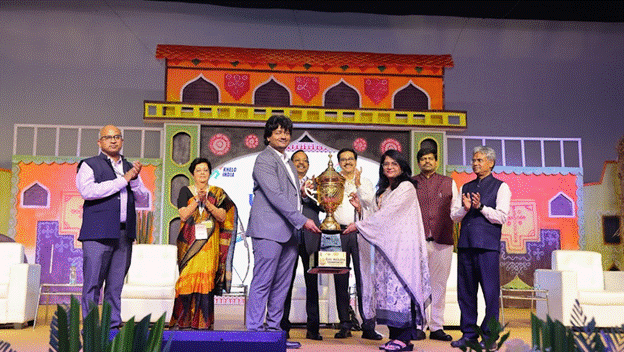
The PESA Mahotsav concluded as a focused national initiative highlighting tribal talent while reinforcing attention on effective implementation of the PESA Act at the grassroots level. It was announced that the PESA Mahotsav will be organized annually, and the baton was formally handed over to Chhattisgarh as the next host State.
13.8 Cultural Documentation Project in Chhattisgarh
The Ministry awarded a unique project titled “Meri Parampara, Meri Virasat” to the Government of Chhattisgarh to systematically document, digitize, and preserve the culture of all 42 tribal communities of the State. The project adopts a community and Gram Sabha-led participatory approach to create detailed video documentaries, safeguard endangered traditions, empower indigenous voices, strengthen intergenerational knowledge transmission, and create a bilingual (Hindi-English) digital repository accessible to communities, researchers, policymakers and the public.
***
Aditi Agrawal
(Release ID: 2209532)
Visitor Counter : 7176