Ministry of Law and Justice
YEAR ENDER 2025 DEPARTMENT OF JUSTICE, MINISTRY OF LAW & JUSTICE
Posted On:
07 JAN 2026 7:33PM by PIB Delhi
1. Appointment and transfer of Judges:
- 157 Judges were appointed in the High Courts - Allahabad (40), Andhra Pradesh (03), Bombay (21), Calcutta (04), Delhi (09), Gauhati (06),
Gujarat (07), Himachal Pradesh (02), J& K and Ladakh (02), Karnataka (04), Madhya Pradesh (15), Patna (04), Punjab & Haryana (14), Rajasthan (15), Telangana (08), and Uttarakhand (03).
- 47 Additional Judges made Permanent Judges in High Courts-
Andhra Pradesh (04), Bombay (09), Calcutta (03), Chhattisgarh (02), Gauhati (04), J& K and Ladakh (03), Karnataka (02), Kerala (03), Madras (08), Meghalaya (01), P&H (04), Telangana (03), Tripura (01).
- Tenure of 13 Additional Judges of High Courts was extended–
Bombay (02), Calcutta (07), Chhattisgarh (03), Gauhati (01).
- 12 Chief Justices in various High Courts were appointed - Bombay, Gauhati, Jharkhand, J&K and Ladakh, Karnataka, Madhya Pradesh, Manipur, Meghalaya, Orissa, Patna.
- 44 High Court Judges were transferred from one High Court to another.
2. Tele-Law: Reaching the Unreached
- During the FY 2025-2026 the Tele-Law has been expanded to cover 2.5 lakh Gram Panchayats across 776 districts (including 112 aspirational districts and 500 aspirational blocks) in 36 states and UTs. About 275 Lawyers have been engaged to provide pre litigation advice. As on 31st December 2025, 1.12 crore + beneficiaries have been provided with Pre litigation advice and consultation.
- District Level Workshop and Training – From January to December 2025 638 District Level workshops and training were organized. During the period these workshops were attended by 37,514 participants including Village Level Entrepreneur (VLEs), government officials and other ground level functionaries of the other Ministries/Departments; During the period 280 awareness sessions were conducted on the implementation of Tele-Law through CSCs, Tele-Law Citizens’ Mobile App, Tele-Law help line number 14454, and human assistance from the VLEs and 500 Nyaya Sahayaks across aspirational blocks.
- Awareness drives by VLEs: Initiatives were undertaken by Tele-Law VLEs to conduct special awareness camps in pockets of their region where awareness on Tele-Law is limited or zero awareness. VLEs made special efforts by using various mode of transport such as e-rickshaw, Mobile vans, Auto-rickshaw, Motorcycle, Bicycle etc. to spread awareness on Tele-Law.
- Strengthen data analytics- Intensive data inputs and data drivers have been analyzed to strengthen and capture the advice delivered through Tele-Law e-platform.
- Hamara Samvidhan Hamara Samman, national campaign to inculcate constitutional values and spirit among the citizens was bolstered through various indigenous sub campaigns-Sabko Nyaya Har Ghar Nyaya, Nav Bharat Nav Sankalp and Vidhi Jagriti Abhiyaan. Episodes highlighting information on socio-legal issues were broadcasted through Doordarshan and aired through Akashwani. Campaign reached out to 70.70 lakh people in the country. Various competition cum awareness generation activity were undertaken with support from MeiTY for example reading of panch paran pledge, DISHA awareness activities by Law Schools in villages adopted by them etc. The campaign was concluded in January 2025.
3. LAP ( Legal Aid to Poor):
i). Celebration of Legal Services Day on 8th and 9th November 2025
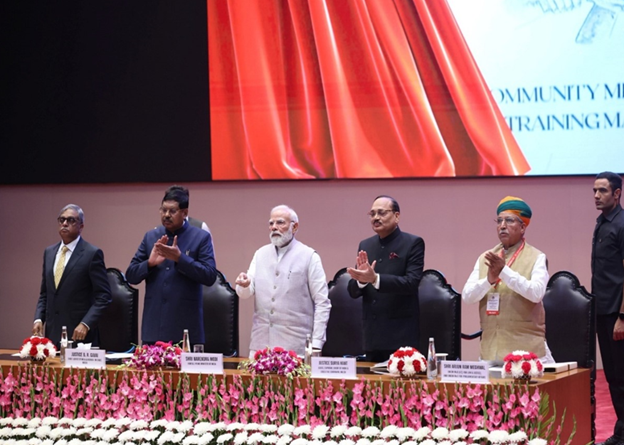
On November 8, 2025, Honourable Prime Minister Shri Narendra Modi inaugurated the 20th National Conference on "Strengthening Legal Aid Delivery Mechanisms" to commemorate 30 years of NALSA and advance the concept of "Ease of Justice." Key initiatives highlighted include the launch of a Community Mediation Training Module to resolve local disputes, the translation of over 80,000 Supreme Court judgments into 18 regional languages to ensure linguistic accessibility, and emphasis on the ongoing repeal of obsolete colonial laws in favor of the Bharatiya Nyaya Sanhita. With the Legal Aid Defence Council System already resolving 8 lakh criminal cases in three years, the Prime Minister called upon young legal professionals to act as "community anchors" in ensuring that free, simplified, and accessible justice reaches every citizen regardless of their background.

ii). National Legal Services Authority (NALSA) launched the "Veer Parivar Sahayata Yojana" Scheme to strengthen Legal Aid to Defence Personnel and families
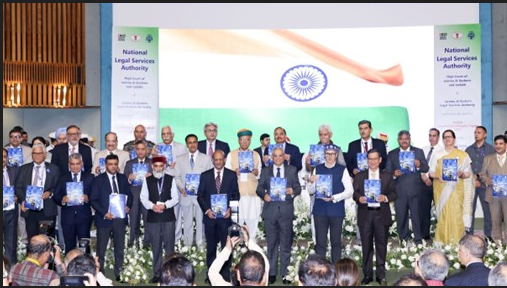
On July 26, 2025, the National Legal Services Authority (NALSA) launched the "Veer Parivar Sahayata Yojana" in Srinagar, an initiative introduced by Justice Surya Kant to provide dedicated legal aid to military and paramilitary personnel and their families. Operating under the theme of reaffirming justice for defense personnel and tribals, the scheme integrates legal service clinics directly into District, State and Central Sainik Boards to ensure that legal guidance is accessible at the same locations where personnel seek welfare services. This strategic mission aims to protect the rights of those who protect the nation's borders, leveraging Sainik Boards as nodal centers to provide seamless support and simplify the process for soldiers and their families to resolve legal grievances at home.
iii). Schemes on Human–Wildlife Conflict and Support for Dependents of Prisoners & Victims of Crime along with e-book on Compendium on Human Wildlife Conflict launched at Southern Regional Conference in Kerala
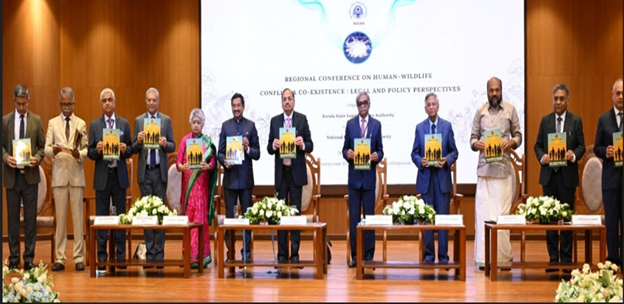
On August 30th 2025, National Legal Services Authority (NALSA), in collaboration with the Kerala State Legal Services Authority (KeLSA), inaugurated the Southern Regional Conference on “Human–Wildlife Conflict & Co-existence: Legal and Policy Perspectives” at the Kerala Legislative Assembly Hall, Thiruvananthapuram.
The two-day conference has brought together Hon’ble Judges of the Supreme Court and High Courts, senior officials from forest and disaster management departments, legal services institutions, and experts to deliberate on legal, policy, and community-based responses to the growing challenge of human– wildlife conflict. As part of the inaugural programme, NALSA launched below major initiatives, along with dedicated videos to enhance public outreach.
(A) NALSA Scheme for Victims of Human–Wildlife Conflict (HWC), 2025
NALSA Scheme for Victims of Human–Wildlife Conflict (HWC), 2025 focuses on addressing the legal and economic vulnerabilities of communities in forest-fringe areas by providing free legal aid, awareness, and assistance in securing timely compensation for victims of human-wildlife encounters. Rooted in the constitutional principles of Article 21 (Right to Life) and Article 48A (Protection of Environment), the scheme treats ecological preservation as a necessity for human sustenance. A major highlight of the program is the launch of a first-of-its-kind digital compendium—an e-book that centralizes national and state-level guidelines, judicial pronouncements, and policy frameworks—to serve as a comprehensive resource for navigating the legal complexities of human-wildlife coexistence. An e-book on Compendium on Human Wildlife Conflict, a first-of-its-kind digital resource compiling national and state-level schemes, guidelines, circulars, advisories, directives, judicial pronouncements and policy frameworks was also launched.
(B) NALSA’s Supporting Potential and Resilience of the Unseen, Held-back and Affected (SPRUHA) Scheme, 2025:
NALSA’s SPRUHA Scheme establishes a "cradle-to-reintegration" support system designed to assist the dependents of incarcerated persons and victims of crime who often face significant legal and economic vulnerabilities. By providing a combination of free legal aid and professional counselling, the scheme helps families navigate the complexities of the justice system while simultaneously addressing the social stigma associated with imprisonment. Beyond legal support, the program focuses on long-term stability by ensuring educational continuity for children, offering vocational training for families, and facilitating the successful social and economic reintegration of individuals to maintain family cohesion during and after incarceration.
4. eCourts Mission Mode Project:
The eCourts Mission Mode Project was launched to improve access to justice through the use of technology and has been implemented in three phases. Phase-I, launched in 2011 with an outlay of Rs 935 crore, focused on basic computerization of courts and establishment of local network connectivity. Phase-II began in 2015 with an outlay of Rs 1,670 crore and expanded the project towards citizen-centric digital services, under which 18,735 District and Subordinate Courts have been computerized. On 13.09.2023, the Cabinet approved Phase-III with a budgetary outlay of Rs 7,210 crore for a four-year period. Phase-III aims at creating digital and paperless courts through digitization of legacy and current case records, expansion of video conferencing to courts, jails and selected hospitals, adoption of AI and OCR, extension of virtual courts beyond traffic offences, and universal saturation of eSewa Kendras.
Over the years, the eCourts project has developed a digital ecosystem throughout the lifecycle of a case. The e-Filing portal allows lawyers and litigants to file cases electronically on a 24×7 basis without physical visits to courts. They can also make online payments of court fees, fines etc using the e-Payment portal under the jurisdiction of 24 High Courts. Approximately 92.08 lakh cases have been filed electronically, and the e-Payments system has processed 49.2 lakh transactions amounting to Rs 1,215.98 crore towards court fees and 4.86 lakh transactions worth Rs 61.97 crore towards fines.
All the cases filed in the courts are managed end-to-end digitally through the Case Information System (CIS), now upgraded to CIS 4.0. Each case is assigned a unique CNR number, enabling litigants to track case status seamlessly. This digitization of the case records makes the online availability of information on case status, cause lists and judgments etc through multilingual e-Courts portal. In addition, the case related information is delivered to the litigants and lawyers through multiple service delivery channels including SMS push and pull, emails, Judicial Service Centres, information kiosks, the e-Courts mobile app with 3.38 crore downloads. The courts currently issue over 4 lakh SMS and 6 lakh emails daily, record nearly 35 lakh daily hits on the e-Courts portal, and have sent more than 14 crore SMS to litigants and advocates.
The CIS also consumes seamlessly the data from various Interoperable Criminal Justice System (ICJS) initiatives such as Crime and Criminal Tracking Networks & Systems of the police, e-Prison, e-Forensic etc rendering the criminal justice system more efficient.
The National Service and Tracking of Electronic Processes (NSTEP) has been developed for process serving and issue of summons. NSTEP is currently functional in 28 States/UTs. has generated 6.21 crore e-processes, of which 1.61 crore have been successfully delivered.
Courts are increasingly adopting virtual and hybrid modes of functioning. Video conferencing facilities support hearings across courts, jails and other institutions, with over 3.91 crore virtual hearings conducted since the Covid lockdown period, positioning India as a global leader in virtual hearings. Live streaming of court proceedings has been implemented in 11 High Courts and the Constitutional Benches of the Supreme Court. 29 virtual courts in 21 States and UTs have been set up to try traffic offences, having adjudicated more than 8.9 crore cases and realized more than Rs 895 crore in fines. The Delhi High Court has established 34 Digital Courts to hear cheque bounce cases under Section 138 of the Negotiable Instruments Act.
Large-scale digitization of court records has been undertaken covering 3108 crore pages in Phase - III. Currently, 224.66 crore pages in High Courts and 354.87 crore pages in District Courts, amounting to over 579 crore pages of judicial records have been digitized. Digital Courts 2.1 enables judges to access pleadings, evidence and case records entirely in digital form, with pilot implementation already underway. In addition, the JustIS app facilitates the judges in online case management.
The National Judicial Data Grid enables lawyers and litigants to access case information and more than 34.23 crore orders and judgments. A dedicated ‘Judgment & Order Search’ portal has been inaugurated which hosts 1.69 crore judgments and allows easy retrieval of judicial decisions. Advanced technologies such as AI-based tools, analytics and OCR are now being integrated for case analysis, decision support, and efficient record management.
Citizen access and inclusivity have been strengthened through 1,987 eSewa Kendras established across the country to facilitate citizen centric services, helping bridge the digital divide. Network infrastructure across courts has been strengthened through WAN connectivity to 2,977 out of 2,992 court complexes, achieving 99.5 % coverage with bandwidth ranging from 10 Mbps to 100 Mbps. All eCourts portals are now hosted on NIC’s Cloud infrastructure, and 730 District Court websites have been migrated to the S3WAAS platform. In addition, solar power systems have been installed in 1,471 out of 1,530 targeted court complexes to ensure uninterrupted ICT operations.
The e-Committee of the Supreme Court of India has conducted 910 training programmes and trained 3,22,740 stakeholders, including judges, court staff, advocates and technical personnel, with specialized programmes for visually challenged officers and training in cybersecurity and digital forensics.
The project has also received national recognition, including the National Award for e-Governance for three consecutive years. From its inception in 2011 to the ongoing Phase III, the eCourts Mission Mode Project has progressed in a structured and chronological manner from basic computerization to a mature, citizen-centric and technology-driven justice delivery system, significantly enhancing efficiency, transparency and access to justice across the country.
5. Scheme of Fast Track Special Courts (FTSC):
A Centrally Sponsored Scheme (CSS) for the establishment of Fast Track Special Courts (FTSCs), including exclusive POCSO (ePOCSO) Courts was launched by the Union of India in October, 2019. These courts are dedicated to the time-bound trial and disposal of pending cases related to rape and crimes under the Protection of Children from Sexual Offences (POCSO) Act, 2012. This Scheme for establishment of 790 courts has been extended twice with the latest extension up to 31st March 2026. The total financial outlay of the scheme is Rs.1,952.23 cr. with Rs.1,207.24 cr. as Central Share to be incurred from Nirbhaya Fund on the CSS pattern.
The Department of Justice has released a total amount of Rs. 1,108.97 crore up to 24.12.2025 since the inception of the Scheme, including Rs. 74.42 crore during the FY 2025–26, out of a budget allocation of Rs. 200.00 crore, to 30 States and Union Territories for the operationalization of FTSCs.
Achievements of the Scheme
774 FTSCs including 398 exclusive POCSO Courts, have been operationalized in 29 States/UTs.
These courts have disposed of 3,61,055 cases since the inception of the Scheme, as on 30.11.2025
Against a target of disposal of 165 rape and POCSO cases per year per court or 13.75 cases per month per court, FTSCs disposed of an average 7.41 cases per month per court, compared to 3.18 cases per month per court by regular courts during 2025 (January–November).
6. National Mission for Justice Delivery and Legal Reforms:
The National Mission for Justice Delivery and Legal Reforms was set up in August 2011. National Mission for Justice Delivery and Legal Reforms focuses on improvement of administration of justice and justice delivery and legal reforms in the entire country and to address the diverse needs of all sections of stakeholders. Its objectives are two-fold:
i. Increasing access by reducing delays and arrears in the system, and
ii. Enhancing accountability through structural changes and by setting performance standards and capacities
Initiatives under National Mission
1. Implementation of the Centrally Sponsored Scheme (CSS) for Development of Infrastructure Facilities for District and Subordinate Courts:
1.1 One of the major initiatives of the National Mission relates to Centrally Sponsored Scheme (CSS) for Development of Infrastructure Facilities for District and Subordinate Courts. CSS for Development of Infrastructure Facilities for District and Subordinate Courts aims to increase the availability of suitable number of Court Halls, Residential Units for Judges / Judicial Officers of District and Subordinate Courts all over the country at District, Sub-District, Taluka, Tehsil, Gram Panchayat and Village level. This will help in improving the functioning and performance of the Judiciary across the country in reaching out to every citizen.
1.2 The Government has approved the continuance of this CSS for a period of 5 years i.e. from FY 2021-22 to 2025-26 with a total outlay of Rs.9000 crore (including Central Share of Rs.5307 crore) and also introduced some new features like provision of Lawyers Halls, Toilet Complexes and Digital Computer Rooms for the convenience of lawyers & litigants, besides Court Halls and Residential Units.
1.3 A sum of Rs. 12,455.57 crore has been released till 30.12.2025 since the inception of the scheme, of which Rs. 9011.26 crore has been released since 2014-15 which is around 72.34% of the total releases under the Scheme. In the financial year 2024-25, an amount of Rs. 1123.40 crore was released to the States/UTs. During the current financial year 2025-26 a sum of Rs. 998 crore has been allocated of which a sum of Rs. 404.16 crore has been released till 30.12.2025.
1.4 As per the information made available by the High Courts as on 30.11.2025, there are 22,663 Court Halls available, a significant increase as compared to the 15,818 available Court Halls in 2014. As far as the Residential Units are concerned, 20,033 Residential units are available in comparison to 10,211 Residential Units available in 2014. In addition, 3,262 Court Halls and 2,824 Residential Units are currently under construction as per Nyaya Vikas portal.
1.5 Online Monitoring through Nyaya Vikas Portal Version 2.0: Nyaya Vikas as an online tool for monitoring of construction projects was launched by Hon’ble Minister of Law & Justice on 11th June, 2018. The Nyaya Vikas web portal and mobile app have been upgraded and Version 2.0 has been made available in public domain from 1st April, 2020 with enhanced capabilities and functionalities, which has been developed based on the feedback from different State Users, in coordination with National Remote Sensing Centre, ISRO. As on 30.12.2025, a total of 3,147 projects are available on Nyaya Vikas Portal, of which 2,979 (94.66%) have been geotagged.
1.6 Filling up of Vacancies in District and Subordinate Courts: As per the Constitutional framework, the selection and appointment of judges in subordinate courts is the responsibility of the High Courts and State Governments concerned. The Supreme Court, through a judicial order in Malik Mazhar case, has devised a process and time frame to be followed for the filling up of vacancies in subordinate judiciary. Department of Justice has been taking up the matter of filling up of vacant positions in District & Subordinate Courts with the States and High Courts. Department of Justice hosts a MIS web-portal on its website for reporting and monitoring of sanctioned and working strength, and vacancies of Judicial Officers of District and Subordinate Courts on monthly basis. This enables the policy makers to get monthly judicial data. Since April, 2021 portal for reporting of compliance of directions for filling up of the vacancies in District and Subordinate Judiciary as directed in Malik Mazhar Sultan case is also live on the Department of Justice website.
1.7 Pendency in Courts: Disposal of cases is within the domain of the judiciary. However, the Union Government is committed to speedy disposal of cases and reduction in pendency of cases to improve access to justice in line with the mandate under Article 39A of the Constitution. The National Mission for Justice Delivery and Legal Reforms, established by the Union Government, has adopted many strategic initiatives, including improving infrastructure [court halls and residential units] for Judicial Officers of District and Subordinate Courts, leveraging Information and Communication Technology (ICT) for better justice delivery, filling up of vacant positions of Judges in High Courts and Supreme Court, reduction in pendency through follow up by Arrears Committees at District, High Court and Supreme Court level, emphasis on Alternate Dispute Resolution (ADR) and initiatives to fast track special type of cases. As on 31st December 2025, there are 92,118 cases pending in the Supreme Court. The pendency in respect of High Courts and District & Subordinate Courts, as on 31st December 2025 stands at 63,70,904 and 4,43,45,599 respectively.
1.8 Reforms under B-Ready Framework: The World Bank’s Ease of Doing Business framework was officially discontinued in September 2021 and replaced by the Business Ready (B-READY) framework, formally launched in 2023, with the first report released in 2024, focusing on regulatory frameworks, public service delivery, operational efficiency, sustainability, and inclusion. India is among the economies participating in the B-READY assessment, with its report expected in the third phase in September 2026; firm surveys commenced in January 2025 and expert consultations in September 2025. DPIIT is the Nodal Department for coordinating with the World Bank, and India’s performance is assessed across ten areas, including Dispute Resolution. For Dispute Resolution, DPIIT and the Department of Justice are the Nodal and Supportive Departments respectively, while the Department of Legal Affairs (DLA), Ministry of Law & Justice, administers the Commercial Courts Act, 2015 at the central level. In this context, the Department has been participating in Inter-Ministerial consultations and the meetings of the B-READY Taskforce convened by DPIIT and DLA respectively for finalization of questionnaires and action plans to improve India’s performance under the B-READY framework.
*******
Samrat: pibpiolaw[at]gmail[dot]com
(Release ID: 2212190)
Visitor Counter : 6247