PIB Backgrounder
Bal Vivah Mukt Bharat
A Pledge Towards Child Marriage-Free India
Posted On:
08 JAN 2026 12:54PM by PIB Delhi
Key Takeaways
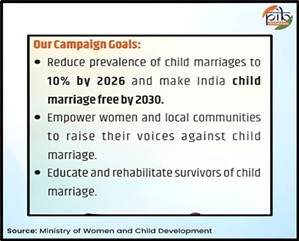
- The Bal Vivah Mukt Bharat campaign aims to reduce the prevalence of child marriage by 10% by 2026 and make India child marriage free by 2030.
- Balod district in Chhattisgarh achieved a milestone by becoming India’s first child marriage-free district in 2025.
- On September 17, 2025, the district administration of Surajpur, Chhattisgarh, declared 75 village panchayats as “Child Marriage-Free Panchayats.”
Introduction
Despite being legally prohibited, child marriage remains a pervasive social challenge in India, impacting millions of young girls and boys across the country. It exposes young girls to serious health risks, especially from early pregnancies, increases vulnerability to domestic violence, and perpetuates cycles of poverty and gender inequality. In India, despite progress, 23% of women aged 20–24 were married before they turned 18 (National Family Health Survey-5, 2019–21)[1]. This makes child marriage both a persistent threat and a heinous crime. While states like West Bengal, Uttar Pradesh, Bihar[2] are some of the states with highest incidences of child marriages, there have been sporadic instances of child marriage across the entire country.
What Is Child Marriage
Child marriage, defined under Prohibition of Child Marriage Act is any union where the female/girl party is under 18 years and a male below 21 years of age, perpetuates cycles of poverty, gender inequality, and health risks, particularly in rural and tribal areas. Furthermore, child marriage directly amounts to child rape under Indian law.
As per the Bharatiya Nyaya Sanhita, 2023, any sexual act by a man with his wife who is below 18 years of age amounts to rape. The Supreme Court of India has further clarified that when the husband of a child bride commits penetrative sexual assault on her, it amounts to aggravated penetrative sexual assault, an offence punishable under the Protection of Children from Sexual Offences (POCSO) Act, 2012.
India’s Fight Against Child Marriage
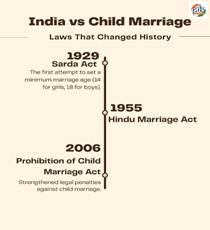
Efforts to curb child marriage in India began as early as the 19th century with social reformers like Raja Rammohan Roy, Ishwar Chandra Vidyasagar, and Mahatma Jyotirao Phule leading campaigns against the practice, resulting in the Age of Consent Act, 1891 and later the Child Marriage Restraint Act (Sarda Act) of 1929, which set the minimum marriage age at 14 for girls and 18 for boys. Post-independence, the government raised these limits through the 1948 amendment (15 for girls)[3], 1978 amendment (18 years for girls and 21 years for boys) and finally the Prohibition of Child Marriage Act, 2006 (18 for women, 21 for men). Alongside legal measures, several awareness campaigns gained momentum nationwide, such as the central government’s Beti Bachao Beti Padhao (2015 onwards), all aimed at changing social mindsets, promoting girls’ education, and empowering communities to report and resist child marriages.
Prohibition of Child Marriage Act, 2006 (PCMA)
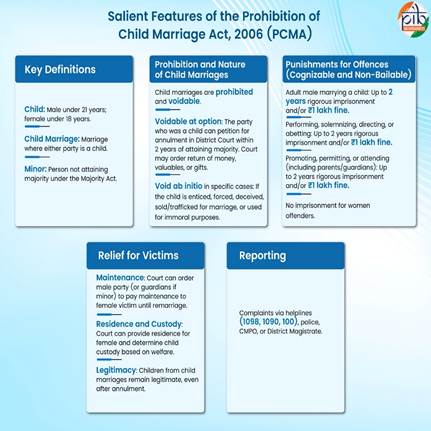
The Prohibition of Child Marriage Act, 2006[4] replaced the Child Marriage Restraint Act, 1929 (Sarda Act), with the aim to prohibit rather than merely restrain child marriages while providing stronger protection and relief for victims.
- The Act clearly states that a "child" is a male under 21 years or female under 18 years. Child marriage involves either party being a child.
- Child marriages are prohibited and voidable[5] at the option of the child party (petition to District Court within 2 years of attaining majority). They are void ab initio in cases of trafficking, force, deceit, or immoral purposes.
- Punishments: Cognizable and non-bailable offences include up to 2 years rigorous imprisonment and/or ₹1 lakh fine for adult males marrying children, solemnizing/performing/abeting/promoting/attending such marriages (including parents/guardians). Women offenders face no imprisonment.
- States appoint Child Marriage Prohibition Officers (CMPOs) to prevent marriages, gather evidence, raise awareness, and report data. Magistrates issue injunctions to stop impending marriages (violation makes marriage void).
Bal Vivah Mukt Bharat (BVMB)
Launched on November 27, 2024, the Bal Vivah Mukt Bharat (BVMB), also known as Child Marriage Free India, represents a bold national commitment by the Ministry of Women and Child Development (MWCD) to eradicate child marriages across the country. This mission is deeply aligned with Sustainable Development Goal (SDG) 5.3, which aims to eliminate all harmful practices, including child, early, and forced marriages, by 2030[6]. Rooted in India's constitutional mandate under Article 21 (right to life and personal liberty) and supported by landmark legislation like the Prohibition of Child Marriage Act (PCMA), 2006, Bal Vivah Mukt Bharat addresses a pervasive social issue that disproportionately affects young children, especially girls in a majority of the cases, and particularly from the marginalised communities.
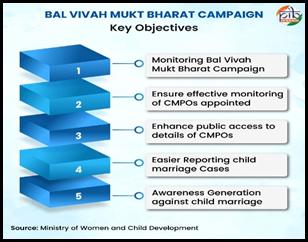
In a landmark judgement delivered on 18th October 2024 in Writ Petition (Civil) No. 1234 of 2017 — Society for Enlightenment and Voluntary Action & Another. vs. Union of India & Others. — the Hon’ble Supreme Court[7] issued a comprehensive framework and detailed directions to all States and Union Territories to effectively prevent and eliminate child marriage across the country. The Court prohibited child betrothals as they undermine autonomy and often lead to forced marriages, urging legislative amendments for an explicit ban. To strengthen enforcement under the Prohibition of Child Marriage Act, 2006, States and Union Territories were directed to appoint full-time dedicated Child Marriage Prohibition Officers (CMPOs) at district/sub-district levels—unburdened by other duties—and establish Special Child Marriage Prohibition Units for coordination, monitoring, and grievance redressal. Proactive prevention measures include:
- Mandatory multi-sectoral awareness campaigns involving schools, Anganwadis, NGOs, and religious leaders;
- Training for police, judiciary, teachers, and health workers and technology-enabled reporting, were emphasised upon.
- Maintaining databases of at-risk areas;
This judgment decisively shifts focus from punishment to prevention, protection, and empowerment, making the framework more robust and child-centric.
The initiative, Bal Vivah Mukt Bharat, thus is a sincere attempt to build on prior efforts like the Beti Bachao Beti Padhao (BBBP) scheme but introduces a more integrated, technology-driven approach to prevention and response towards child marriages.
The 100-Day Campaign: A Momentum-Building Drive Against Child Marriage
On December 4, 2025, a high-intensity 100-day special drive has been rolled out across all States and Union Territories, dedicating each month to a specific outreach.
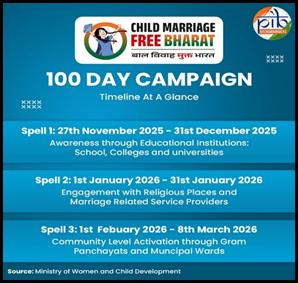
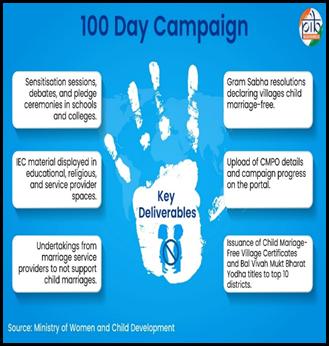
Furthermore, to foster healthy competition and celebrate excellence, the campaign introduces two prestigious honours:
- Child Marriage-Free Village Certificate: Awarded to villages/panchayats that formally pledge to end child marriage and maintain zero reported cases over a sustained period.
- Bal Vivah Mukt Bharat Yodha Award: The top 10 performing districts—evaluated on reporting efficiency, prevention success, and overall reduction in child marriage cases—will be conferred this national title. These districts will be prominently featured on the official Bal Vivah Mukt Bharat portal, receive a formal commendation certificate, and be publicly recognised at the national level for their outstanding leadership and commitment.
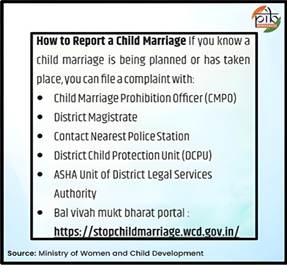
The nationwide campaign officially commenced on December 4, 2025 with a major launch event in New Delhi at Vigyan Bhawan, accompanied by a synchronised national pledge-taking ceremony. This unified commitment will reaffirm India’s determination to become a completely child marriage-free nation.
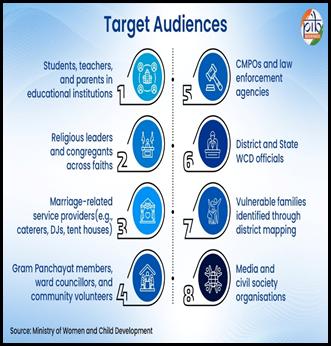
State governments play a pivotal role in implementing these measures, as outlined by MWCD. Chief Secretaries have been directed to form district-level task forces comprising CMPOs, NGOs, and PRIs for weekly monitoring and geo-tagged progress reports via the BVMB portal. The campaign emphasises multi-sectoral convergence, linking with education, health, and rural development ministries.
Bal Vivah Mukt Bharat Portal
This flagship initiative of the Ministry of Women and Child Development offers a centralized, publicly accessible platform that lists all appointed Child Marriage Prohibition Officers across India, enables real-time reporting of child marriage cases, and tracks awareness campaigns and actions undertaken to engage stakeholders and citizens in creating a child-marriage-free India.
Nationwide Awareness Campaigns: A Glimpse
The Ministry of Women and Child Development has committed to fully funding the campaign, giving priority to 257 high-burden districts identified through NFHS- V data (districts where the prevalence of child marriage is at or above the national average)[8].
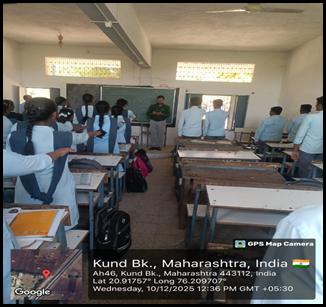
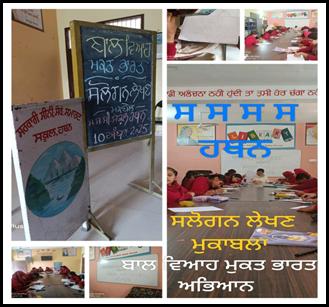
Campaign to Prevent Child Marriage is currently in full swing; states and Union Territories across the country are participating with unprecedented energy and coordination. Millions of students across schools and educational institutions, along with other key stakeholders including Gram Panchayats have taken the anti-child-marriage pledge.
Towards A Child Marriage-Free India: Progress So Far
Since its launch, the Bal Vivah Mukt Bharat (BVMB) mission has made substantial strides in curbing child marriages across India, achieving key enforcement and awareness milestones that align with national child protection goals. A cornerstone of this progress is the nationwide deployment of dedicated Child Marriage Prohibition Officers (CMPOs), as mandated under the Prohibition of Child Marriage Act (PCMA), 2006. These officers, empowered through state-level directives have conducted proactive interventions, including door-to-door awareness drives and rapid-response teams linked to the national Child Helpline (1098). A standout enforcement highlight was the 2025 Akshaya Tritiya directive issued by the Ministry of Women and Child Development (MWCD), which targeted culturally sensitive high-risk periods for mass weddings. This led to heightened monitoring, resulting in the prevention of hundreds of child marriage cases through judicial injunctions, community counselling, and FIR filings. Integrated with schemes like Beti Bachao Beti Padhao, these efforts have boosted conviction rates under PCMA while fostering "no-child-marriage zones" in several villages.
On the international front, BVMB has garnered strong global endorsement, particularly from UNICEF, which has provided technical support for data-driven interventions and capacity-building workshops for CMPOs and One Stop Centres (OSCs). Aligned with SDG 5.3 and the UN Convention on the Rights of the Child (UNCRC), these achievements position India as a leader in South Asia for scalable, multi-sectoral anti-child marriage strategies, with ongoing convergence across health, education, and rural development ministries.
Chattisgarh: A Beacon of Hope Toward Child Marriage Free India
Balod district in Chhattisgarh has achieved a historic milestone by becoming India’s first child marriage-free district. For two consecutive years, not a single child marriage has been reported across its 436 Gram Panchayats and 9 urban local bodies. This remarkable feat is the result of sustained government interventions, active community participation, and widespread awareness drives. Riding on Balod’s success, Chhattisgarh now aims to make the entire state completely free from child marriage by 2028–29[9].
In another remarkable instance in the same state, Surajpur district set a powerful example in social reform and community awareness. On September 17, 2025, coinciding with the launch of Poshan Maah 2025, the district administration proudly declared 75 village panchayats as “Child Marriage-Free Panchayats.”
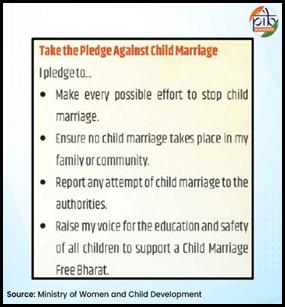
These panchayats earned the honour after recording zero child marriage cases for two consecutive years[10]. This achievement stands as a moment of immense pride for Chhattisgarh and serves as an inspiring model for the rest of India.
Conclusion
India's journey to eradicate child marriage stems from 19th-century reforms and the Sarda Act of 1929 and continues to the robust Prohibition of Child Marriage Act, 2006, and the landmark 2024 Supreme Court judgment. It has yielded remarkable progress, with prevalence dropping significantly over the decades. The Bal Vivah Mukt Bharat campaign, launched in November 2024 and bolstered by the ongoing 100-day intensive awareness drive (running until March 2026), represents a pivotal escalation in this fight. Through dedicated Child Marriage Prohibition Officers, the BVMB portal's tech-enabled reporting, and grassroots successes, the initiative drives prevention, protection, and empowerment, seamlessly integrating with Beti Bachao Beti Padhao.
As millions participate in pledges, crucial efforts not only challenge deep-rooted social norms but also align with Sustainable Development Goal 5.3 and the vision of a Viksit Bharat. Sustained collective action, from government, communities, NGOs, and citizens, holds the promise of breaking cycles of inequality, ensuring every child’s right to education, health, and autonomy. With unwavering commitment, India can achieve a truly child marriage-free future, empowering generations of girls and boys to thrive.
References:
Press Information Bureau:
https://www.pib.gov.in/PressReleasePage.aspx?PRID=2168554®=3&lang=2
https://www.pib.gov.in/PressReleseDetail.aspx?PRID=2197965®=3&lang=1
Ministry of Women and Child Development:
https://stopchildmarriage.wcd.gov.in/public/documents/noticeboard/campaign100days.pdf
https://socialwelfare.tripura.gov.in/sites/default/files/THE%20PROHIBITION%20OF%20CHILD%20MARRIAGE%20ACT%2C%202006.pdf
https://stopchildmarriage.wcd.gov.in/about#:~:text=The%20Prohibition%20of%20Child%20Marriage%20Act%20(PCMA),*%20Put%20in%20place%20a%20comprehensive%20mechanism
https://stopchildmarriage.wcd.gov.in/about#:~:text=The%20Prohibition%20of%20Child%20Marriage%20Act%20(PCMA),*%20Put%20in%20place%20a%20comprehensive%20mechanism
https://wdcw.ap.gov.in/dept_files/cm_cmp.pdf
https://x.com/Annapurna4BJP/status/1993968281439621226?ref_src=twsrc%5Etfw%7Ctwcamp%5Etweetembed%7Ctwterm%5E1993968281439621226%7Ctwgr%5Eb7b72c138a5947de31a0f178d352c201ede5d37d%7Ctwcon%5Es1_&ref_url=https%3A%2F%2Fwww.pib.gov.in%2FPressReleasePage.aspx%3FPRID%3D2197965reg%3D3lang%3D1
https://x.com/MinistryWCD/status/1995429594141458665
https://rsdebate.nic.in/bitstream/123456789/421118/1/PD_104_02031978_9_p131_p222_17.pdf
Ministry of Law and Justice:
https://www.indiacode.nic.in/bitstream/123456789/6843/1/child_marriage_prohibition_act.pdf?referrer=grok.com
Doordarshan (DD National Youtube):
https://www.youtube.com/watch?v=WxlPyjEk5Fk
United Nations Population Fund:
https://india.unfpa.org/sites/default/files/pub-pdf/analytical_series_1_-_child_marriage_in_india_-_insights_from_nfhs-5_final_0.pdf
United Nations Women:
https://sadrag.org/wp-content/uploads/2025/01/Training-Guide-for-service-providers-GBV-compressed.pdf
United Nations Children's Fund:
file:///C:/Users/HP/Downloads/Ending_Child_Marriage-profile_of_progress_in_India_2023%20(1).pdf
Bal Vivah Mukt Bharat
******
PIB Research
(Release ID: 2212352)
Visitor Counter : 17987