Ministry of Culture
“India’s languages are not contradictory; rather, they contribute to one another.” – Vice President Shri C. P. Radhakrishnan
The Third International Bharatiya Languages Conference – 2026 inaugurated in New Delhi
Posted On:
09 JAN 2026 8:48PM by PIB Delhi
The inaugural session of the Third International Bharatiya Languages Conference – 2026 was held at the Indira Gandhi National Centre for the Arts, Janpath, under the joint aegis of the Indira Gandhi National Centre for the Arts (IGNCA), Ministry of Culture, Government of India, Antarashtriya Sahyog Parishad, Vaishwik Hindi Parivar, and the Department of Indian Languages and Literary Studies, University of Delhi. The conference was inaugurated by the Honourable Vice President of India, Shri C. P. Radhakrishnan.
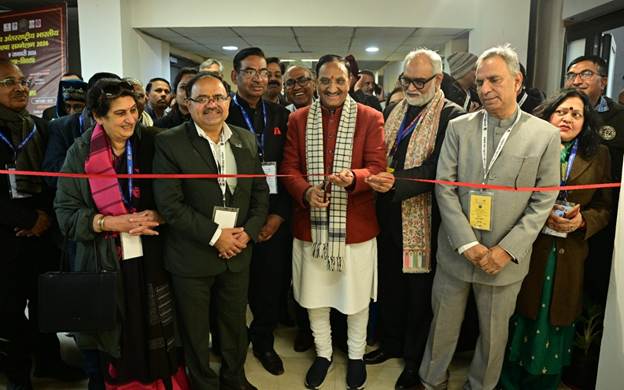
On this occasion, Dr. Ramesh Pokhriyal ‘Nishank’, Union Minister of Education and former Chief Minister of Uttarakhand, attended as distinguished guest. The inaugural session was chaired by the President of IGNCA and eminent scholar, Padma Bhushan Shri Ram Bahadur Rai. Shri Shyam Parande, Secretary General of Antarashtriya Sahyog Parishad, and renowned Japanese linguist Padma Shri Tomio Misokami also attended as special guests. Dr. Sachchidanand Joshi, Member Secretary, IGNCA, and Prof. Ravi Prakash Tekchandani, Head of the Department of Indian Languages and Literary Studies, University of Delhi, were also present on the occasion. The session was conducted by Anil Joshi, Director of the International Bharatiya Languages Conference.
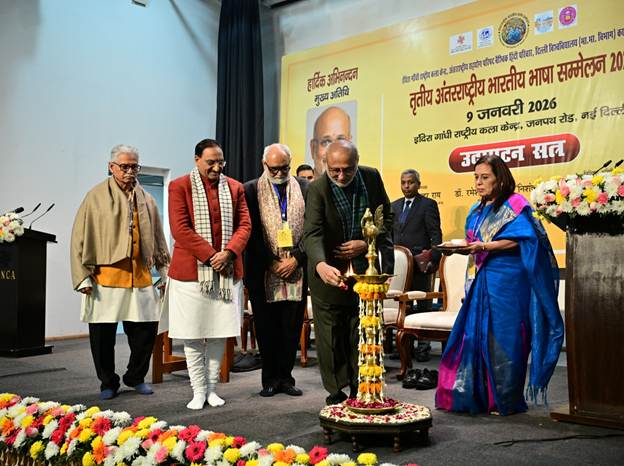
Shri C. P. Radhakrishnan, while speaking at the Third International Bharatiya Languages Conference, said that languages are the living conscience of civilisation, as they are not merely instruments of communication but carriers of memory, culture, tradition, and values passed down through generations. India’s unity has never rested on uniformity; rather, it has been sustained by mutual respect among many languages, which are bound together by a shared civilisational ethos and dharma. Bharatiya languages are not contradictory; instead, they constantly contribute to one another, thereby enriching philosophy, knowledge, and cultural expression.
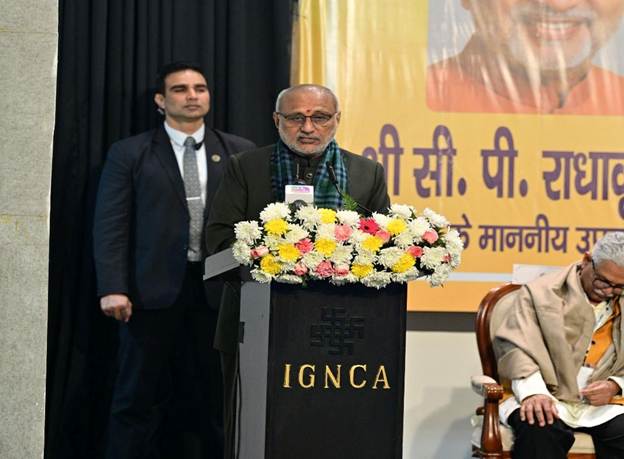
From ancient inscriptions and palm-leaf manuscripts to contemporary digital forms, languages have shaped thought, preserved knowledge, and nurtured collective imagination. Since they have always travelled beyond borders, long before diplomacy, our responsibility today is not only to protect linguistic diversity but also to support endangered languages and carry them confidently into the future through education and technology. Thus, in celebrating every language, we uphold the dignity of every Indian, for Bharat is one and will remain one forever.
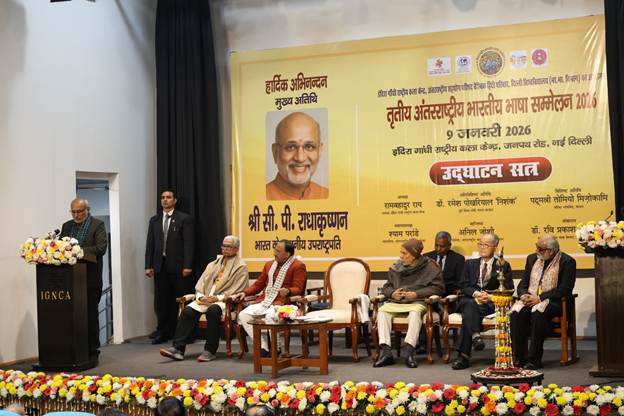
On this occasion, Dr. Ramesh Pokhriyal ‘Nishank’ shared his thoughts on the significance of Indian languages. He stated that Indian languages are not merely tools of communication, but carriers of culture, knowledge, philosophy, and social values.
Dr. Nishank further highlighted that our languages have preserved human consciousness and traditions while promoting India’s civilisation and wisdom across the world. He noted that invaluable treasures such as yoga, Ayurveda, literature, and philosophy have spread globally through the medium of our languages. Emphasising their deeper role, he said that Indian languages do not teach conflict, but rather convey lessons of coexistence, equality, and harmony. They are not only a means of communication but also the foundation for societal and individual development. Dr. Nishank clarified that Indian languages foster unity and knowledge, rather than division, and that this is the source of their strength and pride.
In his presidential address, Shri Ram Bahadur Rai said that this conference is an occasion to reflect on languages and work towards their development. He stated that some confused scholars and linguists have propagated the idea that Indian languages are divided into four families. However, it has now been established that all Indian languages belong to a single family. Recognising this breaks down artificial divisions. He urged efforts to increase dialogue among Indian languages. As dialogue grows, it will create a wave—a wave of languages, a wave of linguistic unity, and a wave of cultural unity. This wave will be the very sentiment that connects languages and brings language communities together. Speaking as a special guest, Padma Shri Tomio Mizokami addressed the audience in Hindi, saying, “People say that I am Indian, though I was mistakenly born in Japan.”
The three day conference will serve as an important academic and cultural platform focused on the global dissemination of Indian languages, contemporary challenges, and future possibilities. Over 100 international delegates from more than 70 countries, including the United Kingdom, Canada, New Zealand, Australia, Singapore, Sri Lanka, Nepal, the Netherlands, France, Mauritius, Thailand, and Japan, participated in the event. In addition, over 100 eminent scholars, writers, and language activists representing various states, languages, and dialects of India contributed to enhancing the prestige of the conference.
*****
Sunil Kumar Tiwari
pibculture[at]gmail[dot]com
(Release ID: 2213089)
Visitor Counter : 2452