PIB Backgrounder
National Youth Day 2026
Posted On:
11 JAN 2026 4:29PM by PIB Delhi
Key Takeaways
- Youth Engagement at Scale: Platforms such as MY Bharat and NSS are enabling youth participation in volunteering, leadership, and nation-building across districts and institutions.
- Education to Employment Pipeline: Flagship initiatives including Skill India, PMKVY, PM-SETU, Agnipath, and Startup India are strengthening pathways from skilling to jobs and entrepreneurship.
- Health and Well-being Focus: Programmes like Fit India, RKSK, and the Kashi Declaration underscore a holistic approach to youth fitness, mental health, and substance-free living.
|
“The power of youth is the common wealth for the entire world.” - Swami Vivekananda
Introduction
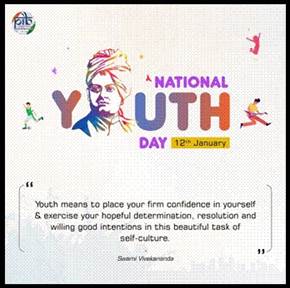
National Youth Day, observed every year on January 12, marks the birth anniversary of Swami Vivekananda. His ideas on character, courage, and nation-building continue to inspire generations of young Indians. More than a commemorative occasion, National Youth Day is a moment to reflect on the aspirations, energies, and responsibilities of India’s youth—who form the backbone of the country’s journey towards Viksit Bharat @2047.
With over 65 per cent of its population below the age of 35, India’s youthful demographic dividend carries immense potential. Recognising this, the Government of India has built a comprehensive youth empowerment ecosystem, spanning civic participation, skill development, entrepreneurship, health, fitness, and national service.
Anchored by the Ministry of Youth Affairs and Sports and strengthened through inter-ministerial collaboration, this framework seeks to enable young Indians not just as beneficiaries of development, but as active partners in nation-building.
Youth Engagement, Leadership & Civic Participation
Youth empowerment has been carried out through a plethora of initiatives and campaigns, that engage the youth with leadership, civic participation and development opportunities:
Mera Yuva Bharat (MY Bharat)
Mera Yuva Bharat (MY Bharat) is an autonomous body under the Ministry of Youth Affairs and Sports, Government of India. It serves as a national, technology-driven platform to engage and empower youth by connecting them with opportunities for volunteering, experiential learning, leadership, and skill development. MY Bharat brings together government ministries, institutions, private organisations, and civil society on a unified digital ecosystem. Anchored in the spirit of “Yuva Shakti se Jan Bhagidari”, it positions young citizens as active partners in nation-building and the vision of Viksit Bharat @2047.
On October 31, 2023, Prime Minister Narendra Modi formally introduced the platform. The MY Bharat portal serves as a central digital gateway connecting young citizens with opportunities for volunteering, skilling, and leadership. It enables seamless registration, digital IDs, opportunity matching, and real-time impact dashboards. As on 26th November 2025 total number of registration on the MY Bharat portal is 2.05 Crores.
With over 14.5 lakh volunteering opportunities generated, MY Bharat now links a vast network of 16,000+ youth club members and 60,000+ institutional partners, including government bodies, educational institutions, and NGOs. Collaborations with major corporate partners, such as Reliance, have further expanded its reach. These partnerships deliver impactful programmes and bootcamps that channel youth energy into civic and community development.
The platform regularly hosts a range of engagement initiatives, such as Experiential Learning Programs (ELPs). It also provides a dedicated web space for different ministries, organisations, industries, youth clubs, and other stakeholders. This space can be used to host volunteer programs, capacity-building activities, and youth engagement initiatives.
Scan now to register on MY Bharat – your gateway to volunteering, skill-building, youth leadership, and nation-building opportunities!
MY Bharat Mobile App (Launched October 2025)
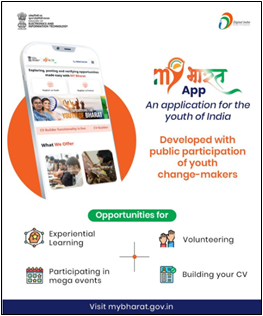
To make youth engagement mobile-first and more accessible, the MY Bharat Mobile App was launched on October 1, 2025. The app brings together the core functions of the portal with added convenience and reach. It features multilingual support, AI-driven chatbots, voice-assist navigation, and Smart CV Builder tools, enabling young citizens to access opportunities and build verified digital profiles on the go. At the time of launch, over 1.81 crore youth and 1.20 lakh organisations were already registered on the platform. The app also provides digital certificates and engagement badges, reflecting each participant’s contributions to national and community projects.
MY Bharat 2.0
In a recent initiative on 30 June 2025 in New Delhi, the Ministry of Youth Affairs and Sports (MYAS) signed a Memorandum of Understanding (MoU) with the Digital India Corporation (DIC), the Ministry of Electronics and Information Technology for the development of MY Bharat 2.0 platform in order to strengthen the digital engagement of India’s youth.
The upgraded youth platform will facilitate technology-driven solutions in order to empower and connect young people across the country.
- MY Bharat 2.0 to empower Amrit-Peedhi and Drive the Vision of Viksit Bharat by 2047.
- Aims to equip youth with Smart CV Builder, AI Chatbots and Voice-Assisted Navigation.
- It features dedicated sections for National Career Services, Mentorship Hub and Fit India
Another major collaboration was formalised on 13th August 2025 with the School of Ultimate Leadership Foundation (SOUL). This collaboration aims to train one lakh youth leaders from diverse backgrounds over the next three years.
National Service Scheme (NSS)
National Service Scheme is a scheme under Ministry of Youth Affairs and Sports and aims at instigating social consciousness of the student youth with an overall objective of personality development of the youth through community service.
Launched in 1969 in 37 Universities involving about 40,000 volunteers, NSS has now spread over 657 Universities and 51 +2 Councils/Directorates, covering 20,669 Colleges/ Technical Institutions and 11,988 Senior Secondary School.
It comprises of the following programs:
- National Integration Camp (NIC)
- Adventure Programme
- Republic Day Parade Camp
- National Youth Festivals (12–16 January annually)
- National Service Scheme Awards
Over 3.9 million NSS volunteers are engaged annually in community service, social awareness programmes, and development activities. In addition, NSS organises National Integration Camps (NIC) annually, with 200 selected volunteers per camp to promote cultural diversity, patriotism and national integration through social service.
Viksit Bharat Young Leaders’ Dialogue (VBYLD)
The Viksit Bharat Young Leaders’ Dialogue (VBYLD) has been reimagined from the National Youth Festival as a national platform for youth-led ideas and solutions. The second edition will be held from 9–12 January 2026 at Bharat Mandapam, New Delhi. It will bring together nearly 3,000 participants, including 1,500 youth from the Viksit Bharat Challenge Track, 1,000 from the Cultural & Design Track, 100 international delegates, and 400 special attendees.
The Dialogue is anchored in a four-stage Viksit Bharat Challenge Track. A nationwide digital quiz hosted on MY Bharat and MyGov saw participation from over 50.42 lakh youth. The programme will culminate on National Youth Day, with young leaders presenting ideas across ten national priority themes before national leadership.
Agnipath Scheme
The Government launched the Agnipath scheme on June 15, 2022. Under the scheme, both male and female aspirants are recruited into the ‘below the officer’s rank’ cadre of the three services for a four-year period as Agniveers. The program aims to recruit youth aged 17.5–21 as Agniveers for four years of military service.
The first batch of 46,000 completed their training in 2023. They gained discipline, leadership, and technical skills, along with a Seva Nidhi package and priority in post-service employment. Upto 1.5 lakh Agniveers have been enrolled till Feb 2025 under the scheme.
Pradhan Mantri Skilling and Employability Transformation through Upgraded ITIs (PM-SETU)
In October 2025, the Government launched PM-SETU (Pradhan Mantri Skilling and Employability Transformation through Upgraded ITIs). It is a flagship, centrally sponsored scheme to modernise India’s network of Industrial Training Institutes (ITIs) and align vocational training with global industry standards.
With an investment of ₹60,000 crore, PM-SETU aims to upgrade 1,000 Government ITIs across the country through a hub-and-spoke model comprising 200 hub ITIs and 800 spoke ITIs.
Each hub ITI is being developed as an advanced skills and innovation centre, equipped with modern infrastructure, digital learning systems, incubation facilities, placement cells, and training-of-trainers capabilities. The spoke ITIs extend access to surrounding regions, particularly smaller towns and aspirational districts. The scheme adopts a “government-owned, industry-managed” model, under which Anchor Industry Partners ensure that course offerings and training outcomes are closely aligned with labour market demand across sectors.
PM-SETU was launched on October 4, 2025 by the Prime Minister to fill existing gaps in the ITI system by making training more relevant to the modern job market. It was part of a broader package of youth-focused initiatives worth over ₹62,000 crore, including the inauguration of 1,200 vocational skill labs in Jawahar Navodaya Vidyalayas and Eklavya Model Residential Schools across 34 States and Union Territories.
These labs will equip students, including those in remote and tribal areas, with hands-on training in 12 high-demand sectors such as IT, automotive, agriculture, electronics, logistics and tourism.
Aligned with the National Education Policy 2020 and CBSE curriculum, the project also involves the training of 1,200 vocational teachers to deliver industry-relevant learning and create an early foundation for employability.
Education and Skills Development
The Government of India has implemented comprehensive programmes to bridge the skills gap and enhance youth employability through structured training, certification, and industry partnerships.
Since 2014, the Ministry of Skill Development and Entrepreneurship has empowered more than 6 crore Indians through its various schemes that help them build a bright future for themselves and for the nation.
At the heart of this transformation is India’s Skill India Mission (SIM), which is providing the youth with essential industry-relevant skills through various programs.
Skill India Mission
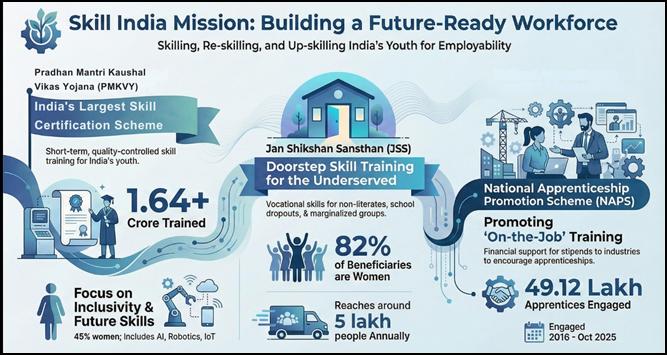
The Skill India Mission (SIM) was launched on July 15, 2015 by the Prime Minister on World Youth Skills Day. The campaign delivers skill, re-skill and up-skill training through an extensive network of skill development centres / institutes under various schemes, such as Pradhan Mantri Kaushal Vikas Yojana (PMKVY), Jan Shikshan Sansthan (JSS), National Apprenticeship Promotion Scheme (NAPS), and the Craftsman Training Scheme (CTS) in Industrial Training Institutes (ITIs).
In February 2025, the restructured ‘Skill India Programme’ was approved for 2022-23 to 2025-26 with an ₹8,800 crore outlay.
This merged Pradhan Mantri Kaushal Vikas Yojana 4.0 (PMKVY 4.0), the Pradhan Mantri National Apprenticeship Promotion Scheme (PM-NAPS), and the Jan Shikshan Sansthan (JSS) Scheme into a single Central Sector Scheme.
Pradhan Mantri Kaushal Vikas Yojana (PMKVY)
Launched on July 15, 2015, the Pradhan Mantri Kaushal Vikas Yojana (PMKVY) was designed to provide short-term skill training and upskilling or re-skilling, including through Recognition of Prior Learning (RPL), to youth across India. It has served as the backbone of the country’s short-term skill development ecosystem.
The scheme focuses on equipping young people from diverse backgrounds with employable, industry-relevant skills through a structured and quality-assured training and certification framework. Over the years, PMKVY has covered a wide range of sectors, including manufacturing, construction, healthcare, information technology, electronics, and retail
By extending certified training to rural and remote regions, PMKVY has significantly expanded access to employment opportunities. Inclusivity has remained central to the programme, with women accounting for 45% of beneficiaries and substantial participation from Scheduled Castes, Scheduled Tribes, and Other Backward Classes.
In order to meet the needs of the future economy, PMKVY has evolved, broadening its focus to encompass cutting-edge industries including robotics, mechatronics, artificial intelligence, drone technology, and the internet of things (IoT).
Note: The total number of candidates enrolled under the Pradhan Mantri Kaushal Vikas Yojana (PMKVY) since its inception up to 31st October, 2025 is 17,611,055, and the total number of candidates trained during the same period is 16,433,033.
- PMKVY 1.0: During its pilot phase in 2015-16, 19.85 lakh candidates were trained.
- PMKVY 2.0: 1.10 Crore candidates were trained/oriented.
- PMKVY 3.0: Two special programs were launched:
Customised Crash Course Programme for COVID Warriors (CCCP for CW) to mitigate the impact of COVID-19 pandemic.
Skill Hub Initiative (SHI) for integration and mainstreaming of vocational education with general education as envisaged under the National Education Policy, 2020 (NEP, 2020).
Under PMKVY 3.0, 7.37 lakh candidates were trained, including 1.20 lakh candidates under CCCP-CW and 1.8 lakh under SHI.
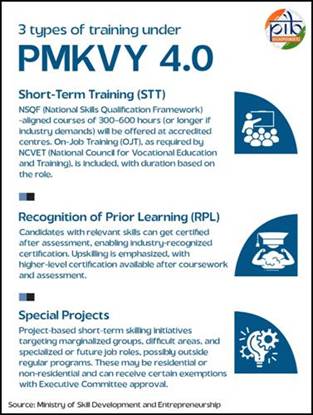
- PMKVY 4.0: Under PMKVY 4.0, implemented since FY 2022–23, the focus has shifted from placement tracking to On-Job Training (OJT) embedded, industry-relevant skill courses, enabling candidates to pursue diverse career pathways. During FY 2022–23 to FY 2024–25, over 28.9 lakh candidates have been trained across States and Union Territories under PMKVY.
Under PMKVY 4.0, the support for boarding, lodging, and transportation is provided to special groups—including women and persons with disabilities (PWDs) — as well as to candidates from Special Areas.
Jan Sikhshan Sansthan (JSS)
The Jan Shikshan Sansthan (JSS) Scheme, initially launched as Shramik Vidyapeeth (SVP) in 1967, aims to provide skill training in a non-formal mode. The training is given at the doorstep of the beneficiary through registered Societies (NGOs), with 100% grant from the Government of India.
It offers vocational skills to non-literates, neo-literates, and school dropouts (up to 12th standard), aged 15–45. The scheme focuses on women, SC, ST, OBC and minorities in rural and low-income urban areas. Since 2018 to 31st October 2025, a total of 32,53,965 beneficiaries have been trained across the country under the JSS Scheme. At present, 289 JSSs are functional in 26 States and 7 Union Territories. The annual coverage of the beneficiaries is around 5 lakhs, out of which 82% are women.
National Apprenticeship Promotion Scheme (NAPS)
The scheme launched in August 2016, promotes apprenticeship by offering financial support for apprentice stipends. Training includes both basic and on-the-job/practical training in industries. 
The scheme is currently being continued under its second phase, where the Government shares partial stipend support, limited to 25% of the minimum prescribed stipend payable to apprentices, subject to a maximum of ₹1,500 per apprentice per month during the training period. In the current financial year (2025-26), a physical target of 13 lakh apprentices has been set under the scheme (NAPS-2), out of which 3.99 lakh apprentices have been engaged up to July 2025.
Under NAPS, 49.12 lakh apprentices have been engaged from 2016–17 to FY 2025–26 (up to 31 October 2025)
Deen Dayal Upadhyaya Grameen Kaushalya Yojana (DDU-GKY)
Launched on 25th September 2014, DDU-GKY is a part of the National Rural Livelihood Mission (NRLM), tasked with the dual objectives of adding diversity to the incomes of rural poor families and cater to the career aspirations of rural youth.
Under the scheme, 65% of the candidates have been placed in gainful employment after completing their training. From FY 2014-15 a total of 16,90,046 candidates have been trained and 10,97,265 candidates have been placed till November, 2024.
Rural Self Employment and Training Institutes (RSETIs)
Launched in January 2009, the scheme provides free, quality residential training to rural youth, along with post-training support and credit linkage to encourage entrepreneurship. As bank-led institutions, RSETIs carry the names of their respective sponsor banks, giving them a distinct identity.
As of 30 June 2025, 56,69,369 candidates have been trained in 2025–26, compared to 22,89,739 candidates trained in 2016–17.
Entrepreneurship and Economic Advancement
Economic empowerment is central to India's vision of Viksit Bharat@2047. The Government recognises that true youth empowerment extends beyond skill-building—it requires creating pathways to dignified employment and entrepreneurial success. Through a combination of large-scale job creation initiatives, startup support systems, and accessible credit mechanisms, India is building an ecosystem where young people can transform ideas into enterprises and aspirations into livelihoods.
Pradhan Mantri Viksit Bharat Rozgar Yojana
On 15th August 2025, Prime Minister Narendra Modi announced the Pradhan Mantri Viksit Bharat Rozgar Yojana with an outlay of ₹1 lakh crore. This transformative scheme aims to support creation of over 3.5 crore jobs in two years. The scheme will offer financial incentives of up to ₹15,000, disbursed in two instalments, to newly employed youth. In addition, employers will receive support of up to ₹3,000 per month for each new employee, encouraging the creation of new job opportunities. This is a landmark step towards strengthening the bridge from Swatantra Bharat to Samriddha Bharat through supporting massive employment generation.
Startup India
Launched on 16th January, 2016 by the Prime Minister of India, Startup India is a flagship initiative of the Government of India aimed at fostering a robust ecosystem for innovation and entrepreneurship. The programme is implemented by the Department for Promotion of Industry and Internal Trade (DPIIT), Ministry of Commerce & Industry, and serves as a central pillar in the country’s youth economic advancement strategy.
The initiative recognises the role of young entrepreneurs as critical drivers of job creation, technological advancement, and inclusive economic growth. It is designed to provide financial support, ease of compliance, incubation facilities, market linkages, and networking opportunities to early-stage ventures, with a particular emphasis on reducing barriers for first-generation and rural innovators.
The Department for Promotion of Industry and Internal Trade (DPIIT) has recognised 1,97,692 entities as startups under the Startup India initiative as of 31st October 2025.
The initiative has significantly expanded beyond metro hubs, with several recognised startups operating from Tier-II and Tier-III cities, reflecting improved accessibility for rural youth.
Core Features of the Startup India Initiative:
- Ease of Doing Business: Simplified compliance, self-certification, and single-window clearances streamline processes for startups.
- Tax Benefits: Eligible startups enjoy tax exemptions for three consecutive financial years.
- Funding Support: The ₹10,000 crore Fund of Funds for Startups (FFS) supports early-stage funding.
- Sector-Specific Policies: Focused policies for sectors like biotechnology, agriculture, and renewable energy foster targeted growth.
Startup India Seed Fund Scheme (SISFS)
Operational since April 2021, the Startup India Seed Fund Scheme (SISFS) is a dedicated financial intervention under the broader Startup India framework, aimed at bridging the critical capital gap at the early stage of a startup’s journey. It targets the proof-of-concept (PoC), prototype development, product trials, market entry, and commercialisation phases—stages where private investors often hesitate to engage due to higher risk and limited market validation.
The scheme is administered by the Department for Promotion of Industry and Internal Trade (DPIIT) and implemented through a network of eligible incubators across India. As of 30 June 2025, the Experts Advisory Committee (EAC)has approved 219 incubators for a total approval funding of Rs 945 Crore.
Pradhan Mantri MUDRA Yojana (PMMY)
On 8 April 2025, India marked 10 years of the Pradhan Mantri MUDRA Yojana (PMMY). Pradhan Mantri Mudra Yojana (PMMY), the Flagship Programme of the Prime Minister aimed at Funding the Unfunded micro enterprises and small businesses. By removing the burden of collateral and simplifying access, MUDRA laid the foundation for a new era of grassroots entrepreneurship. The program provides collateral-free loans up to ₹20 lakh for micro and small enterprises. As on 4 August 2025, total of 53.85 crore loans was sanctioned and ₹35.13 lakh crore amount was sanctioned, with a major focus on women and minority borrowers, and new entrepreneurs.
Health and Fitness
A healthy youth population is vital to India's long-term productivity, national growth, and social cohesion. Health goes beyond physical fitness; it encompasses a holistic well-being. The Government has initiated major campaigns to build healthier habits through balanced nutrition, physical activity, and preventive care practices. These initiatives aim to strengthen awareness, expand preventive health measures, promote traditional wellness practices, and make mental healthcare accessible and stigma-free.
Fit India Movement
FIT India Movement was launched on 29th August, 2019 by Prime Minister Narendra Modi with a view to make fitness an integral part of our daily lives. The mission of the Movement is to bring about behavioural changes and move towards a more physically active lifestyle.
Towards achieving this mission, Fit India proposes to undertake various initiatives and conduct events to achieve the following objectives:
- Promote fitness as easy, fun and free.
- Spread awareness on fitness and various physical activities that promote fitness through focused campaigns.
- Encourage indigenous sports.
- Make fitness reach every school, college/university, panchayat/village, etc
- Create a platform for citizens of India to share information, drive awareness and encourage sharing of personal fitness stories.
Key initiatives under the Fit India Movement promote mass participation and behavioural change. These include:
- Fit India School Certification to embed fitness in education
- Sundays on Cycle to encourage cycling as an accessible activity
- The nationwide Fitness Pledge campaign
- Fit India Mobile App for fitness assessment and tracking.
Together, these initiatives aim to make physical activity a daily habit and foster a culture of holistic health among youth and citizens.
Youth Spiritual Summit & Kashi Declaration
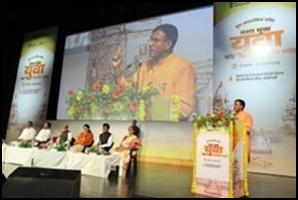
The Youth Spiritual Summit and resulting Kashi Declaration emphasises on mental health, wellness, and drug-free living as integral to holistic youth development.
In July 2025, the Rudraksh International Convention Centre in Varanasi hosted the Youth Spiritual Summit with the theme “Nasha Mukt Yuva for Viksit Bharat”. The Kashi Declaration, a groundbreaking plan to spearhead a national youth-led campaign against drug addiction, was formally adopted. The summit, which was organised by the Ministry of Youth Affairs and Sports, included academicians, specialists, and government authorities in addition to more than 600 youth leaders from more than 120 spiritual and sociocultural organisations. By bringing together spiritual strength and youthful will, the event marked a turning point in India's quest to eradicate drugs by 2047.
The Kashi Declaration outlines a five-year roadmap for drug-free youth action, with clearly defined targets, timelines, and roles for every stakeholder, from local governments and educational institutions to spiritual bodies and civil society.
This youth-led movement is a part of the Ministry’s wider framework under MY Bharat to bring about transformative social change via civic participation and youth leadership.
Rashtriya Kishore Swasthya Karyakram (RKSK)
The Rashtriya Kishor Swasthya Karyakram (RKSK) was launched on 7 January 2014 by the Ministry of Health & Family Welfare to address the holistic health needs of adolescents aged 10–19 years across India, encompassing both rural and urban populations, in-school and out-of-school youth, married and unmarried, with special attention to marginalised groups.
RKSK extends beyond traditional sexual and reproductive health to encompass six thematic domains crucial for adolescent well-being:
- Nutrition (including reduction of malnutrition and anaemia)
- Sexual & Reproductive Health (SRH)
- Mental Health
- Injuries & Violence (including gender-based violence)
- Substance Misuse
- Non-Communicable Diseases (NCDs)
The program is grounded in a health-promotion and prevention-based model, shifting from facility-only care to involving adolescents in their comfort environments such as schools, communities, and families.
Conclusion
As India commemorates National Youth Day 2026, the message is clear: the nation’s future is being shaped not only by policy, but by the energy, innovation, and commitment of its youth. From classrooms and campuses to startups, villages, armed forces, and volunteer networks, young Indians are actively participating in the story of national transformation.
Through platforms like MY Bharat, service-driven movements such as NSS, large-scale skilling initiatives, and targeted entrepreneurship support, the Government of India is fostering an environment where youth are empowered to lead with purpose and responsibility. Equal emphasis on mental health, physical fitness, and social well-being ensures that this journey is both sustainable and inclusive.
Inspired by the ideals of Swami Vivekananda, National Youth Day serves as a reminder that nation-building begins with character, confidence, and collective action. As India advances towards 2047, its youth stand not merely as inheritors of the future—but as its architects.
References
https://www.niti.gov.in/sites/default/files/2025-04/Working%20Paper%20on%20Strategic%20Imperatives_04042025_NEW.pdf
https://www.pib.gov.in/Pressreleaseshare.aspx?PRID=1795442
https://www.pib.gov.in/PressReleasePage.aspx?PRID=2140894
https://nss.gov.in/about-us-
https://www.pib.gov.in/PressNoteDetails.aspx?NoteId=154537&ModuleId=3
https://www.pib.gov.in/PressNoteDetails.aspx?NoteId=154880&ModuleId=3
https://www.pib.gov.in/PressNoteDetails.aspx?NoteId=154880&ModuleId=3
https://www.msde.gov.in/offerings/schemes-and-services/details/jan-shikshan-sansthan-jss-cjM4ATMtQWa
https://yas.gov.in/sites/default/files/Draft%20NYP-2025.pdf
https://www.pib.gov.in/PressReleasePage.aspx?PRID=2184456®=3&lang=2
https://www.pib.gov.in/PressReleasePage.aspx?PRID=2197018®=3&lang=1
https://www.pib.gov.in/PressReleasePage.aspx?PRID=2200500®=3&lang=1
https://www.pib.gov.in/PressReleasePage.aspx?PRID=2212609®=3&lang=1
https://www.pib.gov.in/PressReleasePage.aspx?PRID=2174394&utm_source=chatgpt.com®=3&lang=2
https://www.pib.gov.in/PressReleasePage.aspx?PRID=2200373®=3&lang=1
https://www.pib.gov.in/PressReleaseIframePage.aspx?PRID=2100845®=3&lang=2#:~:text=The%20Union%20Cabinet%20has%20approved%20the%20continuation,(PM%2DNAPS)%20*%20Jan%20Shikshan%20Sansthan%20(JSS)%20Scheme
https://www.mygov.in/campaigns/fit-india/
Click here to see in pdf
PIB Research
(Release ID: 2213415)
Visitor Counter : 7865