Ministry of Culture
Preserving Villages is a Great Cultural Awakening – Dr. Sachchidanand Joshi
NMCM's Foundation Day Celebrated Grandly on the Auspicious Occasion of Makar Sankranti
Posted On:
15 JAN 2026 8:30PM by PIB Delhi
On the auspicious occasion of Makar Sankranti, when the God Sun enters the Capricorn constellation from Sagittarius, and the entire country celebrates this festival with enthusiasm in various forms such as Makar Sankranti, Uttarayan, Bihu, Pongal, and Khichdi, the National Cultural Mapping Mission (NMCM) division of the Indira Gandhi National Centre for the Arts (IGNCA) celebrated its Foundation Day with a dignified and culturally rich program. The event was held on January 14, 2026, at the Samvet Auditorium of IGNCA, New Delhi.
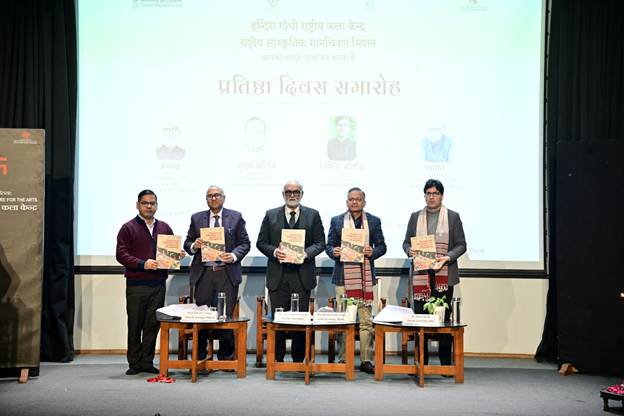
The chief guest at the event was Mr. Rajesh Kumar Singh, Joint Secretary, Ministry of Panchayati Raj, GoI, while the guest of honor was Dr. Shah Faisal, Deputy Secretary, Ministry of Culture, GoI. The program was presided over by Dr. Sachchidanand Joshi, Member Secretary of IGNCA, and the welcome address was delivered by Prof. (Dr.) R. C. Gaur, Head of the kala Nidhi Division and In-Charge of NMCM. Dr. Mayank Shekhar, Director of NMCM, was also present on the occasion.
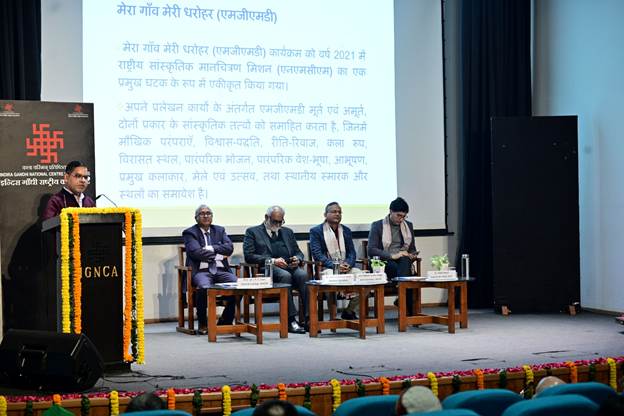
In his presidential address, Dr. Sachchidanand Joshi said that the Makar Sankranti festival is celebrated throughout the country, under different names. It's called Bihu in some places, Pongal in others, Sankranti in some, and Uttarayan elsewhere. Despite being celebrated in different ways, the entire country observes this festival at the same time. He suggested that the traditions of celebrating this festival in different states and regions, including the food, clothing, rituals, and customs, could be documented. He urged the National Mission for Cultural Mapping division to come with a publication on how Makar Sankranti is celebrated across India when they hold their annual day next year.
He spoke about the challenges and achievements of NMCM, saying, "When this task was initially assigned to us, it was a huge challenge in itself. Documenting 650,000 villages is no easy feat. But the way NMCM started its work, the hard work put in by everyone here, and the cooperation received from various agencies, has resulted in us having documented 623,000 villages today." He added that amidst increasing urbanization, we often think fondly of our villages, where our traditions and cultural heritage still exist. If we preserve these villages, we will undoubtedly be contributing to a significant cultural awakening in these times.
Chief Guest Mr. Rajesh Singh said that the cultural mapping of villages is a very ambitious project of the government and is also very necessary. He said that for someone who wants to see a village and understand its heritage, there could be no greater convenience than having authentic information available in one place. Only when we know about our heritage can we discuss it and take pride in it. He said that the Constitution specifies 29 functions for Panchayats, and cultural activities are one of them. This aspect had been overlooked until now. Keeping this in mind, the Ministry of Panchayati Raj launched the 'Panchayat Heritage' program.
The guest of honour, Shah Faisal, emphasized that the essence of Indian culture has been passed down through generations not through written codes, but through the oral tradition and historical narratives. Therefore, documenting this vibrant culture presents several challenges. In other civilizations, such as some in the Middle East or Europe, written texts have held paramount importance, limiting the possibilities for change. In contrast, Indian culture has remained flexible and continuously evolving. He stated that if there are errors in the documentation, incomplete information, or lapses in authentication, it ceases to be merely a technical error and becomes an injustice to the country's cultural heritage. Therefore, authenticity and integrity are the greatest responsibilities in this entire exercise.
Welcoming the guests, Prof. Ramesh Gaur said that India is a land of festivals. When the sun moves northwards (Uttarayana), festivals like Makar Sankranti, Bihu, and Pongal are celebrated across the country. The National Mission on Cultural Mapping (NMCM) was also launched on Makar Sankranti in 2021. The Ministry of Culture, Government of India, entrusted the Indira Gandhi National Centre for the Arts (IGNCA) with the responsibility of the NMCM as the nodal agency. Dr. Mayank Shekhar then presented the department's annual report and highlighted its achievements. He also shared several important details about the 'Mera Gaon Meri Dharohar' (My Village, My Heritage) portal.
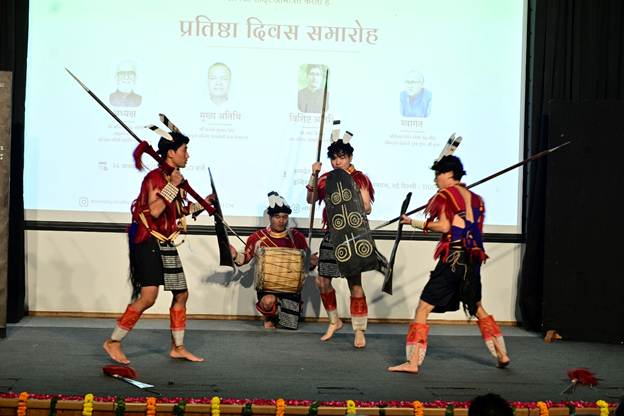
The program began with a powerful performance of 'Panchavadyam', a traditional South Indian instrumental music, which created an auspicious atmosphere. Following this, the NMCM brochure and the second issue of its bi-annual publication, 'Maati', were released, which was described as a significant initiative in the field of cultural research and public relations. Among the cultural performances, a captivating presentation of traditional dance and music by the Ao Naga tribe introduced the audience to the rich cultural heritage of Northeast India. This was followed by a performance by Pragya Arts and a musical program by Mr. Nitish Kumar, which further enlivened the ceremony.
In the concluding session of the program, prizes were awarded to the winners of the rangoli competition, and all the artists were felicitated. The formal program concluded with a vote of thanks. After the program, all the guests and visitors enjoyed the special Makar Sankranti meal of flattened rice and yogurt (chura-dahi).
This foundation day of NMCM was not only connected to the cultural spirit of Makar Sankranti but also conveyed a strong message of national cultural unity by bringing together India's diverse folk, tribal, and classical traditions on a single platform.
****
Sunil Kumar Tiwari
pibculture[at]gmail[dot]com
(Release ID: 2215092)
Visitor Counter : 967