Ministry of Electronics & IT
India in first bouquet of AI Nations, focused on diffusion and ROI: Minister Ashwini Vaishnaw at WEF
AI power comes from economics and deployment, not model size, says the Minister at Davos
Government enables affordable AI Compute through 38,000 GPUs, says Ashwini Vaishnaw
India adopts techno-legal approach to AI governance, focus on bias and deepfake detection
AI diffusion across economy central to India’s strategy
Posted On:
21 JAN 2026 4:05PM by PIB Delhi
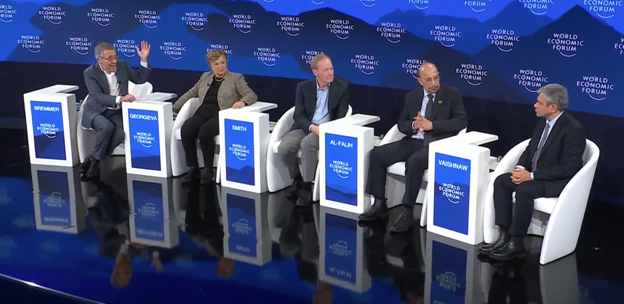
Union Minister for Electronics and Information Technology Shri Ashwini Vaishnaw outlined India’s approach to Artificial Intelligence, emphasising large-scale AI diffusion, economic viability, and techno-legal governance, during a panel discussion titled “AI Power Play, No Referees” at the World Economic Forum (WEF), Davos on 20 January 2026.
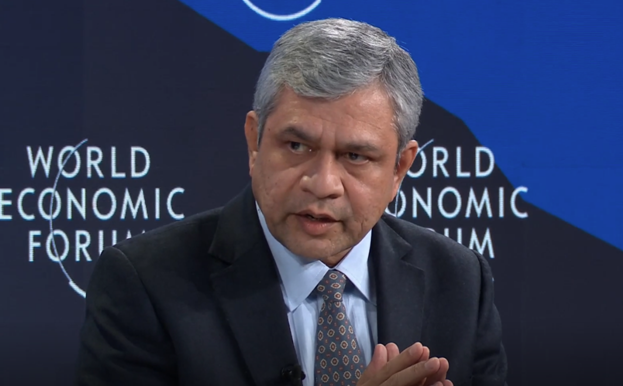
Addressing a question on global AI alignments and geopolitics, the Minister stated that India clearly belongs in the first group of AI nations. He noted that AI architecture comprises five layers — application, model, chip, infrastructure, and energy; and India is actively working across all five. “At the application layer, India will probably be the biggest supplier of services to the world,” he said, adding that return on investment (ROI) in AI comes from enterprise-level deployment and productivity gains, not from creating very large models alone. He observed that nearly 95 per cent of AI use cases can be addressed with models in the 20–50 billion parameter range, many of which India already has and is deploying across sectors.
Speaking on AI’s role in geopolitics, Shri Vaishnaw cautioned against equating geopolitical power with ownership of very large AI models. He noted that such models can be switched off and may even create economic stress for their developers. “The economics of what I call the fifth industrial revolution will come from ROI — deploying the lowest cost solution to get the highest possible return,” he said. He highlighted that effective AI deployment increasingly relies on CPUs, smaller models and emerging custom silicon, reducing dependency on any single country and challenging the notion of AI dominance through scale alone.
Drawing parallels with India’s digital public infrastructure success, the Minister said the Government is pursuing AI diffusion across every sphere of life and the economy in a systematic manner. Identifying availability of GPUs as a major constraint, he said India has adopted a public-private partnership model, empanelling around 38,000 GPUs as a common national compute facility. This facility is government-enabled and subsidised, providing affordable access to students, researchers, startups and innovators at nearly one-third the global cost. He further outlined four pillars of India’s AI strategy:
- A common compute facility through public-private partnership
· A free bouquet of AI models meeting most practical needs
· Large-scale skilling, with programmes underway to train 10 million people in AI
- Enabling India’s IT industry to pivot towards AI-driven productivity and efficiency for domestic and global enterprises
On regulation and governance, Shri Vaishnaw underscored the importance of a techno-legal approach to AI regulation. He said regulation cannot rely solely on laws but must be supported by technical tools that mitigate harms such as bias and deepfakes. “For example, deepfake detection systems must have accuracy that can stand scrutiny in courts,” he said, adding that India is developing technologies to detect deepfakes, mitigate bias, and ensure proper unlearning of models before enterprise deployment.
The Panel Discussion was moderated by Ian Bremmer (President and Founder, Eurasia Group) and other panelists included Brad Smith (Vice-Chair and President, Microsoft), Kristalina Georgieva (Managing Director, IMF) and Khalid Al-Falih (Minister of Investment, Saudi Arabia).
***
MSZ
(Release ID: 2216895)
Visitor Counter : 2367