Posted On:
21 JAN 2026 8:12PM by PIB Delhi
Union Minister for New and Renewable Energy Shri Pralhad Joshi held a series of high-level engagements at the World Economic Forum Annual Meeting 2026 in Davos today, underscoring India’s leadership in driving a just, affordable and inclusive global energy transition.
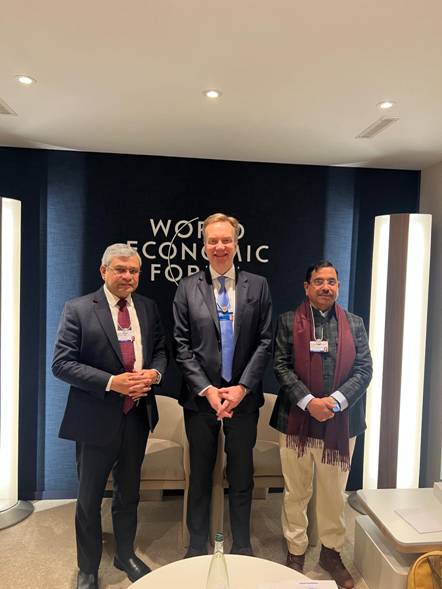
Shri Pralhad Joshi held a constructive discussion with Børge Brende, President and CEO, World Economic Forum along with Union Minister of Railways, Electronics & IT and Information & Broadcasting Shri Ashwini Vaishnaw. The discussions focused on the importance of global cooperation in addressing shared economic and developmental challenges, the role of multilateral platforms such as the World Economic Forum in building global consensus, and the need for sustained dialogue between governments, industry and stakeholders to advance sustainable, resilient and inclusive growth, including across energy and development sectors.
India’s Decentralised Renewable Energy Experience Shared with Global South
During a roundtable discussion at the World Economic Forum, Shri Pralhad Joshi shared India’s experience in rapidly scaling rooftop, agricultural and decentralised renewable energy solutions, particularly relevant for the Global South. The roundtable was attended by Devendra Fadnavis, Chief Minister of Maharashtra, and Amon Murwira, Minister of Foreign Affairs and International Trade, Republic of Zimbabwe.
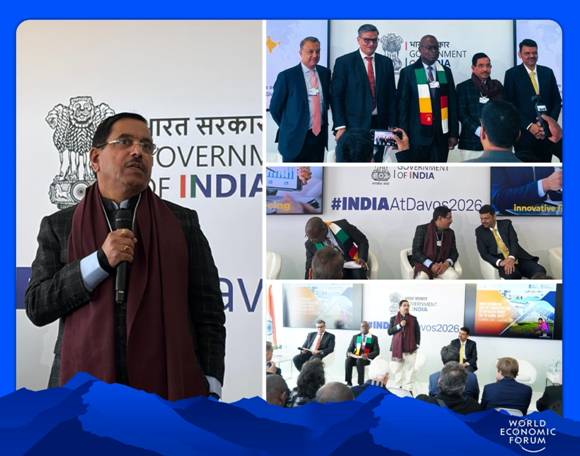
The Union Minister highlighted that, guided by the vision of Prime Minister Shri Narendra Modi, India’s clean energy transition demonstrates that rapid growth, affordability and sustainability can progress together. He elaborated on flagship initiatives such as PM Surya Ghar Muft Bijli Yojana for rooftop solar adoption and PM-KUSUM for solar-powered agriculture, which are expanding clean energy access for households and farmers and reducing costs.
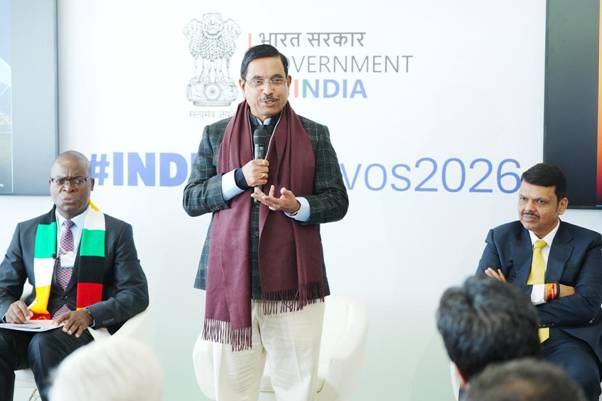
Shri Joshi also underlined the role of decentralised renewable energy systems and mini-grids in improving reliability and resilience in remote and weak-grid regions.
Chief Minister of Maharashtra Shri Devendra Fadnavis lauded the clean energy initiatives being undertaken under the leadership of Hon’ble Prime Minister Shri Narendra Modi and highlighted the rapid strides and achievements in the renewable energy sector under the guidance of the Union Minister for New and Renewable Energy Shri Pralhad Joshi.
Reaffirming India’s commitment to inclusive energy transitions and deeper South–South cooperation, the Union Minister emphasised that India will continue sharing practical, scalable solutions through platforms such as the International Solar Alliance, as the global community works collectively towards a resilient and climate-secure future.
India’s States as Engines of Energy Transition
Addressing a session on ‘De-Risking the Green Leap: Subnational Blueprints for Utility-Scale Energy Transition Session‘ along with Chief Minister of Madhya Pradesh Shri Mohan Yadav, Union Minister Joshi stated that India today stands in the global spotlight for driving the global renewable energy transition. He added that India’s energy transition is being advanced not only at the national level but also through strong, reform-oriented States translating policy into tangible outcomes.
He highlighted Madhya Pradesh as a leading example in terms of scale, speed and system, noting that the State has demonstrated strong execution capabilities, among the lowest costs for solar power and battery storage in the country, and globally competitive green hydrogen prices.
The Union Minister emphasised that the key challenge in the global energy transition today is not ambition or capital, but effective execution, and said that India’s State-led renewable energy success stories offer valuable lessons for the world.
Clean Energy Collaboration
On the sidelines of WEF 2026, Shri Pralhad Joshi held a constructive meeting with Guillaume Vermersch, Group Chief Financial Officer of Mercuria Group. The discussions focused on advancing collaboration aligned with India’s clean energy and energy transition priorities, including scaling renewable energy through market-based mechanisms, strengthening carbon markets and climate finance, and advancing green hydrogen, biofuels and energy storage. The Union Minister welcomed Mercuria Group’s commitment to invest nearly 50 per cent in green energy and its interest in India’s expanding clean energy ecosystem.
Clean Energy Transition Driving Growth and Competitiveness
On 20th January, Union Minister for New and Renewable Energy Shri Pralhad Joshi presented the Country Strategy Dialogue on India at the Congress Centre during the World Economic Forum Annual Meeting 2026 in Davos, in the presence of Union Minister for Railways, Information & Broadcasting, and Electronics & Information Technology Shri Ashwini Vaishnaw and Union Minister for Civil Aviation Shri Ram Mohan Naidu Kinjarapu.
Emphasising India’s scale and speed of execution, he noted that solar tariffs have declined by nearly 80 per cent, renewable energy coupled with storage has become cost-competitive, green hydrogen and green ammonia prices discovered in India are among the most competitive globally, and domestic renewable energy manufacturing capacity has expanded to 144 GW, positioning India not only as a major clean energy market but also as a reliable global manufacturing and investment hub on the path towards Viksit Bharat 2047.
India Reaffirms Commitment to Global Mission on AI for Energy
Shri Pralhad Joshi also delivered the keynote address at the session titled “Call to Action: Spotlight on the Global Mission on AI for Energy” at the World Economic Forum Annual Meeting 2026 in Davos, highlighting India’s energy transition journey and its relevance for the global community, particularly the Global South.
Shri Joshi highlighted the transformative potential of Artificial Intelligence in the energy sector, noting that AI can improve forecasting, reduce losses, lower costs and strengthen grid reliability. He also shared India’s shift from pilot-based interventions to platform-based deployment through Digital Public Infrastructure for Energy, enabling large-scale and systemic adoption of AI-driven solutions.
***
Navin Sreejith