PIB Backgrounder
Celebrating National Girl Child Day
Progress, Initiatives, and Achievements in Girl Empowerment
Posted On:
23 JAN 2026 1:56PM by PIB Delhi
Key Takeaways
- National Girl Child Day, observed annually on January 24 since 2008, promotes awareness of girls’ rights, empowerment, and equal opportunities in India.
- 97.5 per cent of schools nationwide are equipped with girls’ toilet facilities
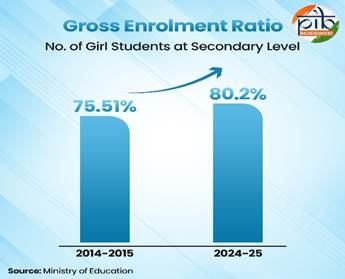
- For the period 2024-2025, the Gross Enrolment Ratio (GER) of girls at the secondary level has reached 80.2%, as per UDISE report.
- In the Union Budget 2025-26, Mission Shakti, received an allocation of Rs. 3,150 crores.
- As of January 2026, a total of 2,153 child marriages have been prevented, and 60,262 Child Marriage Prohibition Officers have been appointed across the country.
Introduction
National Girl Child Day is celebrated annually in India on January 24, dedicated to highlighting the rights, education, health, nutrition, and overall welfare of girls.
Initiated in 2008 by the Ministry of Women and Child Development (MWCD), the day serves as a platform to raise awareness about gender discrimination, promote equal opportunities, and foster an environment where girls can thrive as empowered citizens. It underscores the critical role of girls in shaping a brighter, more equitable future for the nation. This, in turn, aligns effectively with India's vision of women-led development and Viksit Bharat by 2047.
Advocating for Empowerment of Girls
National Girl Child Day provides an opportunity to address persistent inequalities faced by girls, including gender biases, female foeticide, challenges related to the child sex ratio, child marriage, and barriers to education and health. Furthermore, it emphasises changing societal attitudes to value and respect girls as equals, thereby promoting their holistic development.
Key focus areas include advancing girls' education, skill development, digital inclusion, participation in STEM fields, mental health support, safety from violence, and opportunities for leadership roles. Significant progress has been made through sustained efforts, particularly under the Beti Bachao Beti Padhao (BBBP) scheme, with the Sex Ratio at Birth (SRB) rising from around 918 in 2014-15 to 930 in 2023-24 at the national level.
In addition to this, the Gross Enrolment Ratio (GER) for girls at the secondary level (Classes 9-10) in India has shown improvement, rising from 75.51% in 2014-15 to 78.0% in 2023-24. Furthermore, the Gross Enrolment Ratio (GER) for girls at the secondary level reached 80.2 per cent in 2024–25.
This upward trend reflects higher female participation and the impact of initiatives like Beti Bachao Beti Padhao and Samagra Shiksha. This underscores ongoing efforts to enhance girls' access to secondary education amid broader challenges in retention and transition.
Key Government Initiatives and Achievements
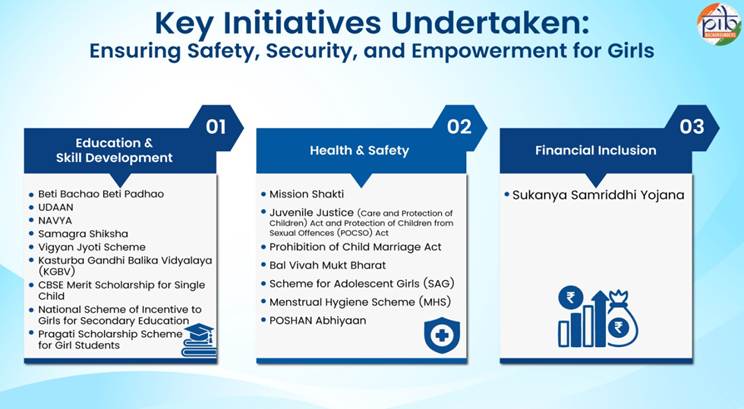
The Government of India has implemented a range of targeted schemes to protect, educate, and empower the girl child, many integrated under the umbrella Mission Shakti, which combines safety, security, and empowerment interventions.
Mission Shakti
Mission Shakti was launched by the Ministry of Women and Child Development in 2022 (effective from April 1, 2022) as an integrated umbrella scheme for the 15th Finance Commission period (2021-26). It strengthens interventions for women's safety, security, and empowerment through two key sub-schemes:
- Sambal (focused on safety and security, incorporating One Stop Centres, Women Helpline, Beti Bachao Beti Padhao, and Nari Adalats)
- Samarthya (focused on empowerment, including Pradhan Mantri Matru Vandana Yojana, Palna, Shakti Sadan, Sakhi Niwas, and SANKALP hubs).
This mission promotes convergence across government departments, citizen participation, and life-cycle support to enable women and girls to thrive as equal partners in nation-building. In the Union Budget 2025-26, Mission Shakti, received an allocation of Rs. 3,150 crores.
Complementing these efforts are strong legal frameworks designed to protect children and prevent gender-based violence.
Faciliating Empowerment through Education and Skill Development
Recognising education as the cornerstone of gender equity and long-term empowerment, several flagship programmes have been designed to address enrolment gaps, enhance learning outcomes, and open pathways to STEM and professional fields for girls.
Progress in School Education for the Girl Child:
- The total number of girl students enrolled from the foundational to secondary stages stood at 11,93,34,162 during 2024–25.
- A total of 14,21,205 schools reported the availability of girls’ toilets, of which 13,72,881 are functional.
Samagra Shiksha
This integrated scheme for school education (from pre-school to Class XII), launched in 2018 by the Ministry of Education, subsumes earlier programs like Sarva Shiksha Abhiyan and Rashtriya Madhyamik Shiksha Abhiyan. It aligns with the National Education Policy (NEP) 2020 and focuses on bridging gender and social category gaps through targeted interventions such as separate toilets for girls, stipend for children with special needs (CWSN), gender-sensitive teaching materials, and teacher sensitisation programs. Samagra Shiksha emphasizes inclusive quality education, foundational literacy/numeracy, and vocational exposure, ensuring equitable access for girls from disadvantaged sections.
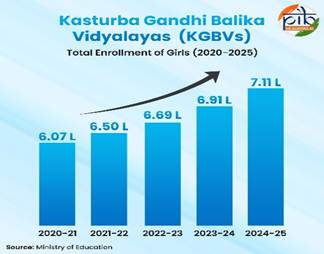
Kasturba Gandhi Balika Vidyalaya (KGBV)
KGBVs provide residential schooling facilities for girls aged 10–18 from marginalised communities (SC/ST/OBC/minority/BPL families), covering Classes VI to XII in educationally backward blocks. Upgraded under Samagra Shiksha, KGBVs ensure smooth transition from elementary to higher secondary levels.
Beti Bachao Beti Padhao (BBBP)
Launched in 2015 in Haryana, this flagship scheme has marked over a decade of impact (celebrating its 10th anniversary in 2025 with nationwide events). Now integrated into Mission Shakti's Sambal sub-scheme and expanded across all districts, BBBP focuses on preventing gender-biased sex selection, ensuring survival and protection, and promoting education. It has driven improvements in Sex Ratio at Birth (SRB), increased girls' enrolment in secondary education[5], enhanced healthcare access, and fostered community-level behavioural change through multi-sectoral campaigns and collaborations with NGOs and media.
UDAAN
UDAAN is an innovative initiative launched in 2014 by the Central Board of Secondary Education (CBSE), under the guidance of the Ministry of Education. The project specifically targets the low enrolment of girl students in premier engineering colleges. It does so by bridging the gap between school-level learning and the demands of engineering entrance examinations (such as JEE).
It provides free online resources, including study materials, video tutorials, virtual classes, and weekend contact sessions. The flagship initiative aims to empower Class XI and XII girl students, particularly from economically disadvantaged backgrounds to prepare effectively and increase their participation in STEM higher education.
This scheme aligns with broader national goals of promoting gender equity in technical education and supports the vision of inclusive access to quality, higher education for girls.
Nurturing Aspirations through Vocational Training for Young Adolescent Girls (NAVYA)
Launched on June 24, 2025, in Sonbhadra, Uttar Pradesh, NAVYA is a joint pilot initiative of the Ministry of Women and Child Development (MWCD) and the Ministry of Skill Development and Entrepreneurship (MSDE). It targets adolescent girls aged 16–18 years (with at least Class 10 qualification) in 27 Aspirational and North-Eastern districts across 19 states, with an initial training goal of 3,850 girls under Pradhan Mantri Kaushal Vikas Yojana 4.0 (PMKVY 4.0). The programme focuses on equipping participants with vocational skills in non-traditional and emerging sectors. Aligned with the vision of Viksit Bharat@2047, NAVYA promotes socio-economic independence, breaks gender stereotypes in the workforce, and empowers girls as agents of inclusive development, especially in underserved and tribal regions. The initiative covers 27 districts across 19 States, targets training 3,850 adolescent girls under PMKVY 4.0 in non-traditional and futuristic sectors like digital marketing, cybersecurity, AI-enabled services, and green jobs[6].
Vigyan Jyoti Scheme
Implemented by the Department of Science & Technology (DST), Vigyan Jyoti scheme encourages meritorious girls from Classes IX–XII (especially rural areas) to pursue STEM fields. Activities include counselling, lab visits, workshops, role model interactions, science camps, and academic support. Since its launch, the Vigyan Jyoti programme has supported more than 80,000 meritorious girls from 300 districts spanning 35 States and Union Territories[7].
Scholarships for Girl Child
The Government of India has implemented several targeted scholarship schemes to promote girls' education, reduce dropout rates, and support meritorious female students across secondary, higher, and technical education levels.
Enrolment of Females in STEM Subjects
To boost female enrolment in Science, Technology, Engineering and Mathematics (STEM), supernumerary seats have been introduced for women in IITs and NITs. This model has improved gender diversity across other higher education institutions nationwide.
UGC NET-Junior Research Fellowship
The fellowships are provided to pursue Ph.D. in all disciplines, including STEM education. During FY 2023-24, out of total 12323 scholars in STEM subjects, 6435 are women which is more than 50%.
During 2024 -25, out of a total of 13727 scholars in STEM subjects, 7293 are women, which is more than 53% of the total fellows.
National Scholarship for Post Graduate Studies
The Central Sector Scheme of Scholarship for College and University Students was implemented on the National Scholarship Portal (NSP) in 2023-24. It supports postgraduate students pursuing regular, full-time programs by merging four existing schemes: P.G. Scholarship for University Rank Holders; P.G. Scholarship for GATE/GPAT qualified students for M.Tech/M.E./M.Pharm; P.G. Scholarship for Professional Courses for SC/ST candidates; and P.G. Indira Gandhi Scholarship for Single Girl Child. A merit list is prepared for 10,000 slots, with 30% reserved for women (3,000 selected), adhering to Government of India reservation norms. Slots are equally divided between STEM subjects (50%) and Humanities (50%), and scholars receive Rs. 1,50,000 annually for the program's duration. Rs. 1,50,000/- per year is awarded to students for the duration of programme.
According to the AISHE report, female postgraduate enrolment has grown substantially from 2014-15 to 2022-23. It increased from 19,86,296 to 32,02,950, reflecting an absolute rise of 12,16,654 students and a 61.3% growth rate.
Enrolment of females in Ph.D. Degree
As per the AISHE Report, between 2014-15 to 2022-23, Ph.D. enrolment among females has shown remarkable growth. Female Ph.D. enrolment increased from 47,717 in 2014-15 to 1,12,441 in 2022-23, registering an absolute rise of 64,724 candidates and a growth of about 135.6%.
AICTE PRAGATI Scholarship Scheme
The AICTE PRAGATI Scholarship Scheme, launched in 2014–15, aims to empower meritorious girl students to pursue higher education, offering 10,000 scholarships annually—5,000 each for Diploma and Degree courses. It covers 23 States/UTs and all eligible girls from the remaining 13 regions, including the Northeast and J&K. In 2024–25, 35,998 female students benefited from the scheme, highlighting its wide reach and impact.
Gender Equality Improving in Indian HEIs
Between 2014-15 and 2022-23 (Provisional), there has been significant growth in Higher Educational Institutions (HEIs) in India. The number of HEIs registered in the All-India Survey on Higher Education (AISHE) increased from 51,534 in 2014-15 to 60,380 in 2022-23. During the same period, student enrolment in higher education also witnessed substantial growth, rising from 3.42 crore in 2014-15 to 4.46 crore in 2022-23. Notably, female enrolment experienced a remarkable increase, reaching 2.18 crore in 2022-23 compared to 1.57 crore in 2014-15, which represents a 38% rise. The Female Gross Enrolment Ratio (GER) also improved, going up from 22.9 in 2014-15 to 30.2 in 2022-23(Provisional), reflecting steady progress towards gender parity in higher education. Additionally, India has achieved one of the highest rates of female participation in STEM education globally, with women comprising 43% of total enrolments in STEM disciplines.
As a result of the various initiatives and schemes put in place by the Department of Higher Education, Female enrolment in IITs and NITs has more than doubled—from under 10 percent to over 20 percent—thanks to the introduction of supernumerary seats. The number of Higher Educational Institutions (HEIs) rose from 51,534 in 2014–15 to 60,380 in 2022–23 (Provisional), with total student enrolment increasing to 4.46 crore, including a 38 percent rise in female enrolment to 2.18 crore. Female Gross Enrolment Ratio (FGER) improved to 30.2 in 2022–23(Provisional), up from 22.9 in 2014–15, reflecting progress in gender parity. Women now make up 43 percent of STEM enrolments—among the highest globally. Infrastructure has also improved, with girls' toilets in schools rising to 97.5 percent. Initiatives like IIT-Madras’s Vidya Shakti Scheme further support rural and female students in STEM education.
Ensuring Safety and Health for Every Daughter
The Government prioritises a secure and nurturing environment for every girl through comprehensive laws against abuse and child marriage. Central interventions in this domain encompass:
Juvenile Justice (Care and Protection of Children) Act and Protection of Children from Sexual Offences (POCSO) Act
The Juvenile Justice (Care and Protection of Children) Act, 2015 and the Protection of Children from Sexual Offences (POCSO) Act, 2012 offer comprehensive safeguards for children. POCSO is a gender-neutral law that defines a child as anyone under 18 and criminalises sexual assault, harassment, and child pornography. It incorporates child-friendly procedures, mandatory reporting requirements, and the establishment of special courts to ensure speedy trials.
Prohibition of Child Marriage Act
The Prohibition of Child Marriage Act, 2006 replaced the earlier Child Marriage Restraint Act, 1929 (Sarda Act). It shifts the focus from merely restraining child marriages to legally prohibiting them, while providing enhanced protection and relief for the affected. The Act provides the legal backbone to empower girls, ensuring their right to education and health, countering the severe risks of early marriage like interrupted schooling, health complications, and limited opportunities. Under the Act, child marriages remain voidable at the option of the party who was a child at the time of the marriage. The affected individual (or their guardian/next friend) can petition a district court to annul the marriage by a decree of nullity, typically within two years of attaining majority.
Bal Vivah Mukt Bharat
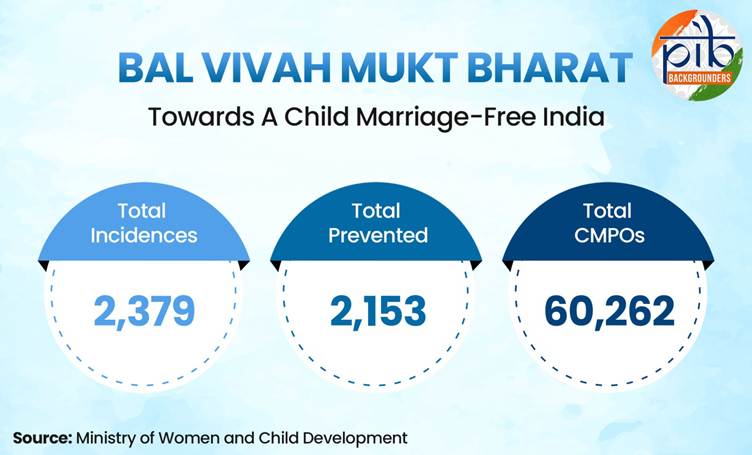
Building on the Prohibition of Child Marriage Act, the Government of India launched the Bal Vivah Mukt Bharat (Child Marriage-Free India) campaign in November 2024, under the Ministry of Women and Child Development. This nationwide initiative aims to eradicate child marriages through intensive awareness, enforcement, community mobilisation, and multi-sectoral collaboration. It aligns closely with Sustainable Development Goal (SDG) 5.3, which targets the elimination of all harmful practices—including child, early, and forced marriages—by 2030. The campaign includes features like a dedicated portal for reporting and awareness, district-level monitoring, awards for high-performing areas, and a 100-day intensive phase (launched in December 2025), to accelerate progress toward reducing prevalence by 10% by 2026 and achieving a child marriage-free India by 2030.
Scheme for Adolescent Girls (SAG)
The Scheme for Adolescent Girls targets girls aged 14-18 years in Aspirational Districts nationwide and all districts of North Eastern States.It aims to improve their health and nutritional status. There are two main components under the scheme.
The nutrition component provides supplementary food and nutrition (600 calories, 18-20g protein and micronutrients) for 300 days annually, delivered as Hot Cooked Meals and Take Home Ration incorporating local produce, fortified rice, millets, nuts, and fresh fruits/vegetables[8][9]. The non-nutrition component, through inter-ministerial convergence, includes Iron-Folic Acid (IFA) supplementation, health check-ups, nutrition & health education, skilling, and anaemia management. It also motivates adolescent girls to go back to formal schooling, provides life skills, literacy and numeracy skills, and helps them improve their decision-making capabilities.As of 31 December 2024, 24,08,074 adolescent girls are registered on the Poshan Tracker app.
Menstrual Hygiene Scheme (MHS)
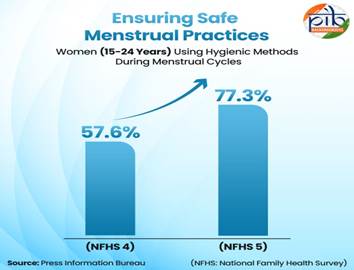
The Ministry of Health and Family Welfare launched a scheme to promote menstrual hygiene among rural adolescent girls aged 10-19 years.
The scheme aims to build awareness about safe and hygienic menstrual practices among adolescent girls.
It seeks to improve access to affordable, high-quality sanitary napkins in rural areas.
Environment-friendly and safe disposal of sanitary napkins is also a key focus of this scheme.
Launched in 2011 across 107 selected districts, the scheme provided subsidised napkins under the brand “Freedays.”From 2014 onwards, states procure napkins under the National Health Mission, with ASHAs managing distribution and awareness activities. As on November 2025, the collective sales of Suvidha Napkins is 96.30 Crores. ASHA workers distribute subsidised sanitary napkin packs and conduct monthly health awareness meetings.While the Pradhan Mantri Bharatiya Janaushadhi Pariyojana (PMBJP) provides Jan Aushadhi Suvidha sanitary pads at Re. 1 per pad to ensure affordable menstrual hygiene access.
POSHAN Abhiyaan
Launched on 8thMarch 2018 in Jhunjhunu, Rajasthan, the Abhiyaan aims to improve the nutritional status of adolescent girls, pregnant women, lactating mothers, and children aged 0-6 years. Through technology-driven monitoring, inter-sectoral convergence, and community participation, the programme aims to reduce stunting, wasting, and underweight issues in children primarily. This adopts a holistic approach in addressing malnutrition.
Mission Vatsalya
Mission Vatsalya is a Centrally Sponsored Scheme which aims to foster a sensitive, supportive, and synchronized ecosystem for children in difficult circumstances as they transit different ages and stages of their development. The Scheme provides financial support to state Government/UT Administrations, for delivering of institutional care and non-institutional care services to the such children as defined under the Juvenile Justice (Care and Protection of Children) Act, 2015 (as amended in 2021) and Rules thereof.
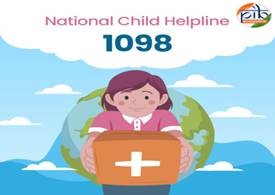
Complementing these efforts, an emergency outreach helpline for children as mandated under the JJ Act, 2015 is run in coordination with States/UTs under the scheme with integration with 112 Helpline of MHA. State WCD Control Rooms have been set up in all States/UTs and 728 District Child Help Line Units have been connected.(as on 21.01.2026).
Further, the Mission Vatsalya Portal - a unified digital platform has being developed that integrates earlier child protection systems like ‘Track Child’ and ‘Khoya-Paya’, making services for missing, orphaned, abandoned, and surrendered children more accessible and transparent. By providing a single workspace for stakeholders such as CWC, JJB, and CCI, it reduces duplication of work, strengthens monitoring through MIS dashboards.
Fostering Financial Inclusion
In order to promote long-term economic security and independence for girls, the Government of India has introduced dedicated savings and investment schemes that encourage families to plan for their daughters’ education, marriage, and future needs.
Sukanya Samriddhi Yojana (SSY)
Launched in 2015 by Prime Minister Narendra Modi, as a part of the Beti Bachao Beti Padhao scheme, this flagship offers financial security and savings for girls' future education and marriage. By November 2024, more than 4.2 crore accounts had been opened nationwide, indicating strong public participation and confidence in the scheme. Marking its 11-year milestone this month, SSY continues to encourage families to invest in their daughters’ futures—fostering financial inclusion, gender equity, and long-term social progress.
Conclusion
National Girl Child Day 2026 serves as areminder of the importance of empowering girls and fostering an environment of equality and opportunity. Through different initiatives, supported by community participation, NGOs, schools, and Anganwadis, measurable gains have been made in girls' survival, education, and empowerment.Through multi-sectoral awareness campaigns, policy enforcement, and community engagement, India continues to build momentum towards gender equity and societal attitudes.
With the ongoing commitment from government, civil society, and communities, India is advancing towards an equitable society where every girl child is valued, protected, and empowered to realise her full potential.
References
Press Information Bureau:
https://www.pib.gov.in/PressReleasePage.aspx?PRID=2205104®=3&lang=2
https://www.pib.gov.in/PressNoteDetails.aspx?NoteId=154585&ModuleId=3®=3&lang=1
https://www.pib.gov.in/PressReleseDetailm.aspx?PRID=2100642®=3&lang=2
https://www.pib.gov.in/PressReleasePage.aspx?PRID=1808683®=3&lang=2
https://archive.pib.gov.in/4yearsofnda/schemesSlide/Beti%20Bachao.htm?
https://www.pib.gov.in/PressReleasePage.aspx?PRID=2204133®=3&lang=1
Ministry of Health and Family Welfare:
https://sansad.in/getFile/loksabhaquestions/annex/1715/AU1348.pdf?source=pqals#:~:text=The%20aim%20is%20to%20promote,health%20services%20at%20affordable%20prices
https://nhm.gov.in/index1.php?lang=1&level=3&sublinkid=1021&lid=391#:~:text=Background,for%20her%20own%20personal%20use
Ministry of Women and Child Development:
https://sansad.in/getFile/loksabhaquestions/annex/184/AU913_GfputK.pdf?source=pqals
https://www.indiabudget.gov.in/doc/eb/sbe101.pdf
Ministry of Education:
https://www.education.gov.in/sites/upload_files/mhrd/files/statistics-new/UDISE+Report%202024-25%20-%20Existing%20Structure.pdf
https://dashboard.udiseplus.gov.in/report2025/static/media/UDISE+2024_25_Booklet_nep.ea09e672a163f92d9cfe.pdf
Click here to see in pdf
PIB Research Unit
(Release ID: 2217624)
Visitor Counter : 5891