Ministry of Finance
HEALTHY POPULATION A KEY PILLAR TO ENSURE RESILIENT FUTURE: ECONOMIC SURVEY 2025-26
INDIA ACHIEVES SUCCESSFUL REDUCTION IN MMR, U5MR, NMR SURPASSING GLOBAL REDUCTION TRENDS SINCE 1990s
THE INFANT MORTALITY RATE (IMR) DROPS BY MORE THAN 37 PER CENT OVER THE PAST DECADE
ICT INNOVATIONS SUCH AS AYUSHMAN BHARAT DIGITAL MISSION (ABDM) AND E-SANJEEVANI SUPPORT UNIVERSAL HEALTH SYSTEM REFORMS
MULTI-PRONGED STRATEGY NEEDED TO TACKLE THE PROBLEM OF OBESITY, SAYS ECONOMIC SURVEY
SURVEY STRESSES ON DIETARY AND POLICY INTERVENTIONS TO ADDRESS THE PROBLEM OF ULTRA-PROCESSED FOODS
INITIATIVES LIKE PRAGYATAH FRAMEWORK AND THE ONLINE GAMING (REGULATION) ACT, 2025 INTRODUCED TO ADDRESS DIGITAL ADDICTION AMONG CHILDREN
MENTAL HEALTH ISSUES ADDRESSED THROUGH TELE-MANAS AND THE SHUT (SERVICE FOR HEALTHY USE OF TECHNOLOGY) CLINIC AT NIMHANS, BENGALURU
SURVEY HIGHLIGHTS THE ROLE OF AI AND TECHNOLOGY DRIVEN SURVEYS TO IDENTIFY ‘HEALTH HOTSPOTS’
Posted On:
29 JAN 2026 1:48PM by PIB Delhi
The country has made significant improvements in increasing access to healthcare by providing better and more affordable facilities through public investment in health, including access to preventive and curative care, nutrition, and health insurance. Infant and maternal mortality rates have reduced, immunisation coverage has expanded, and access to primary healthcare services has improved. Initiatives like the National Health Mission, Ayushman Bharat, and various disease control programmes have contributed to these advancements.
The Economic Survey 2025-26 tabled in the Parliament today by the Union Minister for Finance and Corporate Affairs Smt. Nirmala Sitharaman, draws attention to the importance of enhancements in public health for strengthening human capital and economic productivity.
Improved Health parameters:
The Survey documented that since 1990, India has reduced its maternal mortality rate (MMR) by 86 per cent, far exceeding the global average of 48 per cent. Similarly, a 78 per cent decline in the under-five mortality rate (U5MR) was achieved, surpassing the global reduction of 61 per cent and a 70 per cent decline in the neonatal mortality rate (NMR) compared to 54 per cent globally during 1990-2023.
Notably, the infant mortality rate (IMR) marked a drop of more than 37 per cent over the past decade, declining from 40 deaths per thousand live births in 2013 to 25 in 2023. This marks improvement in the state of neonatal and maternal care, as well as overall healthcare and socioeconomic conditions.
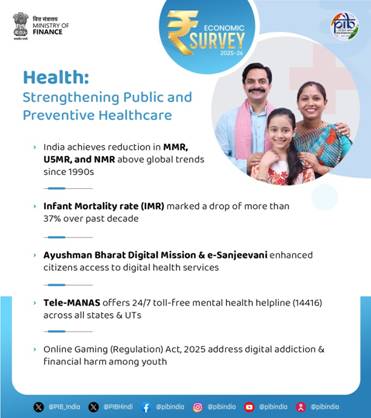
Digital technologies for better health care: The Survey points out the use of digital technologies and ICT innovations to build integrated healthcare and insurance systems that enhance transparency, minimise fragmentation, and expand access. Initiatives such as the Hospital Management Information System, Ayushman Bharat Digital Mission (ABDM), and e-Sanjeevani have enhanced citizens' access to digital health services, created digital employment opportunities, enabled evidence-based policymaking, and improved hospital management.
New age health concerns:
Obesity: Obesity is rising at an alarming rate and is today a major public health challenge in India. Driven by unhealthy diets, lifestyle changes, including sedentary lifestyles, increased consumption of ultra-processed foods (UPFs), it is affecting people across all age groups and increasing the risk of NCDs such as diabetes, heart disease, and hypertension.
The 2019-21 National Family Health Survey (NFHS) reports that 24 per cent of Indian women and 23 per cent of Indian men are overweight or obese. More troubling still, the prevalence of excess weight among children under five has risen from 2.1 per cent in 2015-16 to 3.4 per cent in 2019-21.
Recognising obesity as a critical public health concern, the government has launched interventions to a holistic approach that integrates health, nutrition, physical activity, food safety, and lifestyle modifications. Some examples include the POSHAN Abhiyaan & Poshan 2.0, Fit India Movement, Khelo India, Eat Right India, Nationwide Awareness Campaign – ‘Aaj Se Thoda Kam. Furhter, the FSSAI has launched the ‘Stop Obesity & Fight Obesity- Awareness Initiative to Stop Obesity’.
Ultra-processed foods (UPFs) are displacing long-established dietary patterns, worsening diet quality, and are associated with increased risk of multiple chronic diseases. The survey highlights how dietary reforms should be treated as a public health priority. India is one of the fastest-growing markets for UPF sales. It grew by more than 150 per cent from 2009 to 2023. This indicates the need to popularise locally grown food, traditional foods and use traditional practices like AYUSH (such as, the promotion of Yoga) for effective management.
Digital addiction: The Survey sheds light on the growing problem of digital addiction among children. Digital addiction negatively affects academic performance and workplace productivity due to distractions, ‘sleep debt’, and reduced focus. It also erodes social capital. The survey notes the measures taken by the government to address this problem. The CBSE has issued guidelines on safe internet use in schools and school buses. The Ministry of Education’s Pragyatah framework guides digital education planning with attention to screen time. At the same time, the National Commission for Protection of Child Rights has issued guidelines on screen time limits and online safety.
Mental Health crisis: Closely linked with digital addiction is the degrading mental health of the youth. There is a high prevalence of social media addiction among those aged 15-24 with multiple Indian and global studies confirming it. Social media addiction is strongly associated with anxiety, depression, low self-esteem, and cyberbullying stress. Other issues plaguing Indian youth include compulsive scrolling, social comparison and gaming disorders. These lead to sleep disruption, aggression, social withdrawal, and depression, with adolescent populations especially vulnerable.
Hence, the Survey notes, how the government has taken multiple measures towards addressing this issue. For instance, Tele-MANAS (Tele Mental Health Assistance and Networking Across States), launched by the MoHFW in October 2022, offers a 24/7 toll-free mental health helpline (14416) across all states and UTs, connecting callers to trained professionals at no cost. The Tele-MANAS app, launched in 2024, further expanded access. The service has received over 32 lakh calls since its launch, reflecting its relevance and impact. The SHUT (Service for Healthy Use of Technology) Clinic at NIMHANS, Bengaluru, provides specialised care for excessive and compulsive technology use, focusing on adolescents and young adults. It also conducts free online sessions for parents to support healthier screen-time practices. The Online Gaming (Regulation) Act, 2025, represents a major step to address digital addiction and financial harm among youth.
Recognizing the importance of data, the upcoming Second National Mental Health Survey (NMHS), led by NIMHANS and commissioned by MoHFW, is expected to generate empirical and actionable insights into the prevalence of mental health issues in the Indian context.
The Economic Survey suggests the establishment of offline youth hubs, particularly in urban slums and rural areas to provide alternatives to digital spaces. Recognising that digital access cannot be fully restricted, moderated online safe spaces hosted by schools or similar institutions are also suggested. Schools play a critical role in shaping digital habits and hence, they should introduce a Digital Wellness Curriculum covering screen time literacy, cyber safety, and mental health awareness.
Use of AI and technology-driven surveys: The Survey highlighted the role of technology-driven surveys using platforms like the UDISE+, AISHE, ABDM and integration of AI tools in identifying 'health hotspots' such as prevalence of obesity in urban slums or rising digital addiction in peri-urban schools. Public-private partnership can help develop frontline workers-led initiatives in India, employing technology like mobile apps, AI chatbots (ASHABot), and digital dashboards (e.g., ASHA Kirana's M-CAT and ASHA Digital Health), to effectively manage chronic conditions such as diabetes, monitor infectious diseases including COVID-19, and enhance maternal and child health outcomes.
India's health sector require unwavering focus to unlock the nation's true potential, especially in addressing interconnected new emerging issues such as the double burden of CDs and NCDs, increasing digital addiction, concerning mental health issues, poor nutrition, and increasing obesity. A holistic approach including physical and mental health is essential to ensure a resilient future.
***
SR/BJK
(Release ID: 2219931)
Visitor Counter : 7792
Read this release in:
Urdu
,
Marathi
,
हिन्दी
,
Bengali
,
Assamese
,
Punjabi
,
Gujarati
,
Odia
,
Tamil
,
Kannada
,
Malayalam