Ministry of Finance
RURAL INFLATION ON A DECLINING TREND FURTHER REDUCING RURAL STRESS;
INFLATION REMAINS WITHIN THE TOLERANCE BAND IN MOST STATES;
Posted On:
29 JAN 2026 2:15PM by PIB Delhi
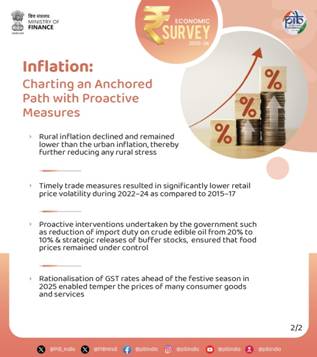
The Economic Survey 2025-26 tabled in the Parliament today by the Union Minister of Finance and Corporate affairs, Smt. Nirmala Sitharaman has observed that unlike previous years (2023 and 2024), rural inflation declined and remained lower than the urban inflation, further reducing rural stress. Throughout much of 2023 and 2024, rural inflation remained above urban inflation. This pattern reflected a difference in consumption weights across rural and urban baskets, particularly the larger share of food items in rural consumption, which rendered rural inflation more responsive to movements in food prices. During 2025 as food inflation eased, inflation declined across both sectors, with inflation in the rural sector going below that in the urban sector.
During 2025-26, the state-level incidence of inflation followed the national trend, with an across-the-board reduction in inflation, except in Kerala and Lakshadweep, where retail inflation breached the upper tolerance band of 6 per cent. In rest of the states, average inflation remained within the 2-6 per cent tolerance band of the Reserve Bank of India, or below that.
Deviations in State inflation are largely driven by local relative-price movements rather than broad-based inflationary persistence. Based on the monthly State-wise CPI inflation data from January 2014 to December 2025, the Survey examined whether some states consistently recorded higher or lower inflation than the national average. Survey says, inflation differentials across States were not purely transitory and deviations from the national average often extended beyond a single month. Far-end States in the South and Northeast tended to have recorded inflation above the national average, with States such as Delhi and Himachal Pradesh, on the other hand, were typically below the national average. (Jan 2014 – Dec 2025)
While national factors remain central in shaping inflation outcomes, State-level inflation dynamics display heterogeneity over time. An examination of inflation and wage rates at the state-level over a decade indicates that the states with an average wage rate above the national wage tend to experience a relatively higher inflation. Survey notes that “our further analysis demonstrated that the state-level inflation rates show a significant positive association with wage rates, state-level GDP growth rates and COVID impact. However, the share of industrial output showed negative association with the state-level inflation, reflecting the benign effect of supply-side efficiencies in manufacturing sector in dampening price pressures”. It further adds that GST imposition was found to be price neutral for state-level inflation differential.
***
PC/SKS
(Release ID: 2220003)
Visitor Counter : 2784