PIB Backgrounder
Electronics Components Manufacturing Scheme
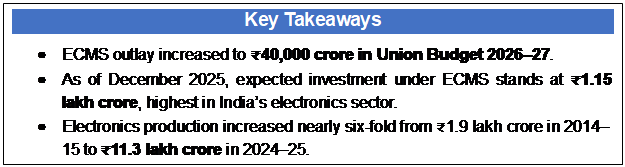
Union Budget 2026–27 Raises Scheme Outlay to ₹40,000 Crore
Posted On:
03 FEB 2026 2:43PM by PIB Delhi
Introduction
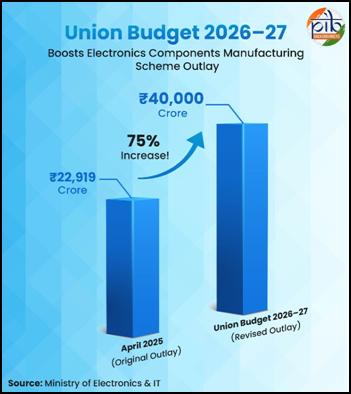
India’s electronics manufacturing sector has entered a decisive phase of growth. The Union Budget 2026–27 has announced an increase in the outlay for the Electronics Components Manufacturing Scheme (ECMS) to ₹40,000 crore, signalling a strong policy push to deepen domestic manufacturing capacity. Over the past eleven years, India has rapidly transformed into a major electronics-manufacturing hub, achieving nearly a six-fold increase in production. The sector has expanded its industrial base, created 25 lakh jobs, and emerged as a key driver of employment and economic growth.
This progress is reflected in India’s export performance and its growing integration with global value chains. Strategic government initiatives and consistent policy support have strengthened local manufacturing, supported export expansion, and attracted significant global investment. ECMS seeks to build on this momentum by reinforcing the domestic component ecosystem and positioning India as a credible global hub for advanced electronics manufacturing.
With the ambitious vision of building a $500 billion domestic electronics manufacturing ecosystem by 2030–31, India is poised to emerge as a global technology leader, innovating for the world while creating vast opportunities at home.
Sectoral Outlook: Electronics as India’s Leading Export Category
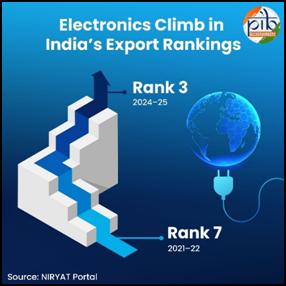
As pointed out in the Economic Survey 2025-26, electronics have emerged as India’s third largest and fastest growing export category in 2024–25, rising from the seventh position in 2021–22. In the first half of FY 2025–26, electronics exports stood at USD 22.2 billion, maintaining strong growth momentum and placing the sector on course to become the country’s second largest exported item.
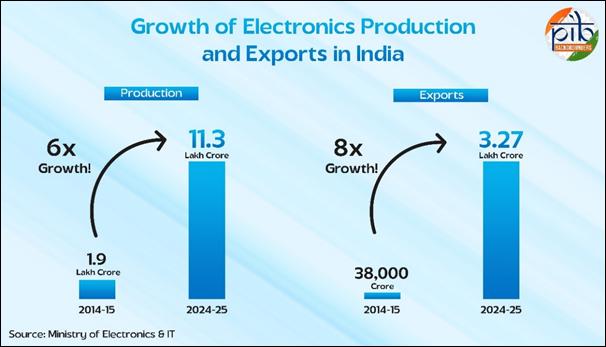
The country’s electronics production has grown from ₹1.9 lakh crore in 2014–15 to ₹11.3 lakh crore in 2024–25, marking a six-fold increase. Exports rose from ₹38,000 crore to ₹3.27 lakh crore in the same period, reflecting an eight-fold jump. Over the past decade, electronics manufacturing has created around 25 lakh jobs across the country.
Mobile manufacturing has played a major role in this transformation. Production in this segment has increased from ₹18,000 crore in 2014–15 to ₹5.45 lakh crore in 2024–25, a 28-fold rise. India is now the world’s second largest mobile phone manufacturer, with more than 300 units operating compared to just two in 2014.
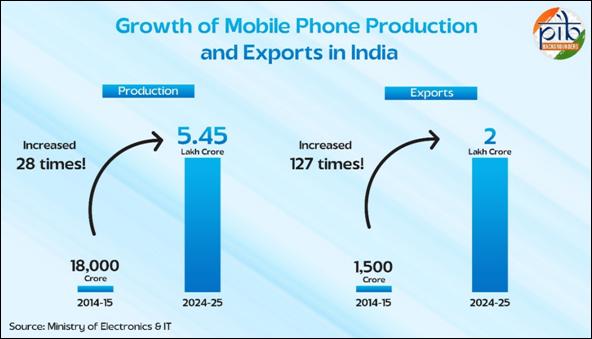
Exports of mobile phones have shown remarkable progress, rising 127 times from ₹1,500 crore in 2014–15 to ₹2 lakh crore in 2024–25. In the first five months of 2025–26, smartphone exports touched ₹1 lakh crore, a 55 per cent rise over the same period last year.
India has now achieved near self-reliance in mobile production, moving from importing most of its requirements a decade ago to manufacturing almost all devices domestically. This transformation highlights the strength of India’s policy ecosystem and its emergence as a trusted hub for global electronics manufacturing and exports.
Overview of ECMS
The Electronics Components Manufacturing Scheme was notified on April 8, 2025 with an original outlay of ₹22,919 crore, equivalent to about USD 2.7 billion. It has a tenure of six years, with an optional one-year gestation period. The scheme aims to build a strong and self-sustaining ecosystem for electronics component manufacturing in the country. Its focus is on attracting both domestic and global investment across the value chain, promoting higher domestic value addition, and positioning India as a key player in global electronics trade. The scheme complements the India Semiconductor Mission (ISM), working alongside it to strengthen the domestic semiconductor and electronics ecosystem.
The ECMS seeks to integrate India’s electronic industry with global value chains by encouraging production of essential components, sub-assemblies, and raw materials within the country.
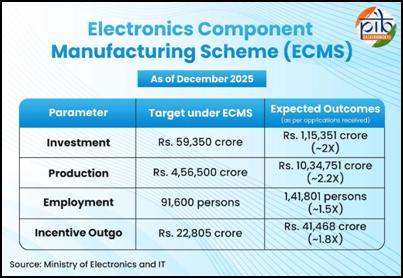
As of December 2025, expected investment commitments under the scheme stand at ₹1,15,351 crore, nearly double the original target of ₹59,350 crore. Production worth ₹10,34,751 crore is expected to be generated over the next six years, which is 2.2 times higher than the initial projection. The incentive outgo is projected at ₹41,468 crore, around 1.8 times the original estimate of ₹22,805 crore. The scheme is also expected to create 1,41,801 direct jobs, surpassing the target of 91,600, along with a large number of indirect employment opportunities.
Approved Applications under ECMS
Since its notification, the Electronics Component Manufacturing Scheme has received strong interest from industry across India. So far, a total of 46 applications have been approved under the scheme in 11 states. These approvals represent a cumulative investment of ₹54,567 crore, with a projected production value of ₹3,67,343 crore. They are expected to generate direct employment for around 51,000 people.
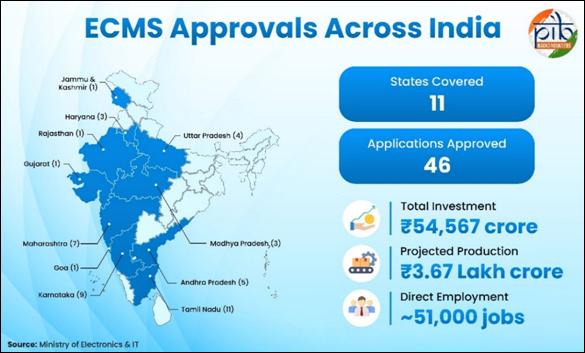
These approved applicants would manufacture a wide spectrum of electronic components such as multi-layer PCBs, camera modules, connectors, oscillators, optical transceivers, and enclosures for mobile and IT hardware products as well as related devices.
The approvals have been disbursed in three tranches, each contributing significantly to production capacity and job creation.
|
Tranche
|
Number of Projects
|
Approval Date
|
Investment (₹ crore)
|
Projected Production (₹ crore)
|
Direct Employment
|
|
First
|
7
|
27 October 2025
|
5,532
|
36,559
|
5,100
|
|
Second
|
17
|
17 November 2025
|
7,172
|
65,111
|
11,808
|
|
Third
|
22
|
2 January 2026
|
41,863
|
2,58,152
|
33,791
|
These approvals demonstrate the scheme’s ability to attract substantial investment while supporting large-scale employment generation and the production of electronic components across the country.
Projected Outcomes for FY 2026–27
ECMS is expected to deliver tangible outcomes during FY 2026–27, reflecting the scale up of approved projects and sustained industry participation. Investments made under the scheme are projected to translate into higher production capacity and steady job creation across the electronics component manufacturing ecosystem.
|
Outcome Indicator
|
Expected Outcome by end of FY 2026–27
|
|
Investment
|
₹11,156 crore
|
|
Production
|
₹29,024 crore
|
|
Employment generation
|
19,240 jobs
|
These expected outcomes signal steady progress towards a resilient and high-value electronics manufacturing base.
Other Key Government Initiatives to boost Electronics Manufacturing
India’s electronics industry has grown on the back of strong policy support and targeted government initiatives. These programmes aim to build a globally competitive manufacturing ecosystem, attract investment, and create large-scale employment while strengthening India’s role in global value chains. The sector has also benefited from allowing 100 per cent foreign direct investment in electronics manufacturing, subject to applicable laws and regulations.
Production-Linked Incentive (PLI) Scheme
The Production-Linked Incentive Scheme, with an outlay of ₹1.97 lakh crore, spans 14 key sectors including electronics and IT hardware. It encourages companies to boost production, adopt new technologies, and expand exports.
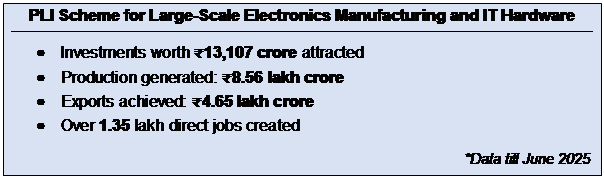
India has attracted more than USD 4 billion FDI Inflow in the field of electronics manufacturing since FY2020-21. Nearly 70% of this FDI is contributed by the beneficiaries of PLI Scheme.
Modified Electronics Manufacturing Clusters (EMC 2.0)
The Government of India notified the Modified Electronics Manufacturing Clusters, known as EMC 2.0, in April 2020. The scheme aims to create world-class infrastructure for electronics manufacturing by funding dedicated clusters with common facilities. These clusters provide shared amenities such as ready industrial plots, Ready Built Factory sheds, and Plug & Play facilities to accelerate manufacturing operations.
As of December 2025, 11 EMC projects and 2 Common Facility Centre projects have been approved. Together, they cover 4,399.68 acres with a total project cost of ₹5,226.49 crore, including Central financial assistance of ₹2,492.74 crore. These projects are spread across 10 states with a projected investment of ₹1,46,846 crore and an estimated employment generation of around 1.80 lakh people.
Customs and Surcharge Exemptions
The Union Budget 2026‑27 announced exemptions on basic customs duty for certain inputs used in the manufacture of microwave ovens, effective from 2nd February 2026.
At the same time, parts for manufacturing electronic toys are now exempt from the Social Welfare Surcharge, also effective from the same date.

Scheme for Promotion of Manufacturing of Electronic Components and Semiconductors (SPECS)
The SPECS scheme offers a 25 percent financial incentive on capital expenditure for producing key electronic goods. It helps bridge critical supply chain gaps, encourages local production, and supports India’s transition from assembly-based manufacturing to high-value component manufacturing.
National Policy on Electronics (NPE) 2019
The National Policy on Electronics aims to position India as a global hub for Electronics System Design and Manufacturing (ESDM). The policy promotes innovation, encourages design-led manufacturing, and supports research and development to ensure long-term industry growth.
Together, these measures demonstrate the government’s commitment to building a robust electronics-manufacturing ecosystem, attracting investment, and generating employment while enhancing India’s position in global value chains.
Conclusion
The Electronics Components Manufacturing Scheme has emerged as a cornerstone of India’s electronics manufacturing strategy. The Union Budget 2026–27 enhanced its outlay to ₹40,000 crore, reflecting a strong policy commitment to expanding domestic production capacity. ECMS has mobilised substantial investment, increased production, and generated significant employment. By strengthening the local component ecosystem and integrating India with global value chains, the scheme reinforces the country’s position as a credible hub for advanced electronics manufacturing.
References:
PIB Backgrounders:
Ministry of Electronics & IT:
Union Budget:
Click here to see PDF
******
PIB Research
(Release ID: 2222519)
Visitor Counter : 15045