PIB Backgrounder
Seven Chakras of the India–AI Impact Summit 2026
Driving Global Collaboration Across Seven Themes of AI Impact
Posted On:
08 FEB 2026 12:17PM by PIB Delhi

Key Takeaways
- The India–AI Impact Summit 2026 will be the first global AI summit to be hosted in the Global South.
- Over 100 countries are engaging through the Seven Chakra or Working Groups, reflecting broad global participation in shaping responsible and inclusive AI.
- The Summit is also anchored in three Sutras: People, Planet and Progress which define the core principles for global cooperation on AI.
Introduction
India is at a pivotal stage in its development journey, with Artificial Intelligence (AI) emerging as a key enabler. For India, AI functions as a strategic national tool to drive the democratisation of technology, ensuring access, inclusion, and equity at scale. This technological revolution has opened vast opportunities for advancements across every domain of human endeavour. India’s role in global technology and governance forums continues to expand, reflecting its growing engagement in shaping international policy discourse on emerging technologies.
As part of this growing global engagement, the India–AI Impact Summit 2026 is slated to take place in New Delhi from 16–20 February. It will be the first-ever global AI summit to be hosted in the Global South.
The Summit will serve as an impact-focused global platform, shaping AI into measurable outcomes across economies, aligning with the national vision of Welfare for All, Happiness of All and global principle of AI for Humanity. It will bring together global leaders, policymakers, innovators, and experts to showcase applications and define AI pathways across governance, innovation, and sustainable development.
Core Principles: The Three Sutras Articulating the AI Impact
The India–AI Impact Summit 2026 is guided by three foundational pillars, referred to as Sutras, which articulate the core principles guiding global cooperation on AI.
- People: Promoting human-centric AI that safeguards rights, enhances access to services, builds trust, and ensures equitable benefits across societies.
- Planet: Advancing environmentally sustainable AI by encouraging energy-efficient systems, responsible resource use, and applications that support climate action and environmental resilience.
- Progress: Enabling inclusive economic and technological advancement through innovation, capacity building, and the use of AI to drive productivity, growth, and development outcomes.
Thematic Areas: The Seven Chakras of the India–AI Impact Summit 2026
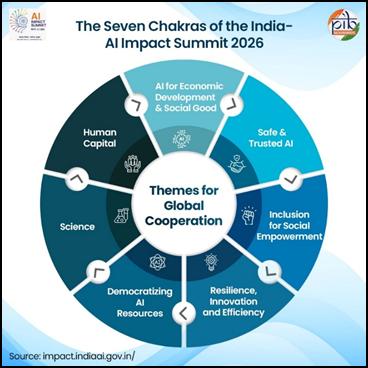
The India-AI Impact Summit 2026 has attracted significant high-level engagement, with 15–20 Heads of Government, over 50 international ministers, and more than 40 global and Indian CEOs expected to participate.
The Summit’s deliberations are organised through Chakras or Working Groups structured around seven interconnected thematic areas. Each Chakra focuses on a core area of AI impact and translates the Sutras into concrete areas of action across policy and real-world applications. Over 100 countries worldwide have engaged through these Working Groups to shape a future of responsible and inclusive AI.
Each Chakra fosters multilateral collaboration on AI's societal impacts, from building skills to ensuring ethical deployment:
|
Chakra
|
Focus Areas
|
|
Human Capital
|
Advancing equitable skilling and inclusive workforce transitions for an AI-enabled future of work.
|
|
Inclusion for Social Empowerment
|
Advancing AI systems that are inclusive by design, empowering diverse communities and ensuring equitable representation.
|
|
Safe and Trusted AI
|
Building globally trusted AI systems anchored in transparency, accountability, and shared safeguards for innovation.
|
|
Science
|
Harnessing AI to accelerate frontier science, foster scientific collaboration, and translate breakthroughs into shared global progress.
|
|
Resilience, Innovation, and Efficiency
|
Driving sustainable, resource-efficient AI systems that strengthen climate resilience and sustainability.
|
|
Democratizing AI Resources
|
Promoting equitable access to foundational AI resources for inclusive innovation and sustainable development worldwide.
|
|
AI for Economic Development & Social Good
|
Leveraging AI to enhance productivity, innovation, and inclusive development across economies and societies.
|
Through these Chakras, India aims to shape global AI norms while addressing local challenges. The outcomes of the Summit will guide policy makers, investors, and industry leaders in the years ahead.
Human Capital: India’s Talent Pool Anchoring Global AI Cooperation
India’s rapid adoption of AI is opening new pathways for innovation and inclusive growth across sectors. As technology evolves, India is advancing workforce readiness for an AI-driven economy while ensuring broad participation across regions and socio-economic groups. The Human Capital thematic working group focuses on strengthening these efforts by shaping an equitable AI skilling ecosystem that enables smooth workforce transitions and equips citizens with capabilities for emerging roles.
Key National Indicators of India’s Talent-Force
- AI Skills and Talent Growth: India ranks among the top countries globally in AI skill penetration and has grown more than threefold since 2016 in terms of AI talent concentration.
- Global Leadership in AI Capability: As per the Stanford AI Index Report 2025, India leads global AI talent acquisition with about 33% annual hiring growth and ranks among the top three in the Global AI Vibrancy Tool.
- Empowering AI Workforce: Under the IndiaAI FutureSkills, the government is supporting 500 PhD scholars, 5,000 postgraduates, and 8,000 undergraduates in AI research and training.
- Global Outreach: IndiaAI Mission under MeitY selected 10 Indian AI startups for the IndiaAI Startups Global Initiative, a global acceleration programme with Station F, Paris, the world’s largest startup campus, and HEC Paris, a top-ranked European business school, positioning India’s AI innovation on the world stage.
- Employment Impact: AI is set to transform India’s tech services sector by redefining the workforce, with the potential to create millions of jobs over the next few years.
Government-led investments in skilling, research, and global exposure are strengthening domestic capabilities while aligning them with international requirements. These efforts position India as a dependable and inclusive partner in advancing global cooperation on AI.
Inclusion for Social Empowerment: India’s Approach to Inclusive AI
AI offers India a powerful pathway to expand social inclusion by improving access to services and participation for communities across languages, regions, and abilities. India’s digital public infrastructure positions it well to translate AI innovations into tangible social outcomes. The Inclusion for Social Empowerment thematic working group focuses on advancing inclusive-by-design AI solutions that reflect India’s diversity, strengthen institutional readiness, and ensure AI systems remain safe, relevant, and usable, with clear benefits for underserved and vulnerable communities.
Flagship Initiatives Enabling Social Empowerment through AI
- Global HealthAI Engagement: India is engaging with HealthAI, the global platform for safe and ethical use of AI in healthcare, strengthening responsible innovation and adoption of global best practices.
- BHASHINI: The BHASHINI platform enables inclusive and a voice-first digital governance, supporting over 36 text languages, 22 voice languages, and 350+ AI language models, expanding social inclusion across regions.
- AI-Enabled Farmer Service Delivery: ‘Kisan e-Mitra’ is a voice-based AI chatbot that enables farmers to access PM-Kisan Samman Nidhi services in 11 regional languages. It handles over 20,000 queries daily and has responded to more than 95 lakh queries so far, supporting accessible AI-driven service delivery.
Bharat-VISTAAR: AI-Driven Digital Agriculture Platform
Bharat-VISTAAR, a multilingual AI platform to integrate AgriStack portals and the ICAR package of agricultural practices with AI systems is proposed in the Union Budget 2026-2027. The platform will support digital agricultural extension, enable location-specific advisories, and expand farmer access to scientific and data-driven decision support.
- AI for Informal Workforce Inclusion: NITI Aayog’s report AI for Inclusive Societal Development (October 2025) underscores AI’s potential to empower India’s 490 million informal workers by widening access to various services.
By integrating inclusive design into digital public infrastructure, AI systems are improving access to services across languages and regions, reinforcing trust and social empowerment as core outcomes of India’s AI governance journey.
Safe and Trusted AI: Enabling Responsible AI Aligned with National Priorities
As AI systems grow in scale and impact, ensuring reliability, transparency, and accountability becomes central to sustaining public confidence and responsible innovation. India’s regulatory frameworks position it to contribute meaningfully to the global AI safety efforts. The Safe and Trusted AI thematic working group focuses on strengthening governance capacity and enabling shared learning across countries.
India’s Efforts for Developing Safe and Accountable AI
- Responsible AI Project Portfolio: Under the Safe and Trusted AI pillar, 13 projects have been selected through Expressions of Interest to develop responsible AI tools focused on safety, bias mitigation, transparency, and accountability.
- Mission Digital ShramSetu: NITI Aayog proposed Mission Digital ShramSetu to create an ecosystem that will make AI accessible and affordable for all, harnessing AI and emerging technologies to empower informal workers.
- IndiaAI Safety Institute: India is establishing the IndiaAI Safety Institute under the Safe and Trusted Pillar of the IndiaAI Mission to address AI risks & Safety Challenges.
AI Governance Guidelines
India’s AI Governance Guidelines align AI adoption with national development goals ahead of the India AI Impact Summit 2026. To apply these principles into practice, the guidelines propose a structured governance framework.
- Establish an AI Governance Group (AIGG) to coordinate overall policy development and align AI governance with national priorities.
- Constitute a Technology and Policy Expert Committee (TPEC) to provide expert inputs on national and international AI governance issues.
- Provide adequate resources to the IndiaAI Safety Institute (AISI) to undertake research, draft standards, develop testing methods and benchmarks, collaborate with international and national standard bodies, and provide technical guidance to regulators and industry.
India is building a balanced AI ecosystem where innovation moves with responsibility. The Safe and Trusted AI Chakra reinforces national priorities of inclusion, growth and digital sovereignty.
Resilience, Innovation and Efficiency: Strengthening Resilience through Indigenous AI Innovation
India’s approach to AI places strong emphasis on efficiency and sustainability, aligning technological progress with environmental responsibility and inclusive access. The Resilience, Innovation and Efficiency thematic working group builds on India’s strengths to promote efficiency as a core design principle, enabling adaptable and climate-conscious AI systems that expand access, narrow global disparities, and support a resilient, inclusive, and sustainable AI ecosystem.
Measurable Outcomes in Efficient AI Development:
- Rising Data Infrastructure: India’s data infrastructure demand is rising with AI growth, with capacity projected to scale from about 960 MW to 9.2 GW by 2030.
- GitHub Participation: As per global GitHub AI project data (2024), India emerged as the second-largest contributor worldwide public generative AI projects on GitHub.
- Global AI Hubs: Global tech giants are investing in India to accelerate AI and digital infrastructure, marking a major boost for the nation’s technological landscape. Key commitments include Microsoft’s ₹1.5 lakh crore for data centres and AI training, Amazon’s ₹2.9 lakh crore for cloud infrastructure and AI-driven digitization by 2030, and Google’s ₹1.25 lakh crore for a 1 GW AI hub in Vizag.
These efforts widen access to advanced technologies, support climate-conscious innovation, and enhance self-reliance.
Science: AI-Enabled Scientific Research in India
As research becomes more data-intensive and collaborative, there is a strong opportunity to broaden participation and improve the translation of scientific research into real-world solutions in areas such as health, agriculture, and climate. With its growing research base, digital infrastructure, and commitment to open science, India is well positioned to contribute to a more equitable global research ecosystem. The Science thematic working group focuses on advancing open and transparent AI-enabled research and collaborative frameworks that widen participation across regions and institutions.
Progress in India’s Collaborative AI Science
- Innovation Footprint: India is the 6th largest patent filer globally, and its Global Innovation Index rank has improved from 81 to 38, reflecting stronger scientific research translation.
- Boost in R&D Investment: National expenditure on research and development increased from ₹60,196 crore in 2010–11 to ₹1.27 lakh crore in 2020–21, reflecting sustained expansion of India’s scientific research ecosystem.
- ANRF AI-Enabled Research: The Anusandhan National Research Foundation (ANRF) targets ₹50,000 crore in research funding during 2023–2028 to strengthen national research capacity.
- IMD Hybrid AI Forecasting: India Meteorological Department is using hybrid AI models for rainfall, lightning, fog, and fire prediction, along with MausamGPT as a climate advisor for farmers, accelerating AI-enabled scientific forecasting advancements.
- STELLAR Tool: Central Electricity Authority's STELLAR tool is an indigenously developed resource adequacy model launched in April 2025. It aids DISCOMs in generation-transmission-storage planning with demand response, advancing AI-enabled scientific research for energy security.
These initiatives strengthen India's role in collaborative, open AI science, fostering global equitable progress.
Democratising AI Resources: Developing Shared AI Resources
Development of AI systems depends on access to compute, data, and infrastructure, resources that remain unevenly distributed across countries and institutions. Open and interoperable infrastructure, combined with multilateral cooperation, can support contextualised AI development aligned with national priorities. The Democratising AI Resources thematic working group focuses on advancing equitable access and strengthening global representativeness.
Key Milestones in Shared AI Infrastructure
- Sovereign AI Compute: Under the IndiaAI Mission, a secure GPU cluster is being constructed to house 3,000 next-generation GPUs for sovereign and strategic applications.
- IndiaAI Kosh (AIKosh): The platform has over 7,400 datasets and 273 AI models across 20 sectors, enabling researchers and startups to access high-quality, India-centric data for AI innovation.
- AI Data Labs Network: India is launching AI Data Labs to build grassroots AI skills in Tier-2 and Tier-3 cities through training in data annotation and curation, forming a nationwide network of 570 labs.
- National Supercomputing Mission (NSM): The flagship mission has deployed over 40 petaflops machines across IITs, IISERs, and research labs, forming a distributed high-performance computing base for academia.
- AIRAWAT: India’s premier AI supercomputer, launched by MeitY in 2023 and integrated with PARAM Siddhi-AI, delivering shared compute for advanced AI research.
- Compute Access: The IndiaAI Compute Portal democratizes access to over 38,000 GPUs and 1,050 TPUs, empowering large-scale AI model development to address economic challenges and societal needs.
- Inclusive Pricing Edge: Access to compute is available at subsidised rates of under Rs. 100/hour, compared to the global rates of more than Rs. 200/ hour.
These efforts anchor India's vision for open, accessible AI infrastructure, driving equitable innovation and global collaboration.
AI for Economic Growth and Social Good: Scaling Impact through AI
While AI holds immense potential to accelerate economic growth and social progress, realizing this promise at scale remains a challenge. The AI for Economic Growth and Social Good Working Group focuses on scaling AI solutions that deliver measurable economic and social outcomes.
Empowering AI-Driven Economic and Social Impact
- Agriculture: In agriculture, AI-powered advisory tools are improving sowing decisions, crop yields, and input efficiency, with select state-level deployments such as Andhra Pradesh and Maharashtra, reporting productivity gains of up to 30–50%.
- Healthcare: In healthcare, AI applications are enabling early detection of tuberculosis, cancer, neurological disorders, and other conditions, strengthening preventive and diagnostic care.
- Education: In education, National Education Policy 2020 integrates AI learning through CBSE curricula, DIKSHA platforms, and initiatives such as YUVAi, equipping students with practical AI skills.
- Justice delivery: E-Courts Phase III deploys AI and ML for translation, case management, and citizen-facing services, improving efficiency and transparency through vernacular access.
- Sector Revenue Surge: India’s AI-powered technology sector is projected to generate revenues of around US$ 280 billion in 2025, fuelling robust economic expansion amid surging digital demand.
- Startup Ecosystem: India hosts about 1.8 lakh startups and nearly 89% of the new startups launched in 2024 used AI in their products or services, showcasing widespread ecosystem adoption that spurs innovation and job creation for social upliftment.
Together, the Seven Chakras create pathways for India`s responsible innovation, wider participation, and measurable impact. By aligning policy, technology, governance, and capacity-building, they provide a structured framework to translate shared principles into actionable outcomes across countries and sectors.
Conclusion
The India–AI Impact Summit 2026 strengthens India’s role as a key platform for shaping the global AI agenda. Anchored in the Seven Chakras and the Three Sutras of People, Planet, and Progress, the Summit advances a development-oriented framework for artificial intelligence.
By linking policy with implementation and innovation with public purpose, the Summit establishes a structured approach to responsible AI deployment. It aligns technological advancement with inclusive growth and sustainable development.
The Summit positions India as a convenor and partner in global AI cooperation, supporting shared standards, collaborative frameworks, and scalable solutions for public good. It marks a transition from dialogue to delivery, reinforcing India’s commitment to responsible, inclusive, and development-focused AI pathways.
References
Ministry of Electronics & IT
Ministry of Earth Sciences
Ministry of Agriculture & Farmers Welfare
NITI Aayog
PIB Backgrounders
India–AI Impact Summit 2026
Principal Scientific Adviser (PSA)
Click here to see in PDF
PIB Research
(Release ID: 2225069)
Visitor Counter : 31523