PIB Backgrounder
Redefining Inter-City Mobility: High-Speed Rail Corridors in India
Posted On:
11 FEB 2026 2:14PM by PIB Delhi
- High-speed rail is a planned component of India’s future passenger rail system, designed for faster, high-capacity inter-city travel on select corridors.
- Union Budget 2026–27 announced seven new high-speed rail corridors, signalling expansion beyond the Mumbai–Ahmedabad corridor.
- The Mumbai–Ahmedabad corridor is India’s first high-speed rail project, providing institutional and technical experience for future corridors.
- High-speed rail supports reduced travel time, regional connectivity, and sustainable transport objectives.
|
High-Speed Rail in India: An Emerging Mobility Framework
Indian Railways ranks among the largest railway systems in the world and has long functioned as a core mode of passenger and freight transport. By connecting regions and enabling the movement of people and goods, it has supported economic activity, labour mobility, and access to markets, education, and services. Over time, the rail network and its carrying capacity have expanded steadily to keep pace with growing transport demand. In recent years, the nature of mobility has undergone notable change. Rapid urbanisation, rising income levels, the expansion of metropolitan regions, and the emergence of major economic clusters have contributed to a significant increase in long-distance and inter-city travel.
Recognising these trends, the government has adopted a long‑term and structured approach to railway development. The focus is not only on expanding capacity but also on improving service quality, reliability, and speed. The Union Budget for 2026-27 has emerged as a key instrument for articulating India’s priorities with the introduction of seven high‑speed rail corridors. It reflects a shift towards advanced rail systems and corridor‑based development as part of India’s evolving inter‑city mobility framework. The objective is to provide scalable and future‑ready transport solutions that can cater to evolving passenger expectations and support sustained economic growth.
High‑Speed Rail: Concept and Relevance for India
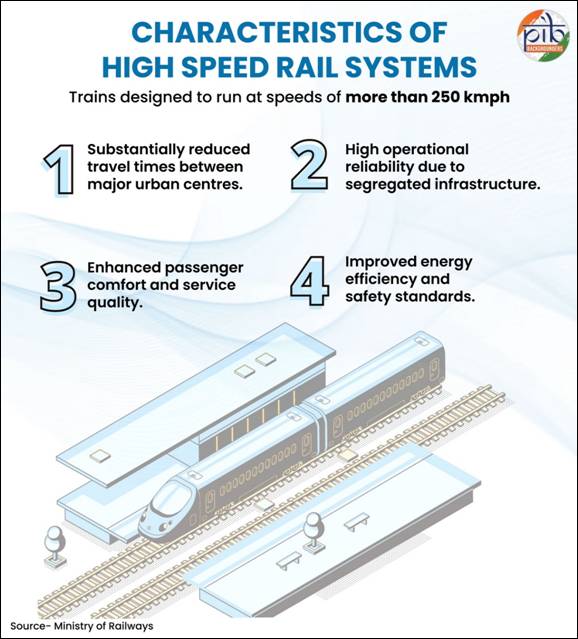
High-speed rail (HSR) refers to passenger railway systems designed to operate at speeds significantly higher than those of conventional railways. These systems typically run on dedicated corridors and are supported by advanced rolling stock, signalling, communication, and safety technologies, enabling high levels of operational efficiency and reliability. For operational purposes, high-speed rail is defined as railway systems running trains at speeds in excess of 250 kilometres per hour.
High‑speed rail differs fundamentally from conventional and semi‑high‑speed rail services. While conventional rail shares tracks with freight and slower passenger trains, high‑speed rail operates on exclusive corridors, allowing for higher speeds and more predictable schedules. High-speed rail involves purpose-built infrastructure designed for sustained high-speed operations.
For India, high‑speed rail corridors are particularly relevant for connecting major city pairs that generate high passenger volumes over medium to long distances. It also supports the Government’s broader objectives of promoting sustainable transport and reducing congestion on existing infrastructure.
The National Rail Plan, a long-term strategic planning document that outlines the development of India’s railway network up to 2030, recognises high‑speed rail as an important component of the future passenger rail ecosystem. It envisages high‑speed corridors as a framework that complements conventional and suburban rail services, enabling Indian Railways to meet diverse mobility needs in the decades ahead.
High‑Speed Rail Corridors in Union Budget 2026–27
The Union Budget 2026–27 reaffirmed India’s approach to railway infrastructure, emphasising modernisation, passenger convenience, regional connectivity, and logistics efficiency. The Budget allocated a record capital outlay of ₹2,78,000 crore for Indian Railways, the highest ever in the history of the sector, underscoring the strategic importance accorded to rail infrastructure as a driver of economic growth and integration.
Within this broader investment framework, the Budget outlined a series of high-impact, capacity-enhancing projects that are expected to reshape inter-city travel dynamics across India. Among these, a major set of initiatives focuses on high-speed connectivity with corridors designed to drastically reduce travel time between major urban and economic centres.
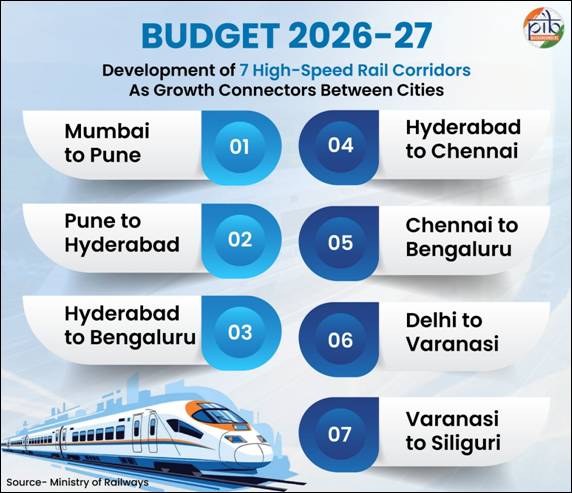
As part of this vision, the Budget announced the development of seven high-speed rail corridors as growth connectors that integrate key cities and regions, facilitate efficient movement of people, and support economic interaction across states. Together, these corridors span nearly 4,000 kilometres and are expected to attract investments of approximately ₹16 lakh crore, reflecting the scale and ambition of the Government’s high-speed rail agenda.
The planned high-speed rail corridors are strategically located across different regions of the country.
Northern and Eastern India
In the northern and eastern regions, high-speed rail corridors are envisaged to strengthen connectivity between historically significant and economically important cities. Key features include:
- A high-speed corridor between Delhi and Varanasi, projected to reduce travel time to approximately 3 hours and 50 minutes, enabling faster movement between the national capital and major cultural and economic centres.
- An extended high-speed link from Varanasi via Patna to Siliguri in West Bengal, expected to enable travel in about 2 hours and 55 minutes, improving connectivity and linking important urban and regional hubs across multiple states.
- These corridors are expected to facilitate greater regional integration by improving access between urban centres and surrounding regions, supporting economic activity and mobility.
Southern and Western India
In the southern parts of the country, the high-speed rail network is envisaged as a South High-Speed Triangle or Diamond, designed to connect major metropolitan and economic centres. Salient aspects include:
- A Chennai–Bengaluru high-speed corridor with a projected travel time of about 1 hour and 13 minutes, significantly enhancing connectivity between two major industrial and technology hubs.
- A Bengaluru–Hyderabad corridor is expected to reduce travel time to around 2 hours, strengthening links between major economic and IT hubs.
- A Chennai–Hyderabad corridor will reduce travel time to around 2 hours 55 minutes, boosting regional development in southern India.
- A Mumbai–Pune corridor with an estimated travel time of approximately 48 minutes, aimed at easing congestion and supporting high-frequency inter-city travel in western India.
- A Pune–Hyderabad corridor with an estimated travel time of around 1 hour 55 minutes, creating onward high-speed links to southern hubs and supporting seamless inter-regional passenger connectivity.
- Collectively, these corridors are expected to support regional growth by improving mobility between key economic, educational, and industrial clusters.
Vision to Execution: Mumbai-Ahmedabad High Speed Rail Corridor
The Mumbai–Ahmedabad High-Speed Rail (MAHSR) Corridor represents India’s first concrete step towards the introduction of high-speed rail systems in the country. Conceived as a dedicated high-speed passenger corridor, the project marks a structural shift in passenger rail planning by introducing segregated infrastructure, advanced train systems, and internationally benchmarked safety standards into the Indian Railways ecosystem.
Corridor Profile and Key Features
The corridor has been planned and is being implemented as a full-scale high-speed rail project with the following key features:
- The corridor connects Mumbai in Maharashtra with Ahmedabad in Gujarat, two major economic and urban centres.
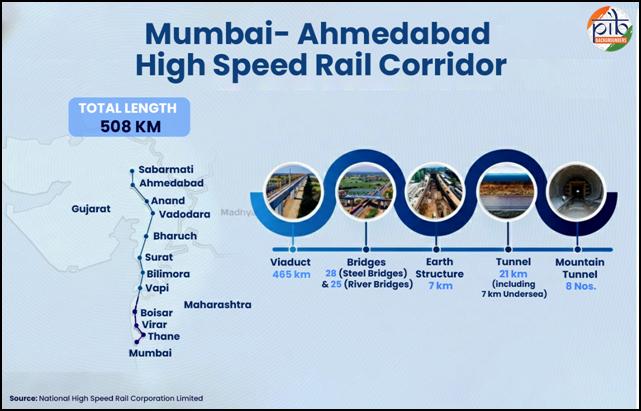
- It covers a total length of approximately 508 kilometres.
- The project is being implemented by the National High Speed Rail Corporation Limited (NHSRCL), a Government of India company under the Ministry of Railways.
- The corridor has been designed for high-speed operations with a speed of 320 kmph, supported by advanced rolling stock, signalling, and train control systems.
Route, Alignment, and Station Planning
The alignment of the Mumbai–Ahmedabad High-Speed Rail Corridor has been planned to balance operational efficiency with engineering and urban constraints:
- The corridor comprises a combination of elevated, underground, and at-grade sections, depending on terrain and urban density.
- A total of 12 stations have been planned along the route.
- Stations are designed to function as multimodal transport hubs, enabling integration with existing railway lines, metro systems, and road-based transport.
Transforming Inter-City Travel
A core objective of the project is to substantially reduce inter-city travel time while improving service quality:
- The corridor is expected to reduce end-to-end travel time between Mumbai and Ahmedabad, completing the entire journey in about 2 hours and 7 minutes.
- The high-speed system is designed to offer high operational reliability, enhanced passenger comfort, and improved safety standards compared to conventional rail services.
- By shifting long-distance passenger traffic to a dedicated corridor, the project also contributes to capacity creation on existing rail routes.
Building Capability for Future High-Speed Rail Corridors
Beyond its immediate transport benefits, the Mumbai–Ahmedabad corridor plays a broader strategic role in India’s rail development trajectory:
- The project has enabled the creation of institutional, technical, and project-management capacity for high-speed rail in India.
- Experience gained in areas such as land acquisition, environmental clearances, stakeholder coordination and technology adaptation is expected to support the planning and implementation of future high-speed rail corridors.
- As India’s first high-speed rail project, the corridor serves as a reference and learning model for the phased expansion of high-speed rail across the country.
Advancing a Corridor-Based High-Speed Rail Network
High‑speed rail represents the next stage in the evolution of Indian Railways, building upon decades of network expansion and service improvement. The emphasis on corridor‑based development and long‑term planning reflects a strategic approach to meeting future mobility needs. The announcement of seven high‑speed rail corridors in the Union Budget underscores the strategic significance of high‑speed rail for India’s economic growth, regional integration, and sustainable development. As planning and implementation progress, these corridors are expected to play a transformative role in shaping inter‑city mobility in the country. Going forward, the successful expansion of high‑speed rail will depend on coordinated institutional efforts, robust planning processes, and sustained investment. Anchored in official policy frameworks and supported by dedicated institutions, India’s high‑speed rail programme is positioned as a key pillar of the nation’s transport infrastructure vision.
Ministry of Railways
https://indianrailways.gov.in/ExeSummary-24122020.pdf
https://sr.indianrailways.gov.in/view_detail.jsp?lang=0&id=0,4,268&dcd=5634&did=15052028451345E19BE8BD0BC0725CF289AF165A9839F.web107
https://iricen.gov.in/iricen/ipwe_seminar/2017/ipwe2019/Understanding%20High%20Speed%20Rail%20Technology%20%E2%80%93%20A%20Comparative%20Study.pdf
https://www.nhsrcl.in/index.php/en/project/project-overview
https://www.pib.gov.in/PressReleasePage.aspx?PRID=2220431®=3&lang=2
https://www.pib.gov.in/PressReleasePage.aspx?PRID=2221838®=6&lang=1
https://www.pib.gov.in/PressReleasePage.aspx?PRID=2222767®=3&lang=2
Ministry of Finance
https://www.indiabudget.gov.in/doc/bh1.pdf
https://www.indiabudget.gov.in/doc/bh1.pdf
Click here to see PDF
*******
PIB Research
(Release ID: 2226302)
Visitor Counter : 7872