PIB Backgrounder
Advancing India’s Mental Healthcare and Well-Being
Budget 2026-2027 Series
Posted On:
11 FEB 2026 2:34PM by PIB Delhi
Key Takeaways
- The Union Budget 2026-2027 announced the setting up of a second National Institute of Mental Health and Neuro Sciences (NIMHANS-2) in northern India.
- The NIMHANS-2 will be modeled on the existing NIMHANS in Bengaluru, and will continue to focus on high-quality treatment, training, and research in the field of neurosciences and mental healthcare.
- The Union Budget 2026-2027 announced the upgradation of of premier mental health institutions at Ranchi and Tezpur into Regional Apex Institutions.
- The Budget proposed establishing Emergency and Trauma Care Centres in district hospitals.
Introduction
The Union Budget 2026-27 marks a decisive shift in India’s mental health policy by placing institutional expansion and regional equity at the centre of public health planning. By strengthening mental health and trauma care infrastructure, the budget advances the Government of India’s vision of inclusive development, under “Sabka Sath, Sabka Vikas” and the vision of a Viksit Bharat.
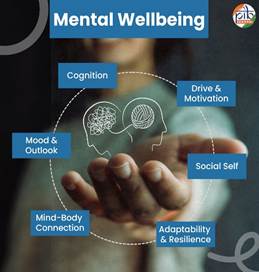
Addressing the long-standing absence of national-level mental health institutions in North India and the growing demand for specialised services, the Budget elevates mental health to a core public health priority. Its focus on targeted interventions, workforce capacity-building, and trauma care support is aimed at reducing the disproportionate burden borne by vulnerable families. This signals a clear and sustained commitment to equitable access to mental health and trauma care.
What is Mental Health?
Mental health is the state of well-being in which a person can cope with normal stresses of life. It allows one to learn, work well and contribute to community. Good mental health includes emotional, psychological, and social well-being. Poor mental health can lead to disorders like anxiety, depression, and other severe disorders, with far-reaching consequences for physical health, relationships, and overall functioning. In India, rising stress levels, rapid urbanisation, and post-pandemic challenges have increased the demand for mental health care. Timely access to support and treatment helps prevent crises and improves quality of life. Recognising this, the government increasingly views mental health as central to inclusive development, social stability and productivity.
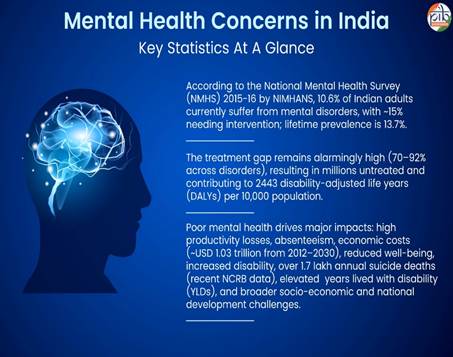
Union Budget 2026-2027: Strengthening Commitment to Mental Healthcare
In the Union Budget 2026-27, the government further reaffirmed its commitment to mental health and trauma care. This is part of ensuring access for the vulnerable under the third Kartavya (duty) – making sure every family, community, region, and sector has resources.
NIMHANS expansion
- There are no national institutes for mental healthcare in north India. The Budget announced the setting up of NIMHANS-2 (a second National Institute of Mental Health and Neuro Sciences) in northern India.
- It will be modeled on the existing NIMHANS in Bengaluru, focusing on advanced treatment, training, research, and neurosciences.
Upgradation of existing institutes
- National Mental Health Institutes in Ranchi and Tezpur will be upgraded as Regional Apex Institutions[1] [2].
- This will strengthen specialised mental health care, education, and trauma services in their regions.
Establishment of emergency and trauma care centres
- The Union Budget proposes establishing Emergency and Trauma Care Centres in every district hospital nationwide.
- These centres will provide affordable, 24x7 access to critical emergency medical services and mental health care for all citizens[3].
These steps aim to reduce regional disparities, improve access for the poor and vulnerable, and address the burden of rising mental health disorders across age groups, genders and regions.
Striding Toward Mental Well-Being: India’s Journey Thus Far
India has built a strong base for mental health care, with NIMHANS, Bengaluru being the apex body for research, training, and care. It received the Nelson Mandela Award for Health Promotion by WHO in 2024[4]. Building on this leadership, India's mental health sector emphasises reducing stigma, expanding access to services, and integrating digital tools. Key progress includes the establishment of rehabilitation homes, stronger community linkages, and efforts to deliver equitable, affordable, and high-quality mental health care across the country.
National Mental Healthcare Act, 2017[5]
- This landmark legislation replaced the outdated Mental Health Act of 1987, granting every individual the right to affordable, quality mental healthcare services.
- This Act ensures protecting the dignity and rights of persons with mental illness, and aligning India's framework with international standards, particularly the United Nations Convention on the Rights of Persons with Disabilities (UNCRPD).
- The Act also notably decriminalises suicide attempts to emphasise rehabilitation over punishment.
National Health Policy, 2017[6] [7]
- A pivotal policy that recognised mental health as a national priority, adopting a comprehensive, multi-pronged strategy to tackle mental health challenges.
- The policy aims at increasing the production of mental health specialists through enhanced public financing for training programs. It also focuses on prioritising and retaining professionals willing to serve in public healthcare systems, addressing shortages and improving equitable distribution.
- The policy further considerable efforts towards strengthening primary-level mental health support through community and digital.
Integration through Ayushman Bharat and Primary Care
- Over 1.75 lakh Sub Health Centres (SHCs) and Primary Health Centres (PHCs) have been upgraded into Ayushman Arogya Mandirs, where mental health services are now part of Comprehensive Primary Health Care[8].
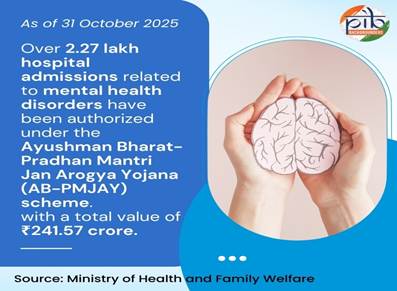
- Under Ayushman Bharat PM-JAY, mental disorders (including intellectual disability, schizophrenia, autism spectrum disorder, etc.) are covered,with cashless treatment available for 22 specified mental health procedures. [9]
National Mental Health Programme (NMHP), 1982
- The National Mental Health Programme (NMHP) was launched in 1982 to tackle the rising burden of mental disorders and the lack of adequate mental health services across India.
- Its main goal is to integrate mental healthcare into the general healthcare system. This makes services available and accessible to everyone, with special focus on vulnerable and underprivileged groups.
District Mental Health Programme (DMHP)[10]
- The DMHP intervention was launched in 1996 and later integrated into the National Mental Health Programme (NMHP).
- It is based on Karnataka's successful 'Bellary Model' and focuses on community-based mental healthcare delivery.
- Coverage expanded from an initial 4 districts in 1996, to 27 districts during the IX Five Year Plan, and now covers 767 districts across India (as per latest official data from the Directorate General of Health Services and Ministry of Health & Family Welfare).
- Services include counselling and outpatient treatment, 10-bedded inpatient facilities at the district level, suicide prevention initiatives, and public awareness programs.
- Each district has a dedicated team: psychiatrist, clinical psychologist, psychiatric social worker, psychiatric/community nurse, monitoring & evaluation officer, case registry assistant, and ward assistant/orderly.
- Key components emphasise early detection and treatment, short-term training for general physicians, training for health workers to identify mental illnesses, public awareness information, education, and communication (IEC) campaigns, and simple record-keeping for monitoring.
National Suicide Prevention Strategy (NSPS)[11]
- Launched by the Ministry of Health and Family Welfare in 2022, its main goal is to reduce suicide mortality in India by 10% by 2030.
- Key components of the intervention include mental health screenings in schools and colleges, setting up crisis helplines and psychological support centres, community awareness programs to reduce stigma around mental health, and workplace mental health programs for early identification and support.
- The strategy targets high-risk groups such as students, farmers, young adults, and other vulnerable populations for focused prevention and intervention efforts.
National Tele Mental Health Programme (Tele-MANAS)[12]
- Launched on October 10, 2022, as a 24x7 toll-free helpline (14416 or 1-800-891-4416).
- Provides free tele-counseling for mental health, with call escalations for more specialised interventions through psychiatrists, clinical psychologists, psychiatric social workers and psychiatric nurses. Individuals are also referred to in-person services through linkages with the District Mental Health Program, Tele MANAS being the digital arm of the DMHP.
- Services available in 20 Indian languages (based on state choices).
- A total of 33,02,000 calls have been handled thus far.
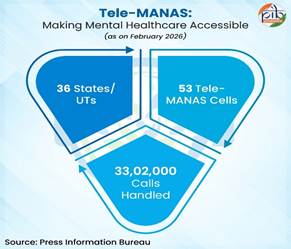
- Enhanced features include the Tele-MANAS mobile app (launched October 2024, upgraded on World Mental Health Day 2025 with multilingual UI in 10 regional langauges, accessibility for visually impaired users, and emergency response content).
- Supported by 23 Mentoring Institutes and 5 Regional Coordinating Centers.
- AI-powered chatbot 'Asmi' added for quick information and engagement.
- Video consultation (VC) feature piloted in some states (Karnataka, Tamil Nadu, Jammu & Kashmir) and expanded nationwide from June 2025.
As of February 5, 2026, a total of 2,065 video calls have been handled through this feature.
Infrastructure for Mental Health Care
India has 47 government-run mental hospitals, including 3 central institutions (NIMHANS Bengaluru, LGBRIMH Tezpur[13], and CIP Ranchi[14]) and 44 state-run hospitals[15]. Mental health services are available across all AIIMS facilities to provide advanced and specialised care.
- Manpower Development Scheme A – Centers of Excellence (CoEs)
A total of 25 Centers of Excellence have been sanctioned to strengthen training in psychiatry, clinical psychology, psychiatric social work, and psychiatric nursing[16]. These include 11 CoEs during the 11th Plan (2007–2012), 10 during the 12th Plan (2012–2017), and 4 beyond the 12th Plan (2017–2018). Grants support upgradations in civil work, equipment procurement, books and journals procurement for library., capital works, equipment, faculty retention, tertiary-level care, creation of PG seats, research, and implementation of the District Mental Health Programme (DMHP)[17].
- Manpower Development Scheme B – PG Department Upgradation
A total of 47 Postgraduate Departments in 19 government institutions have been sanctioned for upgradation. This includes 27 departments in 11 institutions during the 11th Plan (2009–2011), 13 during the 12th Plan (2015–2016) in 5 institutions, and 7 beyond the 12th Plan in 3 institutions (2017–2018)[18]. Upgrades focus on improving training capacity for mental health specialists.
- Digital Training Initiatives for Capacity Building
Digital Academies established at NIMHANS, LGBRIMH, and CIP Ranchi since 2018 have trained 1,76,454 healthcare professionals. The iGOT-Diksha Platform (launched 2020) has provided training to healthcare workers, frontline staff, and community volunteers to build grassroots-level mental health capacity[19].
Conclusion
The Union Budget 2026-27 represents a meaningful advancement in India's mental health landscape. It reinforces the government's long-standing efforts to build an inclusive, accessible, and equitable system of care. By announcing the establishment of NIMHANS-2 in North India and upgrading key institutes in Ranchi and Tezpur, the Budget directly addresses critical regional gaps, strengthens specialised infrastructure, workforce training, and trauma care support.
These targeted measures build on a solid foundation laid over decades. Collectively, these initiatives signal a sustained commitment to reducing stigma, bridging treatment gaps, and prioritising mental well-being as essential to national productivity, youth empowerment, and inclusive growth. Continued implementation and monitoring will be key to translating this momentum into tangible improvements for millions across the country.
References
Press Information Bureau:
https://www.pib.gov.in/PressReleasePage.aspx?PRID=2221455
https://www.pib.gov.in/PressReleasePage.aspx?PRID=2221458
https://www.pib.gov.in/PressReleasePage.aspx?PRID=2221410
https://static.pib.gov.in/WriteReadData/specificdocs/documents/2026/feb/doc202621775901.pdf
https://www.pib.gov.in/PressReleaseIframePage.aspx?PRID=2022303®=3&lang=2
https://www.pib.gov.in/PressReleaseIframePage.aspx?PRID=2100706®=3&lang=2
https://www.pib.gov.in/PressReleaseIframePage.aspx?PRID=2100706®=3&lang=2
https://www.pib.gov.in/PressNoteDetails.aspx?ModuleId=3&NoteId=153277&lang=1®=3
https://www.pib.gov.in/PressReleasePage.aspx?PRID=2188003®=3&lang=2
https://www.pib.gov.in/PressReleseDetail.aspx?PRID=2221458®=3&lang=1
Ministry of Health and Family Welfare:
https://www.mohfw.gov.in/?q=en/pressrelease-206
https://sansad.in/getFile/loksabhaquestions/annex/186/AU1019_QSxLwa.pdf?source=pqals#:~:text=(a):%20Under%20Ayushman%20Bharat,through%20the%20National%20Health%20Mission.
https://indianmhs.nimhans.ac.in/phase1/Docs/Summary.pdf
https://dghs.mohfw.gov.in/national-mental-health-programme.php
https://mohfw.gov.in/sites/default/files/9147562941489753121.pdf
Ministry of Finance:
https://www.indiabudget.gov.in/doc/bh1.pdf
Advancing India’s Mental Healthcare and Well-Being
*******
PIB Research Unit
(Release ID: 2226319)
Visitor Counter : 6381