PIB Backgrounder
Union Budget FY 2026-27: Manufacturing Sector Driving India’s Next Growth Phase
Posted On:
12 FEB 2026 11:36AM by PIB Delhi
Key Takeaways
- India’s manufacturing performance strengthened with GVA growth of 7.72% in Q1 and 9.13% in Q2 in FY 2025-26
- Medium- and high-technology industries contributing 46.3% of India’s manufacturing value added
- Union Budget 2026-27 focuses on scaling up manufacturing across seven strategic and frontier sectors
- Basic Customs Duty exemption granted on inputs for products ranging from seafood to microwave ovens and footwear to aircraft manufacturing.
- Union Budget 2026-27 promotes creating champion SMEs with ₹10,000 crore SME Growth Fund and ₹2,000 crore top-up to Self-Reliant India Fund
|
|
Introduction
India has emerged among the fastest-growing industrial economies, demonstrating resilience amid uneven global industrial performance. While global manufacturing output expanded modestly by 0.7% in the third quarter of calendar year 2025 , India recorded manufacturing output growth of 1.3% during the same period. This performance reflects the strength of domestic fundamentals and sustained policy support for industrial expansion.
Manufacturing today sits as the engine of growth for India’s ambition to become a $35 trillion economy by 2047, with reforms, sectoral initiatives, and resilient supply chains. Recognising this importance, the Union Budget 2026-27 has reinforced support for manufacturing through targeted measures focusing on investment incentives , innovation , infrastructure development , and industrial ecosystem strengthening .
Building on the three defined Kartavyas , the manufacturing sector is poised to drive India’s growth, employment generation, export competitiveness, and long-term economic transformation.
Performance of India’s Manufacturing Sector
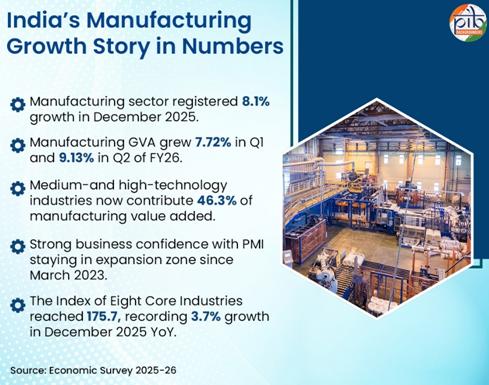
Manufacturing sector is emerging as a key pillar of India’s growing industrial momentum. With capital support and policy-led reforms, recent data across production, investment, and business sentiment indicators point to sustained strengthening in industrial and manufacturing activity.
India’s Industrial and Manufacturing Momentum Strengthens
India’s industrial activity continues to gain strength, with real Industry GVA growing at 7% year-on-year in the first half of FY 2025-26. This momentum carried further into the year as industrial production rose 7.8% in December 2025, the strongest expansion in over two years, after registering a high growth of 7.2%(RE) in November 2025.
This expansion, also reflected in the Index of Industrial Production (IIP), is primarily driven by the manufacturing sector registering a growth of 8.1% in December 2025. Within this, strong growth was recorded in computer and electronic products (34.9%), motor vehicles and trailers (33.5%), and other transport equipment (25.1%).
Manufacturing performance has strengthened further in recent quarters, with GVA growth of 7.72% in Q1 and 9.13% in Q2 in FY 2025-26 , supported by a gradual shift towards higher-value production, improved industrial infrastructure, and wider adoption of technology and formalisation, together reflecting rising industrial capability across the sector.
Confidence Builds as Demand and Business Expectations Improve
Forward-looking indicators continue to reflect optimism in India’s industrial sector, with the manufacturing Purchasing Managers’ Index (PMI) remaining firmly in expansion zone (well above the 50 mark) since March 2023. In January 2026, PMI stood at 55.4 , above its long-run average, indicating continued improvement in the sector’s health.
|
RBI’s Industrial Outlook Survey of the Manufacturing Sector
- The business assessment index improved in Q2 FY 2025-26 compared to Q1 with expected ease in pressures from cost of raw material, financing cost and salary outgo.
- For Q3 FY 2025-26, manufacturers remained optimistic about demand and expecting lower cost pressures, better price realization, and stable business sentiment.
- Demand conditions are expected to strengthen further in Q4 FY 2025-26 and Q1 FY 2026-27.
|
Industrial Expansion Supported by Core Sectors
On the output front, sectoral trends indicate that both heavy industry and light manufacturing are supporting overall growth. The Index of Eight Core Industries (ICI) stood at 175.7 in December 2025 , recording a provisional growth of 3.7% compared to December 2024 , with cement, steel, electricity, fertilizer, and coal registering positive production growth during the month.
|
Cement: India remains the world’s second-largest cement producer, with production reaching around 453 million tonnes in FY25 , supporting infrastructure and construction expansion.
|
|
Steel: India ranks as the world’s second-largest crude steel producer, with crude steel production rising by 11.7% during April-October FY 2025-26 compared to last year. Finished steel production also increased by 10.8% during this period.
|
|
Coal: India’s coal industry reached historic heights in FY25, producing 1,047.52 MT of coal, a 4.98% increase from the previous year.
|
|
Chemicals & Petrochemicals: With production of major chemicals and petrochemicals reaching 58,617 thousand tonnes in FY25 , the sector continues to support industrial development through strong linkages and multiple downstream industries.
|
|
Table 1: India’s Core Input Industries Show Strong Decadal Growth (Val in million tonnes)
|
|
Core Input Industries
|
FY15
|
FY25
|
|
Cement
|
270.00
|
453.00
|
|
Finished Steel
|
81.86
|
146.69
|
|
Coal
|
609.18
|
1,047.52
|
|
Source: Economic Survey 2025-26
|
India’s Manufacturing Sector Expanding its Global Presence
The Economic Survey 2025-26 highlights that medium- and high-technology industries now contribute 46.3% of India’s manufacturing value added, signalling a gradual shift towards more sophisticated production structure. This transition places India among a smaller group of middle-income economies steadily advancing up the manufacturing value chain. Reflecting these gains, India’s global industrial competitiveness has improved, with the country’s ranking in the Competitive Industrial Performance (CIP) index rising to 37th in 2023 from 40th in 2022.
Manufacturing has also contributed in strengthening India’s export performance. In FY26 each of the first three quarters recorded their highest-ever export levels. Further, during April-December 2025, exports amounted to USD 634.3 billion, marking a further 4.3% year-on-year growth , emphasizing sustained resilience in external trade performance.
|
Role of MSMEs in Manufacturing
Micro, Small and Medium Enterprises (MSMEs) remain central to India’s industrial economy, contributing about 35.4% of manufacturing output, 48.58% of exports, and 31.1% of GDP, while employing over 32.82 crore people across 7.47 crore enterprises, making them the second-largest employer after agriculture.
As India’s manufacturing integrates further with global markets, MSMEs play a vital role in strengthening supply chains, promoting local value addition, and supporting inclusive regional development.
|
Budget 2026-27: Major Initiatives to Boost Manufacturing
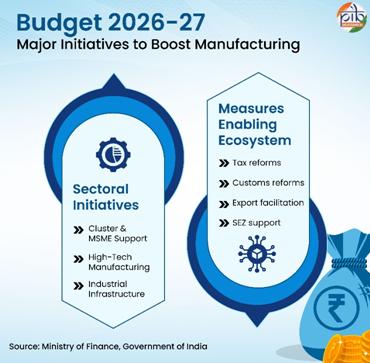
The Union Budget 2026-27, unveiled a comprehensive set of measures aimed at accelerating economic growth through promoting manufacturing in strategic and frontier sectors. These announcements build on the government’s agenda and address both immediate needs (like tax reliefs and customs reforms) and long-term capacity development (like new industrial missions and cluster schemes).
Strategic Sector Initiatives and Industrial Ecosystem Development
The Budget launched new schemes and programmes focusing on high-impact and emerging industries to drive the next phase of industrial growth, with a focus on scaling up manufacturing across seven strategic and frontier sectors.
- Rejuvenation of Legacy Industrial Clusters: A scheme to revive 200 legacy industrial clusters through infrastructure and technology upgradation to improve competitiveness and efficiency through infrastructure and technology upgradation.
- Biopharma SHAKTI: With an outlay of ₹10,000 crore over five years, the scheme aims to position India as a global manufacturing hub for biologics and biosimilars. It aims to expand research capacity, set up 3 new and upgraded National Institutes of Pharmaceutical Education and Research (NIPER) institutes, a network of 1000+ clinical trial sites, and strengthen Central Drugs Standard Control Organisation (CDSCO).
Semiconductor Mission 2.0: Building on earlier initiatives, the programme focuses on production of semiconductor equipment and materials, designing of full stack Indian IP, fortifying supply chains, and creation of industry-led research and training centres.
- Dedicated Chemical Parks: Support for states to establish three chemical parks on a cluster-based plug-and-play model to boost domestic production and reduce import dependence.
- Electronics Components Manufacturing Scheme (ECMS): To capitalise on the momentum of investment commitments beyond set targets and to accelerate domestic component manufacturing, outlay increased from ₹22,919 crore to ₹40,000 crore.
- Rare Earth Permanent Magnets and Corridors: Building on the Scheme for Rare Earth Permanent Magnets was launched in November 2025, development of dedicated rare earth corridors will be developed in Odisha, Kerala, Andhra Pradesh, and Tamil Nadu to promote mining, processing, research, and manufacturing.
- Sports Goods Manufacturing Initiative: Focused support to enhance manufacturing, research, and innovation in sports equipment and material sciences.
- Hi-Tech Tool Rooms in Central Public Sector Enterprises (CPSEs): Establishment of precision tool manufacturing, training and design facilities within CPSEs to support manufacturing innovation and skilling.
- Construction and Infrastructure Equipment (CIE) Scheme: New scheme to strengthen domestic manufacturing of high-value and technologically-advanced CIE.
- Container Manufacturing Scheme: ₹10,000 crore allocation over five years to build a globally competitive container manufacturing ecosystem.
- Dedicated Measures for Textile Sector: Launch of an integrated textile programme covering fibre self-reliance, modernization of clusters, strengthening handloom and handicrafts, promotion of sustainable textiles, and upgrading textile skilling under Samarth 2.0.
-
- Mega Textile Parks to be developed in challenge mode, with focus on value addition including technical textiles.
- Launch of Mahatma Gandhi Gram Swaraj initiative to strengthen khadi, handloom and handicrafts through improved training, skilling, production quality, branding, and global market linkages benefiting rural industries and artisans.
- Recognising MSMEs as a key growth engine: A three-pronged approach has been proposed to help MSMEs emerge as future industry champions, including a dedicated ₹10,000 crore SME Growth Fund to support high-potential enterprises. Additionally, the Self-Reliant India Fund will be strengthened with a ₹2,000 crore top-up to continue providing risk capital support to micro enterprises.
Tax and Customs Reforms to Promote Manufacturing
To complement the above sectoral interventions, The Union Budget 2026-27 introduced a series of tax incentives and customs duty reforms fine-tuning the tax regime to make it more manufacturing-friendly and export-supportive. Key measures include:
- Exemption from income tax for five years to non-residents providing capital goods, equipment or tooling, to any toll manufacturer in a bonded zone.
- Provision of safe harbour to non-residents for component warehousing in a bonded warehouse.
- Deferred duty payment window to trusted manufacturers.
- Increase the limit for duty-free imports of specified inputs used for processing seafood products for export, from the current 1 per cent to 3 per cent of the FOB value of the previous year’s export turnover.
- Duty-free imports of specified inputs extended to export of shoe uppers in addition to leather or synthetic footwear.
- Extension of time for the export of final product from the existing 6 months to 1 year, for exporters of leather or textile garments, leather and synthetic footwear.
- Exemption from basic customs duty on specified parts used in the manufacture of microwave ovens and components and parts used in aircraft manufacturing.
- Exemption from basic customs duty on raw materials imported for manufacture of aircraft parts used in maintenance, repair, or overhaul requirements defence units.
- Regular importers with trusted longstanding supply chains to be recognized in the risk system.
- Export cargo using electronic sealing to be provided through clearance from the factory premises to the ship.
- A special one-time measure to facilitate sale in domestic tariff area at concessional rate of duty by eligible manufacturing units of SEZs.
All these measures are rooted in Government’s sustained push to make India a globally competitive manufacturing hub; one that can create jobs, innovate in frontier technologies , and integrate successfully into global value chains.
Sustained Government Initiatives Driving Manufacturing Growth
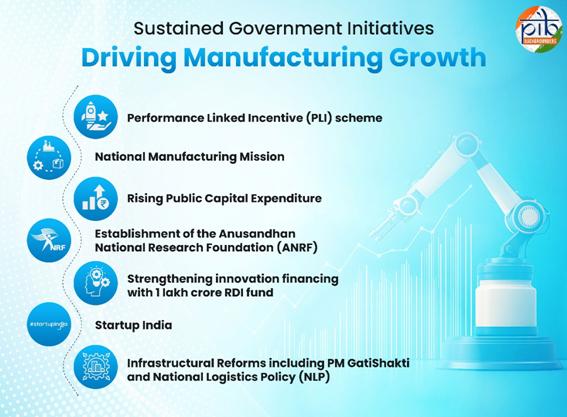
India’s manufacturing expansion is being reinforced by a combination of targeted incentive schemes, mission-driven reforms, infrastructure development, and innovation-led initiatives creating a strong foundation for the next phase of manufacturing growth.
Performance Linked Incentive (PLI) scheme
The Production Linked Incentive (PLI) scheme, aligned with the Aatmanirbhar Bharat vision has emerged as a major catalyst for industrial growth across 14 sectors. Key gains under the Scheme are visible in sectors like electronics, pharmaceuticals, and automobile manufacturing, strengthening India’s global manufacturing competitiveness:
- PLI-led investments have encouraged smartphone production in India, making the country a major global mobile phone manufacturing hub.
- In the first three years, PLI pharmaceutical sales crossed ₹2.63 lakh crore, including ₹1.69 lakh crore exports, with domestic value addition reaching 83.74% as on March 2025.
PLI scheme for automobile and auto-components has attracted cumulative investments worth ₹35,657 crore, resulting in creation of 48,974 jobs, until September 2025.
National Manufacturing Mission
Announced in Budget 2025-26, the National Mission on Manufacturing (NMM) serves as a key catalyst for industrial growth, targeting a rise in manufacturing’s GDP share to 25% by 2035, creation of 143 million jobs, and expansion of merchandise exports to USD 1.2 trillion by through deeper global value chain integration. The following key steps have been taken under National Manufacturing Mission Implementation:
- Work on the National Mission on Manufacturing is underway, focusing on ease and cost of doing business, workforce readiness, MSME growth, deregulation, technology access, and quality manufacturing.
- An Inter-Ministerial Committee has been formed, with NITI Aayog coordinating consultations and advancing implementation proposals.
- Skill development initiatives are being aligned with industry needs through NSQF-based training, targeted skilling interventions, and coordination with industrial corridors and sector-specific industries such as toys, leather, and footwear.
- The National Textile Manufacturing Mission is under formulation, with a core committee and ongoing consultations to finalize the framework.
|
Investments Fueling Industrial Expansion
Investment momentum continues to support economic growth in FY26, with the share of gross fixed capital formation (GFCF) estimated at 30% and expanding by 7.6% in the first half of the year compared to last year.
This investment push is reflected in both public and private spending, with government capital expenditure rising from ₹3.07 lakh crore in FY19 to ₹11.21 lakh crore in FY26 , while private corporate investment announcements surged to ₹14.6 lakh crore in first half of FY26, higher than ₹7.9 lakh crore during same period in FY25.
|
Initiatives Strengthening India’s Innovation Ecosystem
- A major institutional reform supporting India’s R&D ecosystem is the establishment of the Anusandhan National Research Foundation (ANRF) under the ANRF Act, 2023. It is aimed at providing strategic direction, funding support, and stronger collaboration between industry, academia, and government.
- To strengthen innovation financing, the Government announced a Research, Development and Innovation (RDI) Fund with a ₹1 lakh crore outlay over six years, including ₹20,000 crore for FY26, aimed at boosting private investment in high-tech R&D, supporting advanced technology projects, enabling acquisition of strategic technologies, and operationalising a Deep-Tech Fund of Funds.
- Since the launch of Startup India in 2016, a growing startup ecosystem, now over 2 lakh recognised startups, reflects expanding entrepreneurship culture. India now ranks among the top five countries in 45 of 64 critical technologies, strengthening capabilities in areas vital for advanced manufacturing and industrial competitiveness.
|
Impact of Innovation-Led Manufacturing Growth
India’s innovation ecosystem has strengthened significantly, supporting its move towards higher-value manufacturing. India’s Global Innovation Index ranking improved from 66th in 2019 to 38th in 2025, the highest among lower middle-income country group.
India also ranks 4th globally in trademarks, 6th in patents, and 7th in industrial designs in 2024. The World Intellectual Property Organization (WIPO) ranks India 12th globally, for its entrepreneurship policies and entrepreneurship culture.
India ranks among the top four globally in critical technology research output, including defence, space, robotics, quantum computing, AI, biotech, advanced materials, energy, and communications.
|
Infrastructural Reforms Driving Manufacturing Expansion
Government-led infrastructure and logistics reforms are enabling manufacturing expansion through continued investments in connectivity, industrial infrastructure, and skilling support.
PM GatiShakti has transformed infrastructure planning through a unified platform integrating over 1,700 data layers across 57 ministries and departments, while PM GatiShakti Public and the Unified Geospatial Interface now provide 230 datasets for investment and logistics planning. At the state level, 27 States have notified State Logistics Policies, and 28 Aspirational Districts are already using GatiShakti District Master Plan Module for area planning, which will then extend to all 112 districts Aspirational Districts.
Complementing this is the National Logistics Policy (NLP) under which logistics integration is strengthened through Unified Logistics Interface Platform (ULIP). It connects 44 systems across 11 ministries, covering 2,000 data fields, supporting over 1,700 companies, and enabling 200 crore API transactions.
Meanwhile, industrial corridor projects have operationalised cities such as Dholera and Greater Noida, with 350 industrial plots allotted and investments of ₹2.02 lakh crore, supporting new manufacturing hubs beyond major metros.
These initiatives reflect a coordinated push to strengthen manufacturing competitiveness in the country. As implementation progresses, these measures are expected to deepen industrial capacity, enhance global competitiveness, and support sustained manufacturing-led economic growth.
Conclusion
India’s manufacturing sector is entering a new phase of expansion, guided by the Government’s vision of Atmanirbharta and the Sankalp anchored in the three key Kartavyas outlined in the Union Budget 2026-27 . Continued focus on competitiveness, technology adoption, supply chain integration, and skill development is helping position manufacturing as a sustainable engine of growth.
Together, these efforts place manufacturing at the heart of India’s journey towards becoming a globally competitive, resilient, and self-reliant economic powerhouse in the years ahead.
References
Ministry of Finance
https://www.indiabudget.gov.in/economicsurvey/doc/echapter.pdf
https://www.indiabudget.gov.in/doc/budget_speech.pdf
https://www.indiabudget.gov.in/doc/impbud2025-26.pdf
Ministry of Commerce & Industry
https://eaindustry.nic.in/eight_core_infra/eight_infra.pdf
https://www.pib.gov.in/PressNoteDetails.aspx?id=155242&NoteId=155242&ModuleId=3®=3&lang=2
Ministry of Statistics & Programme Implementation
https://www.pib.gov.in/PressReleasePage.aspx?PRID=2219602®=3&lang=2
Reserve Bank of India
https://rbidocs.rbi.org.in/rdocs/Publications/PDFs/IOSR111OCT0120257B0D827F5D6C4B9B9A625D35985D8649.PDF
Other Releases
https://www.pmi.spglobal.com/Public/Home/PressRelease/cf844f6598f24d3d97639f641b315fca
See in PDF
***
PIB Research
(Release ID: 2226828)
Visitor Counter : 18883