Ministry of Labour & Employment
Two-day Regional Conference of Labour & Employment and Industry Secretaries of States/UTs inaugurated in Bhubaneswar on 17th February 2026
Posted On:
17 FEB 2026 3:25PM by PIB Delhi
Shri Ganesh Ram SinghKhuntia, Minister of State (Independent Charge) for Labour and Employees’ State Insurance, Government of Odisha, inaugurated a two-day Regional Level Conference of Labour & Employment and Industry Secretaries of States/UTs in Bhubaneswar today. Union Secretary, Ministry of Labour & Employment, Ms. Vandana Gurnani, Senior Officers of Ministry of Labour & Employment, States Governments of Odisha, Bihar, Jharkhand, Chhattisgarh and Andaman and Nicobar Islands, Employees’ State Insurance Corporation (ESIC), Employees’ Provident Fund Organisation (EPFO), Central Labour Commissioners and VV Giri National Labour Institute (VVGNLI) were also present on the occasion.
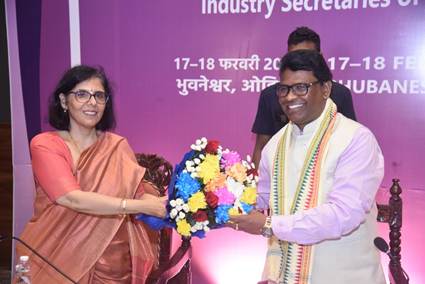
The conference marked the fourth in a series of five regional conferences planned by the Ministry at different locations across the country, covering States/UTs and key stakeholders, with the objective to facilitate smooth implementation of the four Labour Codes and deliberating on issues concerning ESIC, EPFO and the Pradhan Mantri Viksit Bharat Rozgar Yojana (PMVBRY).
In his address, Shri Ganesh Ram SinghKhuntia welcomed the delegates and noted that the country is at a significant juncture with the Labour Codes having been brought into effect. He expressed gratitude to the Prime Minister Shri Narendra Modi for ushering in the transformative labour reforms and providing a forward-looking framework for strengthening labour governance. He also referred to Odisha’s preparatory steps towards timely implementation, including publication of draft rules.
He further stated that the State Government is implementing welfare schemes for construction workers, unorganised workers and migrant workers, which have been acknowledged by the Parliamentary Standing Committee. Emphasising the broader objective of ensuring employment opportunities for jobseekers and social justice for all workers, he underlined the importance of effective implementation of the Labour Codes and expressed hope that the deliberations would lead to fruitful discussions and exchange of experiences for further strengthening workers’ welfare.
Ms. Vandana Gurnani, Secretary, Ministry of Labour & Employment, while setting the context of the Conference, described the Labour Codes as a historic reform designed to align India’s labour framework with evolving national and global economic dynamics. She stated that the consolidation of multiple central labour laws into four Codes streamlines the regulatory structure, enhances workers’ welfare with ease of doing business, and supports employment generation and economic growth.
She highlighted that the Codes reduce complexities while reinforcing worker protections through measures such as mandatory appointment letters specifying terms and conditions of service, prohibition of discrimination and exploitation, universalisation of minimum wages beyond scheduled employments, universalisation of social security and the introduction of a statutory floor wage notified by the Central Government below which States cannot fix minimum wages. She also noted the easing of compliance burdens, including the provision for compounding of offences.
She further underlined the importance of IT-enabled systems such as single registration, single licence and single return to ensure effective, citizen- and business-centric implementation, with flexibility for States/UTs to integrate with Central systems. She underscored that VVGNLI is conducting a series of capacity-building programmes under the Labour Codes and encouraged States/UTs to nominate representatives as master trainers to further disseminate knowledge and facilitate training at the State level.
She also urged States/UTs to expedite the finalisation of Rules, make effective use of the Ministry’s FAQs and handbook on the Codes, avoid duplication or overlap with provisions under the Shops and Establishments Acts, actively utilise the PMVBRY dashboard, and strengthen Centre–State coordination to expand ESIC coverage and medical infrastructure through convergence with State health facilities and PMJAY. She called upon States to act as model employers by ensuring minimum wages, timely payment of wages and provision of social security benefits to workers and employees engaged in State establishments, including those engaged through contractors.
The inaugural session was followed by detailed presentations by senior officers of the Ministry and the States/UTs outlining the progress made in finalizing Rules under the new Labour Codes and the status of IT preparedness. Comprehensive discussions were held on key aspects relating to the drafting and notification of Rules, strengthening and upgrading IT systems at both Central and State levels in alignment with the provisions of the Codes, and exploring the integration of State IT platforms with the Central digital framework.
The conference, attended by senior officials from the Ministry and States/UTs, served as an important platform for deliberating on Rules and Regulations, identifying gaps and areas of divergence, expediting statutory notifications, and discussing the establishment of Boards, Funds, and other institutional mechanisms envisaged under the Codes. Further, the conference emphasized the need for capacity building of field-level functionaries and enhancing awareness among States/UTs and other stakeholders regarding the objectives, structure, and implementation roadmap of the Labour Codes.
*****
Rini Choudhury/Anjelina Alexander
(Release ID: 2229108)
Visitor Counter : 4480