Ministry of Personnel, Public Grievances & Pensions
Dr. Jitendra Singh Proposes India–Portugal Working Group on AI-Led Governance
India Showcases Digital Pension, Grievance Reforms in Talks with Portugal
Simplification Before Digitalisation: India–Portugal Align on Administrative Reform Agenda
Posted On:
17 FEB 2026 5:52PM by PIB Delhi
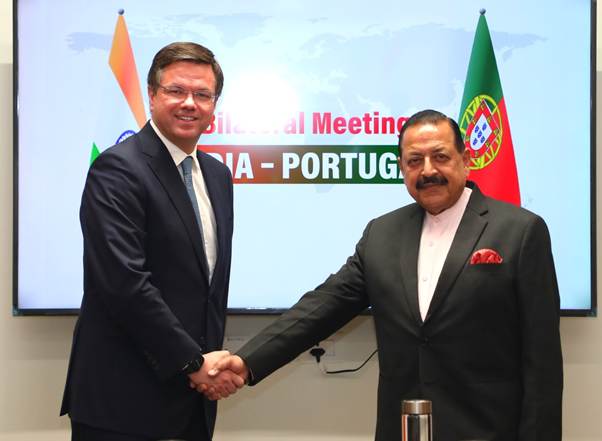
Portugal’s Minister in the Cabinet of the Prime Minister and of State Reform, Gonçalo Matias, who is currently here for the AI Impact Summit 2026, called on Union Minister of State (Independent Charge) for Science and Technology; Earth Sciences and Minister of State for PMO, Department of Atomic Energy, Department of Space, Personnel, Public Grievances and Pensions, Dr. Jitendra Singh and shared views on some of India's best practices in governance.
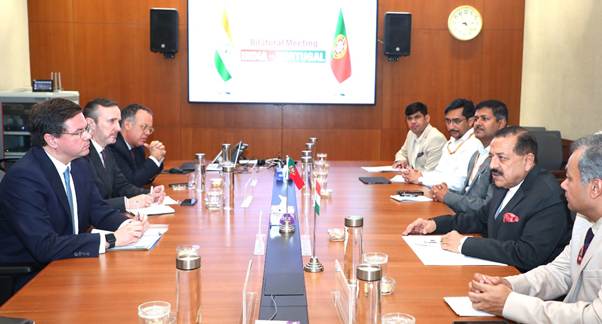
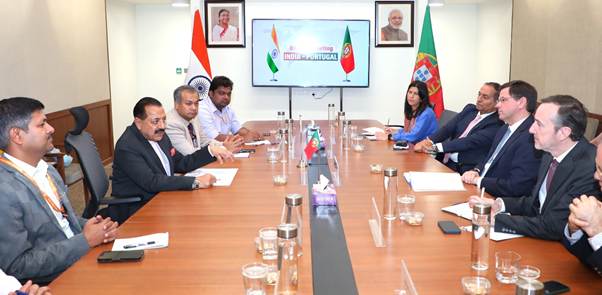
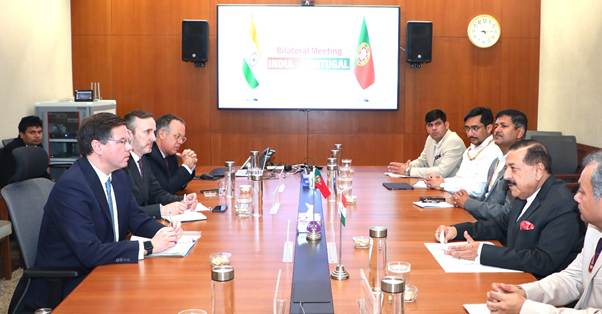
At the delegation level meeting, India and Portugal agreed to set up a joint working mechanism on administrative reforms and digital governance, with a focus on deploying artificial intelligence in public services, as the two sides signalled intent to move beyond dialogue to structured cooperation.
The understanding emerged during talks between Union Minister of State (Independent Charge) for Science and Technology; Earth Sciences and Minister of State for PMO, Department of Atomic Energy, Department of Space, Personnel, Public Grievances and Pensions, Dr. Jitendra Singh and Portugal’s Minister in the Cabinet of the Prime Minister and of State Reform, Gonçalo Matias, who is in New Delhi for the AI Impact Summit 2026.
Dr. Jitendra Singh proposed the creation of a working group to identify priority areas for collaboration, including digital pension systems, grievance redressal platforms and AI-enabled document processing. “We can identify areas of mutual benefit and begin with specific, scalable models,” he said, suggesting training exchanges and technical sharing between the two administrations.
Highlighting India’s reform trajectory over the past decade, Dr. Jitendra Singh said nearly 2,000 obsolete rules had been scrapped, many of them colonial-era requirements that slowed citizen services. He cited the abolition of mandatory attestation by gazetted officers, elimination of interview-based recruitment for certain categories to reduce discretion, and the rollout of single-page digital forms in place of multi-coloured, multi-copy paperwork.
India’s grievance redressal mechanism, now operating on what he described as a “hybrid model” combining AI-led sorting with human oversight, has achieved close to 95% disposal rates, he said, adding that final decisions continue to involve human intervention. The government has also digitised pension processing end-to-end and expanded the use of biometric and facial authentication for life certificates, covering millions of beneficiaries annually.
Matias outlined Portugal’s parallel reform agenda built around “simplification first, digitalisation next”. His government is revising core codes governing public procurement, construction and licensing before embedding AI into administrative decision-making. “There is no point in digitalising what is complex. If we digitalise complexity, we create another layer of bureaucracy,” he said, adding that AI will be used to accelerate document processing but with mandatory human ratification of final decisions.
Portugal is also investing public funds to help small and medium enterprises adopt AI, particularly after extreme climate events in recent weeks damaged industrial units in the country’s central region. Matias said the objective was to ensure affected SMEs rebuild with stronger technological infrastructure by the end of the year.
On the multilateral front, Dr. Jitendra Singh said India had introduced new anti-corruption initiatives in the G20, including a focus on women-centric corruption risks and consensus-building on handling economic fugitives who exploit jurisdictional differences. He also noted India’s recent election to a leadership position at the International Institute of Administrative Sciences as recognition of its governance reforms.
Beyond governance, both sides acknowledged expanding cooperation in trade, technology and education. The two ministers also discussed expediting the third meeting of the senior consultative body under the existing MoU on public administration and governance reforms, as well as exploring collaboration in science and technology, digital inclusion and academic exchanges.
The meeting comes against the backdrop of deepening political engagement between the two democracies, which marked 50 years of re-established diplomatic ties in 2025. With both governments now placing administrative simplification and AI-led governance at the core of reform, Tuesday’s talks signalled a shift from ceremonial engagement to practical institutional alignment in India–Portugal cooperation.
*****
NKR/AK
(Release ID: 2229203)
Visitor Counter : 353