Ministry of Communications
India and Sweden Convene Bilateral Talks to Strengthen Strategic Cooperation in Telecommunications and Digital Innovation
India and Sweden Chart Future‑Ready Collaboration in 5G, 6G, Open RAN, Quantum Technologies, and Cybersecurity
Posted On:
18 FEB 2026 6:04PM by PIB Delhi
A bilateral meeting was held on 18 February 2026 between Sh. Jyotiraditya M. Scindia, Union Minister of Communications and Development of the North Eastern Region, India, and Ms. Ebba Busch, Deputy Prime Minister of Sweden and Minister for Energy, Business, and Industry, at Sanchar Bhawan, New Delhi, to review ongoing cooperation and explore new avenues of collaboration in telecommunications and digital transformation, with discussions also reflecting Sweden’s emphasis on sustainability, inclusive enterprise development, and sustained global climate leadership.
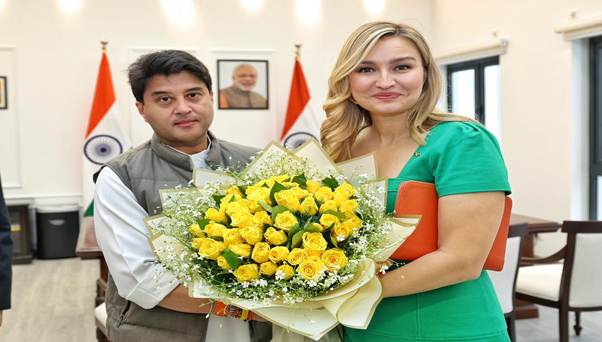
Both sides reaffirmed that digital and telecom cooperation constitutes a key pillar of the India–Sweden strategic partnership, reflecting shared priorities in next-generation connectivity, secure digital infrastructure, innovation-driven growth, and sustainability, with emphasis on ensuring that digital transformation remains inclusive, economically viable, and aligned with clean energy transitions.
Both sides acknowledged the India–Sweden Joint Working Group (JWG) on Digital Technologies and Economy, which serves as the principal institutional mechanism for structured policy and technical engagement. The two sides expressed intention for early scheduling of the third JWG meeting in Stockholm to advance implementation-oriented outcomes.
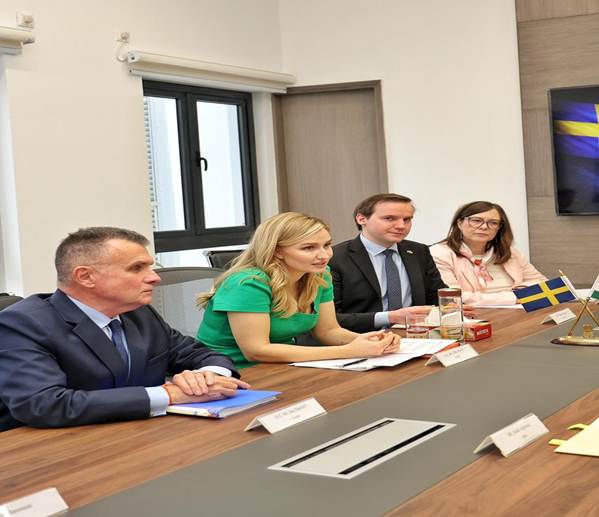
Discussions focused on expanding collaboration in 5G and 5G-Advanced use cases across healthcare, agriculture, smart cities, and rural connectivity. Deputy Prime Minister of Sweden highlighted the importance of integrating sustainability with enterprise development, underscoring that climate action must be inclusive, economically viable, and innovation-driven. The Swedish side appreciated India’s achievement of the world’s fastest 5G rollout and explored how Sweden, including companies such as Ericsson, could contribute to enhancing accessibility and connectivity in India. Both sides recognised the potential of combining Sweden’s strong research and industrial innovation ecosystem with India’s scale of deployment and affordability-driven innovation to develop globally scalable solutions, including for Global South contexts.
Hon’ble Minister Scindia shared India’s digital growth story, noting that India today has over 1.23 billion telecom subscribers and nearly one billion internet users, with four telecom operators serving a predominantly market-driven ecosystem. 4G coverage extends to 98.5% of the population, with universal 4G saturation targeted across all villages by June 2026. India has undertaken the world’s fastest 5G rollout, completed in 21 months with investments of approximately USD 5.5 billion. Public capital expenditure of nearly USD 16.9 billion is being deployed to connect every Gram Panchayat under one of the world’s largest digital broadband networks. The role of the state-owned operator BSNL, which has developed an indigenous 4G stack and serves over 93 million subscribers, was also highlighted, alongside sustainability measures including increasing renewable energy usage in telecom towers and a clean energy transition target by 2030.
India’s Digital Public Infrastructure model—anchored in Aadhaar, UPI and DigiLocker—was presented as an inclusive and scalable framework enabling secure digital governance and economic participation, underscoring that inclusivity remains at the heart of India’s connectivity strategy and that digital infrastructure represents the “invisible highway” driving the next phase of economic growth.
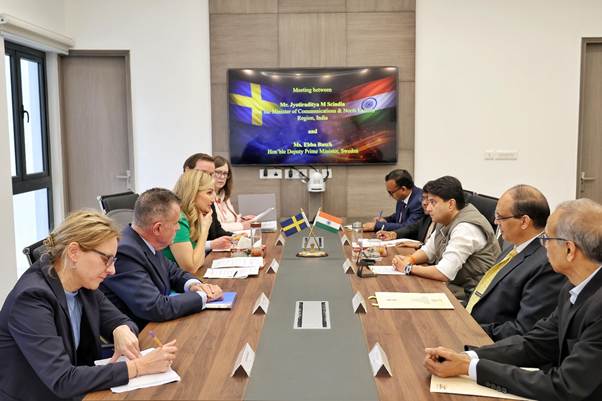
India and Sweden also discussed early engagement in 6G research, spectrum harmonization, and coordinated participation in international standard-setting processes at the International Telecommunication Union (ITU) and 3GPP. India highlighted the formation of the Bharat 6G Alliance with a target of contributing at least 10% of global 6G patents, with participation from industry including Ericsson, and proposed collaboration on joint 6G research, 1 THz test beds, and optical fiber test beds. Both sides underlined the importance of interoperable, open, and secure architectures in the evolution of next-generation networks.
Cooperation in Open RAN, network modernization, and trusted supply chains was highlighted as an area of mutual interest. The two sides emphasized the need to strengthen diversified and resilient telecom ecosystems, including collaboration among operators, original equipment manufacturers, startups, and research institutions, and identified five broad pillars of cooperation covering 5G use cases, 6G collaboration and advanced test beds, Open RAN, quantum technologies, and industry–academia partnerships, with emphasis on developing a structured work plan and stakeholder mapping under each pillar supported by periodic review mechanisms.
Emerging areas, including quantum communication, post-quantum cryptography, and secure network architectures, were also discussed, reflecting a forward-looking approach to future-proofing critical digital infrastructure. Structured engagement on cybersecurity, telecom fraud mitigation, and risk-based regulatory frameworks, including continued institutional dialogue such as cybersecurity discussions in Stockholm, was identified as another priority domain.
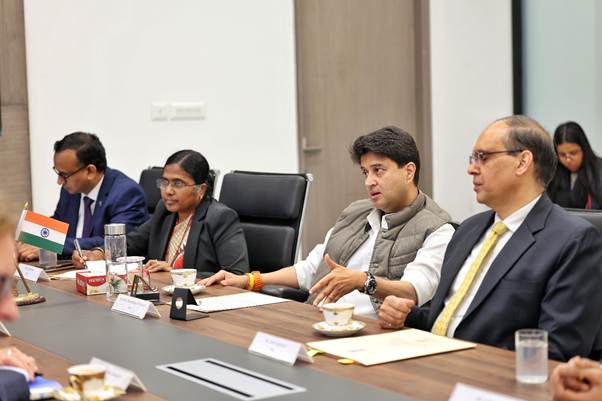
The Indian side sought Sweden’s support for India’s candidature of Ms. M. Revathi for Director, Radiocommunication Bureau at the ITU; for India’s re-election to the ITU Council for the term 2027–2030; and for India’s proposal to host the ITU Plenipotentiary Conference in 2030, noting India’s successful hosting of the World Telecommunication Standardization Assembly and reaffirming its commitment to constructive multilateral engagement.
Both sides reaffirmed their commitment to building trusted networks, resilient supply chains, and inclusive digital ecosystems through sustained engagement under the Joint Working Group framework and high-level dialogue mechanisms.
Tweet Link: https://x.com/jm_scindia/status/2024031796598300725?s=46&t=NaAnVWL-57urtP3cCRvaCg
****
MI/RG
(Release ID: 2229734)
Visitor Counter : 1314