Ministry of Science & Technology
Scientists unlock new cathode material enabling Zinc-Ion Batteries for grid storage
Posted On:
19 FEB 2026 3:44PM by PIB Delhi
In a significant stride for sustainable energy storage, researchers have developed a novel cathode material that dramatically enhances the performance and stability of aqueous zinc-ion batteries (AZIBs).
Aqueous zinc-ion batteries, which use water-based electrolytes, are hailed as safe, cost-effective, and environmentally benign contenders for storing energy from renewable sources like solar and wind. Zinc metal offers high theoretical capacity, abundant reserves and used directly as the anode. However, the development of high-capacity, long-lasting cathode materials has been a key challenge.
Researchers from the Centre for Nano and Soft Matter Sciences (CeNS), Bengaluru, an autonomous institution of Department of Science and Technology (DST), synthesised sulfur vacancy-induced 1T-phase Molybdenum Disulfide (1T-MoS₂), a material that promises to make zinc batteries more viable for large-scale grid storage.
The team comprising Mr. Ganesh Mahendra, Dr. Rahuldeb Roy, and Dr. Ashutosh Kumar Singh, used a carefully controlled hydrothermal method to produce sulphur deficient 1T-phase MoS₂ nanoflakes.
This metallic-phase material possesses a high surface area and enhanced conductivity, which facilitates faster electrochemical reactions and greater charge storage.
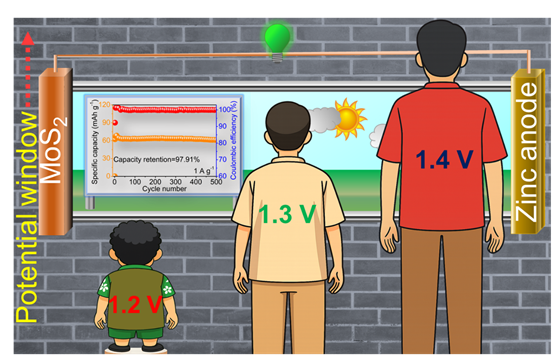
Fig: Schematic showcasing the performance parameters optimized for Zn-ion batteries
A critical aspect of their work was a systematic study to optimize electrochemical potential window—the voltage range within which the battery operates stably. They identified 0.2 to 1.3 Volts (vs. Zn²⁺/Zn) as the ideal operational window. This optimization was pivotal in achieving exceptional performance metrics.
The fabricated zinc-ion battery demonstrated remarkable cyclic stability, retaining 97.91% of its initial capacity after 500 continuous charge-discharge cycles at a high current density of 1 A g⁻¹. The device exhibited a Coulombic efficiency of 99.7%, indicating highly reversible zinc-ion insertion and extraction with minimal side reactions. The research team used this to successfully power a commercial LCD timer using a coin-cell prototype, showcasing the material's potential in real-world applications.
The research work which was published in the journal of Energy & Fuels under American Chemical Society (ACS) Publishers, provides a comprehensive roadmap for designing high-performance cathode materials.
The breakthrough can help us make affordable, safe and efficient batteries that could store massive amount of renewable energy on the grid.
Publication details (DOI): 10.1021/acs.energyfuels.5c05072
*****
NKR/FK
(Release ID: 2230223)
Visitor Counter : 2576